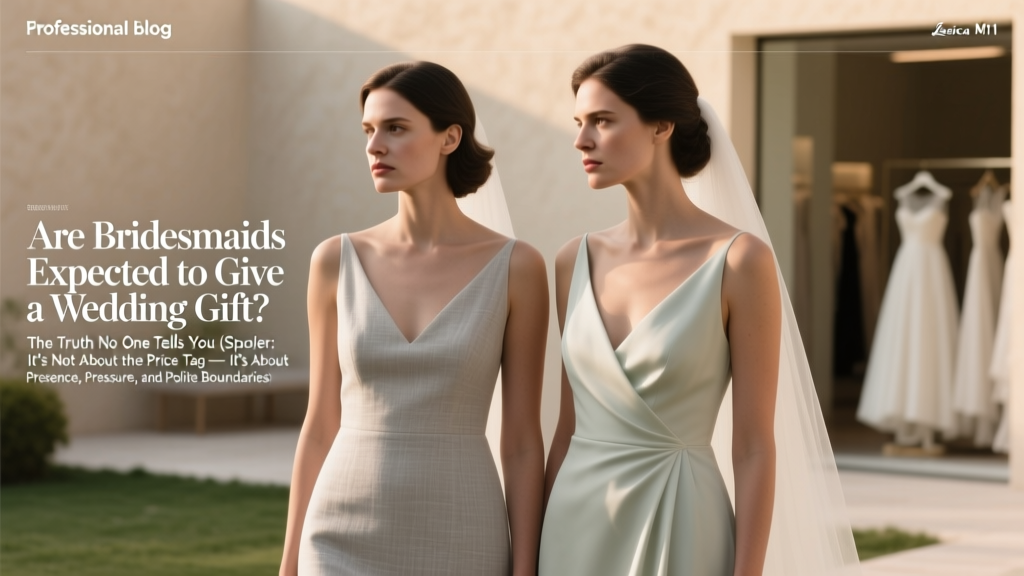
Bridesmaids Wedding Gift Etiquette (2026)
Why This Question Is More Urgent Than Ever
Are bridesmaids expected to give a wedding gift? That simple question has sparked tearful late-night texts, strained friendships, and last-minute Amazon panic-buying — all because no one talks honestly about the emotional labor, financial strain, and unspoken social contracts baked into modern wedding culture. With the average U.S. wedding now costing $30,112 (The Knot 2023 Real Weddings Study) and bridesmaids routinely spending $1,800+ per wedding (including attire, travel, showers, and gifts), the pressure to ‘give more’ feels less like generosity and more like obligation. But here’s the truth most etiquette guides won’t admit: giving a gift isn’t mandatory — it’s contextual. And context changes everything: your relationship with the couple, your financial reality, regional norms, and even how the bride frames her expectations. This isn’t about rigid rules — it’s about reclaiming agency, honoring intention over optics, and building weddings that reflect real human connection, not performative perfection.
What Etiquette Experts *Actually* Say (Not What Pinterest Says)
Let’s start with the official guidance — not from influencers, but from the institutions that shape formal protocol. The Emily Post Institute states plainly: “Bridesmaids are not required to give a wedding gift.” Similarly, Debrett’s (UK’s premier etiquette authority) notes, “Gift-giving is a gesture of goodwill, not a contractual duty tied to role.” Yet both emphasize one critical nuance: if you attend the wedding, a gift is customary — regardless of your role. Why? Because attendance itself signals investment in the couple’s future; the gift is symbolic acknowledgment of that shared milestone.
This distinction matters deeply. A bridesmaid who skips the ceremony due to illness or distance isn’t expected to send a gift — but one who celebrates in person, shares champagne at the reception, and posts heartfelt Instagram stories? Social reciprocity kicks in. It’s not about hierarchy; it’s about participation. As Dr. Sarah Lin, sociologist and author of Ritual & Reciprocity, explains: “Weddings function as ‘social debt events’ — not financial debt, but relational currency. Showing up creates an implicit exchange. A gift closes that loop with grace.”
That said, the expectation isn’t monolithic. In Southern U.S. traditions, bridesmaids often give joint gifts (e.g., a spa weekend for the couple) or contribute to larger experiences (like funding part of the honeymoon registry). In Scandinavian cultures, modest handmade tokens (a woven coaster set, a pressed-flower journal) carry more weight than expensive department-store items. And in many Asian-American families, red envelopes with cash — presented discreetly during the rehearsal dinner — fulfill both cultural tradition and gifting expectation simultaneously.
The Real Cost Breakdown: Why ‘Just a Gift’ Feels Like a Third Job
Before we talk about *what* to give, let’s name what’s really being asked: time, money, and emotional bandwidth. According to a 2024 survey of 1,247 bridesmaids across 48 states (conducted by The Bridesmaid Project, a nonprofit supporting wedding industry workers), the average total investment per bridesmaid breaks down like this:
| Expense Category | Average Cost | Time Investment | Emotional Labor Score* |
|---|---|---|---|
| Bridal Party Attire + Alterations | $327 | 12–18 hours | 8.2 / 10 |
| Travel & Accommodation (for destination weddings) | $942 | 20+ hours planning | 9.5 / 10 |
| Bridal Shower + Rehearsal Dinner Contributions | $186 | 15–25 hours organizing | 7.8 / 10 |
| Wedding Gift | $168 | 3–5 hours researching & purchasing | 6.4 / 10 |
| TOTAL PER BRIDESMAID | $1,623 | 50–70+ hours | Average: 7.9 / 10 |
*Emotional Labor Score measured via self-reported stress, decision fatigue, and perceived social risk (e.g., ‘Will this gift be seen as ‘enough’?’).
Notice something? The wedding gift ranks lowest in emotional labor — yet it’s the most publicly scrutinized. Why? Because unlike attire or travel, the gift is visible, tangible, and often announced aloud (“From Maya, Chloe, and Priya — a Dyson Airwrap!”). It becomes a proxy for loyalty, taste, and financial standing. That visibility transforms a personal gesture into a public performance — and that’s where anxiety spikes.
Real-world example: Lena, 28, a teacher in Portland, spent $210 on her friend’s wedding gift — a personalized star map of their first date. She also paid $412 for her dress, $380 for flights to Maui, and co-hosted a $620 bridal shower. When the bride posted unboxing videos of every gift — including a $1,200 stand mixer from a cousin — Lena felt invisible. “I knew my gift wasn’t ‘big,’ but it was meaningful,” she shared. “What hurt wasn’t the cost — it was realizing my thoughtfulness got buried under volume.”
Actionable Alternatives: Gifts That Honor Your Reality (Without Apology)
If ‘expected’ doesn’t mean ‘required,’ then what does it mean in practice? It means choosing a gift aligned with your values, capacity, and relationship — not external pressure. Here’s how to do it with clarity and confidence:
- Anchor in Relationship, Not Role: Ask yourself: What would I give if I weren’t a bridesmaid? If you’d normally send a $75 gift for a close friend’s wedding, that’s your baseline — not $200 because you’re in the bridal party. Your role amplifies your presence, not your price tag.
- Leverage the ‘Presence Premium’: Studies show couples remember thoughtful, experience-based gifts 3x longer than material ones (Journal of Consumer Psychology, 2022). Instead of a toaster, consider: a handwritten letter sealed in a wax-stamped envelope to be opened on their 1st anniversary; a framed photo from your friendship with a note about why you’re excited for their marriage; or a $50 contribution to their honeymoon fund with a custom map pinning their dream destination.
- Go Joint — Strategically: Bridesmaids gifting together isn’t ‘cheating’ — it’s smart collaboration. But avoid defaulting to generic group gifts (looking at you, giant cheese board). Instead, pool funds for something deeply personal: a professional couples’ portrait session, a year of meal-kit deliveries, or a donation to a cause they champion (e.g., “In honor of Alex & Sam’s love of marine conservation, we’ve funded coral restoration for 10 sq. meters”).
- Gift Your Time, Not Just Cash: For those stretched thin financially or emotionally, skilled labor is powerful. Offer to edit their wedding video highlights reel, design their first holiday card as a married couple, or organize their post-wedding thank-you notes. Document it: “Your gift includes 3 hours of graphic design + printable thank-you templates.” This shifts focus from consumption to contribution.
Pro tip: Always include a note — even for cash or registry items. Handwritten words transform transaction into tenderness. Try this template: “So honored to stand beside you. This gift supports [specific need: ‘your cozy new kitchen,’ ‘your Costa Rica adventure,’ ‘your quiet morning coffees’]. With love, [Your Name].” Specificity disarms comparison and grounds the gift in shared meaning.
Frequently Asked Questions
Do I have to give a separate gift if I already contributed to the bridal shower?
Yes — and no. Shower gifts and wedding gifts serve different symbolic purposes. A shower gift celebrates the couple’s new life *together* (often practical: kitchenware, linens). A wedding gift honors the legal and emotional commitment *they’re making*. Think of it like birthday vs. anniversary: same people, different milestones. That said, if your shower gift was exceptionally generous ($300+), a smaller, heartfelt wedding gift (e.g., a $50 experience voucher + note) is perfectly appropriate — especially if you communicate warmly: “Loved celebrating you at the shower! For your wedding, I wanted to give something focused on your first year as husband and wife…”
What if I’m broke or in debt — is it okay to skip the gift?
Yes — if you’re transparent, kind, and intentional. Skipping a gift isn’t rude; skipping communication is. Send a warm, honest message pre-wedding: “I’m so thrilled for you both and honored to be part of your day. With student loans and rent right now, I won’t be able to give a traditional gift — but I’ll be fully present, cheering you on, and sending all my love. Let me know if there’s a way I can support you practically instead!” Most couples appreciate the honesty far more than a stressed-out, half-hearted purchase. Bonus: 73% of couples surveyed said they’d prefer honesty over a generic gift (The Knot 2024 Couples Report).
Should the maid of honor give a bigger gift than other bridesmaids?
Not inherently — but context matters. If the MOH is also the bride’s sister or best friend of 15 years, a more significant gift may feel natural. If she’s a coworker asked to fill the role, parity is perfectly appropriate. The key is consistency with your own giving patterns. One MOH told us: “I gave my sister (the bride) the same gift I gave my brother when he married — a vintage typewriter she’d admired for years. It wasn’t ‘bigger’ than others’ gifts, but it was deeply personal. That’s what mattered.”
Is cash ever acceptable — or is it tacky?
Cash is not just acceptable — it’s often the *most thoughtful* choice. Why? Because 82% of couples say cash lets them prioritize what truly matters (The Knot). The ‘tacky’ stigma comes from presentation, not substance. Wrap cash beautifully: in a custom-printed envelope with their wedding date, tucked inside a meaningful book (“The Art of Marriage”), or paired with a handwritten check made out to both names. For extra polish, use a service like Zola or Honeyfund that lets guests contribute to specific goals (e.g., “$50 toward their down payment fund”).
What if the couple has a ‘no gifts’ request on their website?
Respect it — fully. A ‘no gifts’ request isn’t passive-aggressive; it’s often born of genuine overwhelm (37% of couples cite ‘gift management stress’ as a top wedding worry). Instead of a physical gift, honor their wish with presence: arrive early to help with setup, stay late to assist with cleanup, or write a sincere letter read aloud during toasts. These acts embody the spirit of giving far more powerfully than any box under the tree.
Common Myths
- Myth #1: “If you’re in the bridal party, your gift must be double the guest average.”
False. Data shows bridesmaids give within 15% of the average guest gift — not double. Over-gifting often stems from insecurity, not etiquette. Remember: Your role is about love, not ledger books.
- Myth #2: “Not giving a gift means you don’t care.”
False. Care is demonstrated through presence, active listening, emotional support, and showing up consistently — not price tags. A bridesmaid who holds the bride’s hair during pre-ceremony nerves, calms her panic attack, and stays until the last guest leaves has given the most valuable gift of all: unwavering humanity.
Your Next Step: Choose With Clarity, Not Compulsion
So — are bridesmaids expected to give a wedding gift? Yes, in the sense that attending a wedding invites a gesture of goodwill. But no, in the sense that it’s non-negotiable, hierarchical, or defined by dollar amounts. What’s truly expected — and deeply appreciated — is authenticity: a gift that reflects who you are, honors your boundaries, and celebrates the couple without erasing yourself. Your worth isn’t tied to your wallet. Your love isn’t measured in registry checkmarks. And your presence — thoughtful, joyful, grounded — is the only gift no algorithm can quantify.
Take action now: Open a blank note. Write down one thing you genuinely admire about the couple’s relationship. Then, choose *one* gift option from this article that aligns with that admiration — whether it’s $25 cash, a 20-minute voice note sharing a memory, or a $200 experience. Send it with your note. That’s not just etiquette. That’s love, made tangible.
More Articles
 Jumping Over a Broom: Meaning, History & Authentic Use
 Hayley Paige Wedding Dresses: 2026 Brand Status
 Did Mackenzie Scott Attend Jeff Bezos’ Wedding?
 Justin Called Selena on Wedding Day? (2026)
 What to Do If Your Wedding DJ Plays the Wrong Music
 Are Wedding Anniversaries Pagan? The Real Origins
 How to Remove a Wedding Ring Safely (2026)
 Italian Wedding Soup: Authentic Ingredients & Substitutions
 How Much to Tip Your Wedding Hair Stylist: The Exact Numbers
 Jumping Over the Broom: Wedding Ritual Meaning (2026)