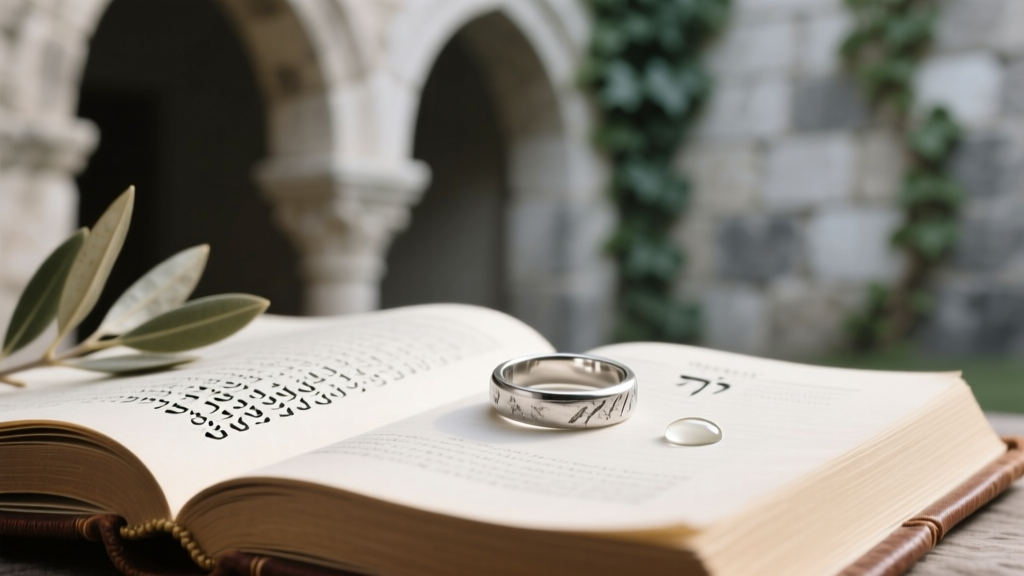
Wedding Rings in the Bible? What Scripture Actually Says
Why This Question Matters More Than You Think
Are wedding rings in the bible? That simple question opens a doorway—not just into biblical archaeology or translation studies, but into how generations of believers have embodied covenant theology in tangible, wearable ways. In an era where couples increasingly seek faith-rooted wedding traditions—and where social media floods feeds with 'biblical wedding' checklists—confusion abounds. Some pastors forbid rings as ‘pagan,’ others bless them as sacred emblems, and many couples quietly wonder: if God didn’t command it, is wearing one spiritually neutral… or even risky? The answer isn’t found in a single verse—but in layers of cultural context, covenant language, and redemptive continuity across Scripture. Let’s move beyond yes/no and uncover what the Bible *actually* teaches about symbols of binding love, fidelity, and eternal promise.
The Short Answer—And Why It’s Misleading
Technically, no—there is no verse in the canonical Bible that describes or prescribes the exchange of wedding rings during a marriage ceremony. Not in Genesis’ account of Adam and Eve, not in the Song of Solomon’s poetic union, not in Jesus’ teaching on divorce in Matthew 19, and not in Paul’s instructions to husbands and wives in Ephesians 5. The word 'ring' appears only seven times in most English translations—and never in connection with marriage vows. But reducing this to ‘not biblical’ ignores how meaning accrues across time, culture, and theological reflection. Ancient Israelites used signet rings as legal instruments of authority and identity (Jeremiah 22:24; Haggai 2:23); Roman brides wore iron rings symbolizing permanence; and by the 9th century AD, Christian liturgies incorporated rings as visible signs of indissoluble commitment. So while are wedding rings in the bible? yields a literal ‘no,’ the deeper question—are they biblically coherent?—demands far richer analysis.
What the Bible *Does* Say About Rings—and Why It Counts
Rings in Scripture are never decorative accessories—they’re instruments of covenant, authority, and restoration. Consider three pivotal moments:
- The Prodigal Son (Luke 15:22): When the father restores his wayward son, he commands, ‘Bring the best robe and put it on him. Put a ring on his finger…’ That ring wasn’t jewelry—it was a signet ring, granting legal standing, inheritance rights, and household authority. In first-century Jewish culture, a man’s signet ring functioned like a notarized signature—its impression sealed contracts and ratified decisions. To place it on the son’s finger was to reinstate his full status as heir.
- Esther’s Royal Decree (Esther 3:10; 8:2): Haman receives ‘the king’s signet ring’ to issue death decrees; later, Mordecai receives the same ring to reverse them. The ring itself carried no magic—but its imprint bore the weight of royal covenant and irrevocable promise.
- Joseph’s Investiture (Genesis 41:42): Pharaoh places his signet ring on Joseph’s hand, transferring executive authority over Egypt. Again—the ring signifies delegated power rooted in trust, loyalty, and covenantal responsibility.
In each case, the ring functions as a physical token of an unbreakable relational bond—whether familial, royal, or divine. That’s precisely the theological DNA of marriage: ‘Therefore a man shall leave his father and mother and hold fast to his wife, and they shall become one flesh’ (Genesis 2:24). The ring, then, becomes a wearable echo of that ‘holding fast’—a daily reminder of covenant fidelity, not because Scripture mandates it, but because it viscerally expresses what Scripture defines.
Ancient Marriage Customs: What Rings Replaced—and What They Represented
To understand why rings entered Christian weddings centuries after the New Testament, we must step into the world of ancient Near Eastern and Greco-Roman marriage practices. Biblical marriage was legally constituted—not by ceremony—but by contract (ketubah), consummation, and public recognition. Rings weren’t part of that framework, but other symbols were:
- Betrothal Gifts (mohar): In Exodus 22:16–17 and Deuteronomy 22:28–29, the groom’s payment to the bride’s father served as a binding pledge—akin to a legal deposit guaranteeing future union.
- Veil and Robe: In Genesis 24:65, Rebekah covers herself with a veil upon seeing Isaac—a sign of modesty, readiness, and transition into wifely role.
- Feast and Covenant Meal: The seven-day feast in Judges 14:12 and the ‘marriage supper’ imagery in Revelation 19:9 root marriage in communal celebration and eschatological promise.
So when Roman culture merged with early Christianity, the iron ring—originally worn by brides as a symbol of endurance (iron being durable, unyielding)—was gradually ‘baptized’ with new meaning. By the 9th century, the Catholic Church formalized the ring blessing: ‘With this ring I thee wed…’ linking the circle (no beginning, no end) to eternal love and the gold (refined by fire) to purified devotion. Crucially, this wasn’t innovation for innovation’s sake—it was theological translation: taking a culturally embedded symbol and investing it with biblical themes of faithfulness, sacrifice, and covenant renewal.
What Modern Couples Get Wrong—and What They Can Do Instead
Many well-intentioned believers fall into two traps: either rejecting rings entirely as ‘unbiblical’ (ignoring the principle of Christian liberty in Romans 14), or treating them as quasi-sacramental objects requiring ‘biblical certification.’ Neither reflects sound hermeneutics. Here’s what works:
- Anchor the symbol in Scripture—not tradition. Choose a ring inscription from Psalm 133:1 (‘How good and pleasant it is when brothers dwell in unity!’) or Ruth 1:16–17 (‘Where you go I will go…’) rather than generic ‘forever’ clichés.
- Use the ring as a discipleship tool. One couple we interviewed (Sarah and David, married 2021) began a weekly ‘ring reflection’: each Sunday, they hold hands and name one way they’ve ‘held fast’ that week—echoing Genesis 2:24. It transformed jewelry into relational accountability.
- Opt for ethical sourcing—with theological intention. A 2023 Barna study found 68% of Christian couples prioritize ethical metals and stones—but only 22% connect that choice to stewardship theology (Genesis 2:15, ‘to work and keep’ the earth). Choosing Fair Trade gold or lab-grown diamonds becomes an act of creation care.
| Symbolic Element | Biblical Root | Cultural Origin | Modern Application Tip |
|---|---|---|---|
| Circle shape | Eternal nature of God’s covenant (Psalm 103:17; Isaiah 54:10) | Roman & Byzantine tradition (symbolizing infinity) | Engrave inside band: ‘My covenant stands forever’ (2 Samuel 23:5) |
| Gold metal | Refinement through trial (1 Peter 1:7); divine glory (Exodus 25:11) | Egyptian & Mesopotamian royalty (associated with sun god) | Select recycled gold—honoring both purity and stewardship |
| Wearing on left ring finger | No biblical basis—but ancient belief in ‘vena amoris’ (vein to heart) | Roman anatomical myth (disproven, but culturally persistent) | Choose placement intentionally: ‘I wear this on my dominant hand—to remind me love requires action’ |
| Matching bands | Oneness theme (John 17:21–23; Ephesians 5:31) | 20th-century American marketing (De Beers’ 1940s campaign) | Customize each band with complementary verses—one with ‘I am my beloved’s’ (Song 6:3), the other with ‘my beloved is mine’ |
Frequently Asked Questions
Did Jesus or the apostles ever wear or endorse wedding rings?
No historical or textual evidence suggests Jesus, Peter, Paul, or any New Testament figure wore wedding rings—or referenced them in teaching. First-century Palestinian Jews did not practice ring-exchange in marriage; Roman citizens sometimes did, but early Christians prioritized distinctiveness in worship and ethics. The earliest documented Christian ring use appears in 2nd-century catacomb art—depicting Christ handing a ring to the Church as Bride—but this is symbolic, not prescriptive.
Is it sinful to wear a wedding ring if it’s not in the Bible?
No—Scripture grants freedom in matters of adiaphora (‘things indifferent’). Romans 14:5–6 affirms, ‘One person esteems one day as better than another, while another esteems all days alike. Each must be fully convinced in his own mind… He who observes the day, observes it in honor of the Lord.’ Wearing a ring falls under Christian liberty: permissible if done with thanksgiving (1 Corinthians 10:31) and without violating conscience or causing stumbling (Romans 14:13).
What do Jewish and Orthodox Christian traditions say about wedding rings?
In traditional Judaism, the groom places a plain gold band on the bride’s right index finger during the betrothal (kiddushin), citing Exodus 21:10’s ‘food, clothing, and conjugal rights’ as foundational obligations. The ring must be owned solely by the groom and have no jewels—ensuring its value is intrinsic, not ornamental. Eastern Orthodox ceremonies include a ‘blessing of the rings’ before crowning, where rings are exchanged three times to signify the Trinity and mutual submission. Both traditions treat rings as covenantal acts—not magical objects, but solemn gestures rooted in halakhic or liturgical continuity.
Can I use a non-traditional ring (wood, stone, silicone) and still honor biblical principles?
Absolutely—and often more faithfully. A wooden ring echoes Psalm 1:3 (‘planted by streams of water’); a river stone ring recalls Joshua 4’s memorial stones; silicone bands reflect practical stewardship for healthcare workers or parents. The material matters less than the meaning anchored in Scripture. As theologian Kevin Vanhoozer notes: ‘The Bible doesn’t prescribe forms—it reveals the heart behind them.’
Common Myths
Myth #1: “Wedding rings originated in pagan fertility cults—so they’re spiritually dangerous.”
While some ancient cultures used rings in ritual contexts, the biblical concept of covenant predates and transcends those uses. Just as Christians repurposed the cross (a Roman instrument of torture) as a symbol of redemption, rings were redeemed as emblems of faithful love—not fertility magic. The origin of a symbol doesn’t determine its meaning; its biblical re-signification does.
Myth #2: “If it’s not commanded, it’s optional—and therefore unimportant.”
This confuses biblical silence with biblical insignificance. Scripture doesn’t command church buildings, hymnals, or wedding invitations—but all can serve gospel witness when rooted in truth. As John Calvin wrote, ‘The whole life of believers ought to be a sort of practice of piety’—including how we mark sacred commitments.
Your Ring—Your Covenant Reminder
So—are wedding rings in the bible? Literally, no. Theologically, profoundly yes—not as mandated objects, but as embodied metaphors. Every time you slip that band onto your finger, you’re participating in a 2,000-year conversation about covenant: the kind God made with Abraham (Genesis 15), renewed with David (2 Samuel 7), fulfilled in Christ (Hebrews 8:6), and mirrored in marriage (Ephesians 5:25–32). Your ring isn’t a relic of religious obligation—it’s a tactile sermon. It’s your daily ‘yes’ to holding fast. Your quiet protest against disposable relationships. Your small, golden echo of eternity. So choose it wisely. Inscribe it meaningfully. Wear it gratefully. And when someone asks, ‘Are wedding rings in the bible?’—don’t just say ‘no.’ Tell them the richer story: how love, once promised, becomes visible—in metal, in memory, and in mercy.
More Articles
 Civil Wedding Cost in Philippines (2026)
 How to Politely Decline a Wedding Invitation
 Did Simone Biles’ Biological Mother Attend Her Wedding?
 Maid of Honor: 7 Truths No One Tells You (2026)
 Did Ethan Go to Trisha’s Wedding? Verified Facts (2026)
 Can You Wear Black to a Wedding? (2026)
 A Common Life The Wedding Story Most Couples Never Tell
 Wedding Day Wishes: 7 Authentic Ways to Make Them Cry (2026)
 A Very Sordid Wedding Full Cast (2026) Verified
 Diana’s Wedding Dress Cost in 2026: $460,000+