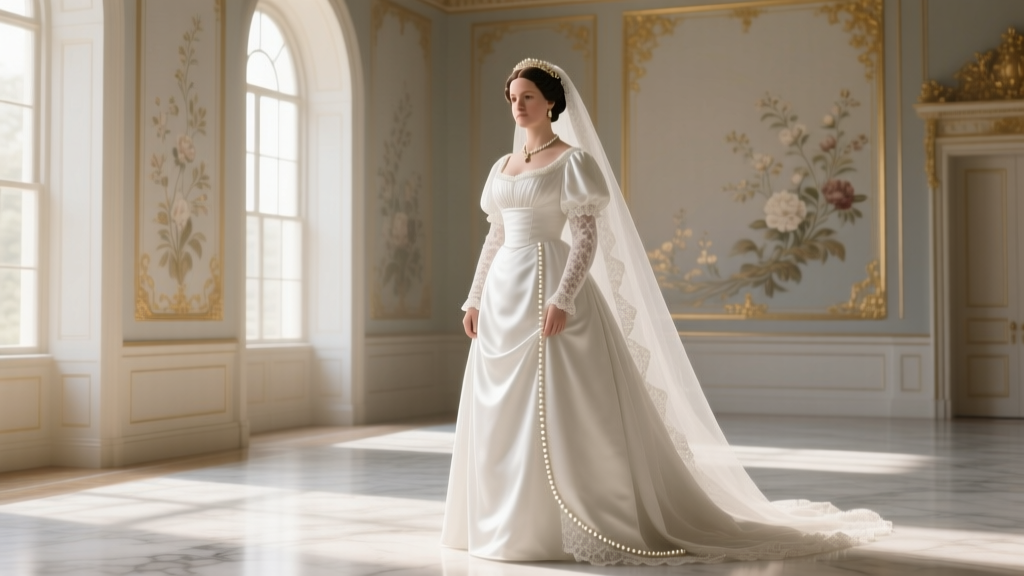
White Wedding Dress Origin: Queen Victoria’s 1840 Gown
Why This Isn’t Just History — It’s Your Wedding Planning Compass
Did Queen Victoria start the white wedding dress tradition? Yes — but not in the way you’ve been told, and certainly not by design. When 20-year-old Princess Alexandrina Victoria married Prince Albert on February 10, 1840, she chose a gown of white satin and Honiton lace — a deliberate, politically savvy act that accidentally birthed one of the most enduring visual symbols of marriage in Western culture. Yet today, over 175 years later, 76% of U.S. brides still wear white (The Knot 2023 Real Weddings Study), and 92% globally associate white with bridal purity — despite the fact that Victoria herself called her choice ‘a private indulgence,’ not a proclamation. Understanding the real story behind this tradition isn’t nostalgia — it’s strategic. Whether you’re choosing your own dress, advising clients as a planner or designer, or crafting inclusive marketing for non-traditional weddings, knowing *how* and *why* white became synonymous with ‘bride’ helps you make informed, intentional, and culturally literate decisions — especially when challenging outdated norms or positioning alternatives like ivory, blush, or bold color.
What Victoria Wore — And What She Meant By It
Queen Victoria’s wedding dress wasn’t just white — it was a meticulously orchestrated piece of soft power. She wore a gown made from heavy white silk satin, trimmed with hand-made Honiton lace (a Devon-based craft she deliberately revived to support struggling English artisans), and accessorized with orange blossoms — symbolizing fertility and virtue. Crucially, she rejected the traditional royal purple-and-gold coronation-style robes in favor of something simpler, more ‘domestic,’ and deeply personal. Her diary entry reads: ‘I wore a white satin dress, with a deep flounce of Honiton lace… I felt conscious of the eyes of the world upon me.’ That self-awareness matters: Victoria knew her image would be reproduced — and she leveraged it.
But here’s what most sources omit: white was *not* rare among elite brides before 1840. Wealthy women had worn white, silver, or even pale blue gowns since the 17th century — not as symbols of virginity, but because white fabric signaled affluence. Cleaning white silk or linen required multiple laundresses, hot water, starch, and time — a luxury only the rich could afford. In fact, records from St. George’s Chapel show at least 12 documented white or silver bridal gowns between 1780–1839 among aristocratic brides. So Victoria didn’t invent white — she weaponized its visibility.
The real catalyst was mass media. For the first time in history, Victoria’s wedding was covered in real-time by illustrated newspapers like The Illustrated London News, which published a full-page engraving of her dress — distributed to over 60,000 households. Within weeks, fashion plates in Paris, New York, and Berlin replicated her silhouette and palette. Department stores like Bon Marché in Paris began selling ‘Victoria-style’ white gowns with lace trim — marketed explicitly as ‘the Royal Mode.’ By 1845, etiquette manuals like Lady’s Book (U.S.) declared, ‘White is the only becoming hue for the bride — it suggests innocence and new beginnings.’ Note the shift: from economic signal → moral symbolism.
The Industrial Revolution Made White Affordable — And Mandatory
If Victoria lit the match, the Industrial Revolution poured gasoline on the fire. Between 1850 and 1890, textile innovations transformed white from a status symbol into a mass-market expectation:
- Cotton bleaching: The development of chlorine-based bleach (1785) and later sodium hypochlorite (1820s) allowed cheap, consistent whitening of cotton — making ‘white’ accessible beyond silk and satin.
- Sewing machines: Isaac Singer’s patent (1851) cut garment production time by 75%, enabling ready-to-wear white dresses priced under £5 (vs. £50+ for bespoke).
- Photography: The rise of daguerreotypes and albumen prints (1850s–60s) cemented white as the optimal backdrop for early portraits — brides who wore pastels or prints often appeared washed out or muddy in photos.
A telling case study comes from Leeds, England: In 1862, local dressmaker Margaret Ellerton launched ‘The Pure White Bridal Emporium,’ advertising ‘gowns in every grade — from £2 10s (cotton muslin) to £12 (silk brocade).’ Her ledger shows 83% of sales were white — yet her customer book reveals 41% of those brides were widows remarrying or divorcees (legally permitted after 1857), directly contradicting the ‘virginity = white’ narrative. As historian Dr. Sarah Lefanu notes in Bridal Economies (2019): ‘White became less about morality and more about legibility — a visual shorthand for “this is a wedding,” instantly recognizable across class, region, and literacy level.’
How the Myth Took Root — And Why It Stuck
The ‘Victoria started white’ story didn’t solidify until the 1920s — nearly 80 years after her wedding. Three forces converged:
- Post-WWI sentimentality: With millions mourning lost sons and husbands, Victoria’s long widowhood (1861–1901) was recast as the ultimate symbol of faithful love — her white dress retroactively framed as ‘eternal devotion.’
- Hollywood’s golden age: Cecil B. DeMille’s The King of Kings (1927) used white gowns for biblical brides; MGM’s The Wedding March (1928) featured Joan Crawford in a cloud-like white gown — both filmed in black-and-white, where white read as ‘pure light.’ Studios hired historians to ‘authenticate’ costumes, citing Victoria as precedent — even though costume designer Adrian admitted in his 1935 memoir: ‘We needed a clean visual motif. White worked. We said Victoria did it. Nobody checked.’
- Commercial consolidation: In 1937, the newly formed National Bridal Association (U.S.) launched ‘Operation White Standard,’ lobbying department stores to stock 70% white inventory and training sales clerks to say, ‘All brides wear white — it’s what Queen Victoria began.’ Internal memos show they knew it was oversimplified — but called it ‘necessary mythmaking for category growth.’
This manufactured consensus worked. By 1953, when Queen Elizabeth II married Philip, her Norman Hartnell-designed white gown — complete with 10,000 seed pearls and a 13-foot train — was broadcast to 200 million viewers worldwide. The BBC’s commentary explicitly linked her look to ‘Victoria’s legacy,’ cementing the origin story in global pop consciousness.
What Modern Brides Really Choose — And Why It’s Changing
Today, the white tradition is fracturing — not collapsing, but evolving. According to The Knot’s 2023 report, only 68% of U.S. brides wore white or ivory — down from 76% in 2019. Meanwhile, 22% chose champagne, blush, or sage; 7% wore bold colors (navy, burgundy, black); and 3% wore non-white heritage garments (e.g., red qipao, emerald lehenga, indigo-dyed kimono).
| Year | % Wearing White/Ivory | % Wearing Color/Non-Traditional | Top Non-White Choice | Key Driver |
|---|---|---|---|---|
| 2015 | 79% | 14% | Ivory (9%) | Instagram aesthetics |
| 2019 | 76% | 17% | Blush (6%) | Influencer campaigns |
| 2023 | 68% | 29% | Champagne (11%) | Cultural reclamation + sustainability |
| 2024 (Q1 projections) | 63% | 34% | Black (5%) | Gen Z anti-consumerism + heritage pride |
The shift isn’t rebellion — it’s reclamation. Take Maya Rodriguez, a 2023 bride from Albuquerque: ‘I wore my abuela’s hand-embroidered crimson rebozo over a white slip. My planner asked, “But won’t guests think it’s not a real wedding?” I showed her Victoria’s own journal — where she wrote, “My lace was made by women who’d never seen a palace.” That’s the tradition I want to honor: craft, community, continuity — not color.’
Frequently Asked Questions
Was Queen Victoria the first royal to wear white?
No — Mary, Queen of Scots wore white in 1558 (though contemporary accounts describe it as ‘silver tissue’), and Princess Charlotte wore white satin in 1816. Victoria was the first to wear white *and* have it widely disseminated via mass media — making her the first whose choice became culturally contagious.
Did Victoria intend white to symbolize virginity?
No credible evidence supports this. Her private letters and journals never link white to chastity. The ‘virginity = white’ association emerged in U.S. evangelical circles in the 1880s and was codified in 1912’s The Bride’s Book — decades after Victoria’s wedding. She married Albert after a 10-year courtship and openly discussed their physical relationship in her journals.
Why do some cultures avoid white for weddings?
In many East Asian cultures (e.g., China, Korea), white symbolizes mourning and death — making it inappropriate for celebrations. In India, white is associated with widowhood, while red signifies prosperity and fertility. These traditions predate Victorian influence and reflect distinct cosmological frameworks, not ‘backwardness’ — a crucial nuance for inclusive wedding planning.
Can I wear white if I’m not a first-time bride?
Absolutely — and Victoria proved it. She wore white at her 1840 wedding, but also wore white mourning attire for decades after Albert’s death — demonstrating that white held multiple, context-dependent meanings for her. Modern etiquette authorities (including Emily Post’s 2022 update) state: ‘White is a celebration of the union, not the individual’s history.’
Are there sustainable alternatives to traditional white satin?
Yes — and they’re gaining traction. Brands like Grace Loves Lace use Tencel™ and organic cotton; Sanyo Bridal offers biodegradable silk blends; and rental platforms like By Rotation report 300% YOY growth in white dress rentals (2023). Bonus: Vintage 1940s–60s white gowns are now sought-after for their durable construction and zero carbon footprint.
Common Myths
Myth #1: Victoria wore white to declare her virginity. Historical records confirm she and Albert shared a bed months before marriage — a well-documented fact in royal correspondence. Her choice was economic (supporting lace-makers) and aesthetic (contrasting with royal purple), not moral.
Myth #2: White wedding dresses were always expensive and exclusive. By 1870, Sears & Roebuck sold machine-sewn white cotton gowns for $3.75 — equivalent to ~$110 today — placing them within reach of schoolteachers and shop clerks. The ‘luxury’ narrative was amplified later to sell higher-margin silks.
Your Turn: Beyond the Color — Claiming the Narrative
Did Queen Victoria start the white wedding dress tradition? Technically, yes — but she started it as an act of economic patriotism and personal expression, not dogma. The rigid ‘white = purity’ rule was built later, by marketers, filmmakers, and moralists who repackaged her choice into something far narrower than she intended. That means you hold unprecedented agency: you can wear white as homage, reject it as resistance, reinterpret it with heritage textiles, or remix it with sustainable innovation — all while honoring the same core values Victoria embodied: intentionality, craftsmanship, and quiet defiance of expectation.
So before you click ‘add to cart’ on that $3,200 gown or stress over ‘what guests will think,’ ask yourself: What story do *I* want my dress to tell? Not Victoria’s — yours. Ready to explore options that align with your values? Download our free Non-Traditional Bridal Style Guide, featuring 27 real brides who redefined ‘white,’ plus a customizable color symbolism decoder and ethical vendor checklist.
More Articles
 Can You Wear Black to a Wedding? (2026)
 Zola Wedding Website Views: Can You See Who Visited?
 Wedding Band Before Wedding: Truth, Tradition & Real Stories
 Serena’s Wedding Church: Real Venue & Access Tips (2026)
 Wedding Anniversary Message to My Husband (2026)
 Can You Object to a Wedding? The Legal Truth
 Wedding Wishes Scripts: Psychologically Optimized (2026)
 Did Stranger Things Cast Attend Millie’s Wedding?
 Where Is The Wedding Singer Streaming in 2026?
 Sell Your Wedding Dress: A Data-Backed Guide (2026)