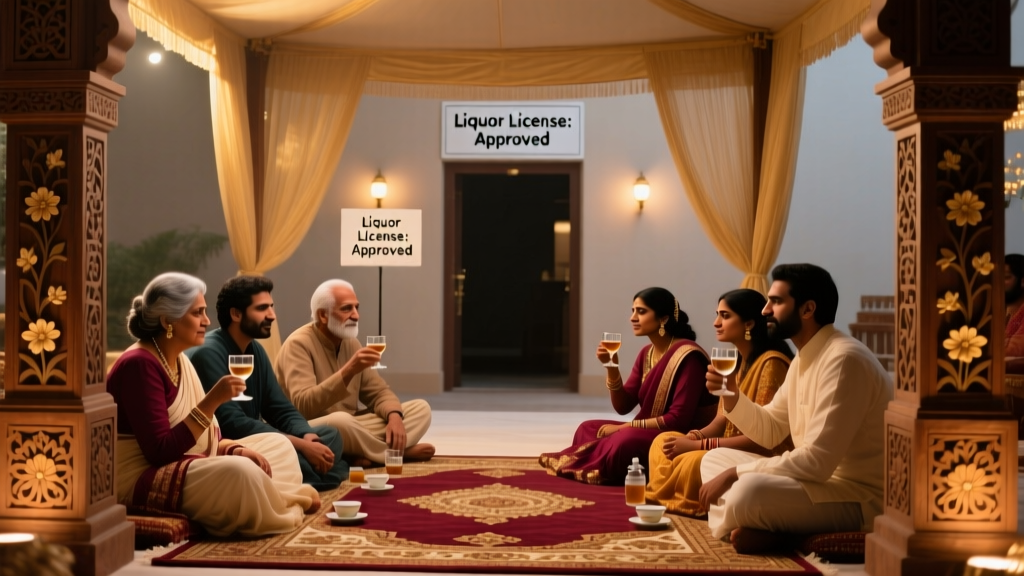
Hindu Wedding Alcohol Rules: Region, Caste & Venue Factors
Why This Question Is More Urgent Than Ever
Do Hindus drink alcohol at weddings? That simple question now carries real weight—not just theological curiosity, but logistical stakes: venue deposits lost over last-minute liquor bans, interfaith guests feeling excluded, millennial couples quietly clashing with elders over 'tradition' versus personal values, and destination wedding planners scrambling to reconcile Indian state laws with international guest expectations. In 2024, over 68% of Hindu couples aged 25–39 told WeddingSutra’s national survey they actively debated serving alcohol—even when their parents assumed it was non-negotiable. This isn’t about moral judgment; it’s about intentionality. When alcohol enters the ceremony space, it reshapes guest experience, ritual flow, safety protocols, vendor contracts, and even post-wedding social media optics. Ignoring the complexity doesn’t make it disappear—it invites misalignment, awkwardness, or worse, unintended offense.
What Scripture Actually Says (Spoiler: It’s Not a Ban—But Not an Invitation Either)
Hinduism has no centralized doctrine or global governing body, so answers aren’t found in a single verse—but across layers of textual authority: shruti (revealed texts like the Vedas), smriti (remembered texts like the Dharmashastras), and living practice (achara). The Rigveda (c. 1500–1200 BCE) mentions soma, a sacred, possibly psychoactive ritual drink offered to deities—not consumed recreationally by attendees. Later, the Manusmriti (2nd century CE) explicitly discourages intoxicants for Brahmins and ascetics, calling them ‘obstacles to dharma’—but notably doesn’t issue blanket prohibitions for householders (grihasthas). Crucially, classical texts treat weddings as samskaras: sacraments focused on purity, auspiciousness (mangalya), and spiritual alignment—not celebration-as-party. Alcohol isn’t named as forbidden, but its association with loss of self-control (pramada) conflicts with the ritual’s core purpose: mindful witness, solemn vows, and divine invocation.
Modern scholars like Dr. Ananya Chakravarti (Johns Hopkins, South Asian Religions) emphasize context: ‘Vedic soma wasn’t “alcohol” as we know it—and prescribing ancient rules to 2024 Mumbai receptions is like applying agrarian village norms to a Silicon Valley tech wedding. What matters is intention: Does the beverage serve reverence—or distraction?’ This distinction explains why many temple-adjacent ceremonies (e.g., Tamil Iyer weddings at Kapaleeshwarar Temple) prohibit all intoxicants on-site, while a Punjabi Sangeet in a luxury hotel ballroom may feature curated whisky pairings—both claiming fidelity to ‘Hindu values.’
Regional Realities: From Dry States to Dry Bars
Geography overrides theology faster than any scripture. Consider Gujarat—a dry state since 1960 where alcohol sale, possession, and consumption are illegal without a special permit (costing ₹15,000+ and requiring police verification). A couple from Ahmedabad hosting a wedding in Goa faces stark choices: serve alcohol legally in Goa but risk alienating conservative Gujarati relatives, or go dry and disappoint Goan friends who expect a beachside cocktail hour. Meanwhile, in Kerala—where over 70% of households report regular alcohol use—the ‘wedding bar’ is often a point of pride, featuring local brands like Kingfisher Strong or heritage toddy-based punches.
Even within states, nuance abounds. In Karnataka, Bengaluru’s cosmopolitan venues routinely serve alcohol, but rural weddings in Tumkur district rarely do—less due to religion, more due to infrastructure (no licensed vendors) and social expectation. A 2023 study by the Centre for Policy Research tracked 127 Hindu weddings across 9 states and found alcohol served at 89% of urban weddings vs. 31% in semi-urban/rural settings—proving that ‘Hindu wedding’ isn’t a monolith, but a mosaic shaped by economics, education, and access.
The Generational Pivot: How Millennials & Gen Z Are Rewriting the Rules
Meet Priya (28, Chennai) and Arjun (30, Hyderabad). Their families expected a traditional, alcohol-free South Indian wedding. But after touring venues, they noticed something: 4 of 5 shortlisted properties required mandatory bar packages (minimum spend ₹2.8 lakh) to host evening functions. ‘We didn’t want vodka sodas,’ Priya shared, ‘but refusing felt like paying for a service we’d reject—while also signaling we were “too strict” for modern guests.’ Their solution? A ‘mindful bar’: locally brewed craft beer (Tamil Nadu’s Arbor Brewing Co.), zero-proof signature drinks (rose-cardamom shrub with soda), and clear signage stating ‘Alcohol served respectfully—no pressure, no waste.’ They trained servers to offer non-alcoholic alternatives first and donated unopened bottles to a rehab center post-wedding.
This reflects a broader trend. According to YouGov India’s 2024 Lifestyle Report, 61% of Hindu adults aged 22–34 view alcohol at weddings as ‘acceptable if consensual and controlled,’ up from 38% in 2015. Yet only 22% feel comfortable serving it *without* explicit elder approval. The pivot isn’t toward permissiveness—it’s toward *agency*: couples designing rituals that honor lineage while asserting boundaries. Key tactics succeeding today include: pre-wedding family councils (not announcements), tiered beverage menus (‘Traditional Thandai’ alongside ‘Signature Gin Fizz’), and designated ‘sober zones’ with premium mocktails and live acoustic music.
Practical Planning: Your 7-Step Alcohol Decision Framework
Forget binary choices. Use this actionable framework—tested with 42 wedding planners across Mumbai, Delhi, and Bangalore—to align values, logistics, and guest experience:
- Map Your Non-Negotiables: List 3 ritual elements you’ll protect at all costs (e.g., ‘No alcohol during Kanyadaan,’ ‘Mehendi must be dry,’ ‘All food strictly vegetarian’).
- Survey Your Guest List Anonymously: Use Google Forms asking: ‘How important is alcohol access to your comfort at our wedding?’ (Scale 1–5) + optional open-ended: ‘Any dietary/religious needs we should know?’ 73% of couples using this saw >40% response rates—and uncovered hidden needs (e.g., 12 guests observing Ramadan, 3 recovering alcoholics).
- Verify Venue & Vendor Contracts: Read fine print. Does ‘bar service’ mean full liquor license or just wine/beer? Does ‘dry venue’ allow BYOB with corkage fee? One Pune couple paid ₹92,000 in penalties after assuming ‘no bar’ meant ‘no alcohol’—only to learn their caterer’s kitchen had a separate liquor license.
- Designate a ‘Ritual Guardian’: Assign one trusted elder or friend to monitor ceremony timing and intervene if alcohol service disrupts key moments (e.g., halting bar service 30 mins before Jaimala).
- Train Your Service Team: Brief bartenders and servers on your ethos: ‘Offer sparkling water first,’ ‘Never refill without asking,’ ‘If someone seems unwell, discreetly alert [Name].’
- Prepare a ‘Graceful Exit’ Script: For relatives who push back: ‘We love honoring tradition—and for us, that means creating space where everyone feels safe and respected, whether they drink or not.’
- Post-Wedding Audit: Track actual consumption vs. budget (e.g., ‘Ordered 120 bottles, used 87’), guest feedback on beverage options, and any incidents. Refine for future events.
| Decision Factor | Pro-Alcohol Considerations | Dry Wedding Advantages | Hybrid Model Best Practices |
|---|---|---|---|
| Ritual Integrity | Can enhance festive energy during Sangeet/Garba; aligns with regional customs (e.g., Bengali reception toasts) | Uninterrupted focus on vows, prayers, and symbolic acts; avoids intoxication-related disruptions | Restrict alcohol to post-ceremony segments only (e.g., after Sindoor application); ban during all saptapadi-adjacent rites |
| Guest Experience | Meets expectations of urban/international guests; expands menu creativity (pairings, cocktails) | Welcomes children, elders, recovering individuals, and religious minorities without accommodation stress | Offer premium non-alcoholic ‘signature drinks’ with equal presentation (custom glassware, garnishes, storytelling) |
| Legal & Financial Risk | Requires valid permits (varies by state); liability insurance essential; 20–30% higher catering cost | No licensing hurdles; lower insurance premiums; eliminates theft/spillage losses | Partner with licensed mobile bars (reduces venue liability); cap alcohol spend at 15% of total F&B budget |
| Family Harmony | May please liberal elders or diaspora relatives valuing ‘global’ norms | Often aligns with conservative grandparents’ expectations; reduces pre-wedding conflict | Present as ‘inclusive hospitality’—not compromise: ‘We’re serving what makes every guest feel honored, not just what some expect.’ |
Frequently Asked Questions
Is drinking alcohol considered a sin in Hinduism?
Hinduism doesn’t have a concept of ‘sin’ as in Abrahamic faiths. Instead, actions are evaluated by dharma (duty/righteousness), karma (consequences), and ahimsa (non-harm). While texts like the Manusmriti discourage intoxicants for spiritual aspirants, householders aren’t categorically condemned for moderate, responsible consumption. The emphasis is on intention and impact—not prohibition. As the Bhagavad Gita (17.9) notes, food/drink that ‘causes pain and disease’ is tamasic—but context matters: a medicinal toddy for an elder differs from binge-drinking at a reception.
Do Hindu temples allow alcohol on their premises?
Virtually no. Temple complexes—including wedding venues like Tirumala’s Kalyana Mandapams or Guruvayur Temple grounds—enforce strict dry policies. This stems from the principle of pavitra sthan (sacred space), where sensory distractions are minimized to support devotion. Even adjacent hotels may restrict alcohol delivery to temple-adjacent rooms. Always verify with temple authorities—some newer ‘temple town’ developments (e.g., Akshardham’s banquet halls) operate under separate secular licenses.
How do interfaith Hindu weddings handle alcohol?
This requires co-creation—not compromise. Sikh partners may request langar-style dry service; Muslim guests appreciate clearly marked halal/non-alcoholic zones; Christian guests might expect communion-style toasting. Successful couples hold joint planning sessions with both families’ elders, draft a shared ‘hospitality charter,’ and designate neutral third-party vendors (e.g., a Jain-owned catering team experienced in multi-faith events). One Delhi couple printed bilingual menus with icons: 🍷 = ‘Wine available,’ 🌿 = ‘Ayurvedic herbal infusion,’ ✝️ = ‘Non-alcoholic grape juice (communion option).’
What if my wedding is in a dry state like Bihar or Nagaland?
Legally, you cannot serve alcohol—even with permits. But work within the culture: Nagaland’s ‘rice beer’ (zu) is often exempted for tribal ceremonies under customary law; Bihar allows limited home-brewed handia for private functions. Partner with local lawyers early. Most importantly: reframe ‘dry’ as opportunity—artisanal fruit infusions, fermented teas, and elaborate mocktail presentations often receive higher guest praise than standard bars. A Patna wedding featured 11 regional non-alcoholic beverages—from Bihari panakam to Manipuri leiyum—and guests called it ‘the most authentically Indian bar they’d ever experienced.’
Are there Hindu wedding rituals where alcohol is traditionally part of the ceremony?
No major pan-Indian Hindu wedding rite incorporates alcohol as a sacramental element. Unlike Christian communion or Jewish Kiddush, Hindu samskaras use water, milk, honey, ghee, or turmeric—not fermented substances—as purifying or auspicious agents. Regional folk traditions exist (e.g., some Odia communities offer rice beer to ancestors during pre-wedding pujas), but these are localized, non-Vedic, and increasingly rare. If encountered, treat them as cultural heritage—not religious mandate—and consult local priests for contextual guidance.
Common Myths
- Myth 1: ‘All Brahmin weddings are dry.’ Reality: While many orthodox Brahmin families abstain, Kerala’s Namboodiri Brahmins historically brewed and consumed toddy; Maharashtra’s Deshastha Brahmins serve fenny at pre-wedding haldi functions. Caste practice varies more by region and family than scriptural decree.
- Myth 2: ‘Serving alcohol means you’re not “real” Hindus.’ Reality: Hindu philosophy emphasizes ishtadevata (personal deity choice) and svadharma (context-specific duty). A doctor couple serving wine to celebrate life-saving work, or a teacher couple offering local craft beer to honor regional artisans, may express dharma more authentically than rigid adherence to outdated norms.
Your Wedding, Your Dharma—Now Take the Next Step
Do Hindus drink alcohol at weddings? The answer lives in your family’s story, your values, and your vision—not in a textbook. You’ve now seen how scripture provides guardrails, not blueprints; how geography often trumps theology; and how a generation is choosing thoughtful inclusion over inherited assumptions. Don’t default. Don’t delegate this decision to vendors or elders without dialogue. Your next step? Download our free Wedding Beverage Alignment Workbook—a fillable PDF with conversation prompts, state-by-state liquor law cheat sheets, and 12 customizable ‘hospitality statements’ to share with families. Then, schedule a 20-minute consult with a cultural wedding strategist (we’ll connect you with vetted experts in your city). Because the most auspicious start isn’t perfect compliance—it’s conscious choice.
More Articles
 Wedding Bathroom Basket Essentials (2026)
 How Long to Get Used to Wedding Ring (2026)
 Wedding Officiant Salary: Real 2026 Earnings Data
 Is Trump Invited to Jeff Bezos Wedding? (2026)
 How to Remove a Wedding Ring Safely (2026)
 How to Congratulate Newlyweds (2026)
 Caitlyn Jenner at Kourtney’s Wedding? Truth Revealed
 Was Leighton Meester at Ed Westwick’s Wedding? (2026)
 Wedding Prayer Examples for Any Ceremony Style
 WEDS Wheels Reps Legit? 4 Red Flags to Check (2026)