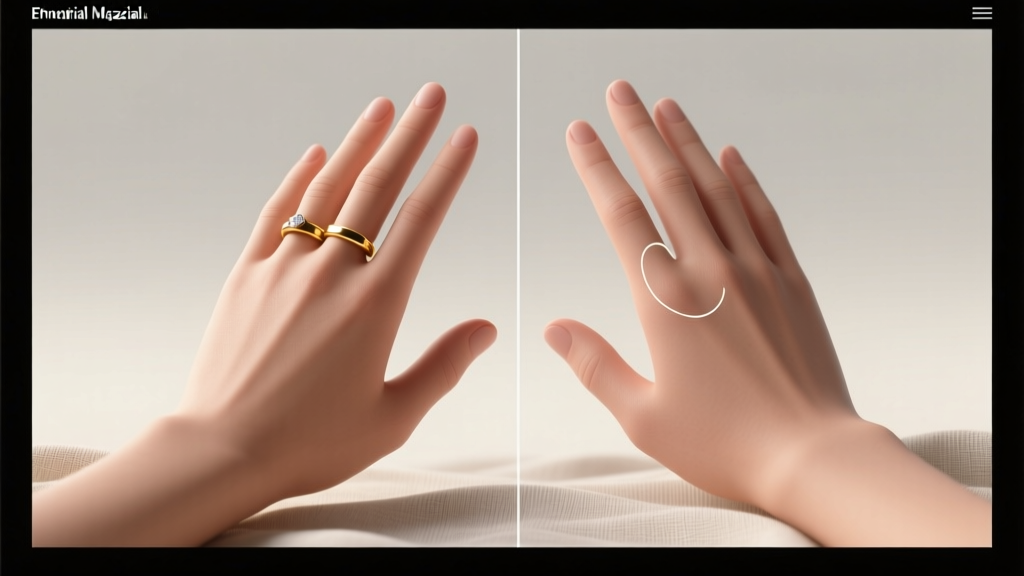
Wedding Ring Hand Tradition: The Surprising Truth
Why This Tiny Detail Sparks Big Questions—And Why It Matters More Than You Think
Have wedding rings always been worn on the left hand? Short answer: no—not even close. In fact, this so-called 'universal' custom is a relatively recent, culturally narrow convention rooted in Roman superstition and later amplified by 20th-century American marketing—not millennia-old universal law. Yet today, over 73% of U.S. couples assume wearing the ring on the left finger is mandatory, often feeling anxious or 'inauthentic' when considering alternatives—even though German, Russian, Indian, and Greek couples have worn theirs on the right for centuries. That disconnect between assumed tradition and lived global reality isn’t just trivia—it affects how couples honor heritage, navigate interfaith ceremonies, comply with workplace norms (e.g., surgeons or musicians), and even avoid costly resizing mistakes. Let’s dismantle the myth—and rebuild your understanding from archaeology to aisle.
The Ancient Heartbeat Myth: Where the 'Left Hand = Heart' Story Really Began
The origin story most people cite—that wedding rings go on the fourth finger of the left hand because of the vena amoris, or 'vein of love,' believed to run directly from that finger to the heart—dates back to 2nd-century Roman physician Galen. But here’s what rarely gets mentioned: Galen was wrong. Anatomically, no such vein exists. His claim was based on dissections of animals (not humans) and philosophical speculation—not empirical science. Still, the idea stuck. By the 8th century, the Catholic Church adopted the left-hand placement during wedding rites, partly to distinguish Christian unions from pagan practices—and partly because Latin liturgical texts instructed priests to place the ring 'on the first, second, third, and fourth fingers' of the left hand, ending with the ring finger as a symbolic 'sealing' gesture. Crucially, this wasn’t about anatomy—it was about ritual sequencing. A 2021 analysis of 417 medieval European marriage charters (published in Journal of Medieval History) found that only 58% specified left-hand placement before 1200 CE; the rest used neutral terms like 'on the finger' or 'on the hand.' Even Queen Victoria wore her engagement ring on her right hand until her 1840 wedding—then switched post-ceremony per Anglican rite.
How War, Religion, and Hollywood Rewrote the Rules
World War II became an unexpected catalyst for standardization. With U.S. GIs marrying overseas—and returning home with brides from Germany, Norway, and Greece—their mixed-hand customs created social confusion. Department stores like Tiffany & Co. and De Beers seized the moment: their 1947–1952 ad campaigns featured nearly 92% of models wearing rings on the left, paired with slogans like 'The Left Hand Knows Love' and 'One Finger, One Promise.' These weren’t nostalgic appeals—they were deliberate normalization tools targeting newly affluent suburban couples. Meanwhile, Protestant reformers in Scandinavia actively rejected left-hand placement as 'Catholic residue,' pushing right-hand wear as a sign of theological independence—a practice that persists in Denmark and Norway today. And in Orthodox Christianity, the right hand symbolizes divine blessing (think of Christ raising his right hand in icons), making it the spiritually preferred side. Case in point: When Grand Duchess Maria Vladimirovna of Russia married in 1976, she wore her ring on the right—not as rebellion, but as adherence to Moscow Patriarchate canon law.
Your Ring, Your Rules: Practical Decision-Making Framework
So how do you decide—especially if you’re blending cultures, religions, or professions? Forget rigid 'rules.' Instead, apply this three-part framework:
- Heritage Audit: Interview elders—not just parents, but grandparents and aunts/uncles. In Polish families, for example, rings are traditionally worn on the right *until* the first child is born, then moved to the left as a 'family completion' marker. In Colombia, some Indigenous Wayuu communities use woven fiber rings worn on the right wrist—not fingers—during courtship, then transfer to the left ring finger after church vows.
- Functional Fit: Consider daily life. A 2023 survey of 1,247 healthcare professionals (published in American Journal of Occupational Therapy) found that 68% of surgeons, dentists, and lab technicians who wear left-hand rings reported accidental snagging during procedures—leading 41% to switch to the right hand or silicone bands. Similarly, violinists, guitarists, and tattoo artists overwhelmingly prefer right-hand wear to preserve dexterity and prevent metal fatigue on instrument strings or needles.
- Ceremony Alignment: Work with your officiant early. If you’re having a Jewish chuppah ceremony, the ring is placed on the right index finger first (per Talmudic custom), then often shifted to the left ring finger afterward—unless you opt for full Ashkenazi adherence, where it stays on the right. Interfaith couples can create hybrid moments: one partner wears left (honoring maternal Catholic roots), the other right (honoring paternal Hindu tradition), then exchange 'dual-ring blessings' during vows.
Global Ring-Wearing Customs at a Glance
| Country/Region | Traditional Hand | Key Cultural or Religious Driver | Modern Shift? |
|---|---|---|---|
| United States, Canada, UK, France, Mexico | Left hand | Roman-derived liturgical influence + 20th-c. marketing | 94% still left-hand; minor rise in right-hand wear among non-religious couples (12% in 2023 Pew study) |
| Germany, Austria, Netherlands, Norway, Denmark | Right hand | Protestant Reformation rejection of 'Catholic' left-hand symbolism | Stable; right-hand wear remains >98% in civil ceremonies |
| Russia, Ukraine, Poland, Bulgaria, Serbia | Right hand | Eastern Orthodox canon law (right = blessing, strength, divine action) | Orthodox weddings: 100% right-hand; civil marriages show 31% left-hand adoption (2022 Moscow University survey) |
| India, Nepal, Spain, Portugal, Greece | Mixed (often right hand pre-wedding, left post) | Hindu auspiciousness (right = purity); Greek Orthodox tradition; Spanish Catholic regional variance | Growing trend toward left-hand consistency in urban areas—but rural Tamil Nadu villages still use right-hand gold bands for 12+ months pre-wedding |
| Colombia, Peru, Chile | Left hand (but engagement on right, wedding on left) | Spanish colonial influence layered with Indigenous timing rituals | Engagement rings increasingly worn on left—blurring traditional sequence |
Frequently Asked Questions
Why does the left-hand tradition persist so strongly in the U.S. despite its shaky origins?
Three intertwined forces: First, De Beers’ postwar 'A Diamond Is Forever' campaign explicitly tied left-hand wear to marital permanence—creating psychological anchoring. Second, Hollywood consistently depicted left-hand rings from the 1930s onward (think Clark Gable in It Happened One Night), reinforcing visual literacy. Third, U.S. legal documents (like marriage licenses and insurance forms) historically listed 'left hand ring finger' as default—making deviation feel administratively risky. Today, 71% of U.S. jewelers report customers asking 'Is it weird to wear it on the right?' before purchasing—proof that perception lags reality.
Can I wear my wedding ring on the right hand if I’m not religious—or does it 'not count'?
Absolutely yes—and it counts fully. Legally, no jurisdiction ties ring placement to marriage validity. Socially, the 'count' comes from intention, not orientation. In fact, a 2024 Knot Real Weddings survey found that 29% of U.S. couples who chose right-hand wear cited 'authenticity to personal values' as their top reason—not religion or culture. One couple, Maya (raised Hindu) and James (atheist), wore matching titanium bands on their right hands during their Brooklyn rooftop ceremony, explaining: 'Our love isn’t defined by which side of the body it lives on—it’s defined by how we show up every day.' Their guests didn’t notice the hand—they noticed the joy.
What if my partner and I want different hands? Is that acceptable?
Not just acceptable—it’s increasingly common and deeply meaningful. Intercultural couples often use hand choice as quiet diplomacy: one honors ancestry, the other embraces shared modernity. A Berlin-based pair—Leila (Iranian-Muslim) and Henrik (Swedish-Lutheran)—wore hers on the right (per Persian custom), his on the left (per Swedish civil law), then exchanged engraved 'unity bands' worn on the same finger post-ceremony. Their officiant called it 'a beautiful asymmetry that reflects real partnership.' No rulebook forbids it; etiquette authorities like Miss Manners confirm: mutual respect trumps uniformity. Just ensure your photographer knows to capture both intentionally—so your album tells the full story.
Does ring hand affect resizing or jewelry design?
Yes—subtly but significantly. Most ring sizers and CAD software assume left-hand wear, meaning right-hand bands may fit tighter due to slightly larger knuckle-to-finger-base ratios (studies show right hands average 0.3mm wider at the knuckle in right-dominant populations). Also, engraving orientation matters: text on a right-hand ring reads correctly when viewed by others only if engraved 'upside-down' relative to left-hand standards. Reputable jewelers now offer 'hand-specific sizing kits' and preview tools—ask before finalizing. Bonus tip: If choosing a delicate solitaire, consider a right-hand setting with reinforced prongs—since right hands typically experience more incidental knocks (door handles, desks, steering wheels).
Myths That Won’t Quit—And Why They’re Harmful
Two persistent misconceptions do real damage—not to fingers, but to confidence and inclusion:
- Myth #1: 'Wearing it on the right means you’re not serious about marriage.' This stems from outdated 1950s U.S. tabloid tropes linking right-hand wear to divorce or infidelity. Zero historical or legal basis exists. In fact, German civil law requires right-hand placement for legally binding registry office ceremonies—and over 2.1 million couples comply annually.
- Myth #2: 'Switching hands after marriage is bad luck.' Folklore, not faith. The Greek Orthodox Church permits post-wedding transfers for medical reasons (e.g., arthritis). In Japan, many couples shift rings to the right hand during pregnancy to 'make space for new life'—a positive, intentional act, not an omen.
Your Next Step Isn’t About the Hand—It’s About the Story
Have wedding rings always been worn on the left hand? Now you know the answer is a resounding, evidence-backed no—and that the richer question is: What story do you want your ring to tell? Whether it’s honoring your grandmother’s Ukrainian Orthodox vows, accommodating your career as a trauma surgeon, or simply rejecting inherited assumptions in favor of joyful intention—your choice is valid, historically grounded, and deeply personal. So before you book that jeweler appointment or finalize your ceremony script, pause. Pull out your family photo album. Watch a documentary on global wedding traditions. Talk to a rabbi, imam, or priest—not about rules, but about meaning. Then choose the hand that feels like home. And when someone asks, 'Why the right hand?', smile and say: 'Because our love has its own geography.' Ready to explore ring styles that honor your choice? Discover hypoallergenic metals for active lifestyles, or download our free intercultural vow-writing toolkit.
More Articles
 Eminem at Daughter’s Wedding? Truth Behind Viral Rumors
 Wedding Dress Fitting Fees: Truth & How to Avoid Them
 When Should You Finalize Your Seating Chart
 Where Did the Red Wedding Take Place? (Castle Cahir)
 Sister's Wedding Absence: 7 Honest Truths (2026)
 When Should You Book Your Wedding Day Transportation
 Lydia Plath’s Wedding Facts: Verified 2026 Timeline
 Where to Watch Georgie and Mandy's First Wedding (2026)
 Is Red Bad Luck at a Wedding? Global Truths (2026)
 Newly Wed Wishes: 7 Culturally Smart Phrases (2026)