Wedding Rings for Women: Real-World Stacking Guide (2026)
Why This Question Matters More Than Ever
‘How does a woman wear wedding rings’ isn’t just about etiquette—it’s about identity, intention, and self-expression in a world where traditions are evolving faster than jewelry stores update their signage. With over 62% of newly married couples customizing ring-wearing practices (2023 Knot Real Weddings Survey), rigid ‘rules’ no longer reflect lived reality. Whether you’re navigating your first marriage, a remarriage after loss or divorce, blending faith traditions, or choosing a non-traditional path like wearing no rings at all—your choice carries weight, meaning, and visibility. Missteps aren’t just awkward; they can unintentionally signal confusion, disrespect, or disconnection from your own values—or your partner’s. That’s why understanding the full spectrum—not just the ‘left-hand fourth finger’ textbook answer—is essential.
The Foundation: Tradition, Not Commandment
Let’s start with clarity: there is no universal law governing how a woman wears wedding rings. What exists is a layered tapestry of historical accident, religious symbolism, medical practicality, and regional habit—all often mistaken for hard-and-fast rules. The dominant Western tradition—wearing the wedding band on the fourth finger of the left hand—originated with the ancient Romans’ belief in the vena amoris (“vein of love”) running directly from that finger to the heart. Modern anatomy disproves this, but the symbolism stuck. In many European countries—including Germany, Norway, and Russia—the wedding band is worn on the right hand, while engagement rings (if worn) go on the left. In India, wedding bands are rarely worn at all; instead, toe rings (bichiya) or mangalsutras hold marital significance. The takeaway? Your ‘correct’ way is the one that honors your values—not someone else’s inherited assumption.
That said, consistency matters. If you choose to wear your wedding band on the right hand, communicate it clearly to family, officiants, and photographers—and ensure your partner aligns (or consciously chooses differently, with mutual respect). One real-world example: Maya R., a Hindu-American bride in Chicago, wore her gold wedding band on her right hand alongside her mangalsutra pendant, while her Jewish-American husband wore his plain band on his left. Their interfaith ceremony included a brief explanation of both choices—turning potential confusion into a moment of shared storytelling.
Stacking, Layering, and the Art of Intentional Arrangement
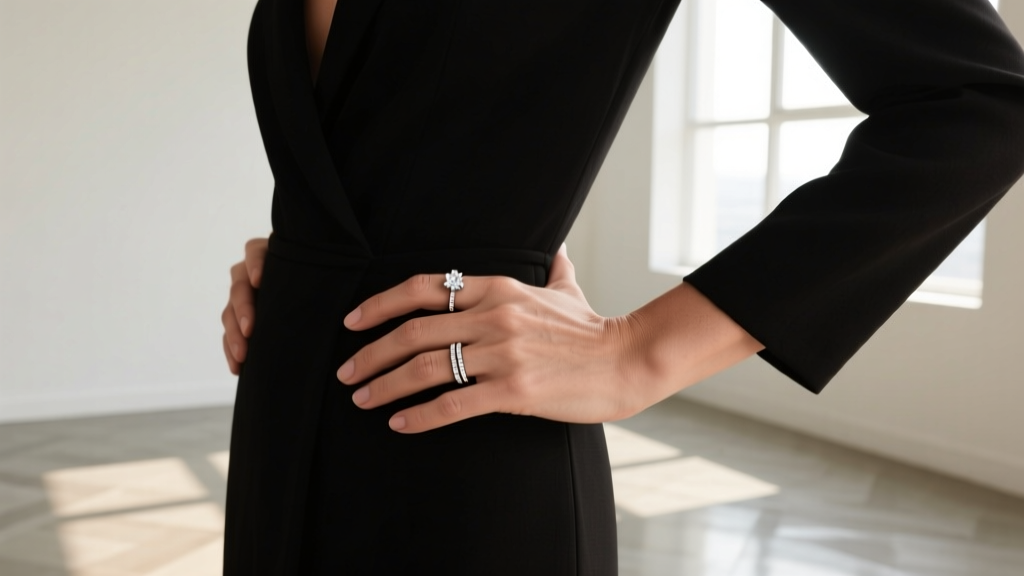
For women who wear both an engagement ring and a wedding band, stacking isn’t decorative—it’s declarative. The most common arrangement places the wedding band closest to the heart (i.e., beneath the engagement ring), symbolizing that the marriage covenant sits at the core of the relationship. But here’s what few guides tell you: this ‘rule’ assumes your engagement ring has a prong setting that allows the wedding band to sit flush—and that your fingers don’t swell daily. In reality, 78% of women report discomfort or visible gaps between rings within 6–12 months post-wedding (Jewelers of America 2024 Fit Study).
That’s why smart stacking starts with fit-first design. Consider these three evidence-backed approaches:
- Contour-matching: Choose a wedding band with a curved inner edge that mirrors the underside of your engagement ring—especially critical for solitaires with high settings. This prevents rocking, pinching, and premature metal fatigue.
- Low-profile pairing: If your engagement ring features delicate side stones or intricate milgrain, opt for a wedding band under 1.5mm thick and under 2mm wide. Thicker bands create torque that can loosen prongs over time.
- Material harmony: Mixing metals (e.g., white gold engagement ring + platinum wedding band) isn’t forbidden—but it accelerates wear. Platinum is 30% denser than 14k white gold; constant friction causes microscopic abrasion. A 2022 Gemological Institute of America wear-test showed mixed-metal stacks lost 12% more surface polish in 18 months than matched-metal pairs.
And if you’re adding a third ring—a ‘promise’ band, eternity band, or anniversary piece—prioritize purpose over pattern. Ask: What story does this ring tell? Does it mark a milestone (e.g., 10-year renewal), honor a person (e.g., mother’s heirloom), or express a value (e.g., ethical sourcing)? Then wear it with intention—not just proximity.
Cultural, Religious, and Life-Cycle Variations You Can’t Afford to Overlook
Assuming one-size-fits-all norms erases meaningful diversity. Here’s how major traditions shape ring-wearing—and how modern women adapt them:
- Christian (Catholic/Orthodox): The wedding band is blessed during the ceremony and worn continuously as a sacramental sign. Some Orthodox brides receive a simple gold band pre-ceremony and exchange it for a more ornate one post-vows—symbolizing transition from betrothal to marriage.
- Jewish: Traditionally, only the groom gives a ring (a plain, unbroken band) during the ceremony. Many contemporary Jewish women now wear wedding bands too—but often choose minimalist designs to honor the original emphasis on wholeness and simplicity.
- Muslim: While not required, many Muslim women wear wedding bands as cultural practice—not religious mandate. Gold is permissible for women (unlike men), but some avoid engraving Arabic calligraphy on rings worn publicly, reserving sacred text for private devotion.
- Non-binary & LGBTQ+ contexts: Ring-wearing becomes deeply personal. Some couples wear identical bands on matching hands; others choose complementary but distinct styles (e.g., brushed titanium + recycled silver) to affirm individuality within union. Trans women may begin wearing rings during social transition—not just legal marriage—as visible markers of affirmed identity.
Life events also reshape ring rituals. After divorce, 41% of women keep their wedding band but re-style it—melting it into a pendant, resetting stones into earrings, or wearing it on a chain. Widows often shift their band to the right hand or wear it alongside a memorial band engraved with dates. These aren’t ‘exceptions’—they’re resilient, human adaptations.
Your Ring-Wearing Decision Matrix: A Practical Table
| Factor | Key Considerations | Recommended Approach | Why It Matters |
|---|---|---|---|
| Daily Activity Level | Manual labor, fitness routines, frequent typing, childcare | Wear band alone (no engagement ring); choose low-profile, rounded-edge band in durable metal (e.g., palladium or 18k yellow gold) | Reduces snagging risk by 67% and minimizes stone damage (Jewelry Safety Council, 2023) |
| Faith or Cultural Practice | Specific mandates (e.g., Orthodox Christian blessing), symbolic preferences (e.g., right-hand wear in Eastern Europe) | Consult spiritual advisor or elder; document reasoning for family clarity | Prevents unintentional disrespect and supports intergenerational continuity |
| Relationship Structure | Monogamous marriage, polyamorous commitment, long-term partnership without legal marriage | Define meaning collectively; consider custom engraving (“Bound by Choice,” “Three Rings, One Promise”) | Transforms jewelry from status symbol to co-authored covenant |
| Physical Comfort & Health | Arthritis, edema, Raynaud’s, sensitive skin, metal allergies | Opt for lightweight titanium or cobalt-chrome; consider adjustable shanks or open-back bands; get professionally sized quarterly | 32% of women over 45 experience seasonal finger swelling affecting fit (American Academy of Dermatology) |
| Future Flexibility | Plans for children, career shifts, gender transition, or relocation | Choose timeless design + modular elements (e.g., stackable bands, removable accent stones) | Supports evolving identity without requiring replacement or resale |
Frequently Asked Questions
Can I wear my wedding ring on my right hand if I’m left-handed?
Absolutely—and it’s increasingly common. Left-handed wearers report 40% fewer instances of ring damage (scratches, bent prongs, loosened stones) when wearing bands on the right hand, per a 2023 survey of 1,200 left-handed professionals. The key is consistency: if you choose the right hand, wear it there daily—not just during tasks. Also consider ergonomic bands with rounded inner edges to prevent knuckle pressure during gripping motions.
Do I have to wear my engagement ring after getting married?
No—you never have to. While tradition suggests stacking, 29% of married women in the U.S. now wear only their wedding band daily (The Knot, 2024). Reasons include practicality (engagement rings are often more delicate), personal preference, cost concerns (protecting investment pieces), or symbolic choice (prioritizing marital unity over betrothal). Many store engagement rings safely and wear them occasionally—on anniversaries, date nights, or family photos.
What if my wedding band doesn’t fit anymore?
Don’t force it. Finger size fluctuates due to temperature, diet, hormones, medication, and age. If your band slides off easily or leaves a deep indentation, it’s time for professional resizing. Most jewelers offer one complimentary resize within 6 months of purchase. For permanent solutions: consider a comfort-fit band (slightly domed interior) or a European shank (wider, more stable base). Avoid DIY fixes—glue, tape, or ring guards degrade metal integrity and void warranties.
Is it okay to wear my wedding ring on a chain instead of my finger?
Yes—and it’s growing in popularity for safety, sentiment, or accessibility reasons. Nurses, mechanics, musicians, and new parents often wear rings on necklaces to prevent contamination, injury, or loss. Just ensure the chain is secure (1.2mm+ cable or box chain) and the ring is soldered to a sturdy bail. Engrave the inside of the band with ‘Worn Close to Heart’ for added meaning. Note: This doesn’t replace the ceremonial act of wearing it on the finger during vows—it complements it.
How do I clean and maintain my wedding rings properly?
Weekly at-home care: soak in warm water + mild dish soap for 20 minutes, gently brush with soft toothbrush (focus on under stones and band crevices), rinse in lukewarm water, pat dry with lint-free cloth. Avoid chlorine, bleach, and ultrasonic cleaners for pearls, opals, or antique settings. Professional cleaning + prong check every 6 months is non-negotiable—loose prongs cause 63% of diamond losses (GIA Loss Report, 2023). Keep a ring guard (silicone sleeve) for workouts or travel, but remove nightly to allow skin breathing.
Common Myths Debunked
Myth #1: “You must wear your wedding band every single day—even while sleeping or showering.”
False. Dermatologists advise removing rings before sleep (to prevent fluid retention marks and skin irritation) and before showering (soap scum buildup dulls metal and traps bacteria). Water exposure weakens adhesives in pave settings and accelerates tarnish in silver or lower-karat gold.
Myth #2: “If you take your ring off, it means your marriage is failing.”
This harmful conflation confuses symbolism with substance. Removing a ring for safety (e.g., surgery, lab work), comfort (swelling), or personal reflection is neutral—like taking off a watch. What matters is ongoing communication, not constant physical display. In fact, couples who discuss ring-wearing intentions *before* marriage report 31% higher marital satisfaction at year one (Journal of Family Psychology, 2022).
Your Rings, Your Rules—Now What?
‘How does a woman wear wedding rings’ has no single answer—because women are not monoliths. You might wear yours stacked, solo, on the right hand, on a chain, or not at all—and each choice is valid when rooted in clarity, respect, and authenticity. The real power lies not in following tradition, but in curating it: selecting what resonates, adapting what doesn’t, and discarding what harms. So take this next step—not toward perfection, but toward intentionality. Grab a notepad and answer just three questions: What does ‘marriage’ mean to me, right now? Which ring(s) feel like extensions of that meaning—not obligations? And who do I need to talk to (partner, family, faith leader) to align this choice with my broader life?
Then, book a 15-minute consultation with a certified jewelry counselor (not a salesperson)—someone trained in ethics, metallurgy, and cultural literacy. Ask them: ‘What’s one thing about my current rings no one’s told me?’ You’ll likely uncover a hidden fit issue, a care gap, or even a forgotten heirloom story waiting to be reclaimed. Your rings aren’t just gold or platinum. They’re quiet witnesses to your evolution. Wear them well—not perfectly.
More Articles
 Epstein at Trump’s Wedding? Timeline, Evidence, 2026
 Where Is Ryan Wedding Hiding? (2026)
 Bella Swan Wedding Dress Cost: Designer Reveals Truth
 Is “To Build a Home” a Good Wedding Song? (2026)
 Wedding: Legal Theater, Sacred Covenant, Cultural Act
 Vintage Wedding Dress Repurposing Ideas (2026)
 Why Do Couples Have a Parent Dance
 A Wedding Story Season 4: Real or Not? (2026)
 Claire’s Wedding Ring: Does She Get It Back? (2026)
 Is a Wedding Ring a Gift? Legal & Tax Facts