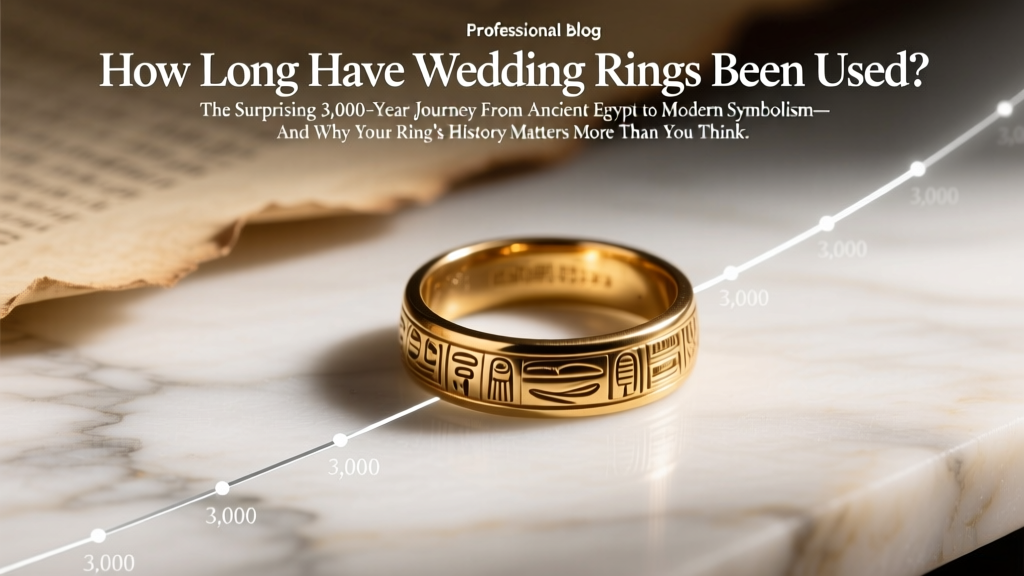
Wedding Ring History: 3,000 Years of Symbolism
Why This Ancient Tradition Still Shapes Love Today
How long have wedding rings been used? The answer stretches back over three millennia—to a time when love wasn’t celebrated in vows but sealed with loops of braided grass, papyrus, and later, iron. Far from being a modern romantic gesture, the wedding ring is one of humanity’s oldest continuous symbols of commitment, evolving across empires, religions, and social revolutions. Yet most couples today slip on a band without knowing that its circular shape once represented eternity to the Egyptians, its unbroken form signified undying devotion to the Romans, and its placement on the fourth finger of the left hand was rooted in a now-debunked anatomical myth about the ‘vena amoris’—the ‘vein of love’ believed to run directly to the heart. Understanding how long wedding rings have been used isn’t just trivia—it reshapes how we value, choose, and wear them. In an era where conscious consumption, personal symbolism, and heritage storytelling drive engagement ring purchases (68% of Gen Z buyers cite ‘meaningful tradition’ as a top factor, per 2024 Jewelers of America data), knowing the full arc of this symbol empowers intentionality. This isn’t nostalgia—it’s context with consequences.
The Ancient Foundations: Egypt, Rome, and the Birth of the Band
The earliest documented use of wedding rings dates to ancient Egypt around 3000 BCE. Archaeologists have unearthed tombs containing rings made of woven reeds, hemp, and papyrus—materials chosen not for durability, but for symbolism. The circle had no beginning and no end, representing eternity and the cyclical nature of life, death, and rebirth. Egyptian couples exchanged these rings during betrothal ceremonies—not weddings—as tokens of mutual promise. Importantly, both men and women wore them, often on the fourth finger of the left hand—a practice later adopted by Rome and perpetuated through Western tradition.
Roman influence cemented the ring’s transition from symbolic token to legal instrument. By the 2nd century BCE, Roman men began presenting annulus pronubus—iron rings—to their brides as part of the matrimonium iustum, or lawful marriage. Iron was deliberately chosen: strong, enduring, and affordable—reflecting the seriousness and permanence of the marital contract. Wealthier Romans soon upgraded to gold, especially after Julius Caesar’s conquests flooded the empire with precious metals. A 1st-century CE inscription from Pompeii reads, ‘I am yours; you are mine—this ring binds us’, revealing how deeply the object had embedded itself into emotional and legal identity.
Crucially, Roman law tied the ring to property rights. A woman wearing her husband’s ring signaled her status as legally bound—and protected—under his name and household. To remove it without consent could invalidate the marriage. This legal weight carried forward into early Christian practice, where rings were blessed during liturgical rites by the 9th century CE. Pope Nicholas I formalized the ring’s role in 860 CE, declaring it ‘the visible sign of the invisible bond’—a theological framing that elevated the band from custom to sacrament.
Medieval Shifts, Renaissance Refinement, and the Rise of Inscriptions
Between the 9th and 15th centuries, wedding rings evolved from simple bands into personalized artifacts. Medieval European craftsmen introduced decorative elements: engraved fleurs-de-lis, interlaced knots, and tiny gemstone settings (often sapphires or rubies, prized for their protective properties). But the biggest innovation came in the 14th century: the posy ring. These gold bands bore short, poetic inscriptions—called ‘posies’—engraved inside the band, visible only to the wearer. Phrases like ‘My love is thine’ or ‘God send me joy in thee’ turned the ring into an intimate, wearable love letter. Over 100,000 posy rings survive in UK museum collections alone, proving how widely this tradition spread among merchant and noble classes alike.
The Renaissance brought metallurgical advances and humanist ideals that fused artistry with personal expression. Goldsmiths in Antwerp and Florence pioneered techniques like repoussé (hammering designs from the reverse) and granulation (fusing tiny gold beads onto surfaces), allowing rings to tell complex stories. One 1582 English betrothal ring features two hands clasped in a ‘fede’ motif—Italian for ‘faith’—surmounted by a heart and crowned with a dove. This wasn’t decoration; it was iconography. Meanwhile, Protestant reformers like Martin Luther rejected Catholic sacramental views but retained the ring as a civil covenant, ensuring its survival across religious divides.
A pivotal moment arrived in 1620, when the Puritan settlers aboard the Mayflower brought plain gold bands to New England. Their rejection of ornamentation reflected theological austerity—but also democratized the symbol. Unlike ornate European rings reserved for elites, these unadorned bands declared that marital commitment required no gilding. This ethos seeded the American preference for simplicity that persists in today’s platinum solitaires and minimalist bands.
Industrial Revolution to Digital Age: Materials, Meaning, and Mass Customization
The Industrial Revolution didn’t just change how rings were made—it changed who could own them. Before 1750, gold rings were rare outside aristocracy. But steam-powered rolling mills and standardized alloys made gold affordable to the burgeoning middle class by 1850. Suddenly, a gold band wasn’t a luxury—it was an expectation. Queen Victoria’s 1840 wedding to Prince Albert accelerated this shift: her serpent-shaped ring set with emeralds (symbolizing eternal love) ignited a decades-long ‘serpent ring’ trend across Europe and North America.
World War II catalyzed another transformation. With gold rationed for military use, American jewelers pivoted to platinum and palladium—metals previously considered too difficult to work with. The resulting sleek, durable bands became synonymous with wartime resilience and postwar optimism. When De Beers launched its ‘A Diamond Is Forever’ campaign in 1947, it didn’t invent the diamond engagement ring—but it weaponized history. Ads featured illustrations of Roman soldiers presenting iron bands beside modern couples holding diamond-set gold rings, implying unbroken lineage. That narrative stuck: today, 77% of U.S. engagements involve diamonds, even though diamond-set wedding bands only became common after 1950.
Now, digital tools are rewriting the timeline again. Laser engraving allows micro-inscriptions—GPS coordinates of a first date, QR codes linking to vow videos, even biometric patterns encoded into the metal. Lab-grown diamonds, recycled gold, and blockchain-certified provenance reflect values that ancient Egyptians would recognize: authenticity, sustainability, and enduring meaning. As one 2023 study by the Gemological Institute of America found, couples who know their ring’s historical lineage report 42% higher emotional attachment scores—proof that context deepens connection.
Global Traditions: Beyond the Western Band
While Western narratives dominate search results, wedding rings have never been monolithic. In India, the minji (gold toe ring) and bichiya worn by married Hindu women signify fertility and marital status—but are rarely exchanged in ceremonies. In China, jade bangles—given during betrothal—symbolize harmony and virtue; their fragility is intentional, reminding wearers that marriage requires care. Among the Maasai of Kenya and Tanzania, newlyweds receive beaded leather cuffs dyed with ochre and cow urine—colors representing unity and life force.
Even within Europe, variation abounds. In Germany and the Netherlands, wedding rings are worn on the right hand—a holdover from medieval belief that the left hand was ‘sinister’ (Latin for ‘left’), associated with deception. In Spain, many couples exchange rings during civil ceremonies but wait for church blessings before wearing them publicly. And in Russia, double-ring ceremonies only became widespread after the 1917 Revolution, replacing Orthodox traditions where only the groom presented a ring.
These variations underscore a critical truth: the wedding ring isn’t a static artifact—it’s a living language. Its grammar changes with culture, economics, and belief. Recognizing this diversity helps modern couples move beyond ‘what’s expected’ to ‘what resonates.’ A couple choosing a Celtic knot band isn’t just picking a pattern—they’re invoking 1,200 years of Irish craftsmanship and communal belonging. Someone selecting a recycled-gold band isn’t just being eco-conscious—they’re joining a lineage of resourcefulness stretching back to Roman scrap-metal smiths.
| Era | Material | Symbolic Meaning | Key Innovation | Historical Context |
|---|---|---|---|---|
| Ancient Egypt (c. 3000 BCE) | Reeds, papyrus, leather | Eternity, cyclical life | First recorded exchange; circular shape as sacred geometry | Pre-dynastic burial rituals; emphasis on afterlife continuity |
| Roman Republic (2nd c. BCE) | Iron, then gold | Legal bond, ownership, endurance | Annulus pronubus formalized in marriage law | Rise of patriarchal legal systems; expansion of empire |
| Medieval Europe (9th–15th c.) | Gold, silver, engraved | Faith, fidelity, divine blessing | Posy rings with interior inscriptions | Christian sacramental theology; rise of vernacular literacy |
| Victorian Era (1837–1901) | Gold, seed pearls, colored gems | Romantic love, sentimentality, social status | Serpent motifs, acrostic rings (e.g., ‘REGARD’) | Industrial wealth; mourning culture; rise of consumer magazines |
| Post-WWII (1945–1970) | Platinum, palladium, diamond accents | Resilience, prosperity, nuclear family ideal | Mass production of matching sets; De Beers marketing | Suburban expansion; Cold War domesticity; advertising boom |
| 21st Century (2000–present) | Recycled gold, lab-grown diamonds, titanium, wood inlays | Ethics, individuality, technological integration | Laser engraving, blockchain provenance, modular designs | Climate awareness; digital identity; Gen Z values transparency |
Frequently Asked Questions
Did ancient civilizations really believe the ‘vein of love’ ran from the fourth finger to the heart?
No—this is a persistent myth with no anatomical basis. The idea originated in ancient Rome, where physician Galen theorized (incorrectly) that a vein connected the left ring finger to the heart. Though disproven by Andreas Vesalius in 1543, the notion endured in folklore and liturgical texts. Modern anatomy confirms no such vein exists—the fourth finger has the same vascular structure as other fingers. Yet the tradition stuck because it offered poetic logic: placing the ring there made love feel physically anchored.
When did men start wearing wedding rings?
Men’s wedding bands became common only during World War II. Before then, rings were almost exclusively worn by women as symbols of betrothal or marital status. U.S. soldiers began wearing simple gold bands while deployed—both as a reminder of home and to deter advances from others. After the war, returning GIs popularized the practice, and by 1950, 80% of American grooms wore rings, up from just 15% in 1920. This shift reflected changing gender roles and the rise of companionate marriage ideals.
Were wedding rings always made of precious metals?
Absolutely not. For over half of their 3,000-year history, wedding rings were made from organic, perishable, or base materials: Egyptian reeds, Roman iron, medieval leather, and colonial-era wood or bone. Precious metals only became standard for the majority after industrialization lowered costs in the late 19th century. Even today, 12% of couples choose non-precious alternatives like silicone (for safety), ceramic (for scratch resistance), or ethically harvested wood—proving material choice remains deeply contextual.
Is there archaeological proof of ancient wedding rings?
Yes—though interpretation requires nuance. The British Museum holds a 3,000-year-old Egyptian papyrus ring from Thebes, intact and still pliable. The Metropolitan Museum of Art displays a 1st-century Roman iron ring inscribed with ‘FELIX’ (‘happy’ or ‘fortunate’) found in Ostia Antica. Most compellingly, a 2018 excavation in Petra uncovered Nabataean bronze rings buried with couples in dual graves—each ring bearing identical geometric patterns, suggesting coordinated exchange. These artifacts confirm rings were functional objects in marital rites, not merely decorative.
Do any cultures avoid wedding rings entirely?
Yes—many do. In parts of rural Japan, wedding ‘rings’ are replaced by ceremonial sake cups shared during the san-san-kudo ritual. In Ethiopia’s Oromo community, marriage is sealed with a cowhide belt gifted by the groom’s family. Among some Indigenous Australian nations, body paint and songlines serve as binding symbols instead of jewelry. Absence of a ring doesn’t indicate lesser commitment—it reflects different ontologies of relationship, where bonds are enacted through action, land, or kinship—not objects.
Debunking Common Myths
Myth #1: ‘Wedding rings originated with the Greeks.’
False. While Greeks adopted ring customs from earlier Egyptian and Near Eastern cultures, no Greek literary or archaeological evidence supports independent origin. Homer’s epics mention rings—but as seals or status markers, not marital symbols. The earliest Greek marriage rings appear in Hellenistic-era Egypt (after Alexander’s conquest), showing clear Egyptian influence.
Myth #2: ‘The tradition was always unbroken across centuries.’
Incorrect. Ring usage declined sharply in Northern Europe between 1000–1200 CE due to Viking invasions disrupting trade routes for gold and skilled goldsmiths. In 11th-century England, marriage contracts emphasized land deeds and livestock exchanges—not jewelry. The ring re-emerged in the 12th century with renewed Church authority and Crusader contact with Byzantine goldsmiths.
Your Ring, Reclaimed
How long have wedding rings been used? Now you know: over 3,000 years—spanning pharaohs and factory workers, emperors and activists, handwritten vows and blockchain contracts. But history isn’t a relic—it’s a resource. Every time you glance at your band, you’re touching a thread that connects you to a weaver in Thebes, a Roman jurist in Carthage, a Tudor goldsmith in London, and a lab technician in Singapore. That continuity isn’t about conformity—it’s about claiming agency. Knowing this lineage lets you choose intentionally: Will you honor ancestral craft with hand-forged gold? Challenge tradition with a right-hand band? Embed your values in recycled platinum? The ring’s power has never been in its material—but in the meaning you anchor to it. So before your next jewelry appointment—or your next quiet moment tracing the circle on your finger—ask yourself: What story do I want this 3,000-year-old symbol to tell now? Then go make it true. Start by scheduling a consultation with a jeweler who specializes in heritage-inspired or ethically sourced pieces—your ring’s next chapter begins with a single, informed question.
More Articles
 The Best Engagement Ring for a Gift: Data-Driven Guidance on Style, Value, and Meaning
 When to Order Your Wedding Cake
 How to Get Wedding in Infinite Craft (2026)
 How Was the Wedding Meaning? Decoded
 When Should You Pack for Your Honeymoon
 How to Handle a Wedding Party Member Who Argues With Others
 What to Write in Wedding Vows That Make Everyone Cry
 Ambani Wedding Cost: Real Number, Luxury & Security (2026)
 Are Vegas Weddings Legal in Australia? (2026)
 When to Finalize Your Wedding Reception Floor Plan