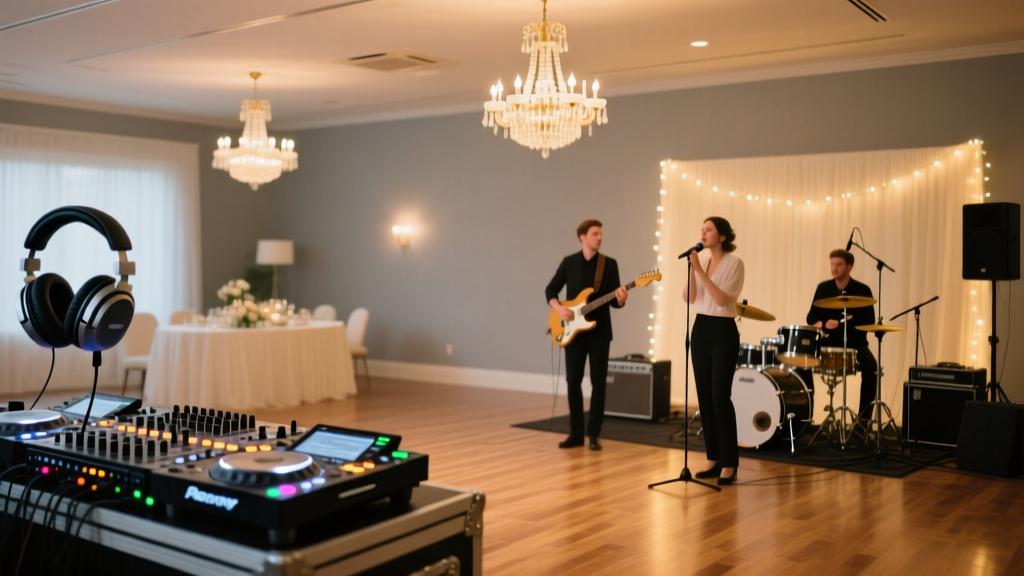
How to Decide Between a DJ or Live Band for Reception
How to Decide Between a DJ or Live Band for Your Reception
You’re planning the reception, you’ve pictured the dance floor, and then the big music question hits: DJ or live band? It’s one of those choices that seems simple until you realize it affects the vibe of the entire night—how dinner feels, how the dance floor builds momentum, even how your guests remember the party.
The good news: there isn’t a “right” answer. There’s a right fit for your guests, your venue, your budget, and the kind of energy you want. A packed dance floor can happen with either option when the music matches the room.
Quick answer: How do you decide?
Choose a DJ if you want maximum song variety, seamless genre-hopping, and usually a lower price point. Choose a live band if you want a high-impact, concert-like experience with visible entertainment and a “special event” feel. If you’re torn, decide based on (1) your crowd’s dance habits, (2) venue space/sound limits, (3) your must-play songs, and (4) the budget you’re comfortable with.
Q: What’s the real difference in the guest experience?
A DJ feels like a great party. The best wedding DJs read the room in real time, mixing decades and styles quickly—Motown to Taylor Swift to early 2000s throwbacks—without missing a beat. If your guest list spans multiple generations or diverse music tastes, a DJ’s catalog can keep more people happy.
A live band feels like an event. Even guests who don’t dance often will watch a band. The live vocals, instruments, and stage presence can elevate the energy instantly—especially for big entrances, first dances, and party sets later in the night.
As one veteran wedding planner, “Maya L., Lead Planner at Harbor & Vine Events,” puts it: A DJ is your playlist brought to life. A band is entertainment plus music. Both can be phenomenal—the question is which kind of ‘wow’ you want.
Q: How does budget typically compare?
In most markets, a DJ costs less than a full live band because you’re hiring one professional (sometimes with an assistant) rather than multiple musicians, sound needs, and rehearsal time. Bands can range widely—an efficient 3–5 piece group is very different from a 10-piece show band with horns.
Real-world example: We fell in love with a nine-piece band, then saw the quote and realized it was the same as our photo and video combined
, says “Talia & Marcus,” married in 2025. We switched to a DJ and used the savings for extra hour of coverage and a late-night snack bar.
Tip: Ask both DJs and bands what’s included: ceremony audio, cocktail hour music, MC services, lighting, travel fees, and overtime rates. What looks like a lower base price can change once add-ons are included.
Q: What do current wedding trends suggest?
Right now, couples are prioritizing guest experience and personalization. That’s showing up in a few music trends:
- Genre-bridging dance floors: couples want Afrobeats + disco + pop-punk + country in one night. DJs do this especially well.
- Hybrid entertainment: a live musician for ceremony/cocktail hour (like a string trio or sax) plus a DJ for dancing is increasingly popular.
- Shorter, high-energy sets: some bands structure the night like a show—two big sets with a DJ or playlist in between.
- “Moment” songs: couples care about precise versions for first dance or parent dances (original recordings), which points toward a DJ unless the band can faithfully cover the track.
Q: What should we consider about the venue and logistics?
This is where the decision often becomes clear.
- Space: Bands need room for multiple performers, instruments, and speakers. If your venue has a tight floor plan, a DJ setup can be more flexible.
- Sound restrictions: Some venues have decibel limits. A skilled band can play controlled volume, but drums and horns may be challenging in small spaces. A DJ can usually manage volume more precisely.
- Load-in and timing: Bands often require longer setup and soundcheck windows. If your venue has limited access times, a DJ may be easier.
- Power needs: Confirm power availability and whether additional circuits are needed.
I always ask about the venue’s sound limiter before clients sign a band contract
, says “Chris D., wedding DJ and production manager.” A limiter can cut audio if you cross the threshold. That’s fixable with planning, but it’s miserable to discover mid-reception.
Q: What about modern etiquette—do we need an MC?
Modern reception etiquette is less about formal announcements and more about smooth flow. Some couples want minimal mic time; others want a classic, structured timeline.
DJs often serve as MCs (introductions, toasts, first dance cues, cake cutting). Many bands also offer MC services, but confirm who is actually speaking on the mic—bandleader, manager, or a separate MC.
Actionable tip: If you don’t want a “talky” vibe, tell your DJ or band: “Short, warm announcements only—no games, no crowd work.” A true professional will match your tone.
Q: Which option is better for different types of couples?
Scenario 1: Traditional, formal reception
If you’re hosting a black-tie or classic ballroom wedding, a live band can complement that timeless atmosphere—especially if you love big-band standards, Motown, soul, or elegant jazz during dinner.
Scenario 2: Modern, high-personalization party
If you want to hear the original tracks, niche genres, or a very specific “sound,” a DJ is usually the better match. You can still make it feel elevated with upgraded lighting, a stylish booth, or a DJ who mixes rather than simply plays songs.
Scenario 3: Mixed-age guest list with varied tastes
A DJ tends to win here because they can pivot quickly: one song for the aunties, one for college friends, one for the kids, one for the couple—all within 15 minutes.
Scenario 4: You care most about “wow” energy
A strong live band is hard to beat for pure hype. If your dream is a packed dance floor with a front-person leading the room, consider prioritizing the band and trimming elsewhere.
Q: How do we actually compare options fairly?
Use a simple decision checklist:
- Must-play list: Do you need exact original recordings? If yes, DJ (or hybrid).
- Do-not-play list: How well do they honor boundaries?
- Performance style: Watch videos of real weddings, not highlight reels only.
- Transitions: Ask how they handle transitions between songs and moments (first dance, bouquet, last dance).
- Breaks: Bands take breaks. Ask what plays during breaks and who controls volume/vibe.
- Lighting and production: What’s included? Do you need uplighting, dance floor lights, or a sound system for toasts?
- Requests: Are guest requests allowed? Are they filtered through you?
Pro move: Ask both a DJ and a band the same question: “If the dance floor is empty at 9:15, what do you do?” Their answer will tell you a lot about experience and crowd-reading.
Related questions couples ask (and honest answers)
Can we do both a DJ and a band?
Yes, and it’s one of the most popular reception entertainment trends. Common formats: live musician(s) for ceremony and cocktail hour + DJ for dancing, or band for the first half and DJ for a late-night club set. Just confirm who handles MC duties and keep one person in charge of the timeline.
What if we love a band, but we want a few specific songs?
Many bands will learn 1–3 songs (sometimes more for a fee). Another option is having the band play live for most of the night, then using the original recording for your first dance or parent dances. Get this approved in the contract and confirm the band can play audio through their system.
What if our venue has strict noise rules?
A DJ is often easier to keep within limits, but don’t assume a band is impossible. Ask the venue what the decibel cap is, whether there’s a sound limiter, and whether drums are allowed. Some bands offer smaller “acoustic” or “lite” setups designed for tighter sound environments.
Do we need to provide meals for the DJ or band?
Typically, yes—especially for a band. Vendor meals are standard wedding etiquette for professionals working through dinner. Confirm how many meals are required in your contract and when they prefer to eat (usually when you eat).
Conclusion: The best choice is the one that fits your priorities
If you want flexibility, original tracks, and fast shifts in music styles, book a great wedding DJ. If you want a show-stopping, live-performance atmosphere and the feeling of a celebration with built-in entertainment, choose a live band. Either way, the biggest predictor of success is professionalism—someone who understands weddings, reads a room, and respects your preferences. Pick the team that makes you feel confident, and your guests will feel it on the dance floor.
More Articles
 Dream About Wedding: 7 Psychological Truths (2026)
 How to Fix a Hole in a Wedding Veil (2026)
 Can Guests Wear White Shoes to a Wedding? (2026)
 Planning a Wedding in Maine: Everything You Need to Know
 Is The Wedding Singer a Happy Madison Production?
 Man’s Wedding Ring: Who Buys, Chooses & Why (2026)
 50th Wedding Anniversary: Golden Milestone Truths (2026)
 Wedding Ring on Right Hand: Why & Where It’s Worn
 How to Call Off a Wedding in The Sims 4 (2026)
 Wedding Crashers Cast: Where Are They Now? (2026)