## Stop Guessing: Here's Exactly How Much Alcohol Your Wedding Needs
Running out of drinks mid-reception is every couple's nightmare — but over-ordering wastes hundreds of dollars. Figuring out how much alcohol for a wedding doesn't have to be a guessing game. With a few simple formulas and honest answers about your guest list, you can nail the quantity, stay on budget, and keep the party going all night.
---
## Step 1: Start With Your Guest Count and Drink Preferences
The foundation of any wedding alcohol calculator is knowing your crowd. Before you order a single bottle, answer these questions:
- **How many guests are adults?** Children and designated drivers won't be drinking.
- **What's the ratio of heavy, moderate, and light drinkers?** A general rule: assume roughly 1/3 of guests drink heavily, 1/3 moderately, and 1/3 lightly or not at all.
- **What's your crowd's preference?** Beer-and-wine crowds differ dramatically from cocktail lovers.
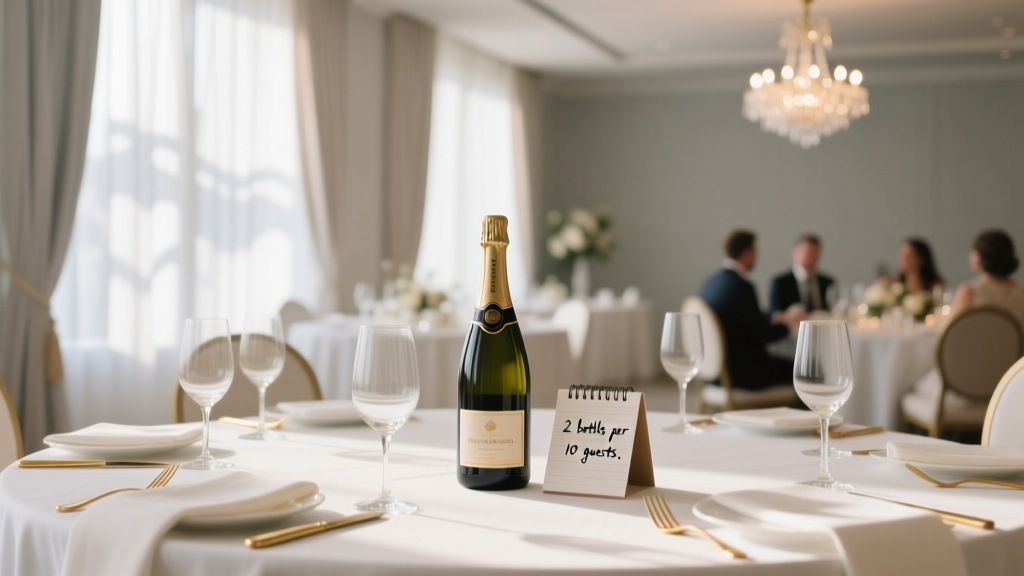
**Industry baseline:** Plan for approximately **1 drink per guest per hour** for the first two hours, then **0.75 drinks per hour** after that. For a 5-hour reception with 100 adult guests, that's roughly 425 drinks total.
---
## Step 2: Break Down the Drink Mix
Once you have a total drink count, split it by type. A widely used wedding industry split is:
| Drink Type | Percentage of Total |
|------------|--------------------|
| Wine | 40–50% |
| Beer | 25–30% |
| Spirits/Cocktails | 20–30% |
For 425 drinks at a balanced crowd:
- **Wine:** ~190 drinks → about 32 bottles (a standard 750ml bottle pours ~6 glasses)
- **Beer:** ~120 drinks → 10 cases (12-pack)
- **Spirits:** ~115 drinks → roughly 8–10 bottles of mixed spirits
Adjust these percentages based on your actual guest profile. A backyard summer wedding skews heavily toward beer; a formal evening affair leans toward wine and cocktails.
---
## Step 3: Account for the Timeline and Meal Service
Drinking patterns shift throughout a wedding. Here's how to plan by phase:
**Cocktail hour (1 hour):** This is peak consumption. Guests are mingling, appetizers are light, and the bar is the main attraction. Budget **1.5 drinks per guest** for this window.
**Dinner service (1.5–2 hours):** Consumption slows as guests eat. Plan for **1 drink per guest per hour**, with wine dominating.
**Dancing/reception (2–3 hours):** Consumption picks back up. Budget **0.75–1 drink per guest per hour**.
**Practical tip:** If you're doing a champagne toast, add one glass per adult guest. A case of 12 bottles covers about 72 toast-sized pours.
---
## Step 4: Build in a Buffer and Know Your Return Policy
Always buy 10–15% more than your calculation suggests. Unexpected guests, heavier-than-expected drinking, and spillage happen. More importantly:
- **Buy from a retailer with a return policy on unopened bottles.** Many wholesale clubs and liquor stores allow returns on sealed cases. This eliminates the risk of over-purchasing.
- **Keep a backup case of wine and a case of beer in a cooler offsite** or in a vehicle. You can retrieve it if needed — or return it Monday morning.
- **Hire a bartender or assign someone to monitor consumption** in real time. They can pace service during dinner to stretch supply.
---
## Common Myths About Wedding Alcohol Planning
**Myth 1: "Open bars always lead to chaos and over-drinking."**
Not true. Professional bartenders are trained to pace service and refuse visibly intoxicated guests. An open bar with a skilled bartender is often *more* controlled than a cash bar where guests rush to drink before the bar closes.
**Myth 2: "You need to offer a full liquor selection to satisfy guests."**
A beer-and-wine-only bar is completely acceptable and can cut your alcohol budget by 30–40%. Many couples offer a signature cocktail alongside beer and wine — this feels festive without requiring a full spirits inventory. Most guests won't notice the absence of a full bar if the options available are quality and plentiful.
---
## Your Next Step
Figuring out how much alcohol for a wedding comes down to three numbers: guest count, event length, and drink preference split. Use the 1-drink-per-guest-per-hour baseline, apply the 40/30/30 wine-beer-spirits split, add a 15% buffer, and buy from a store that accepts returns.
**Action item:** Open a spreadsheet today, plug in your adult guest count and reception hours, and run the math. You'll have a confident order list — and a realistic budget line — before your next vendor meeting.
 How Much Should a Wedding Ring Cost? (2026)
 How to Remove a Bridesmaid From Your Wedding Gracefully
 How to Handle Children at Weddings Policies and Etiquette
 Maid of Honor Duties: What She Actually Does (2026)
 Wedding Anniversary Wishes: 7 Emotional Strategies (2026)
 Happy Anniversary vs Wedding Anniversary: Which Is Correct?
 Do You Get Paid to Be on Four Weddings: The Truth
 Crazy Rich Asians Wedding Venue: Singapore’s Real Location
 Do Catholics Eat Meat on Ash Wednesday? (2026)
 Wedding Band Placement: Inside or Outside? (2026)