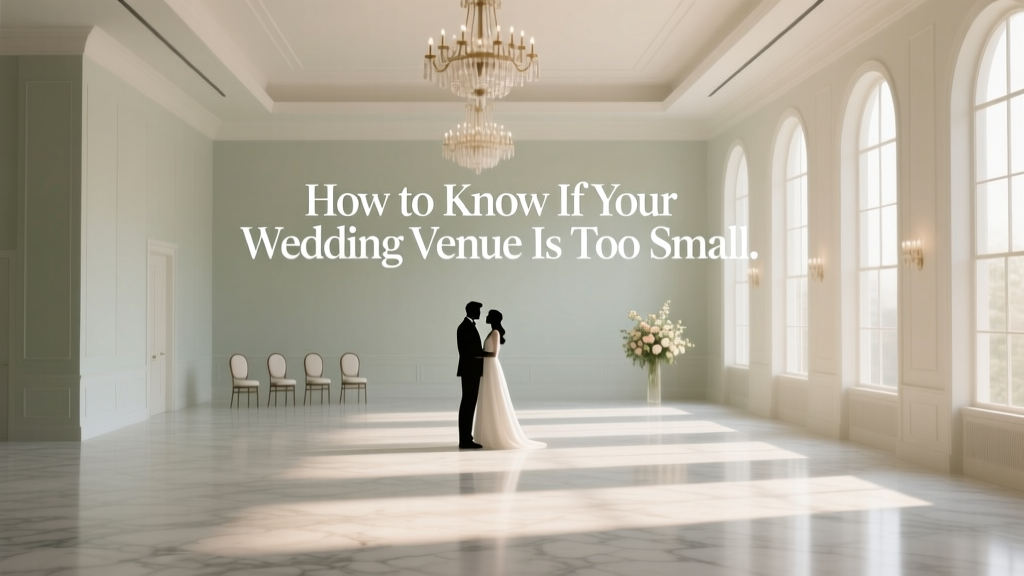
How to Know If Your Wedding Venue Is Too Small
How to Know If Your Wedding Venue Is Too Small
You found a venue you love—maybe it’s a charming greenhouse, a cozy loft, or a historic inn with the dreamiest candlelight. Then reality taps you on the shoulder: Will everyone actually fit? Worrying that your wedding venue is too small is one of the most common (and most stressful) planning questions, because it touches everything: your guest list, your budget, your vibe, and even whether people will have fun.
The good news: “Too small” isn’t just about the number printed on a brochure. It’s about comfort, flow, safety, and the kind of celebration you want—whether that’s a full-on dance party or an intimate dinner party with speeches and string lights.
Q: How do I know if my wedding venue is too small?
A: Your wedding venue is likely too small if your guest count is close to (or above) the venue’s realistic capacity for your event style—meaning there’s not enough room for comfortable seating, clear walkways, key moments (ceremony, dinner, dancing), and service flow. As a rule of thumb, if you’re within 10–15% of the venue’s maximum capacity for a seated reception, you should double-check layouts, rentals, and space constraints immediately.
In other words: a venue can “fit” your guest list on paper, but still feel tight if you want a dance floor, a head table, buffet stations, a photo booth, or a larger band.
Q: What does “capacity” really mean (and why does it feel misleading)?
A: Many venues list a maximum occupancy number based on fire code or a packed-room layout—not the comfortable, guest-friendly setup most couples want.
“A venue might advertise 150, but that could be 150 for a cocktail-style event with minimal furniture,” says Marisol Grant, venue manager at a downtown event loft. “For a seated dinner with a dance floor and a DJ setup, that same room might feel best at 110–120.”
Modern weddings often require more “hidden” space than couples expect. Think: a welcome table, card box, gift table, dessert display, late-night snacks, a lounge area, charging station, vendor storage, and a spot for grandparents to sit away from speakers.
Q: What are the clearest signs the venue is too small?
1) Guests will be cramped at dinner
If you’re squeezing in extra tables, pushing chairs tight, or relying on awkward “partial seating,” it’s a red flag—especially for a plated dinner. Guests should be able to get up without everyone at the table standing.
Real-world example: If your floor plan leaves less than a comfortable gap between tables, servers struggle to deliver plates, guests bump chairs, and the room gets noisy fast.
2) There’s no real dance floor (or it steals dinner space)
A dance floor isn’t just a square on the layout—it’s the emotional center of many receptions. If the only way to “add” a dance floor is removing tables after dinner or placing it in a walkway, your venue may be too small for the party style you want.
“Couples are asking for bigger dance floors again,” says DJ Kevin Liu. “After years of smaller weddings, people want the fun back. If the room is tight, dancing becomes a two-song novelty instead of a vibe.”
3) The ceremony setup feels like an airplane aisle
For on-site ceremonies, check aisle width, where you’ll stand, and whether guests can actually see. If you’re forced into tightly packed rows with no room for late arrivals, photographers, or wheelchair access, it’s a space issue—not a “make it work” moment.
4) The bar line blocks everything
Bars need breathing room. If your bar is placed where the line blocks bathrooms, the entry, or the path to the dance floor, the night will feel congested. This is especially relevant with current trends like signature cocktail moments, espresso martini bars, and mocktail stations—fun, but they attract crowds.
5) Vendor flow is compromised
If there’s no staging area for catering, no safe place for musicians to load in, or the kitchen is far from the dining space with tight doorways, service slows down. That can mean cold food, delayed timelines, and stressed vendors.
6) Comfort and safety start to feel questionable
Overcrowding isn’t just inconvenient. It affects temperature, accessibility, emergency exits, and overall guest experience. If you’re asking, “Is this safe?” trust that instinct and ask the venue for exact occupancy rules for your specific setup.
Q: How do I measure whether my guest count will feel comfortable?
A: Request a scaled floor plan and a sample layout that matches your wedding style (seated dinner vs. cocktail reception, band vs. DJ, round tables vs. long tables). Then pressure-test it.
- Compare your guest list to the venue’s capacity for your exact format: ceremony + reception, or reception only.
- List your “space-eaters”: dance floor, sweetheart table, dessert display, photo booth, lounge seating, escort card display, buffet stations, kids’ table, memorial table.
- Ask where lines will form: bar, bathrooms, buffet, coat rack, coffee station.
- Confirm table sizes (60” vs. 72” rounds) and whether the venue includes them or you’ll rent.
“The best question couples can ask is: ‘Can you show me a layout for 120 guests with a DJ, dance floor, and buffet?’” says Samantha Ortiz, wedding planner. “If the answer is vague, you need more clarity before you sign—or before you panic.”
Traditional vs. modern scenarios: when “small” is actually the goal
Scenario A: Traditional wedding expectations
If your families expect a bigger guest list and a classic reception format (ceremony, cocktail hour, seated dinner, dancing), you’ll need more square footage. Traditional formats have more “must-have” zones: head table, larger cake display, formal seating, and space for toasts.
Scenario B: Modern, experience-driven weddings
Current wedding trends lean intimate and personalized—think micro weddings, restaurant receptions, private dining rooms, and weekend-long celebrations with multiple smaller events. In these cases, a smaller venue can be perfect, as long as it supports your plan.
Real couple experience: “We fell in love with a 48-guest restaurant buyout,” says Jules and Priya. “It would’ve been a disaster at 70, but at 46 it felt like a dinner party where everyone actually talked to each other.”
Scenario C: Cocktail-style receptions
A cocktail reception can allow a higher guest count in the same space—if you’re comfortable with a more mingly vibe and you provide enough cocktail tables and seating pockets. Modern etiquette is more flexible here, but guests still appreciate a place to rest, especially older relatives.
Q: What if I’m already booked and now I’m worried?
A: You usually have three options: adjust the guest list, adjust the layout/format, or add space.
Option 1: Trim the guest list (without drama)
- Re-check your “must-invite” list vs. “nice-to-have.”
- Limit plus-ones to established partners.
- Consider an adults-only reception if that fits your crowd and values.
- Use a “B-list” thoughtfully if your timeline allows and your circle won’t overlap in a messy way.
Option 2: Change the format to fit the room
- Switch to a sweetheart table instead of a large head table.
- Use long farmhouse tables to reduce wasted space (sometimes more efficient than rounds).
- Do a first dance before dinner if you need to keep the dance floor smaller later.
- Choose plated over buffet when buffet lines would clog the room (or do staffed stations).
- Skip bulky extras like large photo booths or oversized backdrops; opt for a simple photo moment wall.
Option 3: Expand your footprint
- Add a tent or covered patio area for cocktail hour or dancing.
- Use a second room for dessert, lounge seating, or late-night food.
- Host the ceremony off-site to free the venue for reception-only setup.
Related questions couples ask (and honest answers)
“Can I rely on RSVP ‘no’ responses to solve this?”
You can expect some declines, but it’s risky to plan for them. With destination-adjacent weddings and more flexible travel, attendance can be higher than couples assume—especially for smaller guest lists. Plan for your realistic “yes” count based on your circles, not hope.
“What about a smaller dance floor—do people even dance anymore?”
Both are true: some crowds barely dance, others go all night. The trend right now is very vibe-dependent. If your friends love a party, prioritize dance space. If your group is more conversational, invest in seating clusters and ambiance instead.
“Is it rude if not everyone has a seat at once?”
For a fully hosted reception with a meal, yes—guests should have a seat. For a cocktail-style celebration, it’s acceptable to have a mix of seating and standing, but provide enough chairs for older guests and anyone who needs them.
“The venue says it fits. Why does it feel tight when I tour?”
Empty rooms look bigger than they are. Ask to see the space set for an event, or request a mock layout with table sizes. If possible, tour during another wedding setup (even briefly) to understand flow.
Conclusion: A small venue isn’t a problem—crowding is
If your venue supports comfortable seating, clear movement, and the kind of celebration you’re picturing, it isn’t “too small.” It’s intimate. But if you’re sacrificing safety, service, or guest comfort to make the numbers work, that’s your sign to adjust—whether that means editing the guest list, reworking the layout, or expanding the space.
The goal isn’t to squeeze everyone in. It’s to create a wedding day that feels effortless for your guests and genuinely joyful for you.
More Articles
 Shivaree After Wedding: Rowdy Tradition Revived in 2026
 Wedding Crisis Response: 7 Steps to Pivot with Dignity
 Wedding Speech Guide: Confident, Heartfelt & Memorable
 Snooki’s Wedding Cost: $500K+ Breakdown (2026)
 Is It Taboo to Wear Red to a Wedding? (2026)
 Did Jane Powell Sing at a Royal Wedding? (2026)
 Best Jewelry for Planning: Functional, Stylish Accessories That Support Productivity and Intentionality
 Wedding Ring on Right Hand? Global Traditions Explained
 Wedding Gift: Should You Bring One? (2026 Checklist)
 Can You Edit Wedding Photos? A Complete Guide