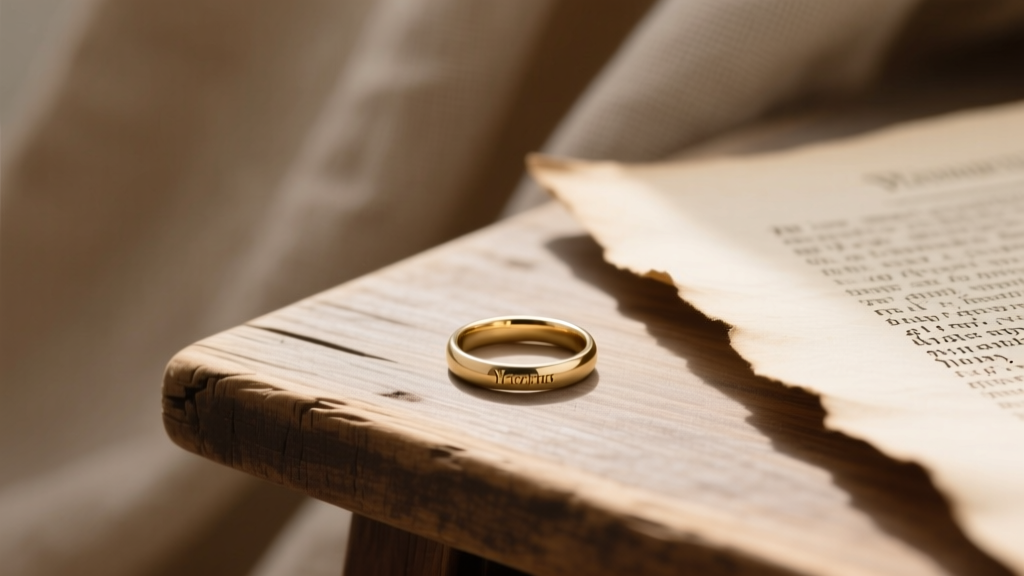
Should Christians Wear Wedding Rings? (2026)
Why This Question Isn’t Just About Jewelry—It’s About Worship, Witness, and Wisdom
Should Christians wear wedding rings? That simple question has sparked quiet debates in church basements, tense conversations among engaged couples, and even pastoral counseling sessions across denominations. In an age where Christian identity is increasingly shaped by visible markers—modest dress, screen time boundaries, or social media silence—the wedding ring stands out as one of the most universally worn yet theologically unexamined symbols in modern discipleship. Unlike baptism or communion, it carries no explicit biblical mandate—but unlike tattoos or piercings, it’s rarely questioned. Yet for many believers, especially those newly awakened to biblical fidelity, the ring feels like a spiritual landmine: Is it a harmless tradition—or a subtle compromise with pagan roots, consumerist values, or even idolatrous devotion? This isn’t about fashion or preference. It’s about stewardship of our witness, integrity of our convictions, and obedience to Christ in the smallest details of daily life.
The Biblical Silence—and Why That Matters Most
The Bible never mentions wedding rings—not once. No Hebrew bride received a gold band at Sinai; no New Testament marriage ceremony includes its exchange; Paul gives zero instructions on metallurgy or finger adornment in Ephesians 5. At first glance, that silence seems like permission. But biblical silence isn’t neutrality—it’s an invitation to discern. Scripture *does* speak clearly about symbols: their power (Exodus 3:2–4), their danger (Exodus 32:2–4), and their purpose (Genesis 9:12–17; Ezekiel 9:4). Rings *are* mentioned—but almost always as objects of authority (Esther 3:10; Luke 15:22), wealth (James 2:2), or covenantal sealing (Jeremiah 22:24). Not marital commitment. When Jesus defines marriage in Matthew 19:4–6, He grounds it in creation order and covenantal union—not jewelry. So the absence of rings in Scripture doesn’t mean ‘go ahead’—it means the burden of proof shifts: What does this symbol *communicate* in *your* context? And does that communication align with the gospel?
Consider Sarah, a 28-year-old Reformed Baptist in Nashville who removed her ring after reading 1 Peter 3:3–4: ‘Your beauty should not come from outward adornment… but from the unfading beauty of a gentle and quiet spirit.’ She wasn’t rejecting marriage—she’d been married for three years—but she realized her ring had become a subconscious security blanket, a visible ‘proof’ of her husband’s love when her heart felt insecure. Her decision wasn’t legalistic; it was liturgical. She began wearing a simple linen cord tied around her left ring finger—a tactile reminder that her covenant rests on Christ’s faithfulness, not metal or memory.
The Pagan Past—and How Early Christians Responded
Wedding rings didn’t originate in Judeo-Christian tradition. They emerged from ancient Egypt (where circular bands symbolized eternity), were adopted by Romans (who used iron rings signifying ownership—anulus pronubis), and later absorbed into Greco-Roman fertility cults. By the 2nd century AD, Roman brides wore rings on the fourth finger of the left hand because of the vena amoris myth—the ‘vein of love’ supposedly connecting that finger directly to the heart. Early church fathers like Tertullian (c. 160–225 AD) explicitly warned against adopting such customs: ‘Let no Christian woman wear gold rings, lest she seem to honor the idols of old Rome’ (On the Apparel of Women, II.12). Yet by the 9th century, Pope Nicholas I formalized ring-giving in Christian weddings—precisely to *Christianize* the practice, redirecting its meaning from ownership to mutual sacrifice.
This historical tension remains live today. A 2023 Pew Research study found that 72% of U.S. Christians assume wedding rings are ‘biblically appropriate’—yet only 18% could name a single Scripture supporting that assumption. Meanwhile, ethnographic fieldwork among Anabaptist communities (Amish, Hutterites, conservative Mennonites) shows near-universal ring avoidance—not as rebellion, but as intentional resistance to assimilation into a culture where marriage is commodified, romanticized, and divorced from ecclesial accountability. Their stance isn’t anti-marriage; it’s pro-covenant. As Elder Jacob Yoder of Holmes County, Ohio explains: ‘We don’t forbid rings. We ask: Does this object help our community see Christ in our marriage—or distract them with romance?’
Your Conscience, Your Context, Your Covenant
So how do you decide? Not by polling your small group or checking Instagram trends—but through a disciplined, three-fold discernment process:
- Examine the Symbol’s Meaning in Your Culture: In Tokyo, a plain platinum band signals elite professionalism—not marital status. In Lagos, gold rings often denote family wealth and ancestral blessing. In rural Guatemala, a silver ring may be the only heirloom passed from grandmother to granddaughter. Ask: What does this ring *say* here? To your neighbors? To your children? To seekers visiting your church?
- Test It Against Your Conscience: Romans 14:23 warns, ‘Everything that does not come from faith is sin.’ If wearing a ring causes you persistent doubt—even if others call it ‘legalism’—don’t wear it. Conversely, if removing it invites gossip, undermines your spouse’s trust, or isolates you from fellowship, examine *why*. Is it fear of man? Or genuine conviction?
- Submit It to Your Church Community: 1 Corinthians 10:24 commands us to ‘seek the good of others.’ Discuss your questions with mature believers—not for permission, but for wisdom. Does your decision strengthen or fracture unity? One Presbyterian elder in Portland shared how his congregation created a ‘Covenant Symbol Policy’ after a young couple requested ring-free vows: ‘We affirmed their freedom in Christ—but asked them to publicly explain their choice during the service, so no one assumed rejection of marriage itself.’
This isn’t about uniformity. It’s about intentionality. Whether you wear a $5 titanium band or no ring at all, the goal is the same: that your marriage becomes a living parable of Christ and the Church (Ephesians 5:32)—not a silent endorsement of cultural assumptions.
Practical Decision-Making: A Comparative Framework
Below is a decision matrix used by pastoral teams across 12 denominations—from Anglican to Pentecostal—to guide couples through this question. It weighs theological weight, cultural impact, and relational health—not aesthetics or cost.
| Factor | Low-Risk Consideration | Moderate-Warning Zone | High-Alert Signal |
|---|---|---|---|
| Biblical Alignment | Ring viewed solely as a personal reminder of covenant vows; no sacramental or magical significance assigned | Ring worn to ‘prove’ marital status to others; invoked in prayers as a ‘holy object’ | Belief that ring-wearing is required for valid marriage; refusal to marry without ring exchange |
| Cultural Messaging | Ring matches local norms (e.g., simple band in Midwest USA); no conspicuous luxury display | Ring draws consistent attention (e.g., oversized diamond in modest community); sparks frequent commentary | Ring functions as status symbol (e.g., matching $20k bands in low-income neighborhood); creates economic pressure on peers |
| Relational Impact | Spouse fully agrees; no tension or secrecy around choice | One spouse wears ring reluctantly to avoid conflict; private disagreement persists | Ring removal triggers marital distrust; used as leverage in arguments; withheld during disagreements |
| Ecclesial Witness | Church leadership affirms decision; choice strengthens communal understanding of marriage | Decision causes confusion among new believers; requires repeated explanation | Choice divides congregation; fuels ‘us vs. them’ rhetoric; distracts from gospel proclamation |
Frequently Asked Questions
Is wearing a wedding ring considered idolatry?
No—unless the ring itself becomes the object of worship, trust, or ultimate security. Idolatry isn’t about the object; it’s about the heart’s orientation (Matthew 6:24). A ring becomes idolatrous when you believe your marriage is ‘safer’ because of it, when you feel spiritually naked without it, or when its loss causes despair disproportionate to its material value. The warning in Exodus 20:4–5 applies to *function*, not form: if the ring mediates your sense of worth, safety, or divine favor, it has crossed into idolatrous territory.
Do any Christian denominations prohibit wedding rings?
Yes—but rarely by formal decree. Conservative Anabaptist groups (Old Order Amish, Beachy Amish, some Hutterite colonies) uniformly avoid wedding rings as part of broader nonconformity to ‘worldly’ customs. Similarly, certain Reformed Presbyterian churches (e.g., Free Church of Scotland historically) discouraged rings in the 19th century due to associations with Roman Catholic ritualism. Today, most denominations leave the decision to individual conscience—but require pastoral counseling for couples requesting ring-free ceremonies to ensure theological clarity.
What if my spouse wants a ring but I don’t?
This is where gospel humility meets covenantal love. First, listen deeply: What does the ring represent to them? Security? Cultural belonging? Family continuity? Then, share your convictions—not as ultimatums, but as invitations to deeper unity. Consider compromises: a simple band worn only at home; a ring engraved with Scripture rather than diamonds; or mutual agreement to revisit the decision annually. The goal isn’t ‘winning’—it’s nurturing a marriage where both spouses grow in Christlike forbearance (Colossians 3:13).
Can a Christian wear a wedding ring after divorce or widowhood?
Yes—but with pastoral sensitivity. Scripture honors lifelong covenant (Malachi 2:14–16), yet also acknowledges brokenness (Matthew 19:8). Many widows and divorcees choose to remove rings as a tangible act of grief, surrender, or readiness for new seasons. Others retain them as memorials—not to the marriage itself, but to God’s faithfulness through it. The critical question isn’t ‘can I?’ but ‘does this honor Christ and serve others in my current season?’ One Lutheran widow in Minneapolis wears her late husband’s ring on a chain around her neck: ‘It’s not about possession. It’s about testimony—how God held me when I couldn’t hold myself.’
Common Myths
Myth #1: “Not wearing a ring means you’re not serious about marriage.”
Reality: Many of history’s most devoted Christian marriages—John and Abigail Adams, Charles and Susannah Spurgeon, Corrie and Casper ten Boom—had no wedding rings. Their seriousness was proven in decades of sacrificial love, not finger jewelry. The ring is a cultural symbol—not a covenant certificate.
Myth #2: “If the Bible doesn’t forbid it, it’s automatically permissible.”
Reality: Romans 14 and 1 Corinthians 8 establish that ‘permissible’ ≠ ‘profitable’ or ‘edifying.’ Paul refused to eat meat sacrificed to idols—not because it was sinful in itself, but because it stumbled weaker brothers (1 Corinthians 8:13). The same principle applies: if your ring confuses new believers, reinforces consumerist values, or undermines your witness, biblical freedom demands restraint—not indulgence.
Conclusion & Your Next Step
Should Christians wear wedding rings? There is no universal yes or no—only a faithful, prayerful, community-saturated ‘yes, because…’ or ‘no, because…’. This question isn’t ultimately about metal or fashion. It’s about whether every detail of your life—including the band on your finger—points people to Christ’s unbreakable covenant love. So take your next step: not by Googling ‘best Christian wedding rings,’ but by opening your Bible to Ephesians 5, gathering two trusted believers, and asking: ‘How can our marriage most vividly display the gospel in *this* time, *this* place, and *this* season?’ Then, wear—or don’t wear—the ring, with gratitude, humility, and unwavering gospel focus.
More Articles
 Smriti Mandhana Wedding: Truth Behind 2026 Rumors
 How to Handle a Wedding Party Member Who Does Not Show Up
 Do Men Wear Diamond Wedding Rings? (2026)
 Madea’s Destination Wedding Filming Timeline (2026)
 Italian Wedding Soup Meatballs: Tender in 5 Minutes
 Can I Wear Black In A Wedding (2026 Guide)
 How to Draw a Wedding Ring Easy (2026)
 Wedding Ring: The 5-Second Rule to Avoid Confusion (2026)
 Can You Wear White Accessories to a Wedding?
 Is “To Build a Home” a Good Wedding Song? (2026)