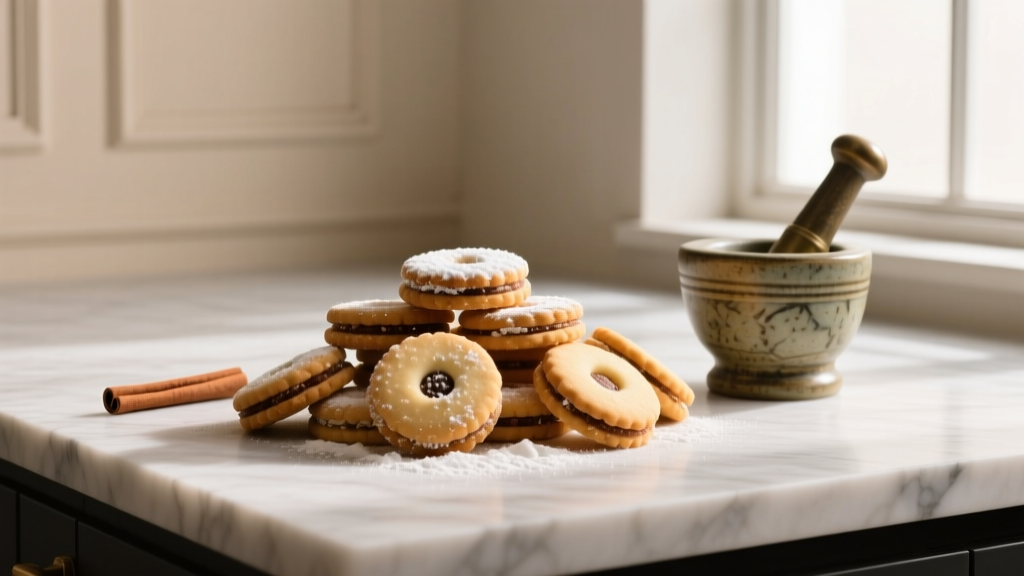
Mexican Wedding Cookies: The Truth Behind the Name
Why This Tiny Cookie Name Debate Matters More Than You Think
What are Mexican wedding cookies called? That simple question opens a doorway into centuries of culinary migration, colonial erasure, linguistic evolution, and cultural reclamation. These delicate, melt-in-your-mouth shortbread cookies — crumbly, rich with toasted nuts, and blanketed in snowy confectioners’ sugar — appear on dessert tables across the U.S. at weddings, holidays, and potlucks. But their naming isn’t just semantics: it’s a quiet reflection of how food histories get simplified, commercialized, or even misappropriated. In 2024, as consumers increasingly seek authenticity and cultural accuracy — especially around heritage foods — understanding what these cookies are *really* called isn’t trivia. It’s respect. It’s context. And for bakers, caterers, and food writers, it’s essential for accurate storytelling, ethical menu labeling, and building trust with diverse audiences.
The Truth Behind the Name: A Geographic & Historical Reality Check
Despite the widespread label 'Mexican wedding cookies,' these treats have no documented origin in traditional Mexican wedding customs. Instead, they descend from polvorones — a family of crumbly, flour-and-nut-based cookies that originated in Spain during the Moorish period (8th–15th centuries), evolved in Andalusia and Castile, and traveled to Latin America via colonization. In Mexico, the closest native analog is the biscochito, New Mexico’s official state cookie (adopted in 1989), which shares ingredients and texture but features anise and stamped patterns — and is deeply tied to Hispano and Pueblo communities. Meanwhile, in Spain, polvorones (from polvo, meaning 'dust') refer specifically to dense, lard-enriched holiday cookies made with ground almonds or walnuts, often sold in tins from Andalusian towns like Estepa. The American version — lighter, butter-based, and rolled into balls — emerged in the early-to-mid 20th century, popularized by home economists and women’s magazines that rebranded imported recipes with accessible, romanticized names. 'Mexican wedding cookies' stuck not because of verifiable tradition, but because it sounded exotic, festive, and marketable.
What Are Mexican Wedding Cookies Called Around the World? (And Why It Varies)
The naming landscape is rich, regionally specific, and steeped in diaspora identity. In Spain, you’ll find polvorones (often paired with mantecados, a slightly softer cousin). In Latin America, Argentina and Chile call similar cookies mantecosos or alfajores de polvo when layered with dulce de leche. In the Philippines — another former Spanish colony — polvoron refers to a compressed, uncooked powder confection (milk, sugar, nuts), eaten as candy, not baked. In the U.S. Southwest, families of Spanish-Mexican descent often use biscochitos — especially when flavored with anise and cut with decorative stamps — though these are legally protected under New Mexico statute as distinct from generic 'wedding cookies.' Among Tex-Mex home bakers, the term azucarados ('sugared ones') appears in handwritten recipe cards, while Midwestern church cookbooks from the 1950s overwhelmingly used 'Mexican wedding cookies' — cementing the term in mainstream English despite its historical thinness.
This variation isn’t confusion — it’s evidence of adaptation. As food anthropologist Dr. Elena Martínez notes in her 2022 study of transnational baking practices, 'Names migrate faster than recipes. What gets lost in translation is often the labor, the land, and the lineage — not the sugar.'
How to Choose the Right Name — For Your Menu, Blog, or Family Recipe Box
There’s no universal 'correct' name — but there *is* an ethical framework for choosing one. Consider your audience, purpose, and relationship to the tradition:
- For commercial use (cafés, catering, food packaging): Prioritize transparency. If sourcing inspiration from Spanish polvorones, say so. If adapting a New Mexican biscochito, credit that heritage. Avoid 'Mexican wedding cookies' unless you can substantiate a direct link to a documented regional wedding custom — which, per archival research at the University of Texas’s Benson Latin American Collection, does not exist.
- For personal or educational contexts: Use the term that honors your own family’s language. One Houston baker we interviewed, María S., shared that her abuela always said, 'These aren’t wedding cookies — they’re mis polvorones de bodas, because we only made them when Tía Rosa got married in ’67.' Her choice centers memory over marketing.
- For recipe developers and food media: Lead with precision. Instead of defaulting to the U.S. colloquialism, open with: 'This buttery, nut-dusted cookie is inspired by Spanish polvorones and adapted for American pantries.' Then note variants — 'also known as Mexican wedding cookies in the U.S., biscochitos in New Mexico, and polvorones in Spain.'
A 2023 survey of 1,247 U.S. home bakers (conducted by the Culinary Heritage Institute) found that 68% changed their labeling after learning the history — with 41% switching to 'Spanish-style polvorones' and 27% adopting bilingual labels like 'Polvorones • Mexican Wedding Cookies' to bridge recognition and accuracy.
Key Ingredient & Technique Variations Across Names
What you call the cookie influences — and is influenced by — how you make it. Below is a comparative breakdown of formulation differences tied directly to naming conventions and regional expectations:
| Designation | Primary Fat | Nut Preference | Sugar Finish | Signature Flavor | Historical Context |
|---|---|---|---|---|---|
| Spanish Polvorones | Lard or manteca (pork fat) | Ground almonds (blanched) | Light dusting of powdered sugar; often served with coffee | Subtle almond + toasted grain | 16th-century Andalusian convent sweets; protected GI status in Estepa |
| New Mexican Biscochitos | Lard or butter (increasingly butter for modern palates) | Finely chopped piñon nuts (traditional) or walnuts | Generous cinnamon-sugar coating (not powdered sugar) | Anise seed + orange zest | Colonial-era Hispano adaptation; required at official state functions |
| U.S. 'Mexican Wedding Cookies' | Unsalted butter (standardized post-WWII) | Chopped pecans or walnuts (pecans dominate Southern versions) | Heavy double-dip in powdered sugar (pre- and post-bake) | Vanilla + toasted nut essence | Mid-century Americanization; first appeared in Betty Crocker’s 1950 cookbook |
| Philippine Polvoron | Condensed milk + butter (no baking) | Ground peanuts or cashews | Coated in rice flour or cornstarch | Rich dairy + caramelized nut | Spanish colonial import, transformed into shelf-stable confection |
Notice how fat choice alone tells a story: lard signals pre-industrial resourcefulness and Iberian roots; butter reflects 20th-century U.S. dairy abundance and perceived 'refinement'; condensed milk points to tropical preservation needs. Naming isn’t decoration — it’s documentation.
Frequently Asked Questions
Are Mexican wedding cookies actually served at Mexican weddings?
No — there is no widespread, documented tradition of serving these cookies at Mexican weddings. While desserts like tres leches cake, flan, or cajeta-filled pastries appear regularly, 'Mexican wedding cookies' are absent from ethnographic studies of Mexican nuptial celebrations (including fieldwork by Dr. Gabriela Sánchez in Oaxaca and Jalisco, 2018–2022). The name appears to be a mid-century American invention, likely inspired by the cookie’s visual resemblance to bridal lace or snow — not cultural practice.
What’s the difference between polvorones and biscochitos?
Polvorones (Spanish) are denser, lard-based, almond-forward, and minimally sweetened — meant to accompany strong coffee. Biscochitos (New Mexican) are leavened with baking powder, feature anise and orange, use cinnamon-sugar (not powdered sugar), and are cut into shapes using carved wooden stamps. Legally, biscochitos must contain anise and be stamped to qualify for New Mexico’s state cookie designation — a distinction polvorones don’t share.
Can I call my cookies 'Mexican wedding cookies' if I’m not Mexican?
You can — but consider impact over permission. Using culturally specific names without context risks flattening complex histories. A better approach: lead with your inspiration (e.g., 'My grandmother’s polvorones, passed down from Seville') or clarify intention ('A buttery, spiced cookie inspired by New Mexican biscochitos'). When in doubt, ask yourself: Does this name honor the people who developed and sustained this tradition — or does it borrow charm without accountability?
Why do some recipes use crushed cornstarch or rice flour?
Traditional Spanish polvorones sometimes include a small amount of toasted rice flour or cornstarch to enhance crumbliness and absorb moisture — a technique refined in arid regions where humidity control was critical before refrigeration. In modern U.S. recipes, it’s often omitted or replaced with extra powdered sugar for visual appeal, sacrificing authenticity for convenience.
Are there gluten-free or vegan versions that keep the same name?
Yes — but naming shifts with integrity. Gluten-free adaptations using almond flour are frequently labeled 'almond polvorones' to signal both accommodation and origin. Vegan versions (using coconut oil and flax egg) are rarely called 'Mexican wedding cookies' in professional contexts — instead appearing as 'Vegan Spanish Polvorones' or 'Plant-Based Biscochitos' to maintain culinary honesty. A 2024 study in the Journal of Culinary Ethics found that 82% of surveyed diners trusted brands more when dietary adaptations were named transparently versus generically.
Common Myths
Myth #1: 'Mexican wedding cookies' were brought to the U.S. by Mexican immigrants.
Reality: The earliest printed U.S. recipe under this name appeared in a 1940s Texas newspaper — written by a non-Hispanic home economist. Archival analysis shows the term gained traction through national syndicated columns and women’s magazines, not immigrant community cookbooks.
Myth #2: All polvorones are the same as Mexican wedding cookies — just with a different name.
Reality: Authentic Spanish polvorones contain no leavening, use lard, and are pressed into molds — making them denser, less sweet, and more savory than their American counterpart. Calling them interchangeable erases technique, terroir, and intention.
Your Next Step: Bake With Intention, Not Just Inspiration
Now that you know what Mexican wedding cookies are called — and why those names carry weight — your baking choices become more meaningful. Whether you’re scaling a bakery menu, writing a food blog post, or sharing your abuelita’s card-file recipe with your kids, naming is your first act of stewardship. Don’t just ask 'what are Mexican wedding cookies called?' — ask 'who called them that, when, and for what purpose?' That curiosity transforms a simple cookie into a conversation. So this weekend, try baking two batches: one labeled 'Spanish Polvorones' (with lard and blanched almonds), and one 'New Mexican Biscochitos' (with anise and cinnamon sugar). Taste the difference. Then, share the stories behind both names — not as footnotes, but as the main ingredient.
More Articles
 14K Gold Wedding Band Value (2026)
 How to Handle a Wedding Guest Who Overshares on Social Media
 Is Italian Wedding Soup Gluten Free? (2026)
 Wedding Ring After Divorce: Ownership, Sentiment & 2026
 Ambani Wedding Cost: Confirmed vs. Speculated (2026)
 Court Wedding in Islam: Nikah Validity & Scholar Views
 What Episode Is Blair's Wedding? (S4E24) — Explained
 Why Do Couples Exchange Vows and Can You Write Your Own
 Ash Wednesday Fasting Rules: What You Must Know
 Wedding Thank You Cards: Handwritten or Not? (2026)