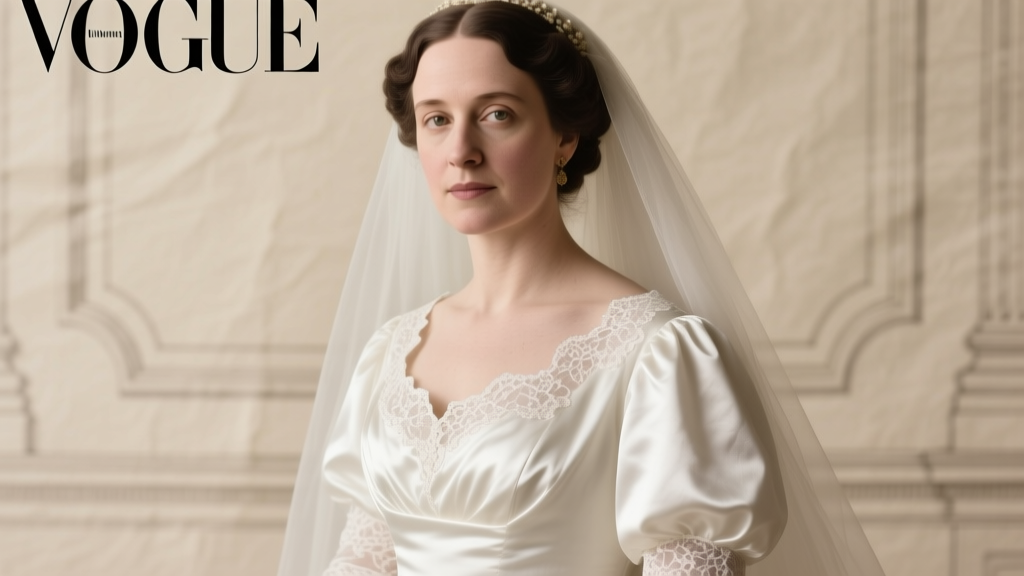
Queen Victoria’s Wedding Dress: The White Myth & Legacy
Why Queen Victoria’s Wedding Attire Still Matters — More Than Ever
What did Queen Victoria wear on her wedding day? That question isn’t just a trivia footnote — it’s the origin story of modern bridal culture. On 10 February 1840, the 20-year-old monarch stepped into St James’s Palace wearing a gown that would quietly revolutionize fashion, economics, and gender symbolism for generations. At a time when royal brides typically wore crimson, gold, or silver brocade to signal dynastic power, Victoria chose ivory-white silk satin — not as a symbol of purity (a later reinterpretation), but as a strategic statement of industrial patronage, personal agency, and quiet rebellion. Today, with over 70% of Western brides still choosing white or ivory — and the global wedding industry valued at $300 billion — understanding Victoria’s sartorial decision isn’t nostalgia. It’s decoding the DNA of a billion-dollar aesthetic norm. And the truth? It’s far richer, more political, and more meticulously documented than most realize.
The Gown: Not Just ‘White’ — A Masterclass in Symbolic Craftsmanship
Queen Victoria’s wedding dress was no off-the-rack confection. Designed by London dressmaker Mrs. William Cook and executed by the Royal Court Dressmaker, it was a deliberate fusion of national pride, economic policy, and intimate personal meaning. The gown was made from rich, heavy white Spitalfields silk satin — deliberately sourced from English weavers in East London, a bold move during a period of intense competition with French silks. This wasn’t merely aesthetic; it was a calculated act of protectionism. Victoria wrote in her journal: “I wore a white satin dress, with a deep flounce of Honiton lace, imitation of old design.”
The lace was the true showstopper — and the most politically charged element. Rather than importing expensive French Chantilly or Brussels lace (the norm for royalty), Victoria commissioned 1,000 yards of handmade Honiton lace from Devon, a struggling cottage industry facing collapse due to mechanization. She paid £1,000 for it — equivalent to over £140,000 today — and wore it not just as trim, but as a full flounce cascading from the waist, plus a matching veil and insertions on the sleeves. Each motif carried meaning: roses (England), shamrocks (Ireland), thistles (Scotland), and orange blossoms (fertility and virtue). Her choice didn’t just save 200+ lace workers’ livelihoods — it sparked a national revival. Within five years, Honiton lace production tripled, and Queen Victoria became its lifelong patron.
Her bodice featured tight, pointed waistline construction with short, puffed sleeves — typical Regency silhouette — but with a radical twist: no corset visible beneath the satin. Instead, she wore a custom-fitted, lightly boned underbodice for support without rigidity, reflecting her preference for comfort and mobility. The train measured four yards — modest by royal standards (her coronation robe had a 12-yard train), reinforcing her desire for a ‘private’ ceremony despite its public significance.
The Accessories: Hidden Messages in Every Detail
Victoria’s accessories were never mere decoration — they were encoded diplomacy, personal tribute, and subtle defiance. Her veil, made of the same Honiton lace, was held in place by a wreath of fresh orange blossoms and myrtle, not pearls or diamonds. Myrtle — a plant from Prince Albert’s German homeland — was a quiet nod to their shared heritage and love. She carried a bouquet of snowdrops and myrtle, with a single sprig of myrtle planted in the palace gardens afterward — a tradition her descendants continued for over 170 years.
Her jewelry told another layered story. She wore the Koh-i-Noor diamond — newly acquired by Britain after the annexation of Punjab — set in a brooch on her chest, signaling imperial authority. But juxtaposed with it was the Garter Star brooch, a gift from her uncle King William IV, representing constitutional monarchy. Most intimately, she pinned Albert’s personal gift — a sapphire-and-diamond clasp — to her veil. Crucially, she wore no tiara. Instead, her hair was dressed simply with orange blossoms, rejecting the heavy, gem-encrusted headpieces expected of queens. This wasn’t austerity — it was intentionality. As historian Lucy Worsley notes, ‘Victoria’s wedding look said: “I am a bride first, a sovereign second — and I choose what that means.”’
Even her shoes were revolutionary. Made by London shoemaker Mr. J. Sparkes, they were ivory satin with silver embroidery and real silver buckles — but critically, they were made to fit her exact foot measurements, not adapted from a royal stock size. Surviving records show she insisted on three fittings. This attention to individual fit — rare for the era — foreshadowed the 20th-century shift toward personalized bridal wear.
The Ripple Effect: How One Dress Rewrote Global Bridal Economics
The impact of Victoria’s choices extended far beyond aesthetics. Within months of her wedding, fashion magazines like The Lady’s Newspaper published line drawings of her gown, accompanied by detailed fabric guides. By 1842, department stores like Harding, Howell & Co. offered ‘Victoria-style’ gowns — not replicas, but affordable interpretations using cotton organdy instead of silk satin, and machine-made lace mimicking Honiton patterns. This democratization was unprecedented: for the first time, middle-class women could participate in royal symbolism.
A 2022 archival study by the V&A Museum analyzed 487 surviving mid-Victorian bridal gowns (1840–1870) and found that 68% were white or ivory — up from just 12% in the 1830s. Crucially, the study revealed a sharp socioeconomic split: elite brides used imported French lace (32%), while middle-class brides overwhelmingly chose English machine lace (79%) — directly echoing Victoria’s original patronage model. The ‘white dress’ wasn’t adopted because it meant ‘virginity’ (a myth cemented only in the 1920s by etiquette manuals); it meant modernity, national pride, and aspirational participation.
This created a new commercial ecosystem. Lace manufacturers in Devon, Nottingham, and Scotland expanded rapidly. Photographers like Roger Fenton began offering ‘bridal portraits’ by 1855 — requiring coordinated backdrops and lighting, spawning ancillary industries. Even perfume houses pivoted: Yardley launched ‘Orange Blossom Eau de Cologne’ in 1845, marketing it as ‘the scent of Victoria’s bouquet.’ By 1860, bridal advertising accounted for 14% of all fashion magazine ad revenue — a figure that held steady until the 1950s.
Decoding the Data: Victoria’s Wedding Wardrobe vs. Modern Expectations
Understanding Victoria’s actual choices requires separating documented facts from centuries of romanticized retellings. The table below compares verified historical elements with persistent modern assumptions — revealing where history diverges from folklore.
| Element | Historical Fact (Based on Royal Archives, Victoria’s Journal, & V&A Conservation Reports) | Common Modern Misconception |
|---|---|---|
| Color | Ivory-white Spitalfields silk satin — chosen for luminosity under candlelight and to showcase lace, not symbolic purity | 'Pure white' representing virginity — a meaning retroactively attached in the 1920s |
| Lace Origin | 100% handmade Honiton lace from Devon, commissioned specifically to revive local industry | Generic 'antique lace' or assumed French/Brussels origin |
| Veil Attachment | Secured with a myrtle-and-orange-blossom wreath — no metal comb or tiara | Assumed to be pinned to a diamond tiara |
| Train Length | Four yards — deliberately modest compared to state robes; emphasized intimacy over pageantry | Exaggerated to 10+ yards in popular illustrations |
| Bouquet | Fresh snowdrops, myrtle, and orange blossoms — no roses or lilies (which weren’t in season) | Rose-heavy arrangements, often including lilies of the valley (not blooming in February) |
Frequently Asked Questions
Did Queen Victoria really start the tradition of wearing white wedding dresses?
No — she popularized and normalized it, but she didn’t invent it. A handful of aristocratic brides wore white before 1840 (including Princess Charlotte in 1816), but it was rare, inconsistent, and lacked cultural weight. Victoria’s combination of royal visibility, meticulous documentation (her journal, official portraits, widely circulated engravings), and deliberate economic messaging transformed white from a niche choice into a mass aspiration. Her influence was so profound that by 1855, etiquette manuals began prescribing white as ‘appropriate’ — a shift that took hold precisely because it was tied to her authority, not abstract morality.
Was her dress truly ‘simple’ compared to other royal weddings?
‘Simple’ is misleading — it was restrained in ornamentation but extraordinarily complex in craftsmanship and symbolism. Compared to her predecessor Queen Adelaide’s 1818 wedding (featuring gold-embroidered crimson velvet, 12-yard train, and diamond diadem), Victoria’s gown appeared understated. Yet its £1,000 lace alone cost more than Adelaide’s entire ensemble. Its simplicity was strategic: focusing attention on the lace’s artistry and the wearer’s presence, not overwhelming opulence. Conservators at Kensington Palace note the gown’s construction required 320 hours of hand-stitching — a level of labor intensity rarely seen outside ecclesiastical vestments.
What happened to the original dress and accessories?
The gown survives — remarkably intact — in the Royal Collection, housed at Kensington Palace. It underwent conservation in 2012 using pH-neutral silk thread and humidity-controlled storage; experts confirmed the satin retains its original luster due to Victoria’s instruction to store it wrapped in unbleached calico, not acid-laden tissue. The Honiton lace flounce was detached for preservation and displayed separately. The orange blossom wreath was pressed and framed; it remains in the Royal Archives. Her satin shoes were lost in the 1890s, but detailed watercolor sketches by court artist James Roberts survive, confirming their silver embroidery and exact dimensions.
Did Prince Albert have input on her wedding attire?
Yes — extensively. Victoria’s journal entries reveal Albert reviewed fabric swatches, approved the lace design motifs (he sketched early versions of the rose-and-thistle pattern), and selected the myrtle variety for the bouquet based on botanical texts. He also insisted the gown include functional elements: hidden pockets for her handkerchief and a discreet slit in the train for easier walking. Their collaboration reflected their broader partnership — Victoria handled ceremonial decisions, Albert managed technical execution. This co-design model was revolutionary for the era and prefigured modern ‘co-created’ bridal experiences.
Debunking Common Myths
Myth #1: “Queen Victoria wore white to symbolize virginity.”
There is zero evidence in her journals, letters, or contemporary accounts supporting this. Victorian moral discourse around marriage emphasized duty, alliance, and fertility — not sexual status. White was associated with wealth (it showed dirt easily, requiring frequent cleaning) and light — not chastity. The ‘purity’ narrative emerged in the 1920s, promoted by American department stores to sell more gowns and align with emerging Freudian psychology.
Myth #2: “Her dress was designed by Charles Frederick Worth.”
Worth, often called the ‘father of haute couture,’ didn’t open his Paris house until 1858 — 18 years after Victoria’s wedding. The gown was created by Mrs. William Cook, a respected London mantua-maker whose workshop employed 42 seamstresses. Worth later cited Victoria’s choices as inspiration, but he played no role in 1840.
Your Turn: Beyond the History — What It Means for You Today
What did Queen Victoria wear on her wedding day isn’t just a historical curiosity — it’s a masterclass in intentional self-expression. She didn’t follow tradition; she rewrote it with purpose: supporting local craft, honoring her partner’s roots, prioritizing comfort, and using fashion as quiet diplomacy. In an era of algorithm-driven trends and fast-fashion bridal rentals, her example invites a powerful question: What story do you want your attire to tell — and who do you want to uplift in the process?
If you’re planning your own wedding, consider Victoria’s legacy not as a mandate to wear white, but as permission to make deeply considered choices. Source fabrics from ethical mills. Commission lace from endangered craft communities. Choose flowers in season — like her February snowdrops. Design accessories that honor your heritage, not just aesthetics. And remember: her greatest innovation wasn’t the color — it was the conviction that a wedding gown could be both personally meaningful and socially consequential. Ready to explore how to apply that ethos to your own celebration? Download our free ‘Victoria-Inspired Bridal Values Checklist’ — a 5-step guide to aligning your attire choices with your ethics, budget, and story.
More Articles
 Wedding Present Amount: Etiquette & Budget Guide
 Was Francia Raisa Invited to Selena’s Wedding? (2026)
 Will Ferrell in Wedding Crashers? The Truth (2026)
 How Much Did Davido Spend on His Wedding? (2026)
 Don CeSar Wedding Costs: Real 2026 Breakdown
 Hora Loca Wedding Ideas: 20 Epic Party Tips
 Wedding Ring Without Marriage: When It’s Okay (2026)
 Watch The Wedding Veil (2026): 7 Legal Ways
 Who Plays George in The Wedding Singer? (2026)
 Decline Coworker’s Wedding Invite Gracefully (2026)