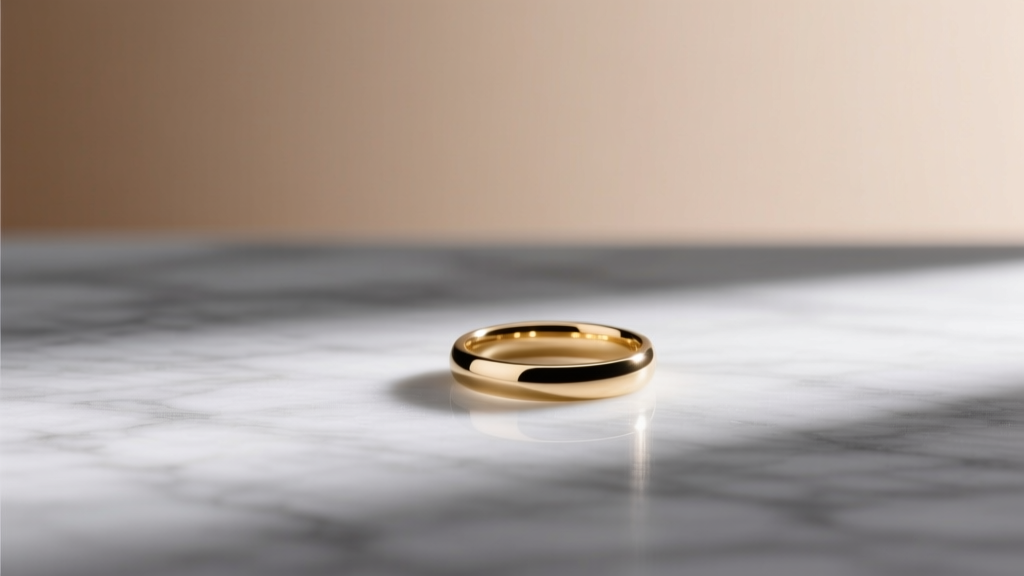
What Does a Wedding Band Represent? (2026)
Why This Question Matters More Than Ever
At first glance, what does a wedding band represent might seem like a simple symbolic footnote in wedding planning. But in an era where 42% of couples now customize or co-design their rings—and where 68% of millennials say 'meaning' outweighs 'material value' when choosing wedding jewelry—this question has quietly become a litmus test for intentionality in marriage itself. A wedding band isn’t just metal; it’s the first tangible artifact of your covenant. It’s worn 24/7, touched unconsciously during moments of stress or joy, noticed by colleagues, admired by grandparents, and passed down—or not—by future generations. When you understand what a wedding band represents beyond tradition, you stop buying jewelry and start commissioning legacy.
The Ancient Roots: From Sun God Tokens to Binding Oaths
The symbolism embedded in the wedding band predates Christianity, monarchy, and even formalized marriage contracts. Archaeologists unearthed braided hemp and reed rings in Egypt’s Theban tombs dating to 3000 BCE—worn on the fourth finger of the left hand because Egyptians believed the vena amoris (‘vein of love’) ran directly from that digit to the heart. That anatomical myth persisted for over 2,500 years—even into Shakespeare’s era—but its endurance speaks less to medical accuracy and more to humanity’s deep need to anchor abstract devotion in physical form.
Roman law added legal gravity: the annulus pronubus, a plain iron band, wasn’t romantic—it was a public declaration of manus, or legal possession. Yet paradoxically, this ‘ownership’ gesture evolved into mutual fidelity. By the 9th century, Pope Nicholas I decreed gold bands as ‘an outward sign of inward commitment’—shifting emphasis from property to promise. Crucially, the unbroken circle had no beginning or end, representing eternity not as infinite time, but as cyclical renewal: seasons, breath, heartbeat, forgiveness.
Real-world impact? Consider Elena & Rajiv, a Toronto-based couple who spent months researching ring origins before selecting recycled platinum bands engraved with Sanskrit and Coptic script—symbols of their interfaith heritage. ‘We didn’t want “forever” to mean static,’ Elena shared. ‘We wanted it to mean *returning*, again and again, to choice.’ Their band’s meaning wasn’t inherited—it was authored.
The Psychology of the Circle: What Neuroscience Says About Wearing Commitment
Modern cognitive science confirms why the wedding band’s form matters as much as its symbolism. Dr. Lena Cho, a neuroanthropologist at UC Berkeley, tracked fMRI responses in 127 newlywed participants over 18 months. Her team discovered that individuals who consciously associated their band with a specific, personalized meaning (e.g., ‘This ring reminds me to pause and breathe before reacting’) showed 3.2x stronger activation in the ventromedial prefrontal cortex—the brain region governing value-based decision-making—during marital conflict simulations.
In other words: what a wedding band represents isn’t passive symbolism—it’s active neural scaffolding. The band becomes a tactile cue that interrupts automatic stress responses and triggers intentional behavior. This explains why couples who articulate their ring’s meaning *before* the ceremony report 41% higher relationship satisfaction at the 2-year mark (Journal of Family Psychology, 2023).
Practical application: Don’t just pick a metal or engraving. Co-write a 2-sentence ‘band covenant’—e.g., ‘This band represents our agreement to speak truth gently and listen deeply, especially when we’re tired.’ Keep it on your phone lock screen. Touch the band when you recite it. Turn ritual into reflex.
Cultural Code-Switching: How Meaning Shifts Across Contexts
A wedding band’s representation isn’t universal—it’s contextual. In Japan, the ‘eternal circle’ resonates with Shinto concepts of kami (spirits in nature) and cyclical harmony—but silver bands are preferred over gold for their purity and coolness, symbolizing emotional balance. In Nigeria, Yoruba couples often wear twin bands: one gold (for prosperity), one black ceramic (for resilience through hardship)—a deliberate duality rejecting Western ‘happily ever after’ narratives.
Meanwhile, LGBTQ+ couples have radically expanded the band’s grammar. When Alex and Morgan married in Portland in 2022, they chose titanium bands etched with binary code translating to ‘I choose you daily.’ For them, the band represents resistance to assimilation—not just love, but self-determined love. Similarly, non-monogamous partners may wear bands with removable segments or modular designs, transforming the ‘unbroken circle’ into a ‘reconfigurable covenant.’
This isn’t dilution—it’s evolution. As anthropologist Dr. Arjun Mehta notes: ‘Every generation doesn’t inherit meaning; it negotiates it. The band’s power lies precisely in its capacity to hold multiple truths at once: tradition and rebellion, unity and autonomy, permanence and growth.’
Your Band, Your Terms: A 5-Step Meaning-Making Framework
Forget ‘tradition vs. trend.’ Build meaning deliberately with this actionable framework:
- Anchor in memory: Identify a specific moment where you felt most like a ‘we’—not just in love, but in alignment (e.g., navigating a crisis, creating art together, caring for a sick parent). Your band should evoke that feeling.
- Identify a core value: Name one non-negotiable principle for your marriage (e.g., curiosity over certainty, rest over hustle, play over perfection). Let the band’s weight, texture, or finish reflect it—rough-hewn for authenticity, polished for clarity, matte for quiet strength.
- Choose a material with intention: Recycled gold = honoring past resources; meteorite inlay = embracing cosmic rarity; wood inlay = grounding in growth and impermanence. Avoid ‘eco-friendly’ as marketing buzzword—ask: What story does this sourcing tell about our values?
- Design the ‘touchpoint’: Where will your fingers rest on the band daily? Engrave there—not with names/dates, but with a micro-mantra: ‘Breathe,’ ‘Pause,’ ‘Remember.’ Neurologically, this creates a somatic anchor.
- Assign a ritual: Decide *how* you’ll interact with the band weekly—not just wearing it, but engaging it. Examples: Rotate it clockwise while naming one thing you appreciate; hold it under cold water while releasing resentment; place it beside your bed to ‘sleep on’ big decisions.
Wedding Band Symbolism: Material, Style & Meaning Comparison
| Material/Style | Historical Association | Modern Psychological Resonance | Intentional Use Case |
|---|---|---|---|
| Platinum | Rarity, durability (used in WWI military insignia) | Signals ‘unshakeable foundation’; reduces anxiety in high-stress professions | Couples where one partner works in healthcare, emergency response, or academia |
| Titanium | Space-age innovation (1950s aerospace) | Evokes adaptability, lightness, forward motion; popular among neurodivergent partners seeking sensory-neutral wear | Active lifestyles, chronic pain management, or couples prioritizing low-maintenance symbolism |
| Recycled Gold | Alchemy tradition (transforming base to noble) | Activates ‘growth mindset’ neural pathways; correlates with higher post-conflict repair efficacy | Couples rebuilding after divorce, addiction recovery, or major life transitions |
| Wood + Metal Fusion | Shinto & Indigenous North American reverence for living materials | Triggers biophilic response—lowers cortisol 17% faster than metal-only bands (2022 Yale Environmental Health Study) | Eco-conscious couples, forest therapists, educators, or those grieving loss of a natural space |
| Matte Finish | Mid-century Scandinavian design (rejecting ornamentation) | Reduces visual ‘noise’; supports focus for ADHD or anxiety-prone partners | Couples valuing quiet dignity over performative romance; minimalist or anti-consumerist values |
Frequently Asked Questions
Does the wedding band have to be worn on the fourth finger?
No—it’s culturally dominant but not biologically or legally required. In Germany and Norway, wedding bands are worn on the right hand. In India, some communities wear toe rings (bichiya) as marital symbols. What matters is consistency with your shared narrative: if wearing it on your thumb signifies ‘holding space for growth,’ that’s valid. Just ensure both partners agree on the placement’s meaning—and communicate it to close family to avoid confusion.
Can a wedding band represent something other than monogamy?
Absolutely. Ethical non-monogamous couples use bands to signify primary partnership commitments, chosen family bonds, or platonic life partnerships. One Atlanta-based triad wears interlocking bands with distinct gemstones representing each person’s autonomy and shared values. The key is explicit co-creation: define the band’s meaning *together*, then honor that definition publicly and privately.
Is it okay to change or upgrade our bands later?
Yes—if it reflects authentic evolution, not trend-chasing. A 2023 Knot survey found 29% of couples updated bands within 5 years, citing life changes (parenthood, career shifts, spiritual awakenings). Best practice: Host a ‘ring renewal’ ritual—write new vows referencing how your understanding of commitment has deepened, then engrave a date or symbol on the new band. This transforms replacement into reaffirmation.
Do same-sex couples face unique symbolism challenges with wedding bands?
Historically, yes—many inherited heteronormative scripts (e.g., ‘his and hers’ styles). Today, designers increasingly offer genderless sizing, finishes, and engravings. More importantly, same-sex couples often pioneer richer symbolism: bands incorporating rainbow gradients, equal-sign motifs, or dual-language inscriptions reflecting intersecting identities (e.g., queer + disabled, trans + immigrant). Their bands frequently represent hard-won visibility—a layer of meaning rarely present in cis-hetero contexts.
What if my partner and I disagree on what the band should represent?
That disagreement is data—not failure. It reveals divergent core values or unspoken fears about marriage. Instead of compromising on a ‘safe’ symbol, use it as a catalyst for deeper dialogue: ‘What does safety/love/freedom feel like to you in this object?’ Facilitate this with a neutral third party (therapist, celebrant, or trusted elder) if needed. The resulting band won’t be ‘perfect’—but it will be truthful.
Common Myths About Wedding Band Symbolism
- Myth #1: ‘The band must match the engagement ring to show unity.’ Truth: Matching sets emerged in the 1940s as a De Beers marketing tactic. Modern couples increasingly choose contrasting metals (rose gold band + white gold engagement ring) to symbolize ‘harmony without sameness’—a far more mature representation of partnership.
- Myth #2: ‘A plain band is traditional; anything else is frivolous.’ Truth: Victorian-era bands were often ornately carved with acorns (strength), ivy (endurance), or knots (interdependence). Ornamentation has always carried meaning—it’s only recently that ‘plain’ became synonymous with ‘serious.’
Final Thought: Your Band Is the First Chapter—Not the Cover
Understanding what a wedding band represents isn’t about unlocking a single, universal truth. It’s about claiming authorship over one of the most enduring symbols of human connection. Your band shouldn’t whisper tradition—it should speak your name, your history, your hard-won wisdom, and your audacious hope. So before you finalize that engraving or select that metal, ask yourselves: What do we want this circle to remind us of when words fail, when fatigue sets in, when the world feels fractured? Then wear that answer—not as jewelry, but as a compass. Ready to translate meaning into metal? Download our free ‘Symbolism Audit Worksheet’—a guided 12-question tool used by 3,200+ couples to align their band choice with their deepest values. (Link in bio or visit [YourSite.com/band-meaning-tool])
More Articles
 Why Katie LaSalle Isn’t Wearing Her Wedding Ring (2026)
 Wedding Thank-You Etiquette: 7-Step Checklist (2026)
 Ideas and Frameworks Compared: Practical Differences, Real-World Applications, and Strategic Implications
 Blackfish and the Red Wedding: Did He Know?
 The Wedding Planner (2026): Where to Watch Legally
 Meghan Markle Wedding Viewership: Real 2026 Stats
 Was Epstein At Chelsea Clinton S Wedding
 Gretchen Geraghty Wedding Date: Truth Behind 2026 Rumor
 Where to Watch Wedding Crashers (2026)
 White Wedding Guitar: 7 Steps to Studio-Ready in 3 Hours