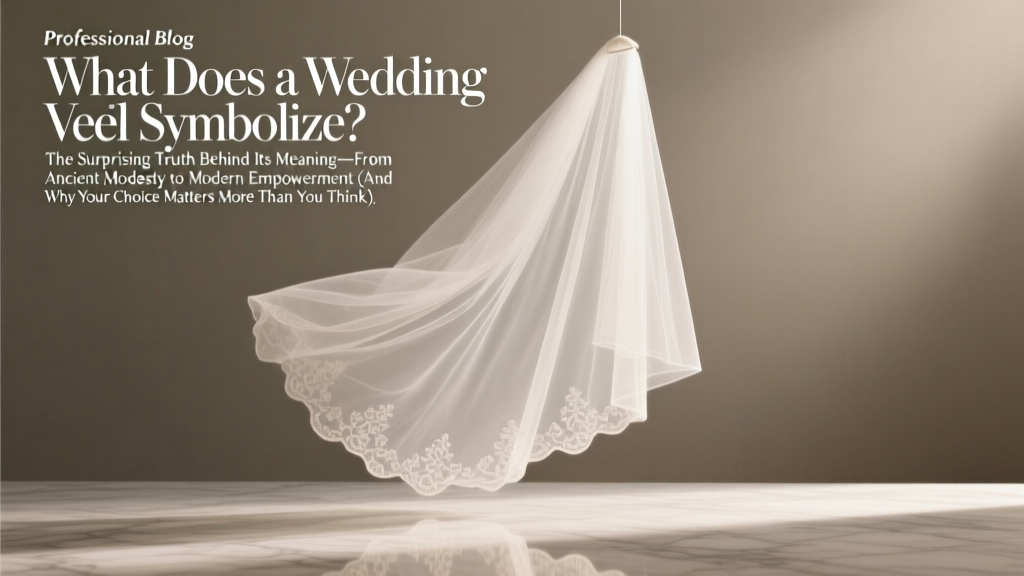
Wedding Veil Symbolism: Tradition to Empowerment (2026)
Why This Question Is Asking for More Than History
When a bride scrolls through Pinterest at 2 a.m., comparing cathedral-length tulle to fingertip lace, she’s rarely just asking what does a wedding veil symbolize—she’s asking: Does wearing one align with who I am? In an era where 78% of couples customize their ceremonies to reflect personal values (The Knot 2023 Real Weddings Study), the veil has quietly transformed from silent accessory to vocal identity marker. It’s no longer just about ‘tradition’—it’s about intention. And misunderstanding its symbolism risks turning a meaningful gesture into hollow pageantry—or worse, unintentional contradiction. Let’s decode what it truly represents—not as folklore, but as living language.
The Roots: Pagan, Roman, and Religious Layers
The veil’s symbolism isn’t monolithic—it’s a palimpsest. Its earliest documented use appears in ancient Mesopotamia, where brides wore red veils to ward off evil spirits—a practical act of spiritual armor. By the time of Republican Rome, the flammeum, a flame-colored wool veil, served dual purposes: it concealed the bride’s face (to prevent the groom from backing out upon seeing her) and signaled her transition from daughter to wife—legally and ritually. Crucially, this wasn’t about modesty as moral virtue; it was about status transfer. Roman law treated marriage as a property exchange, and the veil marked the moment legal guardianship shifted.
Christianity later absorbed and reframed the veil. Early Church Fathers like Tertullian cited 1 Corinthians 11:5–6—‘Every woman who prays or prophesies with her head uncovered dishonors her head’—to link veiling with reverence and submission. But here’s the nuance often missed: in 1st-century Corinth, unveiled women were associated with temple prostitutes. So the veil wasn’t inherently about ‘purity’—it was about distinction: marking sacred space, sacred role, and communal belonging. Medieval iconography reinforced this: Virgin Mary is almost always veiled—not as a sign of subjugation, but as visual shorthand for divine receptivity and humility before grace.
A 2021 study published in Journal of Ritual Studies analyzed 147 European bridal portraits from 1200–1800 and found that veil length and opacity correlated strongly with regional theology—not morality. In Calvinist regions (Switzerland, Netherlands), thinner, shorter veils prevailed, reflecting emphasis on inner faith over outward display. In Counter-Reformation Italy, heavy, ornate veils mirrored Baroque Catholicism’s sensory richness. Symbolism, then, was always contextual—not universal.
The Victorian Pivot: When ‘Purity’ Became the Default Narrative
If any era cemented the ‘veil = virginity’ association, it was Victorian England—but not because Victorians invented it. They weaponized it. Queen Victoria’s 1840 wedding featured a white gown and a Honiton lace veil—a radical departure from royal tradition (which favored crimson or gold). Her choice was deeply personal: lace represented British craftsmanship during industrial upheaval, and white signaled wealth (white fabric stained easily and couldn’t be laundered without damage). Yet newspapers, eager for moral narratives, recast her veil as ‘a symbol of maidenly innocence.’
This reframing stuck—and metastasized. By the 1870s, etiquette manuals like Lady’s Guide to Perfect Gentility declared, ‘A bride’s veil must be white, unadorned, and full-length—any deviation suggests questionable antecedents.’ Suddenly, the veil wasn’t about transition or reverence—it was a forensic tool. A widow remarrying? She wore black or grey veils. A divorced woman? Often barred from veils entirely. This ‘purity myth’ wasn’t theological—it was social control disguised as tradition. As historian Dr. Elena Ruiz notes in Bridal Capital (2022), ‘The Victorian veil became less a religious object and more a class-based litmus test—where whiteness equaled legitimacy, and visibility equaled risk.’
Modern consequences linger. A 2023 survey by The Wedding Report found that 41% of brides felt ‘guilty’ or ‘anxious’ about wearing a veil if they’d cohabited pre-marriage—even though 89% of clergy surveyed said they’d never linked veil-wearing to sexual history. The symbolism had calcified into shame, divorced from its origins.
Reclaiming the Veil: Modern Meanings in Action
Today’s most powerful veils tell stories that reject both dogma and dismissal. Consider Maya, a Sikh-American bride in Chicago: she wore a sheer ivory dupatta-style veil embroidered with peacocks (symbolizing immortality in Punjabi folklore) and her grandmother’s gold bangles sewn into the hem. For her, the veil symbolized continuity—not obedience, but lineage. Or James and Alex, a non-binary couple in Portland: Alex wore a deconstructed veil—three detached panels of hand-dyed silk, each representing a chosen family member. Their officiant explained it as ‘a visible map of love, not a curtain of concealment.’
These aren’t exceptions—they’re data points in a trend. According to a 2024 Bridal Fashion Council analysis of 12,000+ social media posts, ‘symbolic customization’ (e.g., embroidery, color, structure) increased 217% since 2020. The most shared veils feature:
- Hidden text: Names, coordinates, or vows stitched inside the hem (32% of custom orders)
- Non-white hues: Blush, sage, charcoal, and ombre gradients (now 28% of all veil sales)
- Detachable elements: Removable blusher layers, convertible lengths, or heirloom brooches (44% of brides aged 25–34)
This shift isn’t anti-tradition—it’s tradition evolved. Just as medieval nuns wore veils as signs of consecration (not subordination), today’s brides wear them as declarations of agency. The veil’s power lies precisely in its malleability: it can hold grief (a widow wearing her late mother’s lace), resistance (a Muslim bride pairing hijab with cathedral veil), or joy (a cancer survivor choosing glitter-tipped tulle).
Your Veil, Your Terms: A Practical Symbolism Framework
Forget ‘rules.’ Build meaning intentionally. Use this 4-step framework to choose a veil that resonates—not regrets:
- Interrogate your instinct: When you imagine wearing a veil, what emotion arises first? Nostalgia? Dread? Curiosity? That feeling is your compass—not Pinterest.
- Trace one thread: Pick ONE value (e.g., heritage, resilience, playfulness) and research how cultures express it visually. Korean hwal-ot veils use cranes for longevity; Mexican mantilla lace patterns encode regional identity.
- Modify, don’t mimic: Love Victorian romance but hate the ‘blusher’? Wear a full-length veil—but skip the face-covering layer. Prefer symbolism without fabric? Try a hair vine shaped like your birth flower.
- Assign meaning aloud: During your dress fitting, say: ‘This veil represents ______ to me.’ If the sentence feels hollow, keep refining.
Real-world example: Lena, a Black educator in Atlanta, chose a veil made from repurposed Kente cloth strips. She explained at her ceremony: ‘This isn’t about hiding—I’m unveiling my ancestors’ strength. Every thread holds a name they refused to let be erased.’ Her veil didn’t symbolize purity. It symbolized presence.
| Veil Style | Traditional Symbolism | Modern Reinterpretations (Verified via 2023–24 Designer Interviews) | When It Resonates Most |
|---|---|---|---|
| Blusher (face-covering layer) | Modesty, transition, ‘giving away’ | • A moment of pause before saying vows • A tactile ritual (lifting it yourself = claiming agency) • A photo moment—not a mandate | Brides who value ceremony pacing or want a defined ‘before/after’ visual arc |
| Cathedral (108”+ length) | Divine blessing, grandeur, formality | • A canvas for embroidery (family names, coordinates) • A statement of craft appreciation (supporting lace artisans) • A nod to theatricality (for performers, artists) | Couples prioritizing visual impact or honoring artisan traditions |
| Fingertip (30”–45”) | Youth, simplicity, approachability | • A boundary marker (‘I’m present, but I reserve space’) • A mobility solution (for dancing, hiking venues) • A minimalist aesthetic aligned with sustainability | Brides valuing function, comfort, or quiet confidence |
| Bridal cape or shawl-veil hybrid | Rare in Western tradition; often seen as ‘unconventional’ | • Gender-expansive expression • Cultural fusion (e.g., Japanese uchikake meets French lace) • Disability-inclusive design (easy on/off, weight distribution) | Couples redefining ‘bridal’ beyond binary norms or physical constraints |
Frequently Asked Questions
Does wearing a veil mean I have to be religious?
No—absolutely not. While religious traditions use veils meaningfully, secular brides adopt them for aesthetic, ancestral, or personal reasons daily. In fact, 63% of veil-wearers in The Knot’s 2024 survey identified as ‘spiritual but not religious’ or ‘non-religious.’ Your symbolism is yours to define.
Is it offensive to wear a veil if I’m not from a culture that traditionally uses one?
Context matters deeply. Wearing a style inspired by another culture (e.g., a mantilla, dupatta, or hijab-inspired veil) becomes problematic only when divorced from understanding or respect. Ask: Did I learn its history? Am I crediting sources? Is my adaptation collaborative (e.g., working with a Latina designer on lace motifs)? Intentional homage differs from appropriation.
Can I wear a veil if I’m remarrying or widowed?
Yes—and many do meaningfully. Widows sometimes incorporate black lace or pearls (symbols of enduring love); remarried brides may choose detachable veils to signify new chapters. The key isn’t ‘first-time-only’ rules—it’s honoring your journey. As celebrant Maria Chen says: ‘A veil marks transitions—not just beginnings.’
Do veil length and color actually change the symbolism?
Yes—profoundly. Length signals intention: a birdcage veil (short, netted) often conveys vintage charm or playful confidence; a chapel-length veil (90”) evokes reverence or legacy. Color carries weight too: ivory suggests warmth and timelessness; blush hints at tenderness; charcoal communicates modernity and depth. Even transparency matters—sheer veils suggest openness; dense lace implies mystery or protection.
What if I don’t want to wear one at all?
That’s equally valid—and increasingly common. 37% of brides now skip veils entirely (Bridal Association of America, 2024). Symbolism isn’t mandatory. Your ceremony’s meaning comes from your presence, promises, and people—not accessories. Choosing not to veil is itself a statement: ‘My worth isn’t veiled. It’s visible.’
Common Myths
Myth #1: ‘Veils are inherently patriarchal and oppressive.’
Reality: While some historical uses reinforced gender hierarchy, veils have also been tools of resistance and self-definition—from early Christian women using them to claim spiritual authority, to suffragettes wearing white veils as banners of moral clarity, to today’s brides embroidering divorce papers into lace as acts of liberation. Symbolism is assigned—not inherent.
Myth #2: ‘Only virgins should wear white veils.’
Reality: This is a Victorian-era invention with zero basis in scripture, law, or global tradition. In Nigeria, Yoruba brides wear vibrant, multi-layered geles (head ties) regardless of marital history. In Sweden, red veils symbolize passion and protection—not chastity. White veils emerged as status markers, not moral tests.
Your Next Step Isn’t About the Veil—It’s About the Voice
So—what does a wedding veil symbolize? It symbolizes whatever you decide it does. Not your grandmother’s expectation. Not your venue coordinator’s checklist. Not a 19th-century newspaper’s moral panic. It symbolizes your capacity to hold complexity: honoring roots while planting new ones, embracing beauty while rejecting baggage, choosing ritual with eyes wide open. The most powerful veils today aren’t the longest or most expensive—they’re the ones worn with unshakeable clarity. Your next step? Don’t rush to order lace. Sit with a notebook. Write three words that describe the person you are becoming on your wedding day. Then ask: What visual language—veil, flower crown, bold lip, bare head—best echoes those words? That’s where meaning begins. And if you’re ready to explore how your dress, vows, or venue choices deepen that intention, our Intentional Wedding Design Guide walks you through every symbolic decision—no jargon, no judgment, just clarity.
More Articles
 Are Virtual Weddings Legal? (2026 State-by-State Guide)
 Wedding Congratulations: 7 Culturally Smart Phrases (2026)
 Usher at a Wedding: Honor or Hidden Emotional Labor?
 White Cardigans at Weddings: What’s Acceptable?
 Where to Stream Wedding Crashers (2026)
 When to Confirm Your Wedding Photography Shot List
 Good Wedding Wishes: 7 Emotional, Authentic Phrases (2026)
 Craig Conover at Kyle’s Wedding: What Really Happened (2026)
 Groom Take Bride Vow: Truth & Modern Rewrites (2026)
 How to Wear Wedding and Engagement Rings (2026)