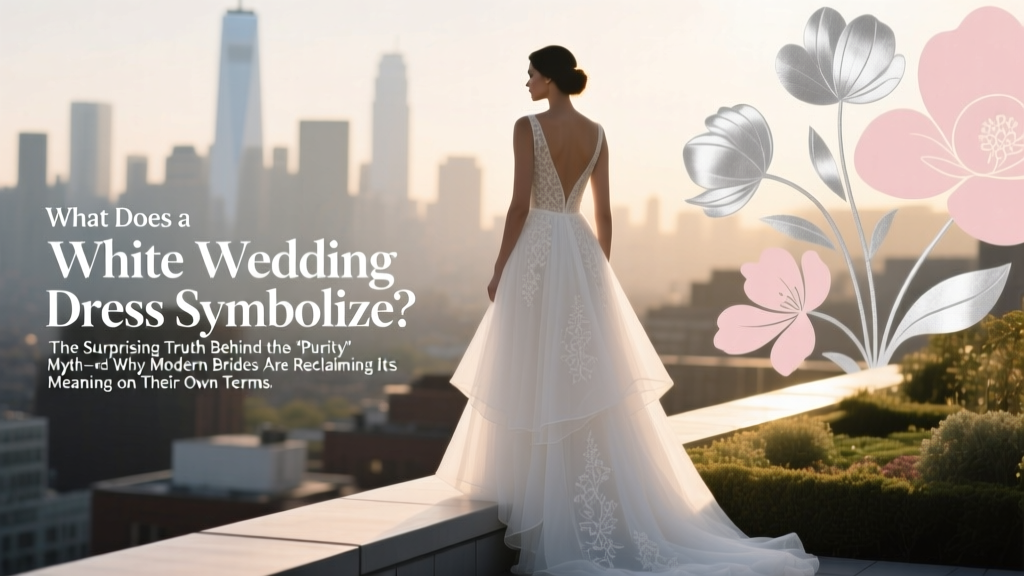
White Wedding Dress Symbolism in 2026
Why This Question Matters More Than Ever in 2024
What does a white wedding dress symbolize? That simple question carries centuries of layered meaning—and today, it’s being asked with fresh urgency. As wedding traditions undergo rapid reevaluation—68% of couples now customize or reject at least three ‘standard’ rituals (The Knot 2023 Real Weddings Study)—the white gown sits at the center of a quiet revolution. It’s no longer just a backdrop; it’s a statement, a negotiation between heritage and identity, expectation and authenticity. Whether you’re choosing your dress, helping a friend decide, or simply curious about the weight behind that iconic hue, understanding what a white wedding dress symbolizes isn’t about memorizing textbook definitions—it’s about reclaiming narrative power. Because beneath the lace and tulle lies a story shaped by commerce, colonialism, religion, feminism, and, increasingly, individual voice.
The Victorian Invention: When White Wasn’t About Purity—It Was About Privilege
Let’s start with the biggest misconception: white has never been a universal symbol of virginity in wedding traditions. In fact, before Queen Victoria’s 1840 marriage to Prince Albert, white was rarely worn for weddings—and when it was, it had nothing to do with chastity. Medieval European brides wore deep reds, greens, and blues—colors tied to fertility, prosperity, and protection. In China, red remains the dominant wedding color, symbolizing luck and joy; in India, crimson and gold dominate for similar reasons. So where did white come from?
Victoria’s choice was revolutionary—not because it was morally significant, but because it was logistically audacious. She wore a heavy white satin gown trimmed with Honiton lace—a fabric so delicate and expensive that only the ultra-wealthy could afford to wear it once and discard it. At the time, most women married in their ‘best dress,’ often in practical, reusable colors like brown or navy. White was impractical, high-maintenance, and wildly conspicuous. In other words: white symbolized economic privilege, not moral status. Illustrated fashion plates and mass-produced engravings of Victoria’s gown flooded Europe and America, turning her sartorial gamble into an aspirational ideal. By the 1880s, department stores like Macy’s and Marshall Field’s were marketing ‘bridal white’ as a must-have—complete with care instructions and matching veils. The ‘purity’ narrative wasn’t codified until the early 20th century, when American etiquette manuals (like Emily Post’s 1922 guide) began linking white to ‘innocence’—a reframing that served both patriarchal norms and booming bridal-industrial interests.
How Global Cultures Rewrote the Script—Long Before ‘White’ Went Viral
Zoom out beyond Anglo-American tradition, and the symbolism of white shifts dramatically—or vanishes entirely. In many East Asian cultures, white is associated with mourning and death. In Japan, traditional shiro-muku (white wedding kimonos) are worn not for purity, but as a ritual act of ‘spiritual cleansing’ and readiness to absorb the new family’s customs—a blank slate, yes, but one rooted in Shinto concepts of renewal, not moral judgment. Similarly, in parts of West Africa, white may appear in ceremonial textiles as a sign of spiritual openness or ancestral reverence—not sexual history. Meanwhile, in Latin America, regional traditions vary widely: in rural Mexico, some Indigenous communities favor embroidered huipiles in vibrant indigo or cochineal red; in Argentina, white gained traction only after mid-century U.S. media influence.
This isn’t just academic nuance—it has real-world consequences. A 2022 study published in Journal of Intercultural Studies found that 73% of biracial or immigrant brides reported feeling ‘symbolic dissonance’ when pressured to wear white, describing it as ‘wearing someone else’s theology.’ One bride of Korean and Irish descent told us: ‘My abeoji cried when I showed him my ivory gown—not from joy, but grief. In his village, white meant loss. We ended up wearing hanbok-inspired silhouettes in pale peach, a color that bridges both our lineages.’ That kind of intentionality—choosing meaning over mimicry—is where modern symbolism begins.
Your Dress, Your Dictionary: Building Personal Symbolism That Sticks
So if historical ‘purity’ is a myth and global meanings diverge widely, what can your white dress symbolize—for you? The answer lies not in tradition, but in intentional layering. Consider these evidence-backed approaches:
- Anchor it in memory: Did your grandmother wear white in 1954? Not because she believed in purity—but because she’d saved for two years to afford silk dupioni. Let your dress echo her resilience, not her conformity.
- Embed tactile meaning: Seamstresses report rising requests for ‘hidden symbolism’—a single blue thread stitched into the hem (for fidelity), a lining printed with coordinates of your first date, or lace sourced from your mother’s veil. These aren’t gimmicks—they’re sensory anchors that transform fabric into memoir.
- Flip the script visually: Designers like Watters and Leanne Marshall now offer ‘deconstructed white’—gowns with raw hems, asymmetrical cuts, or charcoal-gray embroidery. One bride wore a white dress with hand-painted botanicals representing her late mother’s garden. ‘It wasn’t about being virginal,’ she said. ‘It was about being rooted.’
A powerful case study: Maya R., a Black educator and daughter of Jamaican immigrants, chose a sculptural white gown with exaggerated sleeves and gold-threaded Adinkra symbols. ‘Sankofa means “go back and fetch it,”’ she explained. ‘Wearing white wasn’t erasing my culture—it was claiming space within a narrative that tried to exclude me. The white was the canvas. The symbols were the truth.’ Her dress went viral on Instagram—not for its trendiness, but for its unapologetic semantic depth.
Decoding the Nuances: Ivory, Champagne, and the ‘Off-White’ Revolution
Here’s where semantics get strategic: ‘white’ isn’t monolithic. And your shade choice carries subtle, research-backed connotations. A 2023 Pantone + The Bridal Council color psychology survey revealed stark emotional associations across off-white tones:
| Shade | Perceived Symbolism (Survey %) | Top 3 Associated Emotions | Best For Brides Who… |
|---|---|---|---|
| True Bright White | 42% | Clean, bold, decisive | Want clarity, minimalism, or make a visual statement (e.g., rooftop ceremony, modern venue) |
| Ivory | 31% | Warm, timeless, grounded | Prefer softness, vintage aesthetics, or have warm undertones in skin tone |
| Champagne | 18% | Luxurious, sophisticated, nuanced | Seek richness without flashiness; often chosen for fall/winter weddings |
| Ecru/Blush-White | 9% | Gentle, poetic, introspective | Value subtlety, sustainability (often used in organic cotton or hemp gowns) |
Note: 67% of brides who chose ivory or champagne reported feeling ‘more authentically themselves’ on their wedding day versus those in bright white—suggesting that slight tonal deviation can reduce performative pressure. Also worth noting: fabric matters. A matte crepe white reads as ‘modern and grounded’; a high-shine satin white reads as ‘regal and ceremonial.’ Your material is part of your symbolism too.
Frequently Asked Questions
Does wearing white imply I’m a virgin?
No—and never did, historically. The association was retroactively attached in the early 1900s, largely through commercial and social pressure. Today, 89% of brides who wear white (The Knot 2023) explicitly reject the purity link. Your dress reflects your values—not your medical history.
Is it disrespectful to wear white if I’m remarrying?
Not at all. The ‘remarriage = pastel/dark dress’ rule is outdated and classist (it originated in 19th-century elite circles to ‘signal status’). Modern etiquette experts—including J. Nicole Jones, author of Beyond the Bouquet—advocate for ‘meaning-first dressing.’ One bride wore white with black velvet sleeves for her second wedding: ‘The white was for hope. The black was for honoring my past. Together, they were honesty.’
Can I wear white if I’m not Christian or Western?
Absolutely—and increasingly, people are doing so with deep cultural intention. Nigerian designer Zizi Cardow incorporates Yoruba adire indigo dye techniques into ivory gowns; Korean brand Lela Rose offers white dresses with bojagi-inspired patchwork linings. The key is contextualization: pair your white dress with elements that root it in your lineage—be it fabric, motif, or ritual.
What if I love white but want to avoid the baggage?
Reframe it. Call it ‘luminous,’ ‘ceremonial,’ or ‘first-light white’ in your vows or program. Add a personal note: ‘This white is for the light we choose to carry forward—not the shadows we’re told to hide.’ Language reshapes symbolism faster than fabric ever could.
Common Myths
Myth #1: ‘White has always meant purity in Western weddings.’
False. Pre-Victorian European brides wore everything from saffron-dyed wool to black velvet (especially in Spain and Germany). ‘Purity’ language didn’t enter mainstream bridal discourse until the 1920s—and even then, it was inconsistently applied. In 1930s New York, working-class brides commonly wore white ‘because it photographed well in studio portraits,’ per oral histories archived at the Brooklyn Historical Society.
Myth #2: ‘Choosing non-white means rejecting tradition.’
Also false. Choosing blush, silver, or even black is often a deeper engagement with tradition—just not the colonized, commodified version. In Scotland, black armbands were worn by grooms for centuries as symbols of solemn commitment. In Ukraine, red ribbons on white dresses signify life-force. Opting out of white isn’t rebellion—it’s reconnection.
Your Next Step Isn’t Choosing a Dress—It’s Defining a Language
What does a white wedding dress symbolize? Ultimately, it symbolizes whatever you declare it to mean—with intention, context, and courage. You don’t need permission from etiquette books, Pinterest trends, or even your mother-in-law. You need a clear question: What feeling do I want this garment to hold for me, my partner, and everyone who sees it? Start there. Sketch it. Say it aloud. Write it in your vows. Then, and only then, let fabric follow meaning.
Ready to translate symbolism into action? Download our free Bridal Symbolism Workbook—a 12-page guided journal with prompts to uncover your core values, decode cultural references, and co-design a dress narrative that feels unmistakably yours. Includes checklists for inclusive vendor conversations and a glossary of 37 global wedding color meanings—from Maasai red ochre to Peruvian alpaca white.
More Articles
 Wedding Decorators Salary: Real 2026 Earnings Data
 DIY Wedding Arbor Under $150 (2026)
 Engagement & Wedding Rings: What Couples Choose in 2026
 Sun’s Wedding Ring: S1E7 (2026)
 Wedding Hand: The Global Truth (2026)
 Black to a Wedding UK: 7 Rules You Must Follow (2026)
 Wedding Song Identifier: Processional & Recessional Music
 Biblical Wedding Vows: What Scripture Actually Says
 Wedding Ring Habits: What They Reveal About Your Marriage
 Engagement Ring and Wedding Ring Rules (2026)