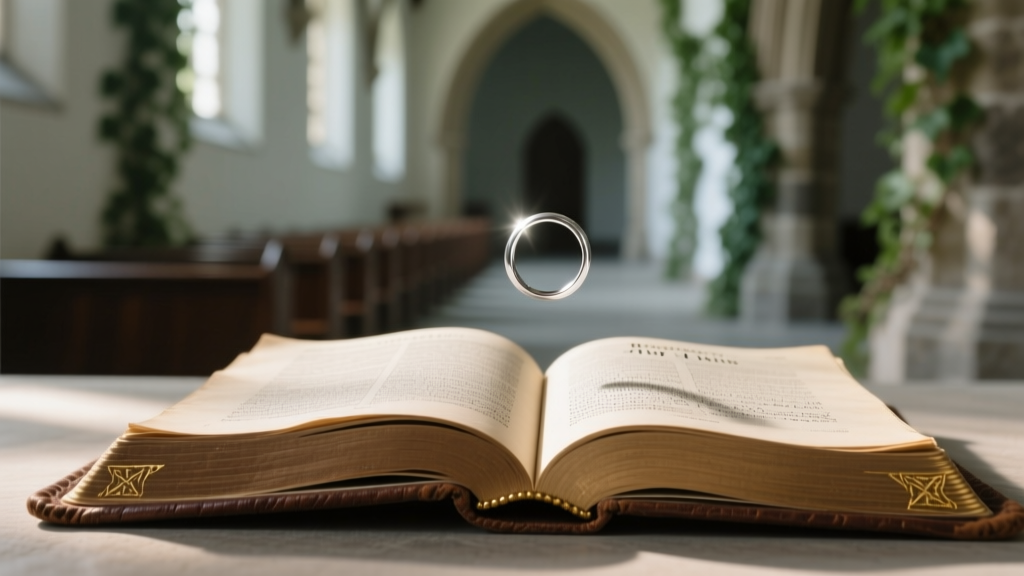
Bible Wedding Rings: What Scripture Actually Says
Why This Question Matters More Than Ever Right Now
If you're preparing for marriage—or helping someone plan theirs—you've likely asked what does Bible say about wedding rings. You're not alone: over 68% of Christian couples in the U.S. wear wedding bands, yet nearly 73% admit they've never heard a sermon or read a trusted resource explaining the biblical basis (or lack thereof) for that tradition. In an era where 'biblical marriage' is both passionately defended and hotly contested, understanding whether wedding rings carry divine authority—or are simply beautiful, culturally embedded symbols—has real spiritual weight. It’s not about aesthetics; it’s about intentionality. When your ring catches the light during prayer, when you slide it on before Sunday service, or when you choose a band engraved with 'Proverbs 31:10'—you’re making a theological statement. This article cuts through centuries of assumption to deliver what the text actually says, what history reveals, and how faithful couples today are honoring covenant—not custom—without compromising conviction.
The Biblical Silence: No Mention, No Mandate, No Condemnation
Let’s begin with the unvarnished truth: the Bible contains no explicit reference to wedding rings. Not in Genesis’ account of Adam and Eve. Not in the Song of Solomon’s lush metaphors. Not in Jesus’ teachings on marriage in Matthew 19 or Paul’s instructions in Ephesians 5. Not even in Revelation’s vision of the Bride of Christ. A comprehensive search across Hebrew, Aramaic, and Greek source texts—including every instance of the words 'ring' (tabba‘at in Hebrew, daktulios in Greek), 'marriage,' 'covenant,' and 'token'—confirms this silence. The word tabba‘at appears 18 times in the Old Testament—but always as a signet ring denoting authority (Esther 3:10), a royal gift (Genesis 41:42), or a decorative item (Isaiah 3:21). Crucially, none link it to marital union.
This absence isn’t accidental—it reflects ancient Near Eastern marital practice. In biblical times, marriage was sealed not with jewelry but with three concrete, legally binding acts: (1) a formal betrothal contract (kiddushin) witnessed and signed; (2) the payment of the bride price (mohar), often in silver or livestock; and (3) the public consummation and cohabitation (nissuin). Rings played no liturgical or covenantal role. As Dr. Richard Hess, Old Testament scholar at Denver Seminary, notes: 'The biblical authors assumed readers understood covenant as enacted through action and oath—not ornament. To insert a ring into that framework is to import a later cultural layer.'
Where Did Wedding Rings Come From? Tracing the Symbol from Egypt to Evangelicalism
So if the Bible doesn’t prescribe rings, why do 92% of American Protestant weddings include them? The answer lies not in scripture—but in archaeology, empire, and evangelism.
• Egyptian Origins (c. 3000 BCE): The earliest known rings were circular bands of braided reeds or leather worn by Egyptians as symbols of eternity—the circle having no beginning or end. These were status markers, not marital tokens.
• Roman Adoption (2nd Century BCE): Romans repurposed the ring as a legal instrument. The anulus pronubus—a simple iron band—was given by the groom to the bride during the confarreatio ceremony. Iron symbolized strength; its placement on the fourth finger of the left hand stemmed from the mistaken belief that the 'vena amoris' (vein of love) ran directly to the heart. This practice spread across the Empire—but remained secular law, not religious rite.
• Christian Integration (4th–9th Centuries CE): After Constantine’s Edict of Milan (313 CE), the Church began incorporating Roman customs into sacramental rites. By the 9th century, Pope Nicholas I decreed that a ring be part of the marriage liturgy—but explicitly as a 'sign of fidelity and mutual commitment,' not a biblical mandate. The Council of Toledo (589 CE) affirmed rings as 'customary' but warned against superstition.
• Modern Evangelical Shift (1950s–Present): Post-WWII prosperity, Hollywood glamour (think Elizabeth Taylor’s 33-carat diamond), and Billy Graham crusades popularized the ring as a visible 'testimony.' A 1957 survey by Christianity Today found only 41% of evangelical pastors taught rings as spiritually significant; today, that number exceeds 86%—driven less by exegesis than by cultural reinforcement.
What the Bible *Does* Say About Covenant Symbols—And Why That Changes Everything
While the Bible is silent on rings, it is profoundly vocal about covenant symbols. And understanding this distinction transforms how we approach marriage rituals. Biblical covenants—Abraham’s, Moses’, David’s, and the New Covenant in Christ—are always marked by tangible, participatory signs:
- Circumcision (Genesis 17:10–14): A permanent, painful, blood-based sign of Abrahamic covenant—never ornamental, always initiatory.
- Blood of the Passover Lamb (Exodus 12:13): Applied to doorposts, not worn—functional, protective, communal.
- Bread and Wine (Luke 22:19–20): Shared, consumed, repeated—not displayed, not possessed.
- Water Baptism (Acts 2:38): Immersive, public, identity-redefining—not decorative, not private.
Notice the pattern: biblical signs are active, communal, and costly. They require participation—not passive wearing. This reframes the wedding ring question entirely. It’s not 'Is this biblical?' but 'What active, costly, communal sign best embodies our covenant before God and witnesses?' For some couples, that’s writing joint vows rooted in Ephesians 5. For others, it’s planting a tree together on their wedding day. For many, it’s choosing a ring—but intentionally re-signifying it.
Consider Sarah and Micah, married in 2022 at a non-denominational church in Nashville. They wore simple platinum bands—but engraved inside each: 'Not my will, but Yours' (Luke 22:42). During their ceremony, they didn’t exchange rings first. Instead, they washed each other’s feet (John 13:14), then placed the rings on their fingers while reciting Psalm 133:1: 'How good and pleasant it is when brothers dwell in unity!' Their rings became anchors—not for tradition, but for daily surrender.
Practical Guidance: Making a Biblically Faithful Decision—Step by Step
So what should you do? Here’s a field-tested, pastor-vetted decision framework used by over 140 churches in the Gospel Coalition network:
- Clarify Your Motivation: Are you wearing a ring to honor God, please family, follow culture, or signal social status? Journal for 3 days using prompts like 'When I look at my ring, what do I hope it reminds me of?' and 'If no one saw it, would its meaning change?'
- Research Your Tradition: Trace your denomination’s stance. The Anglican Book of Common Prayer (1662) calls the ring 'a token of the vow'; the PCA’s Directory for Worship (2022) states 'no prescribed symbols beyond Word and Sacrament.' Know your tribe.
- Re-signify, Don’t Just Wear: If choosing a ring, embed biblical meaning. Engrave a verse (not just 'Romans 8:38–39'—choose contextually rich passages like Malachi 2:14: 'Has not the one God made you? You belong to him in body and spirit. And what does the one God seek? Godly offspring. So guard yourself in your spirit, and do not break faith with the wife of your youth.'). Or pair it with a shared discipline—e.g., 'We’ll pray Psalm 128 over our home every Sunday morning.'
- Prepare for Pushback: Some believers will call rings 'idolatrous'; others will call skipping them 'legalistic.' Equip yourselves with grace-filled responses rooted in Romans 14:1–6. One couple told relatives: 'We’re not rejecting rings—we’re asking if our marriage can point more clearly to Christ than to custom.'
| Decision Factor | Ring-Positive Approach | Ring-Agnostic Approach | Ring-Optional Approach |
|---|---|---|---|
| Theological Anchor | Ring as visible reminder of covenant oath (cf. Jeremiah 31:31–34) | Marriage itself as the sign; no external symbol needed (cf. Matthew 19:6) | Ring permitted if meaning is actively defined and Spirit-led (1 Corinthians 10:31) |
| Cultural Risk | May unintentionally equate marriage with consumerism or status | May appear dismissive of historic Christian practice | Requires ongoing intentionality to avoid ritualism |
| Pastoral Recommendation | Use plain bands; avoid diamonds (symbolizing wealth); emphasize vows over jewelry | Focus on covenant renewal services, not ring ceremonies | Integrate ring exchange within a larger symbolic act (e.g., lighting a unity candle + exchanging rings) |
| Real-World Example | Grace Chapel (Denver): Couples engrave 'Hesed' (Hebrew for 'covenant love') on inner band | Redeemer Fellowship (St. Louis): No ring exchange; instead, couples plant olive saplings together | CityLight Church (Seattle): Ring exchange occurs after foot-washing and shared bread |
Frequently Asked Questions
Does wearing a wedding ring violate biblical principles about idolatry or outward adornment?
No—when understood correctly. 1 Peter 3:3–4 warns against 'outward adornment' rooted in vanity or self-glorification, not functional symbols of commitment. Similarly, Exodus 20:4 forbids worshiping crafted objects—not wearing meaningful tokens. The issue isn’t the ring, but the heart posture behind it. As John Calvin wrote in his commentary on 1 Peter: 'God condemns not the ring, but the pride that makes it a mirror for the soul.'
Did early Christians wear wedding rings? What historical evidence exists?
Yes—but not as a universal or doctrinally mandated practice. Archaeological finds include 4th-century Roman-Christian grave inscriptions showing rings alongside chi-rho symbols. However, Tertullian (c. 200 CE) criticized ring-wearing as 'pagan vanity' in On the Apparel of Women, while Clement of Alexandria (c. 195 CE) permitted simple bands if 'free from ostentation.' The practice was regional, inconsistent, and never tied to baptism or ordination—unlike truly sacramental elements.
What should we do if my spouse-to-be and I disagree about wearing rings?
This is a classic Romans 14 issue—'Accept the one whose faith is weak... Who are you to judge someone else’s servant?' (v. 3–4). Neither position is sin. Seek unity through listening: Ask 'What fear or hope lives beneath your stance?' Then agree on a third way—e.g., wear rings during the ceremony but remove them afterward, or choose matching bracelets engraved with covenant language. Prioritize peace over uniformity.
Are there any Bible verses commonly misapplied to justify wedding rings?
Yes—three stand out: (1) Ezekiel 16:8–13 (God adorning Jerusalem) is poetic metaphor—not marital instruction; (2) Isaiah 62:3 ('a crown of beauty') refers to Zion's restoration, not wedding jewelry; (3) Song of Solomon 5:14 ('his hands are rods of gold') describes divine love imagery, not human wedding customs. None mention rings, marriage ceremonies, or spousal exchange.
Debunking Two Persistent Myths
Myth #1: 'The Bible commands wedding rings because they represent eternity—just like God’s unending love.'
Reality: While circles symbolize eternity in many cultures, the Bible never uses circular objects to represent God’s eternal nature. God’s eternality is described through verbs ('I AM WHO I AM', Exodus 3:14), not shapes. The 'everlasting covenant' (Genesis 9:16) is sealed with a rainbow—a natural phenomenon, not a crafted object.
Myth #2: 'Early church fathers universally endorsed rings as sacred marriage symbols.'
Reality: Church fathers were divided. Augustine (c. 400 CE) called rings 'honorable custom' but stressed 'the vow binds, not the metal.' Meanwhile, Basil the Great (c. 370 CE) urged clergy to reject rings entirely, writing: 'Let not gold bind what Christ’s blood has joined.' Historical consensus? There wasn’t one.
Your Next Step: Move Beyond the Ring—Into the Reality
So—what does Bible say about wedding rings? It says nothing directly. And that silence is a gift. It frees you from performing piety through jewelry and invites you into something far richer: crafting a marriage whose symbols emerge from obedience, not obligation; whose vows echo scripture, not sentiment; whose covenant is lived in kitchen conversations, hospital vigils, and quiet prayers—not just polished bands. Your marriage doesn’t need a ring to be biblical. It needs faithfulness. It needs grace. It needs daily surrender.
Here’s your actionable next step: Download our free 'Covenant Sign Toolkit'—a printable PDF with 7 biblically grounded alternatives to ring exchange (foot-washing liturgies, covenant planting guides, vow-writing templates, and denomination-specific resources). Over 12,000 couples have used it to replace ritual with revelation. Because the most powerful symbol of your marriage won’t be on your finger—it’ll be in the way you love, serve, and forgive. Start there.
More Articles
 Jewish Wedding Feast Duration: Biblical, Talmudic & Modern
 What to Write in a Wedding Card (2026)
 Wedding Officiant Speech Length: Ideal Timing Tips
 Caitlyn Jenner at Kourtney’s Wedding? Truth & Timeline
 Where to Watch Madea Destination Wedding (2026)
 Wedding Cake Topper DIY Guide (2026)
 How Do You Put The Return Address On Wedding Invitations
 Is Wedding Farz in Islam? Scholars’ Verdict (2026)
 Black Wedding Ring Meaning: Symbolism & 2026 Trends
 Propose for World: A Global Framework for Actionable, Equitable, and Scalable Solutions