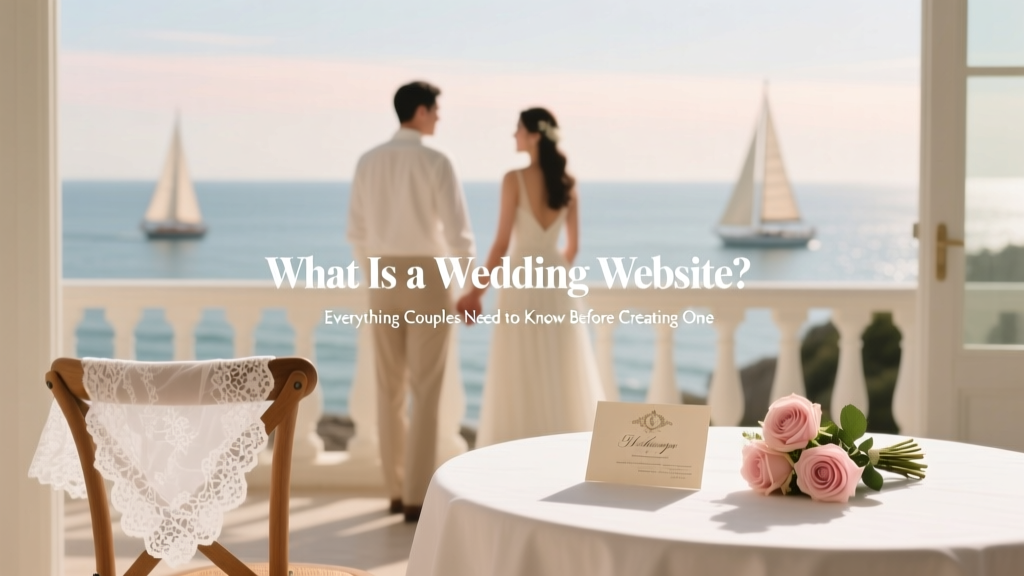
# What Is a Wedding Website? Everything Couples Need to Know Before Creating One
Planning a wedding means managing a flood of questions from guests — where is the venue? What should I wear? Can I bring a plus-one? A wedding website answers all of it in one place, 24/7, without a single phone call. Over 80% of couples now create one, and guests have come to expect it. Here's everything you need to know.
## What a Wedding Website Actually Is
A wedding website is a personalized webpage — or small multi-page site — dedicated entirely to your wedding. It acts as a central hub where guests can find:
- **Date, time, and venue details** with maps and directions
- **RSVP functionality** (replacing or supplementing paper cards)
- **Accommodation and travel info** for out-of-town guests
- **Your love story and wedding party bios**
- **Registry links** in one convenient location
- **FAQs** covering dress code, parking, kids policy, and more
Platforms like Zola, The Knot, and Joy offer free templates you can launch in under an hour. Custom domains (e.g., `sarahandjames2026.com`) typically cost $10–20/year and add a polished touch.
## Why Every Couple Needs One
A wedding website isn't just a nice-to-have — it actively reduces stress for both you and your guests.
**For couples:**
- Cuts down on repetitive guest inquiries by up to 70%
- Centralizes RSVP tracking with real-time counts
- Easy to update if details change (venue, time, COVID policies)
- Free or very low cost compared to printed inserts
**For guests:**
- Accessible on any device, any time
- No lost paper invitations
- Can share with family members who weren't on the original invite list
Most couples launch their site when they send save-the-dates — typically 6–12 months before the wedding — and keep it live through the honeymoon.
## What to Include (and What to Skip)
**Must-haves:**
1. Event details (ceremony + reception, with separate addresses if different)
2. RSVP form with meal preference and dietary restriction fields
3. Hotel room block information with booking deadlines
4. Registry links (2–3 registries maximum)
5. A contact email for questions
**Nice-to-haves:**
- Photo gallery of the couple
- Wedding party introductions
- Itinerary for destination weddings
- Local restaurant and activity recommendations
**Skip:**
- Overly detailed love stories that run 1,000+ words
- Too many registry links (feels greedy)
- Autoplay music (universally disliked)
## How to Choose the Right Platform
| Platform | Best For | Cost |
|----------|----------|------|
| Zola | Modern design + registry integration | Free |
| The Knot | Comprehensive planning tools | Free |
| Joy | Guest messaging + app | Free |
| Squarespace | Full design control | ~$16/mo |
| Wix | Drag-and-drop flexibility | Free–$17/mo |
For most couples, Zola or The Knot is the right call — they're free, fast to set up, and handle RSVPs elegantly. Only go custom (Squarespace, Wix) if design is a top priority.
## Common Mistakes to Avoid
**Myth #1: "We don't need a website — we'll just text everyone."**
Texting works for your inner circle, but extended family, coworkers, and plus-ones won't have your number. A website ensures *every* guest has access to accurate, up-to-date information without you playing telephone.
**Myth #2: "Setting up a wedding website is complicated and expensive."**
Modern platforms require zero coding knowledge and are completely free. Most couples have a fully functional site live within 30–60 minutes of starting. The only optional cost is a custom domain, which runs about $15/year.
## Start Your Wedding Website Today
A wedding website is one of the highest-ROI moves in wedding planning — it saves you hours of repeated communication, keeps guests informed, and creates a lasting digital keepsake of your day. Pick a platform, grab your venue details, and get it live before your save-the-dates go out. Your future self (and your guests) will thank you.
 Did Gwen Attend Christine’s Wedding? The Truth (2026)
 What Episode Is Blair's Wedding? (S4E24) — Explained
 Is It Haram to Attend a Church Wedding? (2026)
 Promise Rings on Wedding Finger? Truth About Placement
 Smriti Mandhana Wedding Cancelled? The Truth (2026)
 Should Christians Wear Wedding Rings? (2026)
 Who Designed Lauren Sanchez Wedding Dress? (2026)
 25th Wedding Anniversary: Silver Meaning & 2026 Ideas
 Black to a Wedding: Elegant, Respectful & Preferred (2026)
 Church Wedding Without Baptism: Truth & Options