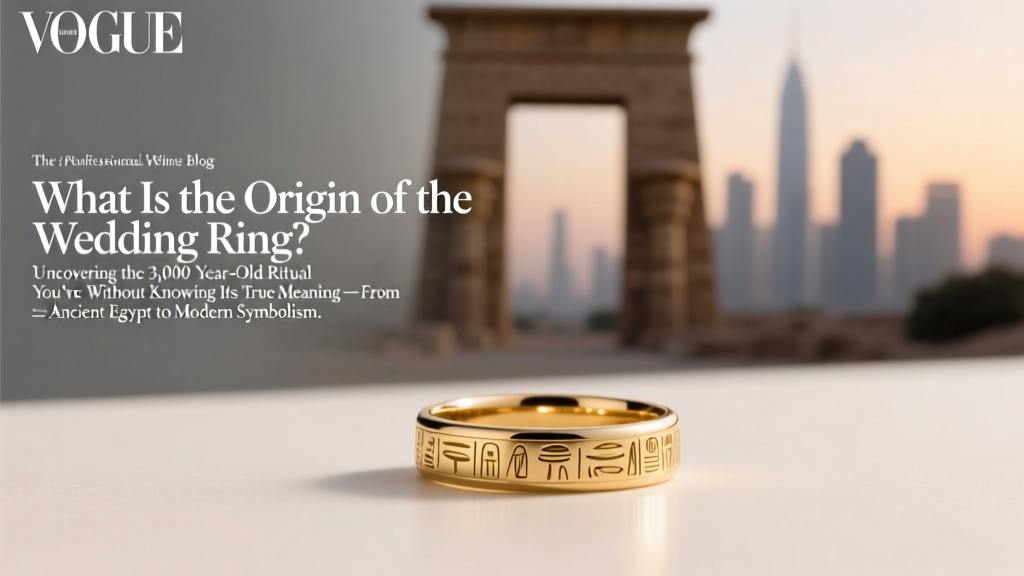
Wedding Ring Origin: Ancient Roots to Modern Symbolism
Why This Ancient Circle Still Captures Our Hearts Today
What is the origin of the wedding ring? That simple question opens a door into millennia of human ritual, power dynamics, spiritual belief, and even economic policy. Far from being a timeless ‘tradition’ handed down unchanged, the wedding ring is a living artifact — reshaped by empires, reinterpreted by religions, and repackaged by marketers. In an era where couples increasingly customize vows, venues, and even ring metals (hello, lab-grown moissanite and recycled platinum), understanding what is the origin of the wedding ring isn’t just academic — it’s empowering. It helps you decide whether to honor a symbol with intention, adapt it meaningfully, or create something entirely new. And the truth? The story starts not with romance — but with cattle, contracts, and cosmic geometry.
Ancient Egypt: Where the Circle Began (and Why It Wasn’t Gold)
The earliest archaeological evidence of ring-wearing for marital symbolism dates to ancient Egypt around 3100 BCE — over 5,000 years ago. But these weren’t the polished gold bands we recognize today. Egyptian ‘rings’ were woven from braided reeds, hemp, or papyrus — perishable materials chosen deliberately. Why? Because the circle had no beginning and no end — a physical manifestation of eternity, mirroring the sun god Ra’s daily journey and the Nile’s cyclical flooding. Crucially, Egyptians wore rings on the fourth finger of the left hand, believing a vein — the *vena amoris*, or ‘vein of love’ — ran directly from that finger to the heart. Modern anatomy disproves this (all fingers have similar vascular pathways), but the poetic idea stuck — and shaped Western practice for centuries.
Yet here’s what most gloss over: Egyptian rings weren’t gifts of love. They were tokens of economic agreement. When a man offered a ring, he wasn’t declaring devotion — he was signaling his ability to provide. The size, tightness, and durability of the band reflected his wealth and reliability. A loose reed ring? A temporary arrangement. A tightly woven palm-fiber band? A serious commitment. This functional origin explains why early rings lacked stones — gems were rare, expensive, and reserved for royalty or deities. The ring’s value lay in its form, not its material.
Rome: From Love Token to Legal Contract
The Romans adopted and transformed the Egyptian custom — adding iron, law, and social hierarchy. By 200 BCE, Roman men presented their brides with *annulari*, plain iron bands called *bulla* or *fede* (‘faith’) rings. Iron was chosen not for beauty, but for strength and permanence — symbolizing the unbreakable bond of marriage under Roman civil law. More importantly, the ring became legally binding. According to the jurist Gaius, exchanging a ring during the *sponsalia* (betrothal ceremony) created a formal contract enforceable in court. Breach meant financial penalties — sometimes double the ring’s weight in silver.
A fascinating twist: Roman women wore rings on the right hand — not the left. Why? Because the right hand was associated with oaths, justice, and public action (think of raising your right hand in court). This practice persisted across much of continental Europe until the Middle Ages. Even Charlemagne’s 9th-century capitularies referenced ‘the ring placed upon the right hand’ as proof of marital consent. So when you see Renaissance portraits of nobles wearing rings on their right hands — that’s not a fashion error. It’s documented legal tradition.
By the 2nd century CE, gold began replacing iron among the elite — not as a romantic upgrade, but as a status marker. Roman law forbade non-senatorial classes from wearing gold rings. So a gold wedding ring wasn’t about love; it was a walking ID card confirming aristocratic rank. This class-based symbolism would echo through European jewelry laws for nearly a millennium.
Medieval Europe: Faith, Fear, and the Rise of the Gemstone
The fall of Rome fragmented ring traditions — until the Catholic Church stepped in. In the 9th century, Pope Nicholas I declared that a ring was essential for a valid marriage, cementing its sacramental role. But the Church didn’t just bless the ring — it redesigned it. Medieval liturgical manuals specified the ring must be made of ‘pure, unbroken gold’ — no alloys, no stones — to represent Christ’s unblemished love. The circular shape was now explicitly tied to divine perfection, echoing St. Augustine’s writings on God as ‘the Alpha and Omega, the Beginning and the End.’
Then came the Black Death. Between 1347–1351, Europe lost 30–60% of its population. Labor shortages empowered peasants, inflation soared, and surviving elites sought new ways to display continuity and control. Enter the *posy ring*: inscribed with short poems (‘posies’) in French or Latin, like ‘God me guide’ or ‘My love is true.’ These weren’t sentimental — they were apotropaic. People believed engraved words could ward off plague, witchcraft, and misfortune. Over 1,200 posy rings survive in UK museums alone, many recovered from Thames mudlarking — tangible proof that rings became portable talismans during existential crisis.
Gemstones entered mainstream wedding rings only after 1477 — when Archduke Maximilian I of Austria commissioned the first documented diamond engagement ring for Mary of Burgundy. Diamonds weren’t chosen for sparkle, but for their legendary hardness — symbolizing unconquerable fidelity. Yet for 300 years, diamond wedding rings remained vanishingly rare. Most couples used garnets (symbolizing constancy), sapphires (divine favor), or rubies (passion and protection). It wasn’t until De Beers’ 1947 ‘A Diamond Is Forever’ campaign — backed by $30M in mid-century ad spend — that diamonds became synonymous with marriage. Before that, only 10% of U.S. brides received diamond rings. Today? Over 78% do — a shift driven less by history and more by 20th-century marketing.
Global Variations: Why ‘Tradition’ Depends on Where You Stand
Assuming the ‘wedding ring tradition’ is universal is one of the biggest misconceptions in modern matrimony. In India, married women wear toe rings (*bichiya*) and red sindoor powder — not finger rings. In Orthodox Jewish ceremonies, the groom places a plain gold band on the bride’s index finger (not the fourth), citing Talmudic law requiring visible, unobstructed placement. In Norway and Germany, many couples wear rings on the right hand — a holdover from Roman practice still legally recognized. And in Brazil, it’s common to wear the engagement ring on the right hand and switch it to the left after marriage — a fluid, intentional transition.
This geographic diversity matters because it reveals the wedding ring’s core function: it’s a local language of commitment. Its meaning isn’t encoded in metal, but in shared cultural grammar. When a South Korean couple chooses a platinum band with a cherry blossom engraving, they’re speaking Korean aesthetics and Confucian values — not Egyptian cosmology. Understanding what is the origin of the wedding ring helps you decode that grammar, so you can speak your own truth — whether that means wearing your grandmother’s 1923 Art Deco band, commissioning a ring forged from meteorite iron, or choosing no ring at all.
| Era/Culture | Material | Finger/Hand | Primary Symbolism | Legal/Social Function |
|---|---|---|---|---|
| Ancient Egypt (c. 3100 BCE) | Braided reeds, papyrus | Left hand, fourth finger | Eternity (circular shape); ‘vein of love’ myth | Economic pledge; indicator of provider status |
| Roman Republic (c. 200 BCE) | Iron (later gold for elites) | Right hand | Strength, permanence, fidelity | Legally binding betrothal contract |
| Medieval Catholic Europe (9th–15th c.) | Pure gold, unadorned | Left hand, fourth finger (increasingly) | Divine perfection; Christ’s eternal love | Sacramental requirement for valid marriage |
| Victorian England (1837–1901) | Gold, often with seed pearls or turquoise | Left hand, fourth finger | Mourning, sentimentality, moral virtue | Public declaration of respectability |
| Modern Global (Post-1947) | Diamond-set gold/platinum; alternatives rising | Left hand (Western norm); variable elsewhere | Love, luxury, enduring partnership | Consumer ritual; social expectation; identity marker |
Frequently Asked Questions
Did ancient Greeks use wedding rings?
No — ancient Greeks did not exchange wedding rings as part of marriage rites. While they wore ornate finger rings for status and adornment (often with intaglio carvings), these had no marital symbolism. Greek marriage contracts focused on dowry transfers and civic registration, not symbolic jewelry. The ring tradition entered Greece later, via Roman occupation and Byzantine Christian liturgy.
Why is the wedding ring worn on the fourth finger?
The fourth-finger tradition stems from the ancient Egyptian ‘vena amoris’ myth — the belief that a vein ran straight from that finger to the heart. Though anatomically false (all fingers have similar venous return paths), the idea was popularized by Roman writers like Pliny the Elder and cemented in medieval Europe through liturgical texts. Cultural reinforcement — not biology — made it standard.
When did men start wearing wedding rings?
Men’s wedding bands emerged widely only during World War II. With millions of soldiers deployed overseas, wearing a ring became a visible sign of fidelity and connection to home. U.S. military suppliers mass-produced simple gold bands, and returning GIs normalized the practice. Before 1940, fewer than 15% of American grooms wore rings; by 1950, it exceeded 80%. It was practical symbolism born of separation — not ancient tradition.
Are wedding rings mentioned in the Bible?
No — the Bible contains no instruction, description, or endorsement of wedding rings. References to rings (e.g., Pharaoh giving Joseph his signet ring in Genesis 41:42) signify authority or favor, not marriage. Early Christian weddings used veils, crowns, or shared cups — rings entered liturgy gradually between the 8th and 11th centuries, via regional customs, not scripture.
Do same-sex couples follow the same ring origins?
Historically, no — same-sex unions weren’t legally or ritually recognized in most cultures where the ring tradition developed. Modern LGBTQ+ couples consciously adopt, adapt, or reject the symbol. Many choose matching bands to claim equal visibility; others opt for asymmetrical designs or non-ring tokens (like engraved bracelets) to reflect their unique relationship narrative — turning historical exclusion into intentional reclamation.
Debunking Two Persistent Myths
- Myth #1: “The wedding ring has always symbolized romantic love.” Reality: For over 3,000 years, its primary meanings were economic security (Egypt), legal obligation (Rome), divine covenant (Medieval Church), or social conformity (Victorian era). Romantic love as the central justification is largely a 20th-century reframing — accelerated by Hollywood and advertising.
- Myth #2: “Wearing the ring on the left hand is universal and ancient.” Reality: The left-hand norm is geographically limited to English-speaking countries, France, and parts of Latin America. Over 60 countries — including Russia, India, Greece, and Spain — traditionally use the right hand. The ‘left-hand rule’ was codified in England only in the 16th century via the Book of Common Prayer, and globally standardized through British colonial influence — not divine decree or biological fact.
Your Ring, Your Story — What Comes Next?
Now that you know what is the origin of the wedding ring — from papyrus bands to platinum contracts — you hold something powerful: context. History doesn’t dictate your choices; it equips you to make them with clarity. Whether you choose a vintage Egyptian-inspired band, a fair-trade gold ring with ethically sourced stones, or no ring at all, your decision gains depth when rooted in awareness, not assumption. So take the next step intentionally: Visit a local jeweler who specializes in historical reproductions — ask about sourcing, symbolism, and customization options. Or explore our Guide to Ethical Wedding Rings, which breaks down certifications, metal origins, and artisan partnerships with real supply-chain transparency. Because the most meaningful ring isn’t the one with the longest history — it’s the one that tells your truth.
More Articles
 Black to a Wedding UK: 7 Rules You Must Follow (2026)
 Did Tuohys Attend Michael’s Wedding? (2026)
 Why Did They Stop Throwing Rice at Weddings?
 Jewish Wedding Feast Duration: Biblical, Talmudic & Modern
 Vegas Weddings Legal? 5 Mistakes That Void Your License
 American Wedding" on Spotify? (2026) | Truth & Where to Hear
 Wedding Card Congratulations That Move People (2026)
 Did Kathy Attend Farrah's Wedding? The Truth
 Who Buys Wedding Rings in 2026? Data & Trends
 A Wedding and a Murderer Episodes (2026)