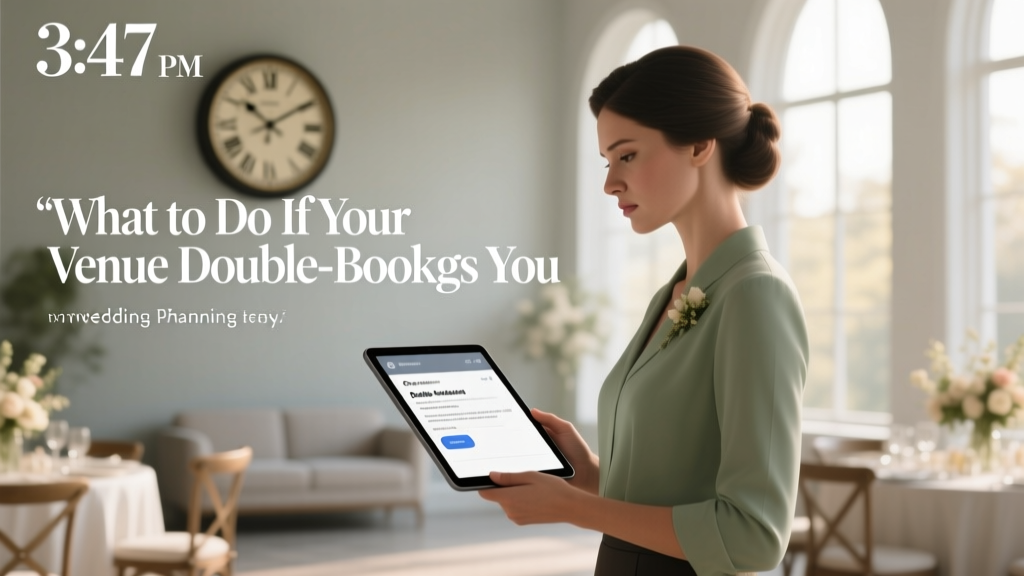
What to Do If Your Venue Double-Books You
You’ve picked the perfect wedding venue, signed the contract, paid your deposit, and finally exhaled—until you get an email or call that makes your stomach drop: the venue has double-booked your wedding date. It’s one of the most stressful wedding planning problems because it can affect everything downstream: your ceremony timeline, vendors, guest travel plans, and your peace of mind.
If this happens, you’re not alone. With packed post-pandemic wedding calendars, micro-weddings, weekday celebrations, and venues juggling more events than ever, double-bookings do occur—sometimes from a simple admin error, sometimes from unclear “holds,” and sometimes from venues trying to maximize revenue. The good news: you have options, and you can handle this in a way that protects your day and your budget.
Quick Answer: What should you do first?
Act fast, stay calm, and put everything in writing. Ask the venue to confirm the double-booking details immediately, pull your contract, and request a written plan for how they’ll make it right—whether that means honoring your reservation, relocating you to an equivalent (or upgraded) space, or providing a full refund plus compensation for any additional costs. Your goal is to protect your date (if that’s the priority) or your specific venue (if that’s the priority) while minimizing disruption.
Q: How do I confirm what happened without making things worse?
A: Start by gathering facts, not accusations. Send a concise email and request a call if needed. You want a clear record for your wedding contract dispute protection.
Ask these questions:
- “Can you confirm in writing whether our date is fully booked and what events are scheduled?”
- “Do you have our signed contract and payment history on file?”
- “Was our date confirmed or placed on hold, and when was it entered into your system?”
- “What solutions are you offering, and by when can we decide?”
Wedding planner “Maya L.,” (fictional) puts it this way: Stay polite, but be specific. Venues respond faster when you show you’re organized and you understand your contract.
Q: What does my contract usually say—and what should I look for?
A: Your venue contract is your roadmap. Look for:
- Date and space guaranteed: Does it list your exact date and the specific ballroom/garden/room? Or does it say “a comparable space”?
- Force majeure clause: This covers events like natural disasters—not typically a scheduling mistake. Double-booking usually isn’t protected by force majeure.
- Cancellation and refund terms: What happens if the venue cancels? Some contracts include remedies like full refund plus liability limits.
- Damages limits: Some venues cap what they’ll pay even if they breach. This affects how hard you negotiate and whether you seek legal help.
- Communication clause: Does it require changes to be made in writing?
If you’re unsure, consider having a local attorney review it quickly. Even one hour of legal advice can clarify whether you’re dealing with a breach of contract and what leverage you have.
Q: What are my best-case solutions if the venue double-books my wedding date?
A: Most couples land in one of these outcomes, depending on priorities and flexibility:
Scenario 1: The venue honors your booking (ideal)
If you have a signed contract and paid deposit, the venue should typically honor your reservation. Sometimes the venue moves the other event, especially if yours was confirmed first or if the other party was only on a tentative hold.
A realistic couple experience (fictional): We had a signed agreement and receipts. Once we forwarded everything, the venue admitted it was an internal calendar error and relocated the other event to their sister property.
— “Jenna & Luis”
Scenario 2: You’re offered an equivalent or upgraded space
For venues with multiple rooms or partner properties, they may offer a different space. If you consider it, ask for:
- Same guest capacity (comfortably, not “technically”)
- Same prime-time hours and access for setup
- No extra fees for the change
- Upgrades to make it worthwhile (better suite, extra hour, premium bar package, upgraded linens, included ceremony space)
Modern etiquette note: It’s okay to ask for upgrades. You’re not being difficult—you’re restoring the value you contracted for.
Scenario 3: You keep the date but change venues (common in peak season)
If your date is the non-negotiable piece (for family travel, school calendars, military leave, or cultural considerations), prioritize locking a new venue fast. Ask the venue that double-booked you to provide:
- A full refund immediately (deposit and any payments)
- A letter acknowledging they canceled due to double-booking (helpful for vendor negotiations)
- Referrals to comparable venues with availability
- Compensation for cost differences where reasonable (especially if their error forces a higher-priced venue)
Scenario 4: You change the date to keep the venue (traditional approach)
Some couples are deeply attached to the venue’s meaning—maybe it’s where you got engaged, or it fits your vision perfectly. In that case, ask for perks in exchange for moving your date: reduced site fee, complimentary upgrades, or an off-peak rate applied to a new date.
Traditional etiquette leans toward accommodating the venue if they’re apologetic and solutions are fair. Modern etiquette says your inconvenience has value—don’t absorb all the burden alone.
Q: How do I negotiate with the venue without burning bridges?
A: Use calm, clear language and focus on outcomes. Here’s a script you can adapt:
We’re disappointed to hear our wedding date was double-booked. We have a signed contract for [date] and [space]. Please confirm by [time/day] how you will honor our reservation or provide an equivalent solution. If you’re unable to accommodate our event as contracted, we’ll need a full refund plus reimbursement for documented additional costs we incur due to this cancellation.
Ask for one point of contact (usually the general manager), and follow every phone call with a recap email. That paper trail matters if things escalate.
Q: What should I do today—step by step?
A: Here’s a practical checklist for handling a venue double-booking:
- Pull your paperwork: Contract, invoices, receipts, emails, and any notes about the date confirmation.
- Request written confirmation: Get the venue to acknowledge the double-booking and outline their proposed solutions.
- Pause other payments: Don’t pay additional installments until the venue confirms your event is secure.
- Call your planner (or designate a helper): If you have a wedding planner, let them take point. If not, assign a trusted friend to help gather alternatives.
- Soft-hold backup options: Reach out to one to three comparable venues immediately. Ask about cancellations and “last-minute openings,” especially for popular wedding dates.
- Loop in key vendors: If you might change venues, check whether your photographer, caterer, and DJ are flexible about location and load-in requirements.
- Decide your priority: Date vs. venue vs. budget. The right answer depends on which one matters most to you.
- Get the final agreement in writing: If you accept a new space or date, update the contract and confirm all revised terms and upgrades.
How current wedding trends affect double-booking (and your options)
Right now, weddings are more flexible than ever—weekday weddings, Sunday brunch receptions, restaurant buyouts, backyard weddings with rental tents, and “ceremony now, party later” plans are all mainstream. That’s helpful because it creates more realistic alternatives if a venue issue pops up.
At the same time, venues are hosting more mixed-use events: corporate retreats, milestone birthdays, and styled shoots. That increases scheduling complexity. Couples are also booking further out, and some venues accept “tentative holds” that aren’t always tracked cleanly. Translation: you’ll want your confirmation, payment receipts, and venue contract language organized and easy to forward.
Related questions couples ask (edge cases)
Q: What if the venue says we were only “tentatively” booked?
A: Ask for the written policy on holds and what triggers confirmation. If you signed a contract or paid a deposit tied to that date, you likely have a strong argument that your booking was confirmed.
Q: What if the venue offers a refund but no compensation?
A: You can request reimbursement for documented costs caused by their cancellation (for example, reprinting invitations, change fees, or the price difference for a comparable venue). Whether they agree often depends on your contract and local consumer laws, but it’s a reasonable ask.
Q: Should I warn other couples or post a review right away?
A: Hold off until you have a resolution. A public post can make the venue defensive and slow down solutions. If they handle it poorly, a factual review later is fair—focus on timelines, communication, and the final outcome.
Q: Can wedding insurance help?
A: Event cancellation insurance may help in certain situations, but a venue’s scheduling mistake isn’t always covered. Still, call your insurer if you have a policy. If you don’t, it’s worth considering for larger budgets and high-travel guest lists.
Conclusion: You still get a beautiful wedding day
A venue double-booking feels personal, but it’s usually an operational mistake—not a reflection of your planning or your worth as a client. Move quickly, lean on your contract, keep communication in writing, and push for a solution that respects your time and your budget. Whether you end up in your original space, an upgraded room, or a new venue that turns out even better, you can absolutely steer this back toward a wedding day that feels joyful and secure.
More Articles
 Four Weddings and a Funeral Episodes (2026) | Stream Guide
 Edmure Tully Red Wedding Survival: Books vs. HBO (2026)
 Engagement Ring vs Wedding Ring Rules (2026)
 Victoria Beckham Wedding Dresses: The Truth (2026)
 When to Finalize Your Wedding Day Transportation
 Angelina Pivarnick Wedding Cost Breakdown (2026)
 Wedding Annulment Steps: 7 Must-Take Actions (2026)
 Smriti Mandhana Wedding: Truth Behind 2026 Rumors
 Barney and Robin Wedding: What Really Happened (2026)
 Invite Boss to Wedding? HR Managers’ 2026 Advice