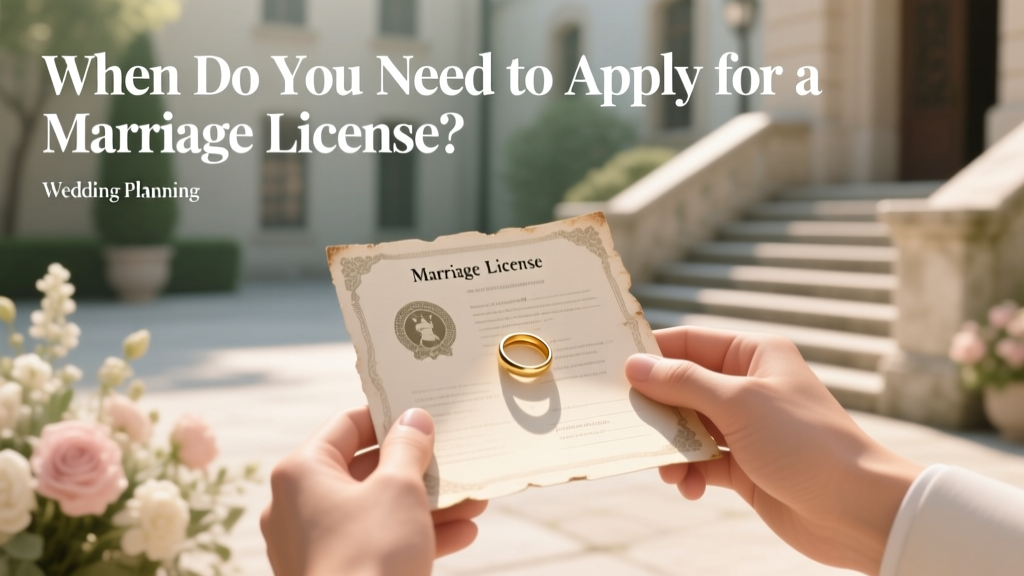
When Do You Need to Apply for a Marriage License
When Do You Need to Apply for a Marriage License?
If you’re in the thick of wedding planning, the marriage license can feel like the least exciting item on the checklist—until you realize it’s the one thing you can’t skip. Venues, flowers, and seating charts can be adjusted. But without a valid marriage license (and the right timing), your ceremony may not be legally recognized.
Couples ask this question all the time because the rules vary by location, and modern wedding timelines are more flexible than ever. Between destination weddings, courthouse ceremonies, and “we’ll do the legal part later” celebrations, it’s easy to get confused about when you actually need to apply.
Quick Answer: When should you apply?
Apply for your marriage license after you’ve set your wedding date and location, and within your jurisdiction’s allowed window—typically 30 to 90 days before the ceremony. Many counties won’t issue a license too far in advance, and some have waiting periods (like 24–72 hours) before it becomes valid. Others require the license to be used within a certain time (often 30–60 days) before it expires.
The safest plan for most engaged couples: Start researching 3–4 months out, and apply 2–6 weeks before the wedding (unless your area requires earlier or you’re planning a destination wedding).
Q: Why does the timing matter so much?
Because marriage licenses come with rules—usually a combination of:
- Issuance window: How far ahead you’re allowed to apply (some offices won’t issue more than 60–90 days before).
- Waiting period: How long after issuance you must wait before you can legally marry (common in a few states/counties).
- Expiration date: How long you have to use the license once it’s issued (30–90 days is common).
- Jurisdiction requirements: Whether you must apply in the county where you live or where you’re getting married.
“The biggest heartbreak is when a couple realizes their license expires the day before their ceremony—especially with long engagements or destination weekends,” says Maya Lopez, a wedding planner based in Southern California. “The good news is it’s totally avoidable with one calendar reminder.”
Q: What’s the best timeline for most couples?
Here’s a practical, low-stress approach that works for many wedding planning situations:
- 3–4 months before: Look up the marriage license requirements for your city/county/state. Confirm: where to apply, documents needed, fees, waiting period, expiration, and appointment availability.
- 6–8 weeks before: If your area requires appointments, book one. Popular counties can fill up, especially during peak wedding season (spring and fall).
- 2–6 weeks before: Apply and pick up the license (or complete the online process if offered). This window helps you avoid expiration issues while leaving time for a waiting period.
- Wedding week: Assign a specific person (often the couple, planner, or best person) to physically bring the license to the ceremony if required.
Real-world example: Jordan and Priya planned a Saturday wedding and applied three weeks before. Their county had a 48-hour waiting period, so they were glad they didn’t wait until the final week. “We thought we could just pop in on Wednesday,” Priya says. “But appointments were booked. We ended up going the week before, and it saved us.”
Q: What if we’re doing a destination wedding?
Destination weddings are one of the biggest wedding trends affecting marriage license timing. Many couples either:
- Legally marry at home (courthouse or short ceremony) before traveling, then have a symbolic ceremony at the destination.
- Legally marry at the destination, which can involve extra paperwork, residency requirements, translations, or longer processing times.
“If you’re getting married outside your home state—or especially outside the country—start researching the legal requirements as soon as you book travel,” advises Elena Price, destination wedding coordinator. “Some locations require documents weeks in advance, and couples are surprised by how long it takes to get everything approved.”
If you want the simplest logistics: consider doing the legal marriage license process locally, then treat the destination celebration as your wedding ceremony with all the emotional meaning—just without the legal paperwork stress.
Q: Traditional vs. modern approaches—does it change when we apply?
Yes, your wedding style and timeline can affect your “right” moment to apply.
Traditional approach (one ceremony, one date)
If you’re having one legal ceremony where your officiant signs the marriage license right after vows, apply within the standard window your jurisdiction allows—usually a few weeks before the wedding. This keeps everything clean and easy.
Modern approach (legal ceremony + celebration later)
Micro-weddings, courthouse ceremonies, and “private legal vows now, party later” celebrations are common. In this case, you’ll apply based on the date of the legal ceremony—the day the license will be signed—not the party date.
Example: You’re doing a courthouse ceremony in June and a big reception in September. Apply according to the June date, because that’s when the license needs to be valid.
Q: What documents and details do we need to plan for?
While requirements vary, many marriage license offices commonly ask for:
- Government-issued photo ID (driver’s license, passport)
- Basic personal details (full legal names, birthplaces, parents’ names)
- Proof of divorce or death certificate if previously married (in some jurisdictions)
- Fee payment (often by card or cash; check your county’s policy)
- An appointment or online application confirmation
A tip from the field: “Use the names exactly as they appear on your IDs—middle names, hyphens, accents, everything,” says Thomas Reed, a wedding officiant. “Fixing a name error can take days, and you don’t want to do that the week of your wedding.”
Actionable tips to make this easy
- Put it on your timeline: Add a calendar reminder for “Marriage license research” and “Marriage license appointment.” Treat it like a vendor deadline.
- Check for waiting periods: If your area has a 72-hour waiting period, don’t apply too close to your ceremony.
- Watch for expiration dates: If your license is valid for 30 days, applying too early can backfire.
- Confirm who returns the license: Some officiants mail it in; some couples must return it. Ask in advance.
- Make copies or photos: Snap a photo of the license for your records (but keep the original safe and unbent).
- Plan for travel: If you’re marrying out of town, build in time to pick up the license where required.
Related questions couples often ask (and the answers)
Q: Can we apply before we have a wedding date?
Usually, you’ll want your date set first. Some applications ask for your intended ceremony date, and you also need to ensure the license will still be valid. If you’re early in planning, do research now and apply later.
Q: Do we need to apply in the county where we live or where we’re getting married?
It depends on local law. Some states allow you to apply in any county and use it statewide; others require you to apply in the county where the ceremony will take place. This is a big one—double-check before you assume.
Q: What if we’re having a friend officiate?
Make sure your officiant is legally authorized where you’re marrying (ordination rules vary). Also confirm they know how to complete the marriage license correctly and on time. A friend-officiant is a beautiful trend, but it comes with paperwork responsibility.
Q: What if one of us can’t appear in person?
Some jurisdictions allow online applications, remote appearances, or an affidavit; others require both parties in person. If military deployment, travel, or illness is involved, call the clerk early—there may be exceptions or alternate processes.
Q: What if we lose the license before the wedding?
Contact the issuing office immediately. Many can reissue, but it may require another fee and time. This is why couples often keep it with their rings or in a labeled folder with other day-of essentials.
Q: Does applying for a marriage license mean we’re legally married?
No. The license is permission to marry. You become legally married after the ceremony is performed and the license is signed and properly filed according to your local rules.
Takeaway
You don’t need to apply for your marriage license the minute you get engaged—but you do want to apply at the right time: within your local window, early enough to handle appointments and waiting periods, and late enough to avoid expiration. A little planning here protects everything you’ve put into your wedding day, and it’s one of the simplest ways to keep your celebration stress-free and fully official.
More Articles
 Find Old Wedding Photos: 7 Proven Methods (2026)
 Happy Wedding Anniversary Grammar: What to Say Instead
 Pencil Skirt Wedding Outfit Guide (2026)
 Who Should Host the Bridal Shower in 2026
 Mexican Wedding Cookies: Origin Truth (2026)
 What Is the Etiquette for Wedding Hashtags
 Wedding Ring Origins: A 3,000-Year History
 Bronze Wedding Anniversary: What to Gift & Celebrate (2026)
 Wedding Singer Streaming: Where to Watch in 2026
 Where to Buy a Wedding Gown: 7 Smart Options