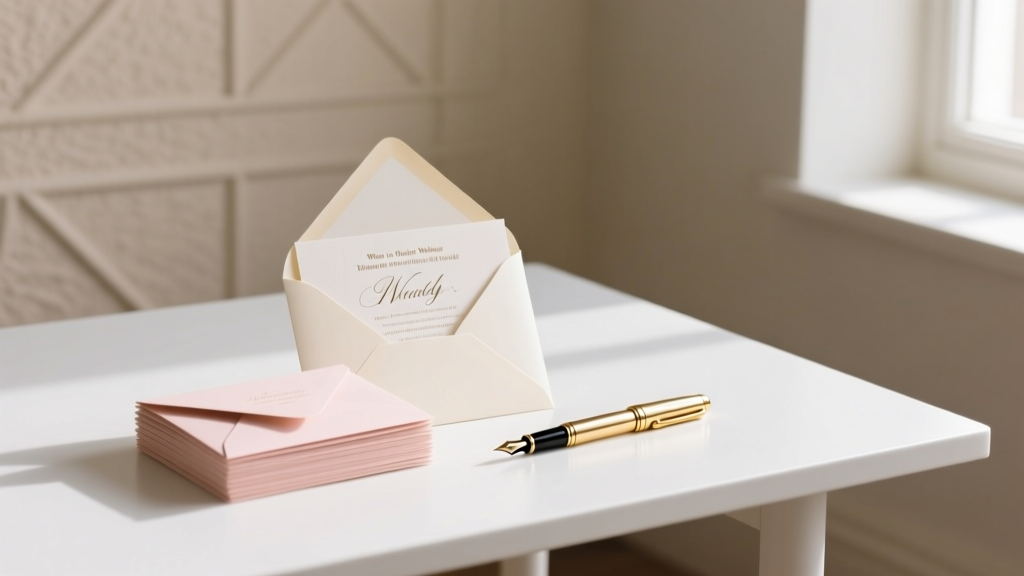
When to Order Wedding Invitations Timeline Guide
When to Order Wedding Invitations: A Timeline Guide (With Real-World Buffers)
If you’ve started looking at wedding invitation designs, you’ve probably felt the whiplash: one person says “Order them a year out,” another says “We did ours in a month,” and suddenly you’re wondering if you’re already behind. You’re not alone. The invitation timeline matters because it connects a lot of moving parts—your guest list, venue details, registry, travel plans, and your overall wedding planning timeline.
The good news: there’s a clear, flexible window for when to order wedding invitations, and it can be adjusted for destination weddings, holiday weekends, or modern trends like all-digital RSVPs.
Q: So… when should we order wedding invitations?
A: Most couples should order wedding invitations about 4–6 months before the wedding date. That timing gives you room for design, proofs, printing, addressing, and any reprints—without scrambling. Then you’ll typically mail invitations 6–8 weeks before the wedding (or 8–12 weeks for destination weddings or major travel).
Think of ordering as the “production phase,” and mailing as the “guest response phase.” Ordering earlier helps everything downstream feel calmer.
Q: Why does ordering 4–6 months early work so well?
Because invitations take longer than most couples expect—especially when you factor in real life. Here’s a realistic breakdown:
- Design & wording: 1–2 weeks (longer if you’re still finalizing ceremony time or venue details)
- Proofing & revisions: 3–10 days (you’d be amazed how often tiny wording choices go back and forth)
- Printing: 1–3 weeks (faster for simple digital printing; longer for letterpress or foil)
- Assembly: 1–2 weeks (stuffing, sealing, belly bands, wax seals, inserts, etc.)
- Addressing: 3–10 days (hand calligraphy adds time; printing labels is faster)
Wedding stationer “Maya R.,” who works with couples across the U.S., puts it plainly: “The biggest surprise is that invitations aren’t just one item—they’re a mini project. The earlier you order, the more fun it stays.”
Q: What does a full invitation timeline look like?
Here’s a practical wedding invitations timeline that fits most weddings:
- 8–10 months out: Start gathering inspiration, decide your wedding vibe, and rough out your guest count.
- 6–8 months out: Choose your invitation suite style, confirm ceremony and reception locations, and draft wording.
- 4–6 months out: Order wedding invitations (and any enclosure cards like details or weekend itinerary).
- 10–12 weeks out: Order extra stamps (including heavier postage if needed) and finalize your mailing list.
- 6–8 weeks out: Mail invitations (earlier for destination or holiday weekends).
- 2–4 weeks before: RSVP chase (politely), finalize seating chart and meal counts.
Real couple experience: “We ordered at five months and still felt busy,”
says Jess, who planned a 120-person wedding with a semi-custom suite. “Our RSVP cards needed extra postage and we didn’t know until we went to the post office. Ordering early gave us breathing room.”
Q: What changes the timeline? (Scenarios you might be in)
Scenario 1: Traditional, local wedding with printed RSVPs
If most guests are local or in-state and you’re doing a classic paper RSVP card, stick with the standard: order 4–6 months out, mail 6–8 weeks out. This aligns with modern etiquette while respecting guests’ calendars.
Scenario 2: Destination wedding or heavy travel wedding
If guests need flights, passports, or hotels, give them more runway. Aim to order 6–7 months out and mail 10–12 weeks out. Many couples also send save the dates earlier (9–12 months out) to help with planning.
Wedding planner “Jordan Lee” shares: “For destination weddings, your invitation is also a travel prompt. The earlier it arrives, the better your RSVP accuracy will be.”
Scenario 3: Holiday weekend wedding (or peak season)
For Memorial Day, Labor Day, New Year’s Eve, or a popular fall weekend, guests tend to commit early. Order on the earlier end (around 6 months) and mail around 8–10 weeks out.
Scenario 4: Modern approach with digital RSVPs
Current wedding trends lean toward QR codes, wedding websites, and online RSVPs. Digital RSVPs can shorten your timeline slightly because you’re not waiting on mailed cards. Still, you’ll want to order early enough to avoid rushed printing—especially if you’re adding a details card or weekend schedule.
A great compromise: a printed invitation with a QR code for RSVP and travel info. It feels formal but streamlined.
Scenario 5: Custom invitations (letterpress, foil, vellum, wax seals)
These looks are gorgeous—and they add production time. Order 6–8 months out if you’re doing letterpress, foil stamping, custom monograms, venue sketches, or a full invitation suite with multiple inserts.
Q: What details do we need before we order?
Couples get stuck here, so here’s the checklist. Before you place your invitation order, try to have:
- Date and start time (and whether the ceremony time is firm)
- Venue name and full address (including ballroom/room if relevant)
- Reception details (“Reception to follow” or separate location info)
- Dress code wording if you’re including it (optional, but increasingly common)
- Wedding website URL (and RSVP method)
- Hosting line (who is hosting/paying, if you’re following traditional wording)
- Guest count estimate plus a buffer (usually 10–15 extras)
If you’re still finalizing one piece—like ceremony start time—talk with your stationer. Many couples order the suite and hold printing until the last detail is confirmed, or choose a design that’s easy to update.
Q: How many invitations should we order?
Order by household, not by guest. Then add extras for keepsakes and last-minute additions.
- Rule of thumb: number of households + 10–15% extra
- Add extras if you want flat-lay photos, invitation framing, or keepsakes for parents
Pro tip: It’s usually cheaper to order extras up front than to reprint later.
Q: What if we’re running late?
This happens all the time, and it’s fixable. If you’re within 2–3 months of the wedding and don’t have invitations ordered yet:
- Choose semi-custom or template-based designs with faster production.
- Skip the extras (wax seals, complex layers) if time is tight.
- Use online RSVPs to avoid mail delays.
- Send invitations in waves if needed (out-of-town guests first).
Maya R. adds: “If you’re behind, prioritize clarity over complexity. A simple invite mailed on time is better than an elaborate suite that arrives late.”
Q: Do we still need save the dates if we mail invitations early?
Sometimes, no—but often, yes. Save the dates are most helpful when:
- Guests must travel
- You’re marrying on a holiday weekend
- Your guest list includes busy professionals or families juggling school schedules
- You’re hosting a multi-day wedding weekend
If you didn’t send save the dates, mailing invitations a bit earlier (8–10 weeks out) can help, especially for travel-heavy weddings.
Q: What about international guests, military guests, or guests without stable addresses?
- International guests: Mail earlier (10–12 weeks) and offer digital RSVP options.
- Military guests: Send as early as you can; consider emailing a copy plus a mailed invite.
- Unstable addresses: Collect emails and phone numbers; send a digital invite or link to your wedding website as backup.
Modern etiquette is very forgiving here: it’s completely acceptable to follow up digitally as long as the invitation information is consistent.
Q: Any practical tips to make the invitation process easier?
- Build in a “life buffer” of two weeks for unexpected delays.
- Do a postage test at the post office with a fully assembled, sealed invite.
- Use a shared spreadsheet for addresses, household names, and RSVP status.
- Set your RSVP deadline about 3–4 weeks before the wedding (or earlier if your caterer requires it).
- Order matching day-of stationery (menus, programs, escort cards) once your design is set—it keeps everything cohesive.
Conclusion: The calm, confident way to time your invitations
If you want the simplest, least stressful path: order your wedding invitations 4–6 months before the wedding, then mail them 6–8 weeks before (earlier for destination weddings and holiday weekends). A little extra time upfront saves you from last-minute printing rush fees, postage surprises, and RSVP chaos.
Your invitations don’t need to be perfect on day one—they just need a realistic timeline and a plan. Once you give yourselves that buffer, the whole process feels a lot more like celebrating and a lot less like scrambling.
More Articles
 Was Kim Richards at Alexia Umansky’s Wedding? (2026)
 Vinny Invited to Nicole’s Wedding? (2026)
 Best Jewelry for Checklist: A Practical, Data-Driven Selection Guide
 Funny Wedding Speech Framework That Works
 Deceased Spouse's Wedding Ring: 7 Respectful Options
 Madea Destination Wedding on Netflix: Release Date (2026)
 Do You Say Mazel Tov at a Wedding? (2026)
 Do Muslims Wear Wedding Rings? Scholar-Vetted Truth
 Wedding Ring vs Engagement Ring: Stacking Order (2026)
 Wedding Ring Hand: Global Traditions & Cultural Tips