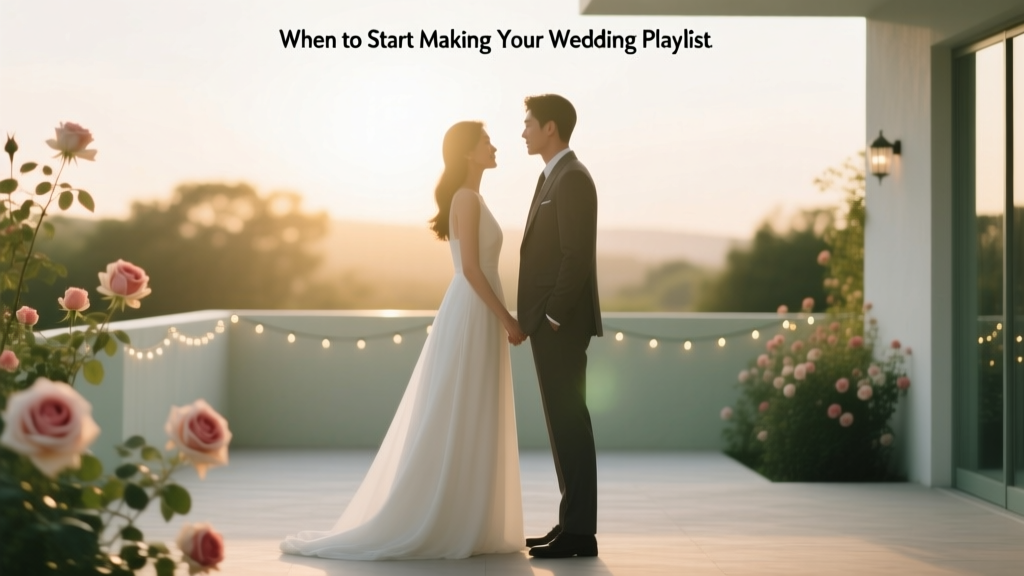
When to Start Making Your Wedding Playlist
When to Start Making Your Wedding Playlist
Music sets the emotional temperature of a wedding. It’s the difference between a cocktail hour that feels polished and one that feels awkwardly quiet, between a dance floor that stays packed and one where guests hover near the bar. That’s why couples often ask, “When should we actually start making our wedding playlist?”
Most people assume it’s a last-minute task—something you do once you’ve picked flowers and finalized the seating chart. But your wedding playlist (or music plan) influences the flow of the entire day, from the ceremony processional to the final send-off song.
Quick answer: When should you start?
Start building your wedding playlist as soon as you’ve booked your venue or set a date—typically 6 to 9 months before the wedding. You don’t need a finished, minute-by-minute soundtrack that early, but you should start collecting songs, clarifying your “must plays” and “do not plays,” and deciding whether you’re using a DJ, live band, or a DIY Spotify wedding playlist.
Finalize the key moments 8 to 12 weeks out (ceremony songs, first dance, parent dances, reception vibe), and lock the full timeline 2 to 4 weeks before the wedding so your vendors can execute smoothly.
Q: Why start so early—can’t we do it closer to the wedding?
You can, but it’s one of those tasks that gets surprisingly emotional and time-consuming. Couples often underestimate how many music decisions they’ll need to make:
- Ceremony seating and processional songs
- Recessional (your “we’re married!” moment)
- Cocktail hour music
- Grand entrance song
- Dinner/background music
- First dance, parent dances, and any special dances
- Open dance floor (the biggest chunk)
- Cake cutting, bouquet toss (if you’re doing it), last song, after-party
Starting early keeps the process fun instead of frantic. It also prevents a common problem: realizing too late that you and your partner have completely different definitions of “danceable.”
As DJ Marisol King (fictional) puts it: Couples who start early give me better direction. When they begin a month before, we’re often guessing the vibe—and that’s when you end up with a dance floor that’s ‘fine’ instead of unforgettable.
Q: What does “start making a playlist” actually mean?
Think of it in three layers. You’re not trying to perfect everything on day one—you’re building a music plan.
- Inspiration list: A running note on your phone of songs you love, songs that feel like “you,” and songs that remind you of friends/family.
- Must-play / do-not-play lists: The clearest way to communicate your tastes, especially if you’re hiring a wedding DJ.
- Moment-by-moment picks: Ceremony, special dances, and the overall reception arc (warm-up, peak hour, late-night).
Real couple experience (fictional): We started a shared playlist the week we booked our venue and dropped songs in whenever we heard one we liked. By the time we met our DJ, we had a clear vibe—retro pop, early-2000s throwbacks, and a little country for my side of the family.
—Alyssa & Jordan
Q: How does your choice of DJ vs. band vs. DIY affect the timeline?
Scenario 1: Hiring a DJ (most common)
Start: 6–9 months out. A DJ will usually ask for your must-plays, do-not-plays, and key moment songs. Many also provide planning forms 1–3 months before the wedding.
Why early matters: The best DJs book up fast, and your DJ can help you shape the vibe—especially for multicultural weddings, blended families, or mixed-age crowds.
Scenario 2: Hiring a live band
Start: 8–12 months out. Bands often have set lists and limited flexibility compared to DJs, especially for niche genres. If you want specific songs, ask early whether they can learn them (and whether there’s a fee).
Bandleader Theo Grant (fictional) says: If you want us to learn your first dance song or a cultural song for your parents, tell us at least two months ahead. Earlier is even better in peak season.
Scenario 3: DIY wedding playlist (Spotify/Apple Music)
Start: 4–6 months out. DIY can be amazing, but it requires more structure. You’re not just choosing songs—you’re managing transitions, volume, announcements, and timing. Many couples assign a trusted friend as “music captain” to handle cues.
Trend note: More couples are doing hybrid setups: a DJ for the reception, and a curated Spotify playlist for cocktail hour and dinner to save money or keep a specific aesthetic.
Q: What’s the modern etiquette around wedding music?
Today’s wedding etiquette is less about rigid rules and more about guest experience. A few modern guidelines couples appreciate:
- Make the ceremony feel like you. String quartet covers of pop songs, acoustic versions, and instrumental renditions are all common and widely accepted.
- Keep lyrics in mind. Some couples avoid explicit songs early in the night if kids are present, then shift to a late-night set.
- Balance “your songs” with crowd-pleasers. Your favorite indie deep cuts may be perfect for cocktail hour, while the reception dance floor often benefits from familiar hits.
- Be thoughtful with cultural music. If you’re blending traditions (Latin, South Asian, Jewish, Caribbean, etc.), plan the flow intentionally so it feels celebratory—not like abrupt genre whiplash.
One of the biggest current wedding trends is the “multi-phase reception”: a relaxed dinner vibe, a high-energy peak, then a late-night club set. Planning your wedding reception playlist with that arc in mind helps the night feel intentional.
Q: What should you decide first?
If you’re overwhelmed, decide these five things first:
- Your top 10 must-play songs. The tracks that instantly feel like your relationship or your friend group.
- Your do-not-play list. Include songs tied to an ex, overplayed wedding songs you can’t stand, or anything that would make you cringe.
- Your “vibe words.” Examples: “disco sparkle,” “romantic and classic,” “country dance hall,” “modern club,” “old-school R&B.”
- Key moment songs. Processional, recessional, first dance, parent dances, grand entrance.
- Any sensitive concerns. Divorced parents who shouldn’t be paired for a dance, religious guidelines, volume limits at the venue, or requests to avoid certain genres.
Actionable timeline: A stress-free way to build your wedding playlist
- 9–12 months out: Start a shared “Wedding Vibes” playlist. Add songs casually, no pressure.
- 6–9 months out: Book your DJ/band. Share your vibe words and a few favorite tracks.
- 4–6 months out: Create three buckets: Cocktail Hour, Dinner, Dancing. Start sorting songs into the right energy level.
- 8–12 weeks out: Choose ceremony music and special dances. Confirm any band song requests.
- 4–6 weeks out: Draft your reception flow (warm-up → peak → late-night). Build your must-play and do-not-play lists into a clean document.
- 2–4 weeks out: Final vendor meeting. Confirm cues, pronunciations, and your “if the dance floor dips, play these” list.
Q: What are common worries couples have?
“We have totally different music taste.”
That’s normal. Use a “his/hers/ours” approach: each of you picks 10 non-negotiables, then build the rest around overlapping genres or eras. A skilled wedding DJ can blend styles so it feels cohesive.
“Our guest list is mixed ages—what if no one dances?”
Plan in waves. Early in the night, lean into universally known songs (Motown, ‘90s pop, classic rock, current hits). Later, sprinkle in niche favorites. Also consider two short “anchor moments” like a group singalong song or a line dance if your crowd likes it.
“We don’t want cheesy wedding songs.”
You can avoid clichés without sacrificing energy. Give your DJ examples of what “not cheesy” means to you, and offer alternatives. Instead of banning everything popular, ban what you truly dislike and let your pro do their job.
“We’re doing a small wedding—do we still need a playlist plan?”
Even more so. Intimate weddings feel every silence. A well-timed playlist keeps the atmosphere warm and intentional, especially at dinner.
Related questions and edge cases
What if the venue has noise restrictions or a hard cutoff?
Ask early. Some venues require music to end at a certain hour or limit bass levels. Your DJ can adjust with cleaner mixes or shift to a quieter “afterglow” playlist late-night.
Do we need separate playlists for ceremony, cocktail hour, and reception?
Yes, at least conceptually. Each part of the day has a different purpose. Ceremony music supports emotion; cocktail hour supports conversation; reception music supports momentum.
Can guests request songs?
You can allow requests with guardrails. Many couples tell their DJ: “Requests are fine if they fit the vibe and aren’t on the do-not-play list.” Some also add a song request line on wedding websites—popular with modern couples—then the DJ curates from that list.
What if we’re skipping traditional dances?
Totally fine. Replace them with a “sweetheart last dance” during golden hour, a private first dance before guests enter, or a group dance that brings everyone in.
Takeaway
Start your wedding playlist early—around 6 to 9 months out—then refine it as your plans become real. Treat it like gathering memories, not completing homework. With a few key decisions made ahead of time and a clear vibe in mind, you’ll walk into your wedding day knowing the music will carry you (and your guests) through every moment.
More Articles
 What Hand Do Guys Wear Wedding Rings On? (2026)
 Did Adam Sandler Sing In The Wedding Singer Movie (2026)
 Wedding Ring Hand: Tradition, Exceptions & Meaning (2026)
 Engagement vs Wedding Ring: Key Differences (2026)
 Best Wedding Movie of 2026: Realistic Budget Scenes
 Do Russians Wear Wedding Rings? Truth & Trends (2026)
 Costa Rican Wedding Traditions Explained
 Notary Wedding Officiant in Georgia? (2026)
 Thank Your Wedding Photographer: 7 Meaningful Gestures
 4th Wedding Anniversary: What Couples Actually Celebrate