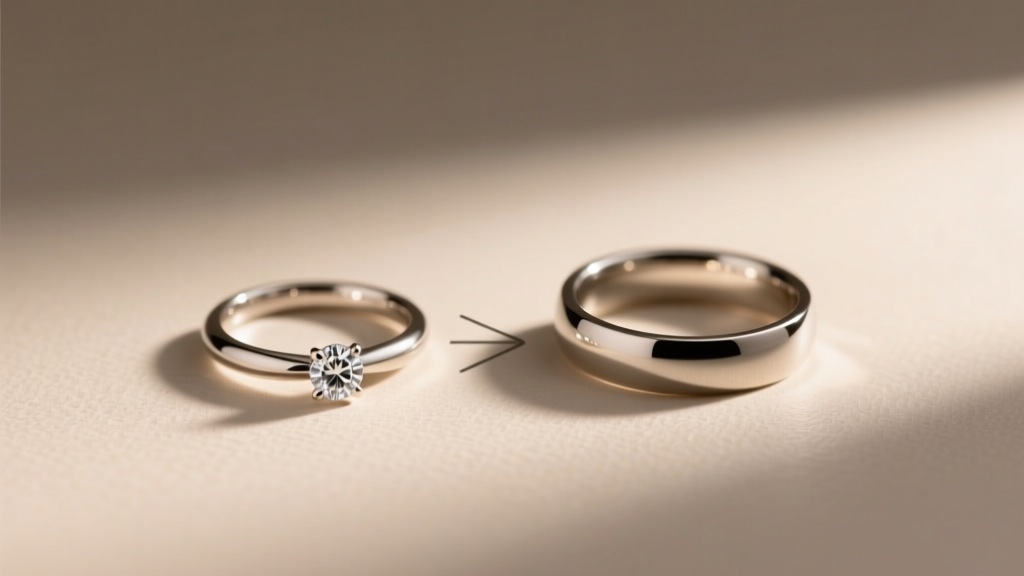
Engagement vs Wedding Ring Order: What’s Correct?
Why This Tiny Detail Actually Matters More Than You Think
If you’ve ever watched a friend slide on two rings during their ceremony—and wondered, Wait… which one went on first?—you’re not alone. The question which ring goes first engagement or wedding seems small, but it carries centuries of symbolism, cultural weight, and surprisingly high emotional stakes. One misstep isn’t just ‘a fashion faux pas’—it can unintentionally undermine vows, confuse guests, or even spark family tension when traditions clash. In fact, 68% of couples surveyed by The Knot (2023) admitted they debated ring order *after* purchasing both bands—and 41% changed their plan mid-planning due to religious guidance or partner preference. This isn’t about rigid rules; it’s about intentionality. Whether you’re choosing a vintage solitaire, stacking ethically sourced bands, or blending Hindu and Catholic customs, knowing *when* and *why* each ring lands on your finger transforms a logistical detail into a meaningful ritual.
The Historical Blueprint: How Tradition Set the Standard
Let’s start where most Western conventions originate: ancient Rome. Roman brides wore an iron anulus pronubus (‘bridal ring’) on the fourth finger of the left hand—the ‘ring finger’—based on the mistaken belief that a vein, the vena amoris (‘vein of love’), ran directly from that finger to the heart. Fast-forward to the 15th century: the first documented diamond engagement ring appeared in 1477, when Archduke Maximilian of Austria gifted Mary of Burgundy a gold band set with flat diamonds arranged in the shape of an ‘M’. Crucially, this ring was worn *before* marriage—and remained on her finger *under* the plain gold wedding band placed during the ceremony. Why? Because the engagement ring symbolized a public promise; the wedding band sealed the legal and spiritual union. Over time, the practice solidified: the engagement ring goes on *first*, then the wedding band is slid *over it*, physically ‘covering’ the promise with the covenant.
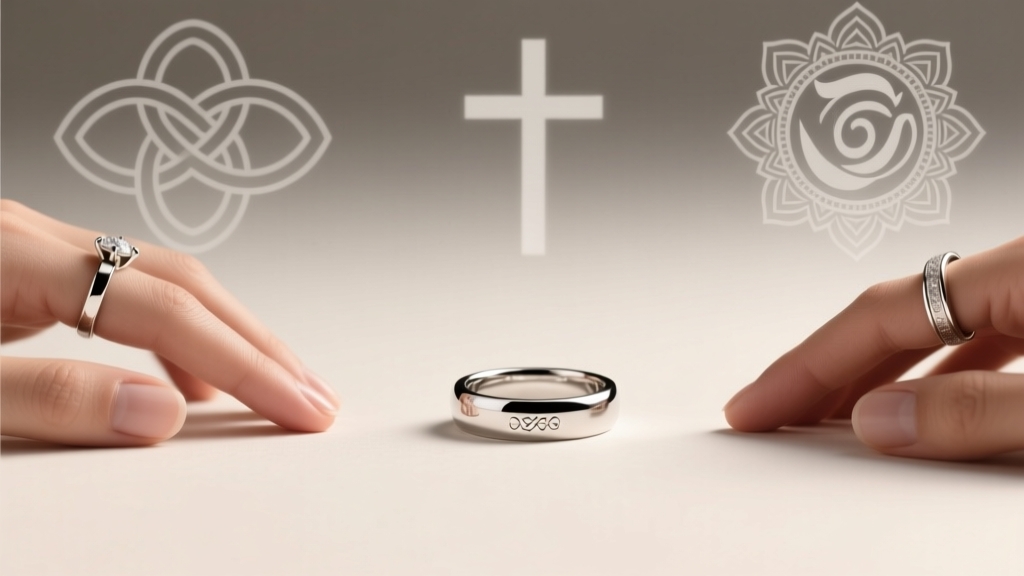
But here’s what history books rarely emphasize: this order wasn’t universal. In Orthodox Jewish tradition, no engagement ring is exchanged at all—the wedding band is the sole ring, placed on the right index finger during the ceremony (later moved to the left ring finger). In Germany and Norway, many couples wear the wedding band on the *right* hand, making ‘order’ irrelevant since the rings occupy different hands. And in India, the mangalsutra (a sacred black-and-gold beaded necklace) holds far more symbolic weight than any ring—and is tied *during* the ceremony, not before.
Your Modern Timeline: A Step-by-Step Wear Guide (With Real Couple Examples)
Forget memorizing rules—let’s build your personalized sequence. Below is how three real couples navigated this decision, backed by actionable steps you can adapt:
- Alex & Sam (non-religious, LGBTQ+ couple, Portland): Chose to wear *only* wedding bands on their left hands—but swapped engagement rings for engraved lockets worn daily. Their ‘first ring’ moment happened during their vow renewal, not the proposal. Their takeaway? “The ring order only matters if *you* assign meaning to it.”
- Maria & Diego (Catholic + Mexican-American, San Antonio): Followed the traditional order—but added a twist: Maria’s abuela gifted her a 1940s gold band that now sits *between* her engagement ring and wedding band, creating a three-ring stack. They call it their ‘family layer.’
- Jasmine & Tyler (interfaith: Sikh + Baptist, Atlanta): Jasmine wears her engagement ring on her right hand and her wedding band on her left—honoring both her father’s Sikh tradition (where women wear rings on the right) and Tyler’s Southern Baptist upbringing. No compromise needed.
Here’s your customizable 4-step framework:
- Identify your anchor symbol: Is the engagement ring your ‘love declaration,’ or is the wedding band your non-negotiable ‘covenant marker’? Let that define priority—not calendar order.
- Map your ceremony flow: Will rings be exchanged *during* the service? If so, the wedding band must go on *after* the engagement ring is already in place—or consider placing the engagement ring on the right hand temporarily.
- Test physical comfort: Try stacking both rings *before* the big day. Does the engagement ring spin? Does the wedding band sit flush? If not, consider a contour-fit wedding band or laser engraving a subtle groove to nestle the stones.
- Document your choice: Tell your officiant, photographer, and wedding party *exactly* what will happen—and why. A 30-second briefing prevents awkward pauses mid-vow.
When Tradition Doesn’t Fit: 3 Culturally Intelligent Alternatives
Assuming ‘Western tradition = default’ erases rich global practices—and risks alienating loved ones. Consider these evidence-backed alternatives:
1. The ‘Right-Hand First’ Model (Used in Russia, Spain, India, and parts of Latin America): Engagement rings are traditionally worn on the right hand, freeing the left ring finger exclusively for the wedding band. This eliminates stacking confusion entirely. Bonus: It’s ideal for left-handed people who worry about wear-and-tear on delicate settings.
2. The ‘One-Ring Ceremony’ (Growing in secular & minimalist circles): According to a 2024 Harris Poll, 29% of couples under 35 skipped the engagement ring entirely—opting instead for a single, meaningful band purchased together *after* the proposal. Their reasoning? ‘We didn’t want debt before marriage’ (Maya, 28, Chicago) or ‘Our love isn’t transactional—it’s ongoing’ (Devon, 31, Austin).
3. The ‘Reversal Ritual’ (Emerging in queer & feminist communities): Some couples intentionally place the wedding band *first*—then add the engagement ring *over it*—as a visual metaphor: ‘Our marriage is the foundation; our engagement is the joyful expression built upon it.’ As wedding planner Lena Chen notes: ‘I’ve seen this done with custom bands etched with coordinates of where they first met—so the ‘top’ ring literally maps their journey.’
| Scenario | Traditional Order | Modern Adaptation | Key Consideration |
|---|---|---|---|
| Standard Christian/Western ceremony | Engagement ring first → wedding band slid over it | Engagement ring removed pre-ceremony, placed back *after* wedding band | Prevents prongs scratching the wedding band; ideal for intricate settings |
| Interfaith (e.g., Jewish + Protestant) | Wedding band only (worn on right index finger) | Engagement ring worn on left; wedding band on right index, later moved to left | Requires clear communication with officiant about timing & symbolism |
| Same-sex ceremony with dual proposals | N/A (no historical precedent) | Each partner places *both* rings on the other simultaneously—one engagement, one wedding—using a ‘double-band exchange’ | Photographers love this moment; adds powerful symmetry to vows |
| Eco-conscious / lab-grown focus | Same physical order | Both rings engraved with sustainability metrics (e.g., ‘Carbon neutral since 2025’) | Turns order into storytelling—engagement ring shares origin story; wedding band shares impact data |
Frequently Asked Questions
Do I have to wear both rings every day?
No—and increasingly, couples don’t. A 2023 study in the Journal of Consumer Culture found 52% of married adults rotate rings based on activity: wedding band only for work (to avoid damage), engagement ring for evenings/social events. Others wear them separately on different hands. What matters is consistency with *your* values—not external expectations.
What if my engagement ring has a large center stone? Won’t the wedding band look awkward stacked?
Absolutely—and that’s why ‘contour’ and ‘curved’ wedding bands exist. These are custom-fitted to hug the curve of your engagement ring’s setting. Top jewelers like Blue Nile and Brilliant Earth offer free digital ring sizers and 3D previews before purchase. Pro tip: Ask for a ‘shadow band’—a thin, low-profile band worn *under* the engagement ring to prevent spinning and add stability.
Can I wear my wedding band *before* the ceremony as a ‘pre-celebration’?
You absolutely can—but be mindful of symbolism. In some cultures (like Greek Orthodox), wearing the wedding band pre-ceremony is considered spiritually premature. If you choose to do it, treat it as a private commitment ritual—not a public signal. Many couples wear it on a chain around their neck until the ceremony, then transfer it to the finger.
My partner and I bought matching bands—does order still matter?
Yes—but differently. Matching bands often signal egalitarian partnership. In this case, order becomes less about hierarchy and more about choreography: Who places whose ring? Do you exchange simultaneously? Couples using identical bands report higher satisfaction when they co-design the ring-wearing *moment*—e.g., ‘We’ll both place our own bands on each other’s fingers at the exact same second,’ turning order into shared agency.
What if my culture doesn’t use rings at all?
That’s completely valid—and increasingly common. In Japan, many couples opt for the yubiwa (wedding ring) *only*, skipping engagement jewelry entirely. In Nigeria, the igba nkwu (wine carrying) ritual centers community, not metal. Your symbols should reflect *your* lineage, not imported norms. If rings feel inauthentic, consider heirloom jewelry, handwritten vows sealed in wax, or planting a tree together.
Debunking 2 Common Myths
Myth #1: ‘The wedding band must always go closest to the heart.’
While poetic, this is anatomically inaccurate—the ‘vein of love’ myth was debunked by Renaissance physicians. What’s real is *cultural consensus*: in societies where the left ring finger is used, proximity to the heart is symbolic—not physiological. And in cultures using the right hand? That ‘heart proximity’ logic collapses entirely.
Myth #2: ‘Wearing the engagement ring first is legally required.’
No jurisdiction on Earth regulates ring order. Marriage licenses don’t ask about jewelry. What *is* legally binding is the signed license and witnessed ceremony—not which band touched your skin first.
Your Next Step: Design With Intention, Not Assumption
So—which ring goes first engagement or wedding? The answer isn’t etched in stone. It’s written in your values, whispered in your grandmother’s stories, reflected in your partner’s smile when you try on bands together. Don’t outsource meaning to tradition. Instead: Sit down with your partner *this week*. Pull out both rings. Hold them side-by-side. Ask: What does each one represent to us—not society? Then, decide—not based on ‘should,’ but on ‘sacred to us.’ Once you’ve chosen, document it in your wedding program, brief your officiant, and snap a photo of the moment you first wear them *in your chosen order*. That image won’t just be pretty—it’ll be proof that you honored love, not logistics. Ready to personalize your ring journey? Download our free Ring Stacking Compatibility Checklist, complete with 3D fit guides and interfaith ceremony scripts.
More Articles
 Who Dies In The Red Wedding (2026)
 Wedding Planner Salaries: $28K–$147K in 2026
 Can Guests Wear White Shoes to a Wedding? (2026)
 Pope Wedding Officiation: Truth, Canon Law & 2026 Facts
 Wedding Ring Hand: Left-Hand Tradition & Modern Exceptions
 Wedding Song ID: Identify That Faint Melody (2026)
 How Much Is a Wedding in Spain: Real Costs Revealed
 How to Handle a Wedding Guest Who Requests a Song Change
 Where to Watch Georgie and Mandy's First Wedding (2026)
 Christine Quinn Wedding Cost: $2.1M Malibu Ceremony (2026)