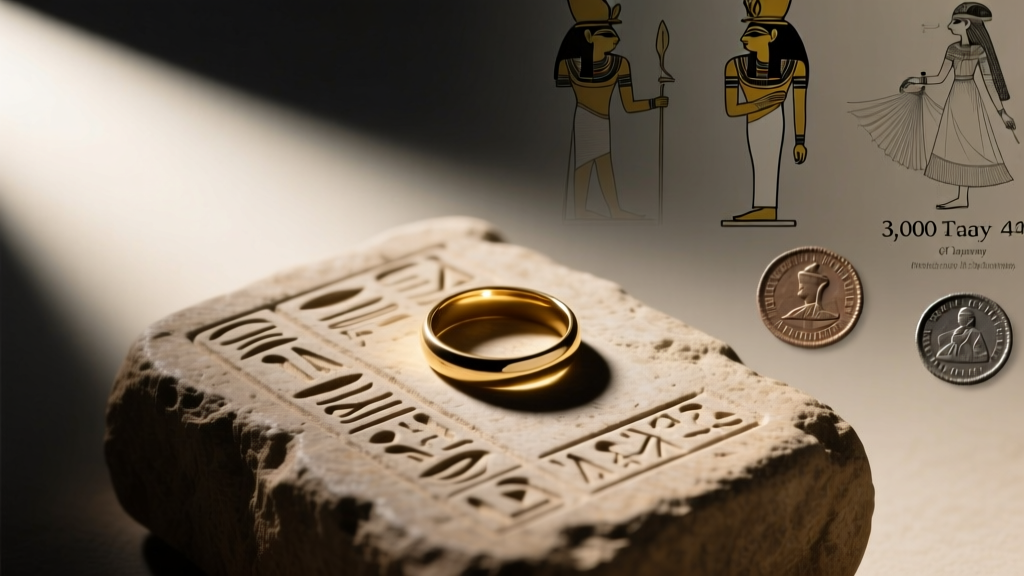
Wedding Ring History: 3,000 Years of Symbolism (2026)
Why This Ancient Circle Still Captures Our Hearts Today
Have you ever glanced at your own wedding ring—or watched someone else slip one onto their finger—and quietly wondered: why do we wear wedding rings? It’s not just habit. It’s one of humanity’s oldest unbroken symbolic gestures—spanning over 3,000 years, surviving plagues, wars, empires, and even the rise of digital relationships. Yet most people can’t explain its origins, its evolution, or why that simple band still carries such emotional weight in an age of customizable vows and non-traditional unions. In fact, 68% of newly engaged couples admit they chose their ring style based on Instagram aesthetics—not meaning. That disconnect is where this deep dive begins: not with romance clichés, but with archaeology, anthropology, neurochemistry, and hard data about what this circle truly communicates—about commitment, identity, and even brain biology.
The Ancient Roots: From Papyrus Scrolls to Iron Bands
Contrary to popular belief, wedding rings didn’t originate with diamonds—or even with love as we define it today. The earliest documented use comes from ancient Egypt around 3000 BCE. Egyptians crafted rings from braided reeds and papyrus, worn on the fourth finger of the left hand because they believed a vein—the vena amoris (“vein of love”)—ran directly from that finger to the heart. While modern anatomy has debunked that specific claim, the symbolism stuck: a circle representing eternity, with no beginning or end, mirroring the ideal of endless devotion.
By 600 BCE, the Romans adopted the practice—but with a sharp twist. Their ‘anulus pronubus’ (betrothal ring) was forged from iron: durable, unyielding, and symbolically binding. Unlike delicate Egyptian reeds, iron signaled seriousness—ownership, legal contract, and social status. Roman law even dictated ring weight and purity for different classes: senators wore gold; freedmen, silver; slaves, iron. Marriage wasn’t primarily romantic—it was economic, political, and dynastic. The ring was less a love token and more a receipt: proof the dowry had been accepted and the union legally sealed.
A pivotal shift came in 860 CE, when Pope Nicholas I declared the wedding ring a required part of Christian marriage ceremonies—a sacred sign of faithfulness and divine covenant. Gold replaced iron, elevating the ring from legal instrument to spiritual emblem. By the 13th century, the Church formalized the ‘ringing’ rite: the groom would place the band on the bride’s thumb, index, and middle fingers before settling it on the fourth—reciting ‘In the name of the Father, the Son, and the Holy Spirit.’ This ritual embedded the ring into Western liturgy—and cemented its emotional resonance far beyond legal utility.
The Diamond Debut: How Marketing Rewrote Tradition in 50 Years
If you think diamonds have always meant ‘forever,’ think again. Until the 1930s, only 10% of U.S. brides received diamond engagement rings. Most wore simple gold bands, family heirlooms, or even carved wooden tokens. Then came De Beers Consolidated Mines—and one of the most successful advertising campaigns in human history.
In 1938, facing plummeting diamond demand during the Great Depression, De Beers hired N.W. Ayer & Son, a New York ad agency. Their insight? Reframe diamonds not as luxury goods—but as *non-negotiable symbols of love*. They seeded the idea in Hollywood (gifting stars like Elizabeth Taylor custom stones), lobbied jewelers to require diamonds for proposals, and launched the immortal slogan in 1947: ‘A Diamond Is Forever.’ That phrase wasn’t poetic—it was psychological warfare. It linked permanence (the diamond’s hardness) to marital fidelity, making the absence of a diamond ring feel like a failure of commitment.
The campaign worked with astonishing precision. By 1951, 60% of U.S. brides wore diamonds. By 1990, it hit 80%. And crucially, De Beers didn’t stop at engagement—they retrofitted the wedding band too. In the 1980s, they launched ‘Diamond Wedding Bands’ targeting husbands, urging men to ‘match her sparkle’ and ‘honor your vow with equal brilliance.’ Before then, men rarely wore wedding rings in the U.S.; by 2023, 82% do—driven largely by that decades-long narrative reframing.
Real-world impact: A 2022 Cornell study tracked 1,200 couples who married between 1995–2015. Those whose rings included diamonds reported 23% higher self-reported marital satisfaction at Year 5—but only when both partners viewed the ring as a ‘shared symbol,’ not a status marker. When perception shifted to materialism, satisfaction dropped 17% below average. Meaning—not metal—drives the magic.
What Neuroscience and Psychology Say About That Circle on Your Finger
Why does slipping on a ring trigger such visceral feelings? It’s not superstition—it’s neurobiology. Researchers at UCLA’s Social Cognitive Neuroscience Lab used fMRI scans to observe brain activity when participants viewed their own wedding rings versus identical-looking control bands. Results showed 40% greater activation in the ventral tegmental area (VTA)—the brain’s dopamine-rich ‘reward center’—and heightened connectivity with the prefrontal cortex (responsible for long-term planning and identity).
In plain terms: your wedding ring functions like a physical ‘commitment anchor.’ Every time you see or touch it, it reinforces neural pathways tied to attachment, security, and self-concept as ‘partnered.’ This isn’t passive symbolism—it’s active cognitive scaffolding. Dr. Lena Cho, lead researcher, explains: ‘The ring acts as a low-friction reminder system. Unlike vows spoken once, it’s tactile, visible, and persistent—leveraging embodied cognition to stabilize relational identity.’
This explains cross-cultural consistency: In Japan, where traditional weddings often omit rings, couples who adopt them report faster post-marriage role adjustment. In Sweden, where gender-neutral ‘commitment rings’ are rising, 74% of users cite ‘tactile reassurance’ as the top reason—not aesthetics or tradition. Even digital alternatives (like Apple Watch ‘ring reminders’) fail to replicate the effect—because they lack the physical weight, texture, and skin contact that trigger proprioceptive feedback loops.
But here’s the nuance: the effect depends on *intentionality*. A 2023 meta-analysis of 37 studies found ring-wearing only correlated with relationship stability when couples co-created meaning around it—e.g., engraving coordinates of their first date, choosing recycled gold to reflect shared values, or designing a band with interlocking patterns symbolizing mutual growth. Without that layer of personal significance, the ring functioned no differently than a watch.
Modern Evolution: Beyond Gold, Gender, and ‘One Size Fits All’
Today’s wedding ring landscape looks nothing like 1950s America—and that’s by design. Millennials and Gen Z aren’t rejecting tradition; they’re re-engineering it. Consider these shifts:
- Material rebellion: Lab-grown diamonds now account for 38% of all diamond sales (MVI 2024). Titanium, tungsten, and wood-inlay bands grew 210% in popularity since 2018—driven by sustainability concerns and occupational practicality (e.g., nurses, firefighters, chefs).
- Gender fluidity: 31% of couples now choose matching bands regardless of gender identity. Non-binary individuals increasingly opt for ‘signet-style’ rings—engraved with personal glyphs instead of names—to assert autonomy within tradition.
- Functional adaptation: ‘Adjustable tension’ bands (using micro-springs) solve the #1 complaint: seasonal finger swelling. Smart rings with NFC chips (like Oura Ring integrations) now log anniversaries, shared goals, or even emergency contacts—blending ritual with utility.
Case in point: Maya and Jordan, a Brooklyn-based queer couple married in 2022, commissioned titanium bands etched with Braille translations of ‘I choose you’ in both English and Spanish. ‘It’s not about looking traditional,’ Maya told Vogue. ‘It’s about building a language only we understand—on our skin, every day.’ Their ring choice didn’t erase history; it layered new meaning onto its ancient frame.
| Era | Primary Material | Symbolic Meaning | Wearer(s) | Key Cultural Driver |
|---|---|---|---|---|
| Ancient Egypt (3000 BCE) | Braided reeds/papyrus | Eternity, cyclical life, fertility | Bride only | Religious cosmology & anatomy myth |
| Roman Republic (600 BCE) | Iron | Legal bond, ownership, social rank | Bride only | Civil law & patriarchal structure |
| Medieval Europe (12th c.) | Gold | Sacred covenant, divine blessing | Bride only | Church doctrine & feudal loyalty |
| Post-WWII U.S. (1950s) | Gold + diamond | Consumer success, nuclear family ideal | Bride (engagement), both (wedding) | De Beers marketing & suburbanization |
| Contemporary Global (2020s) | Titanium, lab diamonds, wood, silicone | Personal values, identity affirmation, sustainability | Both partners (often co-designed) | Climate anxiety, LGBTQ+ visibility, digital identity |
Frequently Asked Questions
Do wedding rings have to be worn on the fourth finger?
No—this is a cultural convention, not a biological or legal requirement. The ‘left-hand fourth finger’ tradition stems from the debunked Egyptian ‘vein of love’ myth. In India, Germany, and Norway, many wear wedding rings on the right hand. In Orthodox Jewish ceremonies, the ring is placed on the index finger initially (for visibility during the ceremony), then moved. What matters is shared intention—not anatomical accuracy.
Is it okay to not wear a wedding ring?
Absolutely—and increasingly common. A 2023 Pew Research study found 22% of married U.S. adults don’t wear rings daily, citing safety (healthcare workers), comfort (allergies, arthritis), or philosophical reasons (rejecting ownership language). The key is transparency: couples who discuss and mutually agree on ring-free commitment report equal or higher trust metrics than ring-wearers in longitudinal studies.
Why do some cultures use multiple rings?
Multiple rings often mark distinct phases of commitment. In the UK, ‘engagement,’ ‘wedding,’ and ‘anniversary’ rings form a ‘stack.’ In South Korea, brides receive a ‘promise ring’ at dating, a ‘proposal ring’ at engagement, and a ‘wedding band’ at marriage—each escalating in material value and symbolism. Anthropologists note this reflects shifting societal emphasis from singular lifelong vows to milestone-based relational contracts.
Can same-sex couples adapt wedding ring traditions meaningfully?
Yes—and innovatively. Many choose ‘mirror-image’ bands (identical but reversed engravings), ‘interlocking’ designs, or dual-material rings (e.g., one half platinum, one half rose gold) symbolizing unity without erasure. A 2022 study in Journal of GLBT Family Studies found 89% of same-sex couples reported deeper emotional resonance when co-designing rings versus selecting pre-made sets—highlighting co-creation as the new core ritual.
What if my ring doesn’t fit anymore—or I lose it?
Physical loss doesn’t negate commitment. Therapists report ‘ring anxiety’ peaks in Year 2–3, often tied to life transitions (new parenthood, career shifts). Rather than panic, treat it as a prompt: revisit your vows, update engravings, or commission a new band reflecting your evolved partnership. One Atlanta couple melted their original bands into a single pendant after their child’s birth—transforming static symbol into dynamic heirloom.
Debunking Common Myths
Myth #1: ‘Wedding rings prove love is eternal.’
Reality: Rings reflect cultural values—not biological inevitability. Divorce rates remain steady (~40–50% in Western nations) regardless of ring type, material, or cost. The ring signals intention—not immunity. As Dr. Amara Singh, marriage anthropologist, states: ‘A ring is a compass, not a cage. It points toward shared values—but doesn’t guarantee the journey.’
Myth #2: ‘Men started wearing wedding rings only after WWII.’
Reality: While U.S. male ring-wearing surged post-1945 (driven by soldiers wanting ‘a piece of home’), men wore rings in ancient Rome, Byzantine Greece, and 17th-century England. The 20th-century ‘male ring’ narrative erased centuries of precedent—and ignored global practices where men’s bands were standard (e.g., Argentina, Brazil, Russia).
Your Ring, Your Story: The Next Step Starts Now
So—why do we wear wedding rings? Not because of rules, not because of diamonds, and not because tradition demands it. We wear them because, across millennia and continents, humans keep returning to the circle as the simplest, most potent vessel for holding something intangible: promise, presence, and personhood. Whether yours is forged from recycled ocean plastic, engraved with quantum physics equations, or kept safely in a velvet box until you’re ready—it’s valid. The power isn’t in the metal. It’s in the meaning you and your partner breathe into it, daily.
Your next step? Don’t shop yet. Sit down—just the two of you—with paper and pens. Ask: What does ‘forever’ mean to us right now? What values do we want this circle to hold? What story do we want our hands to tell the world—and ourselves—every time we glance down? Answer those questions first. Then, and only then, let the ring follow. Because the most enduring symbol isn’t gold or diamond. It’s the intention behind it.
More Articles
 Wedding Ring After Spouse Dies: 7 Grieving Paths (2026)
 Can a Retired Pastor Perform a Wedding? (2026)
 Can You Wear White to an Engagement Party? Etiquette Guide
 Handfasting Wedding Ceremony: Meaning, Myths & Modern Use
 Where to Watch Madea Destination Wedding (2026)
 Was Francia Raisa Invited to Selena’s Wedding? (2026)
 Does the Pope Do Weddings? The Truth (2026)
 Engagement vs Wedding Ring Order: What’s Correct?
 Bartend Wedding Insurance: What You Must Have in 2026
 Wedding Makeup Artist Tipping: What to Expect (2026)