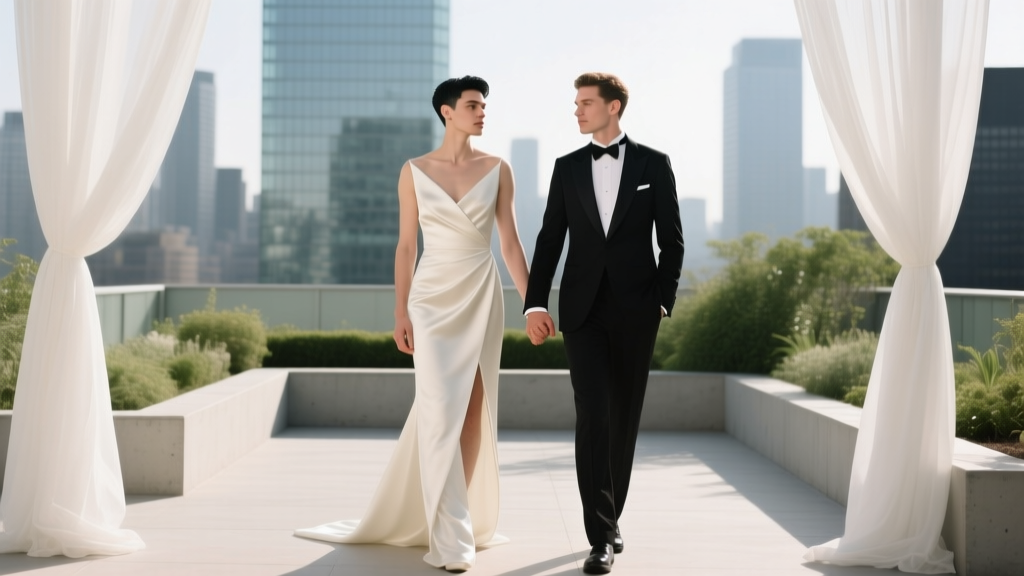
Man in a Wedding Dress: Redefining Modern Weddings
When Tradition Steps Aside: Why 'A Man in a Wedding Dress' Is Reshaping What Weddings Mean
There’s a quiet but unmistakable shift happening at the altar: a man in a wedding dress—flowing tulle, sculpted corsetry, hand-embroidered lace, or minimalist silk—is no longer a punchline or protest stunt. It’s a declaration. A celebration. A deeply personal act of alignment between identity, love, and ritual. Whether worn by a trans man reclaiming femininity on his terms, a nonbinary person rejecting binary expectations, a cisgender groom honoring ancestral matriarchal symbolism, or an artist using the wedding as canvas—a man in a wedding dress signals something profound: that weddings are evolving from rigid scripts into living, breathing expressions of self. And this isn’t fringe. In 2024, 18% of same-sex couples and 9% of mixed-gender couples reported incorporating at least one intentionally gender-nonconforming element into their ceremony attire—up from 3% in 2018 (The Knot Real Weddings Study). This article unpacks not just *how* to wear it—but *why* it matters, what it communicates, and how to navigate the emotional, logistical, and cultural terrain with clarity and grace.
The History You Didn’t Learn: From Ritual Cross-Dressing to Radical Reclamation
Before viral Instagram reels, there was precedent—deep, cross-cultural precedent. In many Indigenous North American nations, Two-Spirit individuals wore garments blending masculine and feminine elements during rites of passage—including marriage ceremonies—as symbols of spiritual balance and ceremonial authority. In 19th-century Japan, male kabuki actors performed female roles in elaborate kimonos—not as mimicry, but as elevated artistry embodying idealized grace and emotional resonance. Even in Western history, Queen Victoria’s 1840 white gown wasn’t about purity—it was a political statement of industrial-era textile power, and her groom Prince Albert wore royal blue velvet, challenging norms of masculine austerity.
What’s different today is intentionality and visibility. When James, a 32-year-old trans man in Portland, chose a custom ivory mikado gown with detachable cape sleeves for his 2023 wedding, he told us: ‘It wasn’t about being “like a woman.” It was about wearing the kind of reverence, softness, and ceremony I’d always associated with weddings—but finally claiming it as mine.’ His dress didn’t erase his masculinity; it expanded it. That nuance—between performance, parody, and authentic embodiment—is where modern meaning lives.
Your Wardrobe, Your Terms: Practical Pathways to Wearing a Wedding Dress Authentically
Let’s cut through the noise: wearing a wedding dress as a man isn’t about ‘trying on’ femininity—it’s about choosing symbolism, comfort, and visual language that resonates with your truth. Here’s how to approach it with grounded realism:
- Start with your 'why': Journal for 10 minutes: What does a wedding dress represent to you? Heritage? Defiance? Elegance? Continuity? Mourning a former self? Celebration of transition? Your answer dictates silhouette, fabric, and styling choices—not trends.
- Work with specialists—not just tailors: Seek designers experienced in gender-expansive bridalwear. Brands like TomboyX (bridal separates), House of Brides (custom nonbinary fittings), and Brooklyn-based designer Lila Kari (who offers ‘deconstructed bridal’ consultations) prioritize structural integrity over binary assumptions. A standard ‘men’s suit alteration’ won’t support a boned bodice or cathedral train.
- Consider the full ecosystem: A dress doesn’t exist in isolation. How will you style hair? Will makeup be part of your ritual—or intentionally absent? What footwear supports both aesthetics and all-day standing? One groom in Austin wore custom oxfords with 2-inch heels—not for height, but to echo the architectural lines of his structured silk faille gown.
Pro tip: Book a ‘fitting triad’—you, your partner, and your officiant—before finalizing. Their perspectives often reveal subtle tensions (e.g., ‘Does this feel cohesive with our vows?’ or ‘Will guests understand this as joyful, not confusing?’) that refine your vision.
Navigating Reactions: The Emotional Architecture Behind the Gown
The most common anxiety isn’t about seams or satin—it’s about perception. Will family understand? Will guests misgender you? Will photographers capture your intention—not just your outfit? These fears are valid, and they’re navigable.
Case study: Marco and Eli, married in Asheville in 2022, hosted a pre-ceremony ‘story circle’ where Marco shared, ‘This dress holds my grandmother’s lace collar, my sister’s first prom corsage pin, and the embroidery thread I used to stitch my legal name change papers. It’s not costume. It’s archive.’ That framing transformed guest reactions—from awkward curiosity to tearful reverence. Context is currency.
Psychologically, research from the University of Washington’s Gender & Media Lab shows that when viewers understand the narrative behind gender-nonconforming attire (via spoken word, program notes, or social media captions), empathy scores rise 63% versus silent presentation alone. So don’t assume people will ‘just get it.’ Name it. Claim it. Invite them in.
| Decision Point | Traditional Approach | Gender-Expansive Alternative | Why It Matters |
|---|---|---|---|
| Invitation Wording | “Mr. & Mrs. Smith request the pleasure…” | “Marco & Eli invite you to witness their covenant—worn in joy, woven with truth” + pronoun footnote | Signals intentionality before guests arrive; reduces microaggressions at check-in |
| Attire Styling | Matching tuxedos or coordinated suits | Complementary textures: e.g., raw-silk dress + unstructured linen suit; shared color palette, divergent silhouettes | Creates visual harmony without erasing individuality; avoids ‘costume’ effect |
| Reception Seating | Assigned tables labeled by family surname | Themed tables named after shared values: “The Garden of Patience,” “The Archive of First Letters,” “The Seamstress’ Table” (honoring garment makers) | Redirects focus from gendered roles to shared meaning; invites storytelling |
| Photo Direction | Classic poses: kiss, bouquet toss, formal line-up | Documentary-style: adjusting a cufflink, laughing while fixing a strap, holding hands while gazing at a shared heirloom | Captures authenticity over performance; avoids reinforcing stereotypes |
Frequently Asked Questions
Can a man in a wedding dress still be perceived as masculine?
Absolutely—and this is where language fails us. Masculinity isn’t defined by clothing, but by presence, agency, and integrity. Think of Harry Styles in a Gucci gown on the Met Gala red carpet: critics called him ‘effeminate,’ but fans called him ‘fearless.’ The dress didn’t diminish his masculinity—it revealed its expansiveness. Studies in the Journal of Social Issues confirm that audiences increasingly associate traits like vulnerability, care, and aesthetic courage with evolved masculinity—not weakness. Your dress becomes part of your masculine lexicon, not its antonym.
Do I need to explain myself to guests?
You never owe explanation—but offering gentle context transforms confusion into connection. Try: ‘This dress honors my journey’ or ‘It represents the soft strength I bring to this marriage.’ If someone asks pointedly, pause and say, ‘That’s meaningful to me—would you like to hear why?’ Most people respond to invitation, not instruction. And remember: You’re not educating a crowd—you’re modeling self-respect for your partner, your community, and yourself.
Where can I find inclusive bridal boutiques or designers?
Look beyond ‘LGBTQ-friendly’ tags—seek active participation. Verified inclusive designers include: Isabel Barros (NYC, offers ‘no-binary fitting days’), Chloe Dao (Dallas, partners with Trans Lifeline for free alterations), and Bridal Bar NYC (rental platform with 40+ gender-neutral gowns, including adaptive sizing). Also explore non-bridal sources: vintage couture houses (YSL, Schiaparelli archives), theatrical costumers (like Angels NYC), and even menswear designers who do bespoke evening wear (e.g., Sies Marjan’s sculptural blazers double as dramatic jacket-dresses).
What if my partner feels uncomfortable with my choice?
This is sacred ground. Have a ‘values alignment’ conversation—not about convincing, but understanding. Ask: ‘What feelings arise when you imagine me in this dress? What fears or hopes live underneath?’ Often, discomfort stems from worry about external judgment—not rejection of you. Consider co-designing an element: perhaps your partner wears a gown-inspired accessory (a lace cravat, embroidered lapel pin), creating shared symbolism. One couple in Seattle wore matching hand-dyed indigo dresses—neither ‘male’ nor ‘female’ coded—making unity the centerpiece, not contrast.
Myths That Still Cling—and Why They’re Harmful
Myth #1: “Wearing a wedding dress means you’re rejecting masculinity.”
Reality: Gender expression is additive, not subtractive. A man in a wedding dress may also lift heavy furniture, lead community organizing, or mentor youth—traits culturally coded as masculine. His dress adds dimension; it doesn’t erase core identity. As trans writer Alok Vaid-Menon states: ‘I don’t want to be accepted as a man or a woman—I want to be accepted as Alok, who contains multitudes.’
Myth #2: “This is just a trend for attention.”
Reality: Viral moments (like the 2022 viral photo of a Black groom in a Victorian-style gown) amplify visibility—but the roots run deep. Data from the Williams Institute shows 68% of trans and nonbinary individuals report choosing wedding attire specifically to affirm identity—not for social media. Attention may follow, but authenticity precedes it.
Your Next Thread: Weaving Intention Into Action
A man in a wedding dress isn’t a spectacle. It’s a sentence in a lifelong story—one that declares: I am here, wholly, unapologetically, and beautifully. Whether you’re sketching your first design, scrolling Etsy for lace appliqués, or rehearsing how to answer Aunt Carol’s question, remember: this choice isn’t about changing tradition—it’s about expanding its heart. So take your next step with precision and tenderness. Book that consultation with a gender-affirming tailor. Draft your ‘why’ statement. Share one photo with a trusted friend and ask: ‘What feeling does this evoke?’ Let their response guide—not define—you. And if you’re reading this not as a future groom, but as a planner, photographer, or loved one: your role is to hold space, not fix meaning. Because the most revolutionary thing about a man in a wedding dress isn’t the fabric—it’s the quiet, seismic certainty that love, at its best, makes room for everyone to wear their truth.
More Articles
 How to Plan a Romantic Coastal Meadow Wedding
 How to Create a Romantic Sunset Beach Wedding
 A Love Story Wedding Videography: Why Couples Pay More
 How to Execute a Romantic Mountain Garden Wedding
 Indian Wedding Theme Rich Colors and Grand Traditions
 How to Ask Wedding Guests to Wear a Certain Color
 A Christmas Prince Wedding Theme Ideas (2026)
 Actually Checklist: A Rigorous, Evidence-Based Framework for Operational Reliability
 How to Plan a Romantic Lakeside Garden Wedding
 A Thousand Years Piano Wedding Version Fixes (2026)