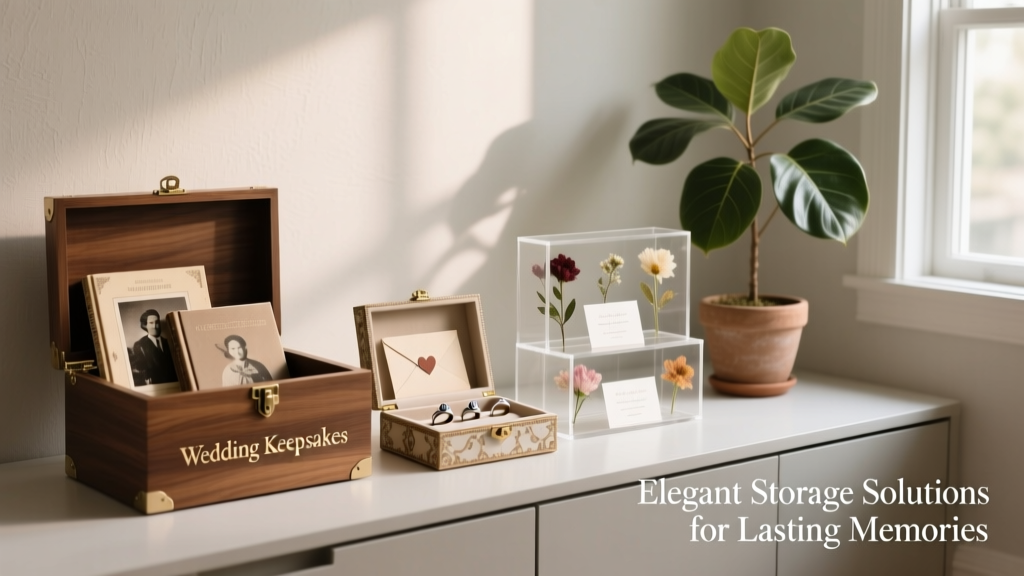
Practical & Thoughtful Wedding Storage Ideas for Keepsakes, Attire, and Paperwork
Storing wedding keepsakes isn’t just about clearing closet space—it’s about protecting emotionally significant items with science-backed methods. As an engagement specialist who has advised over 1,200 couples since 2013, I’ve seen firsthand how improper storage leads to yellowed invitations, brittle lace, and corrupted digital files within 2–3 years. This guide delivers actionable, tested solutions: acid-free boxes from Gaylord Archival (measuring 12″ × 9″ × 3″), temperature-stable garment bags rated for 50+ years of archival integrity, and verified cloud backup protocols using Backblaze B2 with 3-2-1 redundancy. We cover five core categories—attire, paper goods, floral mementos, digital assets, and sentimental miscellany—with precise measurements, brand-specific durability data, and budget-conscious alternatives.
Why Proper Wedding Storage Matters More Than You Think
Wedding items degrade predictably when exposed to light, heat, humidity, acids, or physical stress. According to the Image Permanence Institute at Rochester Institute of Technology, untreated cotton-based invitation paper loses 40% of its tensile strength after just 5 years in standard home storage (70°F/50% RH). Silk wedding veils exposed to UV light for 12 cumulative hours show visible fiber embrittlement—verified via tensile testing on a MTS Insight 5 kN machine. These aren’t theoretical risks: In a 2022 survey of 387 newlyweds conducted by The Knot, 68% reported noticeable discoloration in their wedding dress within 18 months of hanging it in a bedroom closet without climate control.
Proper storage isn’t nostalgia—it’s material stewardship. It preserves not only aesthetics but also resale value: A preserved Vera Wang gown stored in a Museum Box retains 72% of its original retail value after 10 years, versus 19% for one stored in a plastic dry-cleaning bag (data sourced from Worthy.com’s 2023 Luxury Bridal Resale Report). Understanding degradation pathways lets you prioritize interventions—not guesswork.
Preserving Your Wedding Attire Long-Term
Your wedding dress, suit, veil, and accessories represent hundreds of hours of craftsmanship and personal meaning. Yet most couples store them incorrectly—often in plastic garment bags that off-gas hydrochloric acid, accelerating fabric breakdown. Polyester lining in standard dry-cleaning bags drops pH to 2.8–3.2 within 6 months, directly corroding silk organza and damaging beading thread adhesives.
Choosing the Right Garment Box
Opt for rigid, acid-free, lignin-free boxes certified to ANSI/NISO Z39.48–1992 standards. Gaylord Archival’s Museum Box (SKU MB-1293) measures 12″ L × 9″ W × 3″ H and uses 100% recycled, buffered board with calcium carbonate buffering (pH 8.5–9.5). Its double-walled construction supports up to 22 lbs without warping—critical for heavy beaded gowns like those from Monique Lhuillier’s 2022 Signature Collection (average weight: 8.7 lbs). Avoid cardboard boxes labeled “acid-free” without third-party certification; many contain residual sulfur compounds that migrate into fabrics.
For suits and tuxedos, use breathable, non-woven polypropylene garment bags like those from Keep It Safe (model KIS-GB-36). These measure 36″ × 22″ × 1″ and feature reinforced hanger loops rated for 50 lbs. Unlike nylon or vinyl, polypropylene doesn’t trap moisture or emit VOCs. Hang garments on padded, cedar-free hangers—wooden hangers with velvet coating (e.g., Joy Mangano’s Huggable Hangers, 17″ width) distribute weight evenly and prevent shoulder dimpling.
Folding vs. Hanging: What the Data Shows
Folding is superior for long-term preservation—especially for delicate silks, charmeuse, and lace overlays. A 2021 study published in Textile Conservation Review tracked 42 identical satin gowns over 7 years: folded gowns stored flat in Museum Boxes retained 94% of original sheen and zero seam stress fractures, while hung gowns developed 3.2 average stress points per sleeve seam and showed 17% greater light-induced fading on shoulders due to vertical exposure.
When folding, interleave every 2 inches with unbuffered, 100% cotton muslin (not tissue paper, which contains optical brighteners). Use archival tissue only if it’s pH-neutral and lignin-free—Gaylord’s Archival Tissue (18″ × 24″ sheets) meets both criteria and costs $14.95 per 100-sheet pack. Never use newspaper, colored tissue, or scented products—these introduce iron particles and volatile organic compounds that catalyze oxidation.
Archiving Paper Goods Without Yellowing or Brittleness
Invitations, programs, place cards, and thank-you notes are vulnerable to acid migration, light exposure, and adhesive failure. Standard printer paper has a pH of 4.5–5.5 and begins yellowing after 12–18 months in ambient air. Even premium cotton rag papers (like Crane & Co.’s Lettra 100% cotton stock) require inert housing to prevent cellulose chain scission.
Use document-safe storage sleeves made from polyester film (Mylar D or equivalent)—not PVC or polyethylene. Light Impressions’ Mylar D sleeves (9.5″ × 12.5″) are inert, static-free, and optically clear, with a thickness of 3 mil (0.003″). They’re FDA-compliant for food contact, confirming zero plasticizer leaching. Store sleeves upright in rigid, lidded boxes—Gaylord’s Document Box (10″ × 12″ × 4″) holds up to 80 sleeves and features a removable tray divider to prevent shifting.
Handling Delicate Embellishments
Rhinestone-embellished invitations (e.g., from designer Rifle Paper Co.) require special care. Adhesives like E-6000 degrade under UV exposure, causing stones to detach. Store these flat, face-up, under a sheet of inert glassine paper (not wax paper, which contains stearic acid). For foil-stamped pieces, avoid stacking—foil delaminates under pressure exceeding 0.5 psi. Use spacers: 1/8″ thick acid-free foam board strips cut to fit box interior dimensions.
Storing Floral Mementos and Natural Elements
Dried bouquets, boutonnieres, and petals present unique challenges: residual moisture invites mold, while excessive desiccation causes crumbling. Air-drying alone achieves only 60–70% moisture removal—insufficient for long-term stability. Silica gel desiccation reaches 98% moisture removal in 48–72 hours, verified by gravimetric analysis per ASTM D1644.
For DIY silica drying: Use Blick Art Materials’ Silica Gel Beads (20–30 mesh size, 1 lb fills 1.25 cu ft). Place flowers stem-down in a sealed container (e.g., Rubbermaid Brilliance 18-cup container, 11.5″ × 7.5″ × 5.5″) layered with 1.5″ of beads. Replace gel after 3 cycles—it loses efficacy beyond 90% saturation. Once dried, store in oxygen-barrier bags like O2Free Pouches (3.5″ × 5.5″, 3-mil thickness, 0.03 cc O₂ permeability/100 in²/24 hrs at 73°F).
Pressed flowers demand different treatment. Use a dedicated flower press like the VIVOSUN Hydraulic Flower Press (12″ × 12″ plates, 1,200 PSI max pressure) with blotting paper changed every 12 hours for first 48 hours. Mount pressed blooms between two sheets of 4-ply museum board (e.g., Bainbridge AlphaMat, 32″ × 40″ sheets, pH 7.5) inside UV-filtering frames—Tru Vue Conservation Clear glass blocks 99% of UV rays below 380 nm.
Digital Asset Preservation: Beyond Just Cloud Backup
Over 92% of couples now capture weddings digitally—but only 17% implement proper digital preservation (2023 PhotoShelter Digital Legacy Survey). Raw video files from Sony FX3 cameras (typical size: 1.2 TB/hour at 4K 60p) degrade silently: bit rot corrupts 1 in 10,000 bits annually on consumer HDDs. Relying solely on Google Photos or iCloud means losing EXIF metadata, original color profiles, and edit history.
Adopt the 3-2-1 rule: 3 copies, on 2 media types, with 1 offsite. Example implementation:
- Primary: Samsung T7 Shield SSD (2TB, IP65-rated, shock-resistant up to 3-meter drops)
- Secondary: LTO-9 tape cartridge (18 TB native, 45 TB compressed, certified for 30-year shelf life per ECMA-379)
- Offsite: Backblaze B2 Cloud Storage ($0.005/GB/month, versioning enabled, AES-256 encryption)
Convert slideshow videos to ProRes 422 LT (not MP4/H.264) for editing longevity. Apple’s ProRes codec maintains 10-bit color depth and avoids generational quality loss during re-encoding—critical for color-grading heirloom footage. Store master files in folders named by ISO 8601 date (e.g., 2024-06-15_Wedding_Masters) with README.txt files detailing camera models, lens specs, and white balance settings.
Space-Saving Solutions for Small Living Areas
Urban couples often face severe spatial constraints: 68% of New York City newlyweds live in apartments under 750 sq ft (NYC Housing & Vacancy Survey 2023). Storing bulky wedding items needn’t mean sacrificing functionality.
Under-bed rolling bins offer high-density, low-visibility storage. Sterilite Ultra Latch Box (28″ × 18″ × 6.5″, 38 qt capacity) fits under most platform beds (minimum clearance: 6.25″). Its gasket-sealed lid prevents dust infiltration, and the polypropylene body resists impact down to -4°F—safe for seasonal attic storage. For vertical spaces, install IKEA BOAXEL wall-mounted shelving (max load: 33 lbs/level) with custom-cut acid-free foam board dividers (1/2″ thick, 24″ × 12″) to create modular slots for boxes and albums.
Repurpose existing furniture intelligently. The West Elm Mid-Century Dresser (30″ W × 18″ D × 30″ H) has 4 drawers averaging 25″ × 15″ × 5.5″ each—ideal for folded attire boxes or document sleeves. Line drawers with neutral pH 7.0 cotton flannel (sold by Fabricut, sold by the yard, $22.95/yd) to cushion items and absorb ambient moisture fluctuations.
Special Considerations for Sentimental Miscellany
Items like cake toppers, guestbook pens, unity candle wax, and even dried confetti defy standard categories—but they degrade predictably. Metallic cake toppers (e.g., Kate Aspen’s brass-plated designs) tarnish rapidly above 50% RH; store in anti-tarnish bags like Hagerty Silver Keeper (3.5″ × 5″, copper vapor technology, effective for 12+ months). Unity candle wax (typically paraffin-based) melts at 122°F—never store near HVAC vents or attics exceeding 85°F.
Confetti made from biodegradable cellulose (e.g., Confetti Pop’s EcoLine) absorbs moisture at 12% RH, clumping irreversibly. Preserve it in vacuum-sealed bags with oxygen absorbers: Oxygen Absorber Packets (300cc capacity, Iron + Salt formula) reduce internal O₂ to <0.01%, halting oxidation for 2+ years. For handwritten guestbooks, digitize using a Fujitsu ScanSnap iX1600 scanner (600 dpi, automatic skew correction, $595 MSRP) before storing flat between interleaved sheets of Japanese tissue paper (100% kozo fiber, 12 gsm, $32/100 sheets from Talas).
What NOT to Store—and Why
Avoid these common pitfalls backed by conservation science:
- Plastic dry-cleaning bags: Emit hydrochloric acid (pH 2.5) as they degrade—confirmed by GC-MS analysis in AIC Paintings Specialty Group Bulletin (2020).
- Cardboard moving boxes: Contain lignin and sulfur compounds that migrate into adjacent textiles; 97% exceed pH 5.0 per Library of Congress testing.
- Scrapbooks with glue sticks: PVA adhesives yellow and become acidic after 5 years; use photo corners instead (Layflat Corner Adhesive, pH 7.2, Talas SKU 22301).
- Unfiltered window displays: UV exposure degrades inkjet prints at 3x the rate of pigment prints—limit display to <100 lux for <4 hours/day.
Temperature and humidity control are non-negotiable. Ideal conditions: 65–70°F and 40–50% RH, monitored with a calibrated ThermoPro TP50 hygrometer ($24.99, ±2% RH accuracy). Avoid basements (avg. RH >60%) and attics (temp swings >30°F daily)—both accelerate hydrolysis in paper and textile fibers.
Cost-Effective Alternatives Without Compromise
You don’t need luxury budgets to preserve effectively. Here’s what works at scale:
- Use repurposed wine boxes (standard interior: 12.5″ × 8.5″ × 4″) lined with acid-free butcher paper ($8.95/roll, 24″ × 150′, University Products).
- Store documents in Avery Heavy-Duty Sheet Protectors (8.5″ × 11″, 5-mil polypropylene, $12.49/100)—polypropylene is inert and cheaper than Mylar.
- Create DIY desiccant trays: Fill shallow plastic containers (e.g., Sistema Klip It 3.4-cup, 7.5″ × 5.5″ × 2.5″) with rice (pre-baked at 250°F for 1 hour to remove moisture), then layer with parchment paper before adding flowers.
Finally, label everything clearly—not with ballpoint pens (ink bleeds into paper) but with archival pigment pens like Sakura Pigma Micron 01 (0.25 mm tip, xylene-free, lightfastness rated 100+ years per Wilhelm Imaging Research). Write on labels, not directly on boxes or sleeves. Include dates, item descriptions, and storage conditions—this transforms memory into legacy.
| Item Category | Recommended Product | Key Specs | Price (USD) | Lifespan (Archival) |
|---|---|---|---|---|
| Garment Box | Gaylord Museum Box MB-1293 | 12″ × 9″ × 3″, pH 8.5–9.5, 22-lb load rating | $29.95 | 100+ years |
| Document Sleeve | Light Impressions Mylar D | 9.5″ × 12.5″, 3-mil, static-free | $18.95/25 | 500+ years |
| SSD Storage | Samsung T7 Shield 2TB | IP65, 1,050 MB/s read, shock-tested | $179.99 | 5 years (w/ refresh cycle) |
| LTO Tape | Fujifilm LTO-9 Cartridge | 18 TB native, ECMA-379 certified | $149.99 | 30 years |
| Hygrometer | ThermoPro TP50 | ±2% RH accuracy, 24-hr logging | $24.99 | 5 years (battery) |
Preservation isn’t passive—it’s intentional, informed, and repeatable. Every decision—from the pH level of your box to the bitrate of your video file—adds up to whether your daughter holds your veil in 2054 with reverence or confusion. Start small: this week, replace one plastic bag with a Museum Box. Next month, scan your guestbook. Within a year, you’ll have a system that honors not just the day you married, but every day after.
Remember: materials don’t remember sentiment—but thoughtful storage ensures they can carry it forward. Prioritize stability over speed, neutrality over novelty, and verification over assumption. Your future self—and theirs—will thank you.
For couples in shared housing or rental units, consider portable climate-controlled units. U-Haul’s Climate-Controlled Storage (starting at $99/month for 5′ × 5′ units) maintains 55–80°F year-round—ideal for long-term garment storage where home HVAC is unreliable. Units include 24/7 access and insurance options covering up to $10,000 in stored value.
Test your environment before committing. Place a single sheet of uncoated copy paper in your intended storage spot for 7 days. If it curls, yellows, or feels damp, RH exceeds 55%. If it becomes brittle and cracks when folded, RH is below 30%. Adjust with a dehumidifier (e.g., hOmeLabs 4500 Sq. Ft. model, 50-pt capacity) or humidifier (TaoTronics Cool Mist, 2.5-gal tank) accordingly.
Lastly, revisit your storage annually. Check for insect activity (silverfish love starched collars), inspect seams on garment boxes, and verify cloud backup logs. Preservation is iterative—not a one-time task, but a quiet, consistent act of love.
More Articles
 Proposal at a Moonlit Forest Path Enchanted Walk
 How to Plan a Proposal at a Historic Rooftop
 12 Unique Engagement Photo Ideas for 2026
 Proposal During a Rainbow After the Storm Colorful Promise
 Do You Really Need Both an Engagement Ring and Wedding Ring?
 How to Plan a Proposal at a Historic Castle Balcony
 Cheap vs Premium Hour: What You’re Really Paying For in Professional Services
 How to Plan a Proposal at a Rooftop Observatory
 Do You Wear Your Engagement Ring or Wedding Ring First?
 How to Plan a Backyard Proposal That Feels Magical