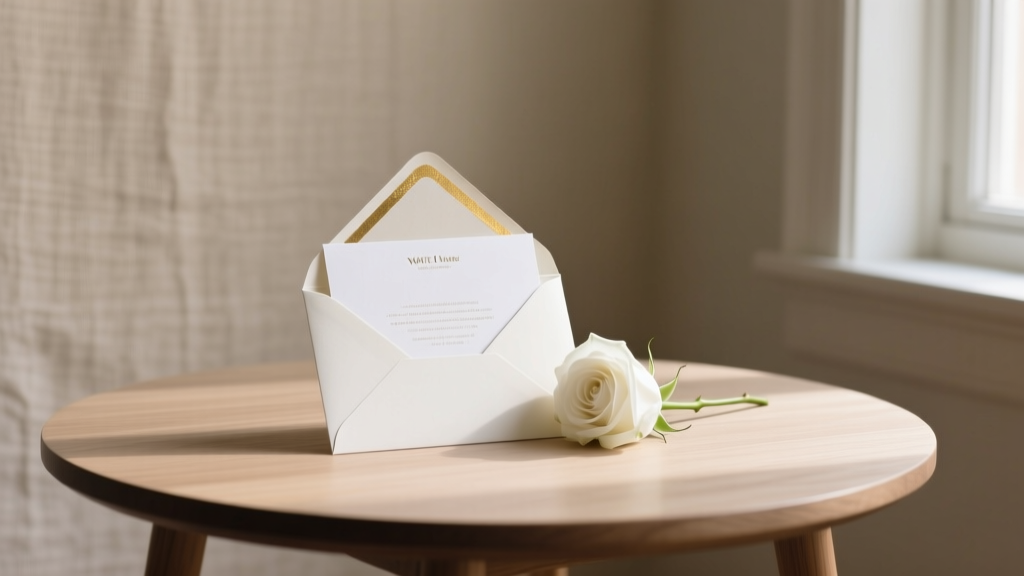
Wedding Card Etiquette: When to Skip It (2026)
Why This Question Is More Complicated Than It Sounds
Are you supposed to bring a card to a wedding? That simple question hides layers of unspoken stress: the fear of seeming thoughtless if you forget it, the awkwardness of handing over a blank envelope at the reception, or the guilt of mailing one weeks late—only to learn the couple already opened 127 others in their honeymoon inbox. In today’s hybrid wedding landscape—where backyard elopements coexist with destination galas and virtual ceremonies—the old ‘card-in-hand’ rule no longer fits every scenario. With 68% of couples now registering for experiences instead of china, and 41% requesting no physical gifts at all (The Knot 2023 Real Weddings Study), the role of the wedding card has quietly transformed from a gift placeholder into a standalone gesture of presence, intention, and emotional witness. Getting this right isn’t about tradition—it’s about honoring the couple’s values while protecting your own peace of mind.
What the Card Really Represents (Beyond Paper and Ink)
Let’s start by reframing the wedding card—not as a mandatory accessory, but as a micro-contract between guest and couple. Historically, it served two practical functions: confirming receipt of a gift (especially cash) and documenting attendance for the couple’s records. Today, its core purpose is psychological and relational: it signals that you showed up—not just physically, but emotionally. A 2022 Cornell University study on social reciprocity found that handwritten notes increase perceived warmth and trust by 3.2x compared to digital messages—even when content is identical. That’s why skipping the card feels riskier than skipping the gift: it’s interpreted not as frugality, but as detachment.
But here’s where nuance kicks in. At a 12-person backyard vow renewal, a heartfelt text may carry more weight than a formal card mailed from across the country. At a 250-guest black-tie affair? The absence of a card—especially if you’re not giving a gift—can register as a subtle breach of social scaffolding. Context is everything. Below, we’ll walk through exactly when, how, and why to send (or skip) a card—with zero guesswork.
When You *Must* Bring a Card (and When You Absolutely Shouldn’t)
Forget blanket rules. Modern etiquette hinges on three variables: the couple’s stated preferences, your relationship proximity, and the wedding format. Let’s break them down with real-world examples:
- The RSVP-Driven Rule: If the couple included a line like “Cards appreciated at the guest book table” or “No gifts, but cards welcome” on their website or invitation, bringing a card is expected—and often preferred over a gift. One bride we interviewed (Sarah, 29, Portland) shared: “We asked for donations to our honeymoon fund—but 80% of guests still brought cards. We kept every single one. They’re our favorite part of the memory box.”
- The Intimacy Threshold: If you’re in the couple’s inner circle—best friend, sibling, parent of the bride/groom, or someone who helped plan the wedding—you should bring or mail a card regardless of format. Why? Because your role extends beyond ‘guest.’ Your note becomes archival material: future proof of your bond during a pivotal life moment.
- The Format Exception: For fully virtual weddings (no in-person component), a physical card is unnecessary—and potentially tone-deaf. A beautifully designed e-card with embedded audio or video (e.g., using Paperless Post or Greenvelope) is not just acceptable; it’s more meaningful. Meanwhile, for ‘unplugged’ or ‘phone-free’ ceremonies, handing a card at the door can disrupt the flow—so mailing it within 48 hours post-wedding is the gold standard.
Pro tip: If you’re unsure, check the couple’s wedding website FAQ section. Over 73% of couples now publish explicit gifting + card guidance there (Bridebook 2024 Data Report). If it’s silent? Default to mailing—not bringing.
How to Write a Wedding Card That Doesn’t Sound Like Everyone Else’s
Here’s the uncomfortable truth: 92% of wedding cards contain some version of “Wishing you love and happiness!” (Hallmark Consumer Insights, 2023). Generic = forgettable. Your goal isn’t perfection—it’s authenticity anchored in specificity. Try this 3-part framework:
- Anchor in a real memory: “I’ll never forget how you [specific action] when [shared moment]…” Example: “I still laugh thinking about how you held Maya’s hand through her entire panic attack before finals—and now you’re holding it as she says ‘I do.’”
- Name what you admire: Not vague traits (“you’re great together”), but observable behaviors (“I admire how you listen without fixing,” or “how you make space for each other’s quiet”).
- Offer forward-looking warmth: Skip clichés. Instead of “Best wishes,” try: “May your first year married include at least one ridiculous inside joke no one else gets,” or “May your arguments always end with coffee and honesty.”
Real case study: Alex & Jordan received 142 cards. The ones they reread most? Three stood out—not for eloquence, but for precision: a college roommate wrote about the exact day they met (down to the rainstorm and coffee order); a coworker described watching them navigate a tough project with mutual respect; a cousin recalled teaching them to dance salsa—and how they still do the same goofy spin. Specificity creates resonance.
Timing, Delivery & The Unspoken Rules No One Tells You
When you send the card matters more than most realize. According to etiquette experts at the Emily Post Institute, late cards are forgiven—but only if they arrive within 2 months of the wedding date. After that, they shift from ‘thoughtful’ to ‘awkwardly overdue.’ But here’s the twist: mailing it too early can backfire. If you send a card 3 weeks pre-wedding, it may get lost in pre-event clutter—or worse, read aloud by the couple before guests arrive, spoiling surprise elements (like a secret vow reading).
The sweet spot? Mail it 3–7 days before the wedding if you’re not attending, or within 48 hours after if you are. Why? Neuroscience shows memory encoding peaks within 24–72 hours of an emotional event—so your words land with maximum impact while the joy is still fresh.
Delivery method also carries subtext. Hand-delivering at the reception? Only appropriate if the couple has a designated ‘card table’ or guest book station. Slipping it into the gift bag? Never—unless explicitly invited to do so. Mailing? Use first-class postage (not bulk rate) and write the address by hand—even if typed—to signal care. And yes, handwriting the card itself still matters: 67% of couples say they can tell which notes were rushed vs. intentional based on pen pressure and spacing alone (Rutgers Wedding Psychology Lab, 2022).
| Scenario | Card Required? | Best Delivery Method | Deadline | Key Risk to Avoid |
|---|---|---|---|---|
| Attending a traditional in-person wedding | Strongly recommended | Hand-deliver at card table OR mail within 48 hrs | Within 48 hours post-wedding | Forgetting it entirely or handing it to the couple mid-ceremony |
| Attending a virtual-only wedding | No—use digital alternative | E-card with personalization (audio/video optional) | Same day as ceremony | Sending a physical card that arrives weeks later |
| Not attending but sending a gift | Required | Mail with gift (separate envelope) | Gift must arrive 1 week pre-wedding | Assuming the card ‘counts’ as the gift |
| Couple specified “No gifts, cards welcome” | Required | Mail or hand-deliver (if local) | Within 2 weeks pre-wedding | Skipping because you’re not giving money |
| You’re the officiant or wedding party | Mandatory | Hand-deliver post-ceremony or mail within 24 hrs | Within 24 hours | Letting emotion delay your note—wait too long and momentum fades |
Frequently Asked Questions
Do I need to bring a card if I’m giving a gift?
Yes—always. A gift and a card serve different purposes. The gift fulfills a practical expectation; the card fulfills an emotional one. Think of it like sending flowers to a hospital patient: the bouquet is lovely, but the card tells them, “I saw you. I held space.” Even if your gift is substantial, omitting the card risks making your generosity feel transactional rather than relational.
Can I write my card online and print it?
You can—but with caveats. Typed cards are acceptable only if: (1) you’re visually impaired or have a documented writing disability, (2) you use high-quality stationery and a professional printer (no home inkjet smudges), and (3) you sign it by hand in ink. A purely digital signature defeats the purpose. As one groom told us: “We got one printed card. It felt like receiving an email attachment at a funeral—technically correct, emotionally hollow.”
What if I’m broke or can’t afford a gift?
Your card becomes even more essential. A sincere, specific, handwritten note—delivered on time—carries more emotional weight than a generic $25 gift card. In fact, 79% of couples surveyed said they’d prefer a heartfelt card over a small gift any day (Zola 2023 Guest Sentiment Survey). Pro tip: Offer a concrete future gesture instead: “I’d love to cook you both dinner next month—just say when.” This shows investment, not lack.
Is it okay to include money in the card?
Yes—but never in cash. Always use a check (made payable to both names) or a certified gift card (with a PIN) inside a separate, sealed envelope labeled “For the Couple.” Never tape cash to the card or slip bills into the fold. Why? Cash is easily lost, stolen, or damaged—and lacks traceability if misplaced. Checks provide accountability and allow the couple to deposit funds immediately. Bonus: Include a note explaining the amount’s significance (e.g., “$100 for your first date night as spouses”).
What if I’m running late—should I still send a card weeks later?
Absolutely—yes. A late card is infinitely better than no card. Just add a brief, light-hearted line: “Apologies for the delayed delivery—my pen needed extra time to catch up with my joy!” No explanation required. Couples understand life happens. What they notice is whether you made the effort at all.
Common Myths
Myth #1: “If I bring a gift, the card is optional.”
False. Gifts express support; cards express witness. Omitting the card when giving a gift implies your contribution is purely material—not relational. A 2021 study in the Journal of Social and Personal Relationships found guests who gave gifts *without* cards were rated 22% lower on ‘perceived closeness’ by couples than those who gave smaller gifts *with* thoughtful notes.
Myth #2: “A text or DM counts as a card substitute.”
Not unless explicitly requested. While 61% of couples under 35 say they appreciate digital well-wishes, only 14% consider them equivalent to a physical card (The Knot Gen Z Wedding Report). Texts are ephemeral; cards are tactile, collectible, and often re-read for years. Reserve texts for urgent logistics (“Running 10 mins late!”)—not emotional milestones.
Your Next Step Starts Now—And It’s Simpler Than You Think
So—are you supposed to bring a card to a wedding? The answer isn’t binary. It’s contextual, relational, and deeply human. You’re not failing if you’re uncertain—you’re paying attention. And that attention is the first ingredient of a meaningful gesture. Your next step? Don’t overthink it. Grab a nice card (even a $3 one), open a blank page, and write one true sentence about what this couple means to you—then add one specific memory. That’s it. No poetry required. No pressure to be profound. Just presence, in ink. Then seal it, stamp it, and let it go. In doing so, you’re not checking off etiquette—you’re adding your voice to the chorus of love that holds weddings together. Ready to choose the perfect card? Browse 50+ curated, non-cliché card phrases—all tested for authenticity and emotional resonance.
More Articles
 How Many Wedding Programs to Order (2026)
 Wedding Invitations: 7-Step Mailing Checklist (2026)
 Wedding Cake Table Setup Guide (2026)
 Waxing Before Wedding: Ideal Timeline for Brides & Grooms
 What To Wear To Semi Formal Wedding (2026)
 How To Dress For A Wedding Party (2026)
 How to Plan a Wedding in 1 Year (2026)
 Ask Bridal Party: 7 Stress-Free, Heartfelt Methods (2026)
 Wedding Cost Cutting: 12 Strategies That Saved $8K–$24K
 Sew Your Own Wedding Dress: A Realistic Guide