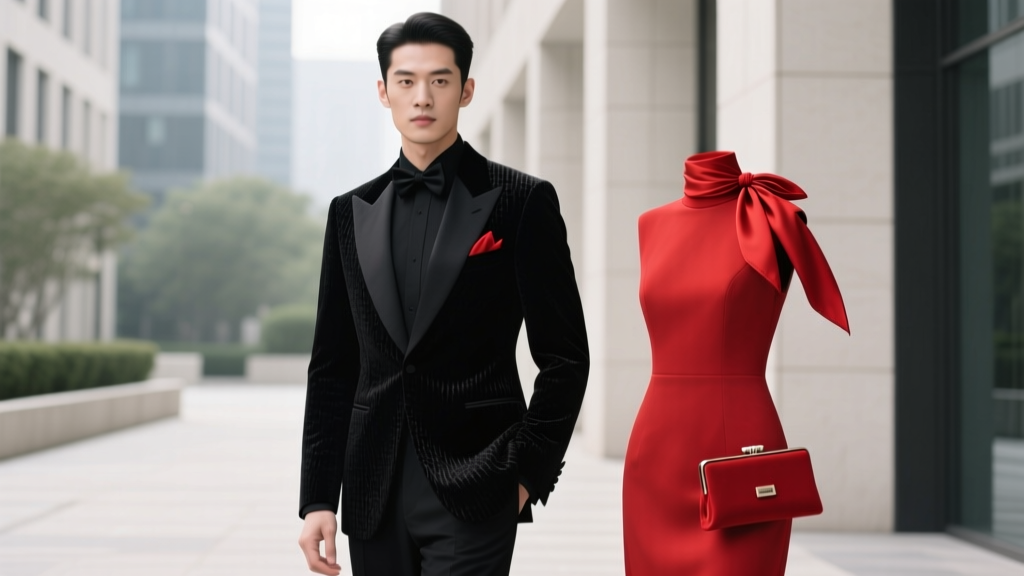
Red at Black Tie Wedding? Etiquette & Tips (2026)
Why This Question Is More Urgent Than Ever
Can I wear red to a black tie wedding? That question isn’t just about fashion—it’s about respect, cultural nuance, and digital visibility. With 68% of couples now sharing wedding photos on Instagram within 24 hours (2024 Knot Real Weddings Report), your outfit doesn’t just land with the couple—it lives in their feed, their highlight reels, and their family group chats for years. A bold red dress that reads as celebratory to you might read as competitive—or even culturally insensitive—to others. And yet, red remains one of the top three most-searched colors for formal guest attire (Google Trends, Q2 2024), driven by Gen Z’s embrace of self-expression and rising demand for inclusive, non-prescriptive etiquette. So the real question isn’t ‘Can I?’—it’s ‘How do I wear red *well*, without undermining the couple’s vision or violating decades-old sartorial codes?’ Let’s settle this—with data, diplomacy, and zero dogma.
The Hierarchy of Red: Not All Reds Are Created Equal
Red is not a monolith—and treating it as such is where most guests go wrong. In black tie contexts, red functions less like a color and more like a social signal: its shade, saturation, texture, and placement all telegraph intent. Think of red as existing on a spectrum from ‘warm support’ to ‘unintentional upstaging.’
A deep burgundy silk gown with a modest neckline and floor-length hem? That reads as sophisticated homage—especially when paired with antique gold accessories and a clutch in charcoal. But a neon-coral satin mini dress with cutouts and sky-high stilettos? That lands as thematic dissonance—even if technically ‘formal.’ Why? Because black tie isn’t just about fabric weight or sleeve length; it’s about tonal alignment with the ceremony’s gravity.
Consider Maya, a bridesmaid at a May 2023 black tie wedding in Charleston. She wore a rust-red crepe column dress—low-saturation, matte finish, elbow-length sleeves. Guests praised her ‘timeless elegance’; the bride later told her it felt like ‘a warm hug in fabric form.’ Contrast that with Derek, a groomsman’s brother, who chose a fire-engine red velvet tuxedo jacket (not part of the agreed-upon attire). Though he meant no offense, multiple guests privately remarked that his look ‘clashed with the moody navy-and-ivory palette’—and the couple quietly asked him to remove the jacket for portraits. Same color. Opposite outcomes. The difference? Context, contrast ratio, and consent.
When Red Works (and When It Doesn’t): The 4-Point Litmus Test
Forget blanket rules. Instead, apply this field-tested, etiquette-adjacent framework before clicking ‘add to cart.’ Each point answers a critical layer of intentionality:
- Timing Check: Is the wedding before 6 p.m.? If yes, lean toward ruby, brick, or oxblood—richer, lower-luminance reds that harmonize with daytime light. After 6 p.m., deeper shades (merlot, garnet, blackened crimson) gain sophistication and avoid ‘costume’ associations.
- Proportion Guardrail: Limit red to *one* dominant element. A red gown is fine—but pair it with neutral shoes (nude, charcoal, or black), minimal metallics, and zero red accessories. Conversely, a black gown with a single red detail—a silk flower at the shoulder, a red enamel cufflink, or a crimson-lined cape—often reads as more refined than head-to-toe scarlet.
- Cultural Alignment Scan: Does the couple have cultural ties where red carries ceremonial weight? In many Chinese, Indian, Nigerian, and Korean traditions, red symbolizes prosperity, joy, or marital blessing—but wearing it *as a guest* can unintentionally mimic bridal symbolism. When in doubt, ask discreetly: ‘Is there a color palette or cultural note we should honor?’
- Photography Protocol: Review the couple’s wedding website or save-the-date for visual cues. If their branding uses muted tones (sage, taupe, cream), high-chroma red may visually disrupt cohesion. If they’ve embraced jewel tones or maximalist contrast (think emerald + tangerine), your red becomes part of the aesthetic ecosystem—not an outlier.
Styling Red Without Apology: Fabric, Fit & Footwear
Red’s power lies in its physics: it’s the longest visible wavelength, commanding attention instantly. That means fabric choice isn’t aesthetic—it’s behavioral design. Avoid anything that amplifies reflectivity (glossy satin, patent leather, sequins) unless the couple explicitly encourages glamour. Instead, prioritize tactile sophistication:
- Wool crepe (for suits or structured dresses) diffuses red’s intensity while adding gravitas.
- Tencel-blend twill offers drape and depth—ideal for wide-leg trousers or bias-cut gowns.
- Matte faille delivers structure without shine, perfect for tuxedo jackets or cocktail separates.
Fitting is non-negotiable. Ill-fitting red reads as chaotic; precision tailoring reads as intentional. A red jumpsuit with razor-sharp seams and a hidden waistband conveys confidence far more effectively than a flowing, ill-defined maxi dress—even if both are ‘red.’
Footwear deserves special attention. Red shoes with a red dress? Over-indexing. Instead, anchor with grounding neutrals: espresso leather, smoked quartz suede, or brushed gunmetal. One exception: if your red is a true primary (like Pantone 186 C), then matching red heels *can* work—if they’re minimalist, low-heeled (<2.5”), and made of soft, unstructured leather. Think ‘quiet luxury,’ not ‘runway finale.’
Black Tie Red: A Comparative Decision Matrix
| Red Shade | Best For | Risk Level | Style Tip |
|---|---|---|---|
| Burgundy | Evening ceremonies, winter weddings, traditional venues (ballrooms, historic mansions) | Low | Pair with antique brass or oxidized silver jewelry—avoids ‘new money’ flash. |
| Oxblood | Outdoor tented weddings, garden estates, spring/summer black tie | Low-Medium | Opt for open-weave wool or linen-blend—adds airiness and prevents overheating. |
| Crimson | Couples who love bold aesthetics, art-gallery weddings, urban lofts | Medium | Balance with architectural accessories: geometric earrings, a sculptural clutch. |
| Scarlet | Rare—only appropriate with explicit couple permission or themed events (e.g., ‘Carmine & Champagne’) | High | Must be matte-finish only; avoid any sheen. Never wear with red nails or lips—monochrome fatigue triggers visual overwhelm. |
| Rosewood | Daytime black tie, beachfront ceremonies, modern-minimalist couples | Low | Works beautifully with ivory lace overlays or raw-hemmed silk—softens formality without breaking code. |
Frequently Asked Questions
Is red considered bad luck at weddings?
No—this is a persistent myth rooted in Western Victorian-era superstition (where red symbolized passion or danger), not universal tradition. In fact, across China, India, Nigeria, and Armenia, red is the *preferred* auspicious color for weddings—symbolizing fertility, prosperity, and protection. As a guest, your red attire carries no inherent ‘luck’ value; its impact depends entirely on execution and cultural awareness.
Can men wear red to a black tie wedding?
Absolutely—but with tighter constraints. A red bow tie is widely accepted (especially in burgundy or wine), as is a red pocket square—provided it’s silk, folded cleanly, and doesn’t match the tie. A full red tuxedo jacket? Only if the couple has specified ‘colorful formalwear’ or you’re part of the wedding party with approved direction. For safety: stick to red accents, not primaries.
What if the invitation says ‘black tie optional’?
‘Black tie optional’ signals flexibility—not carte blanche. It means guests may choose between full black tie (tuxedo/gown) or elevated formalwear (dark suit + tie / cocktail dress). Red remains permissible, but the bar for restraint rises: avoid loud prints, excessive shine, or overly revealing silhouettes. Think ‘refined vibrancy,’ not ‘festival energy.’
Does the season affect whether red is appropriate?
Yes—but not in the way most assume. Winter reds (burgundy, plum-red) feel natural; summer reds (tomato, coral-red) require careful balancing. The real seasonal factor is *light*: midday sun flattens red’s dimensionality, making it appear harsher. Evening light, especially candlelit or golden-hour, enhances red’s warmth and depth. So for daytime black tie, opt for reds with brown or violet undertones—not orange-based ones.
Can I wear red if the bride wore red for her ceremony?
This is nuanced. If the bride wore red *as part of her cultural tradition* (e.g., a Chinese qipao or Indian lehenga), wearing red as a guest is often seen as honoring that heritage—especially if done thoughtfully (e.g., a subtle red sash or embroidered detail). If the bride chose red as a personal, non-cultural statement, err toward tonal deference: choose a significantly darker, duller, or smaller-scale red element to avoid mirroring.
Debunking Two Persistent Myths
- Myth #1: “Red is always inappropriate because it competes with the bride.” Reality: Modern brides increasingly wear blush, champagne, ivory, or even gray—so ‘competition’ is rarely about hue, but about volume, placement, and confidence. A well-tailored burgundy gown worn with quiet poise draws admiration, not comparison.
- Myth #2: “If the invitation doesn’t forbid red, it’s automatically okay.” Reality: Etiquette isn’t defined by omission—it’s defined by presence. Absence of prohibition doesn’t equal endorsement. Proactive alignment (checking the couple’s Pinterest board, asking the wedding planner, or reviewing their registry notes) is far safer than assuming silence equals permission.
Your Next Step: Confident, Considerate, Unforgettable
So—can I wear red to a black tie wedding? Yes. But ‘yes’ isn’t the finish line—it’s the starting point. True guest excellence lies in transforming that ‘yes’ into intention: choosing a red that honors the couple’s story, respects the occasion’s weight, and expresses your authenticity without demanding center stage. Don’t just wear red—curate it. Pull out your calendar, open the couple’s wedding website, and spend 7 minutes doing three things: (1) screenshot their color palette, (2) note the ceremony time and venue type, and (3) draft a polite text to the couple or planner: ‘I’m considering a deep red option—would you welcome that energy, or prefer something more neutral?’ That tiny act of alignment does more for your credibility—and their peace of mind—than any designer label ever could. Ready to find your perfect shade? Explore our Black Tie Dress Guide for 37 vetted, photo-tested red options—from sustainable silk to size-inclusive crepe—each tagged with ‘low-contrast,’ ‘cultural-safe,’ or ‘evening-approved’ filters.
More Articles
 How Much Is a Wedding in Egypt (2026)
 Wedding Suit Rules: Time, Venue, Dress Code & Culture
 Wedding Message for Best Friend: Scripts & Tips (2026)
 Who Directed My Best Friend’s Wedding? (2026)
 How to Wear Wedding Ring and Engagement Band
 Double Wedding Ring Quilt: 7-Step Checklist (2026)
 Wedding Jacket Rules: What You Really Need to Know
 Open Bar Wedding Cost: Real 2026 Breakdown
 Wedding Band Finder: Style, Budget & Values (2026)
 Wedding List That Gets Used: 7 Steps (2026)