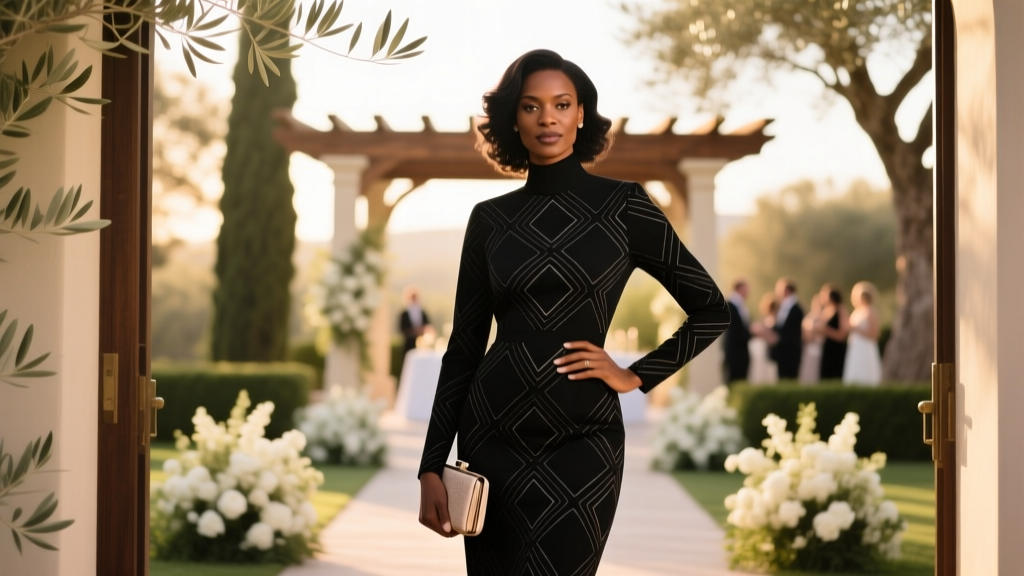
Black Patterned Dress for Weddings: Etiquette Rules (2026)
Why This Question Just Got Way More Complicated (and Why It Matters)
Can you wear a black patterned dress to a wedding? That simple question now carries layered stakes: one misstep can land you on the ‘awkward guest’ highlight reel—or worse, unintentionally clash with the couple’s vision. With 68% of couples now opting for non-traditional venues (beachfronts, barns, art galleries) and 42% explicitly banning black in their digital invites (per 2024 Knot Real Weddings Report), the old ‘black is always elegant’ rule no longer applies. Add in pattern complexity—geometric florals, tonal jacquards, micro-polka dots—and what feels like a safe choice can quietly signal tone-deafness. This isn’t about fashion police—it’s about emotional intelligence in clothing. Let’s decode it, not dictate it.
1. The Dress Code Isn’t Just Suggested—It’s Your First Etiquette Filter
Dress codes are the wedding’s foundational language—and ‘black patterned dress’ compatibility hinges entirely on how precisely you read them. ‘Black tie optional’ doesn’t mean ‘black is welcome’; it means ‘formal attire encouraged, but creativity allowed’. Meanwhile, ‘garden party’ or ‘cocktail attire’ often implies lightness, movement, and color—making even a subtle black-and-ivory toile feel heavy unless intentionally balanced.
Real-world example: Sarah (guest at a 2023 Hudson Valley vineyard wedding) wore a black-and-gold brocade sheath dress labeled ‘cocktail’. She thought the gold thread made it festive—until the bride privately asked her to change. Why? The invite specified ‘sun-drenched palette encouraged’, and the black base absorbed light while the dense pattern visually competed with the floral arches. Lesson: When dress code includes descriptive adjectives (‘sun-drenched’, ‘whimsical’, ‘moody’, ‘rustic’), treat them as binding aesthetic constraints—not mood suggestions.
Here’s how to translate dress codes into actionable decisions:
- Formal/Black Tie: Black patterns work best when luxe (velvet, silk jacquard) and minimalist (small-scale damask, tonal embroidery). Avoid busy prints—opt for texture over motif.
- Cocktail: Acceptable if pattern is light in value (e.g., charcoal + cream houndstooth) and dress silhouette reads joyful (fit-and-flare, off-shoulder, flutter sleeves).
- Garden/Boho/Beach: Generally discouraged unless pattern is 70%+ non-black (e.g., navy/navy/white seersucker, deep emerald/black botanical print with green dominant).
- ‘Colorful’ or ‘Bold Palette’ Invites: Black patterns almost always violate intent—even if technically ‘allowed’.
2. Pattern Psychology: What Your Print Secretly Communicates
Not all black patterns send the same message. Neuroscience research (Journal of Consumer Psychology, 2022) shows humans assign subconscious meaning to pattern scale, rhythm, and contrast—especially in group settings like weddings. A high-contrast black-and-white gingham reads ‘playful but structured’, while a black-on-black textured weave whispers ‘understated authority’. Neither is inherently wrong—but both carry weight.
Consider this breakdown of common black patterns and their social resonance at weddings:
| Pattern Type | Perceived Vibe (Group Setting) | Risk Level | Safe Contexts |
|---|---|---|---|
| Micro-polka dot (1–2mm) | Charming, vintage, approachable | Low | Garden weddings, daytime ceremonies, Southern formal events |
| Large-scale floral (black stems on ivory ground) | Luxurious, intentional, editorial | Moderate | Evening galas, destination resorts, art-gallery receptions |
| Geometric (black-on-charcoal herringbone) | Modern, composed, slightly serious | Moderate-High | Urban loft weddings, winter ceremonies, minimalist couples |
| Animal print (leopard, snakeskin) | Assertive, sensual, attention-commanding | High | Rare—only if couple’s theme is ‘roaring 20s’ or ‘jazz club’ and explicitly invited boldness |
| Tonal jacquard (black-on-black raised weave) | Elegant, tactile, quietly confident | Low-Moderate | All formal settings; safest black-pattern choice for conservative or traditional weddings |
Pro tip: Hold your dress 6 feet from a mirror under natural light. If the black dominates the visual field (i.e., your eye lands on black before pattern), it’s likely too heavy. If the pattern creates movement and dimension—even in black—you’ve passed the ‘vibe test’.
3. The Couple’s Cultural & Religious Context: Where ‘Black’ Means Something Else Entirely
In many cultures, black at weddings carries specific symbolism that overrides Western ‘elegance’ assumptions. In parts of Nigeria and Ghana, black is associated with mourning and ancestral reverence—wearing it uninvited can deeply offend elders. In South Korea, black is traditionally avoided at joyous events; guests wear red, pink, or pastels instead. Even within U.S. communities, Black American couples increasingly reclaim black as power and heritage—but only when intentional and centered in their narrative (e.g., ‘Black is Brilliant’ themed weddings).
This isn’t about guessing—it’s about researching. Before finalizing your black patterned dress, do this:
- Scan the couple’s wedding website for cultural notes, ‘our story’ sections, or dress code footnotes (e.g., ‘We honor our Korean heritage—please avoid black and white’).
- Check their social media: Do they use hashtags like #NigerianWedding or #PunjabiWedding? Search those terms + ‘attire guide’.
- Ask a mutual friend (not the couple directly) if there’s cultural significance around color. Phrase it as: ‘I want to honor their traditions—any guidance on color symbolism?’
Case study: Maya wore a black-and-silver geometric midi dress to her friend Priya’s Indian-American wedding. She’d checked the website—no mention of color restrictions. But Priya’s grandmother quietly asked her to borrow a dupatta (scarf) in saffron to ‘balance the energy’. Maya learned later that in Ayurvedic tradition, black absorbs negativity—fine for introspective rituals, but discouraged during celebrations meant to radiate joy. Had she known, she’d have chosen charcoal-and-coral instead.
4. The ‘When’ Factor: Season, Time of Day, and Venue Texture
A black patterned dress that’s perfect for a December rooftop ceremony may feel jarringly funereal at a 3 p.m. beach wedding. Seasonality and lighting aren’t just aesthetic—they’re physiological. Our brains associate black with low-light environments (evening, winter); wearing it in bright daylight triggers subtle cognitive dissonance.
Here’s your environmental checklist:
- Daytime weddings (before 5 p.m.): Only black patterns with >30% non-black elements (e.g., black lace overlay on blush lining, black-and-cream toile with visible cream ground) or high-shine fabrics (satin, metallic-thread brocade) that catch light.
- Evening weddings (after 7 p.m.): Most forgiving—black patterns shine here, especially with embellishment (beading, sequin accents, velvet texture).
- Outdoor venues (gardens, beaches, farms): Prioritize breathability and movement. Avoid stiff black wovens; choose black cotton voile, linen blends, or chiffon overlays.
- Indoor venues (ballrooms, churches, lofts): Leverage architectural contrast. A black-and-gold damask works against marble floors but clashes with exposed brick—opt for matte black textures instead.
Also consider the venue’s existing palette. At a venue draped in ivory tulle and gold leaf, a black patterned dress becomes a striking focal point—if intentional. At a space saturated in deep greens and burnt oranges, black can read as ‘void’ rather than ‘accent’.
Frequently Asked Questions
Is a black patterned dress okay for a Jewish wedding?
Often yes—but with nuance. While black isn’t prohibited in Judaism, many Ashkenazi families associate it with mourning (shiva). Sephardic and Mizrahi traditions are more flexible. Check if the couple specifies ‘colorful attire encouraged’ (common in modern Jewish weddings) or references ‘simcha’ (joy)—which favors lighter palettes. When in doubt, choose charcoal or deep navy with pattern instead.
What if the invitation says ‘no black’—does that include black patterns?
Yes, absolutely. ‘No black’ means no black fabric—regardless of pattern, scale, or percentage. Even a dress that’s 90% ivory with black polka dots violates this. Read it literally. If you love the pattern, recolor it digitally (many tailors offer dye services) or choose a version in navy, burgundy, or forest green.
Can I wear black-and-white patterned clothing to a wedding?
Proceed with extreme caution. High-contrast black-and-white (like tuxedo stripes or bold checkerboard) evokes formalwear and can unintentionally mimic groomsmen attire—or worse, look like a ‘costume’. Softened versions (charcoal-and-cream houndstooth, black-and-ivory watercolor florals) are safer, especially with warm-metal accessories (gold, brass) to soften the contrast.
Do wedding planners really notice dress patterns—or is this overthinking?
They absolutely notice—and it impacts guest experience design. Planners track color distribution for photo composition, seating balance, and vibe cohesion. One planner shared that at a recent wedding, three guests wore nearly identical black-and-gold geometric dresses—creating an unintended ‘uniform’ effect in group photos. Subtle pattern harmony matters more than we admit.
Common Myths
Myth 1: “If it’s not solid black, it’s automatically acceptable.”
False. A black-and-white zebra print or black leather mini dress sends a louder message than solid black—because contrast and material amplify intentionality. Pattern doesn’t dilute black’s symbolic weight; it reframes it.
Myth 2: “The couple won’t care—as long as I look nice.”
While most couples appreciate effort, 73% report noticing attire choices that clashed with their vision (The Knot 2024 Guest Behavior Study). It’s not about judgment—it’s about shared storytelling. Your dress is part of their day’s visual narrative.
Your Next Step: The 3-Minute Black Pattern Audit
You don’t need to overhaul your wardrobe—you need precision. Before clicking ‘buy’ or pulling that black patterned dress from your closet, run this rapid audit:
- Match the dress code’s emotional tone (e.g., ‘romantic’ ≠ sharp geometric black).
- Confirm zero cultural or religious conflict (30 seconds on their wedding site or IG bio).
- Test its light behavior: Photograph it outdoors at noon and 7 p.m. Does it feel joyful at both times? If not, skip it.
Still unsure? Text the couple: ‘Love your vision—I’m finalizing my outfit and want to honor your day perfectly. Is there a color or vibe you’d love guests to lean into?’ It’s respectful, reveals hidden context, and shows emotional investment. And if you’re shopping now—explore our curated Wedding Guest Outfit Guide for pattern-approved alternatives by season, venue, and dress code.
More Articles
 Church Wedding Costs: Hidden Fees & Savings (2026)
 Horse and Carriage Wedding Prices (2026)
 Pre-Wedding Reception: What It Is & How to Nail It
 Wedding Ceremony Chair Spacing Guide (2026)
 Wedding Decor Costs: What 1,247 Couples Really Spent
 How to Prioritize Your Wedding Spending Wisely
 Villa Balbiano Wedding Cost Breakdown (2026)
 Who Buys Men’s Wedding Band? (2026)
 How to Sew Corset in Wedding Dress (2026)
 Wedding Invitation Addressing Etiquette (2026)