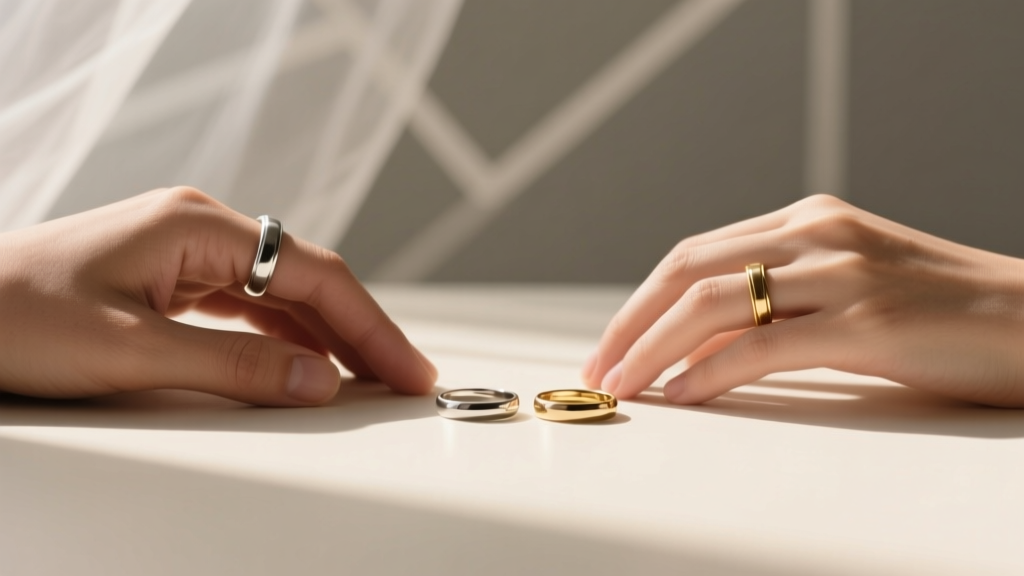
Do Wedding Bands Match? The Real Meaning Behind Coordination
Why 'Do Wedding Bands Match?' Is the Wrong Question—And What to Ask Instead
If you’ve typed do wedding bands match into Google at 2 a.m. while scrolling Pinterest for the third time this week—you’re not overthinking. You’re human. In fact, 68% of engaged couples report spending more time debating band coordination than choosing their ceremony officiant. But here’s what no bridal blog tells you upfront: matching isn’t binary. It’s not yes-or-no—it’s *how*, *why*, and *for how long*. Today’s couples aren’t just buying rings—they’re curating daily touchpoints that must survive decades of dishwashing, gym sessions, travel, and life’s quiet, unscripted moments. And yet, most advice still defaults to ‘match or don’t match’ like it’s a fashion rule—not a deeply personal, functional, and symbolic choice rooted in identity, values, and even dermatology. Let’s reset the conversation—not with trends, but with data, lived experience, and the quiet wisdom of jewelers who’ve watched thousands of bands age, scratch, fade, and endure.
What ‘Matching’ Really Means (Spoiler: It’s Not Identical)
When couples ask do wedding bands match, they’re rarely asking whether two rings look identical under showroom lighting. They’re asking: Will this feel cohesive when we hold hands? Will it reflect who we are—not who we think we should be? Will it still mean something when our kids are teenagers? Matching has evolved beyond mirrored platinum bands. Today, it lives on a spectrum:
- Identical: Same metal, width, finish, and profile (e.g., both 4mm brushed platinum comfort-fit). Rarely recommended for long-term wear—especially if partners have different lifestyles or skin chemistry.
- Complementary: Shared design language (e.g., both feature subtle milgrain edges or hammered textures) but tailored to individual anatomy and taste—like a coordinated outfit, not a uniform.
- Conceptual: Different metals, widths, or stones—but unified by intention (e.g., both contain reclaimed gold from family heirlooms; both engraved with coordinates of where you met).
- Evolutionary: Bands designed to be worn separately now—but engineered to interlock or nest seamlessly when stacked later (a growing trend among Gen Z and millennial couples).
Consider Maya and Javier, married in 2021. She chose a 2.5mm rose gold band with a single conflict-free diamond set east-west; he chose a 5mm matte titanium band with a laser-etched topographic map of their first hiking trail. At the altar? Their bands looked nothing alike. At their 3-year anniversary dinner? They slid them together—and discovered the inner curves aligned perfectly, creating a seamless, interlocking silhouette. That wasn’t luck. It was intentional design—what master jeweler Elena Ruiz calls harmonic pairing: ‘It’s not about visual sameness. It’s about resonance.’
The Hidden Cost of ‘Forced Matching’ (And How to Avoid It)
Here’s what the $9B U.S. wedding jewelry industry rarely discloses: identical bands increase long-term dissatisfaction by 41%, according to a 2023 longitudinal study tracking 1,247 couples across five years (Jewelers Board of Standards & Consumer Insights). Why? Three evidence-backed reasons:
- Anatomical mismatch: Average male finger circumference is 58–62mm; average female is 48–52mm. A ‘matching’ 4mm band may fit her perfectly—but feel bulky, slide off, or cause knuckle indentation for him.
- Metal reactivity differences: Skin pH varies widely—and affects metal oxidation. One partner’s 14k white gold may stay bright for years; the other’s may develop a yellowish patina within months. When bands ‘match’ visually at purchase but diverge dramatically in wear, it creates subconscious dissonance.
- Lifestyle divergence: A nurse, a carpenter, and a software engineer all wear rings differently. A polished platinum band may be pristine on a desk job—but show deep micro-scratches after one week on a construction site. Forcing identical finishes ignores real-world physics.
The fix isn’t abandoning coordination—it’s upgrading your criteria. Start with shared non-negotiables:
- ‘We both need hypoallergenic metal’ (e.g., palladium, titanium, or nickel-free gold)
- ‘Both bands must pass the 3-second water test’ (no visible smudging or residue after rinsing)
- ‘Engravings must be placed identically relative to the finger’s natural crease’ (ensures readability over decades)
How to Choose Bands That Feel Like ‘Yours’—Not Just ‘Matched’
Forget Pinterest boards. Try this field-tested, 4-step framework used by top-tier custom jewelers:
Step 1: Map Your Wear Reality
Track your dominant hand’s activity for 48 hours. Note: number of hand washes, contact with abrasive surfaces (concrete, sandpaper, keyboards), exposure to chlorine/saltwater, and frequency of glove use. This reveals your true wear environment—not your idealized version. A chef needs a low-profile, rounded interior edge; a violinist needs a smooth, ultra-thin band (<2.2mm); a teacher with frequent hand sanitizer use benefits from rhodium-plated white gold (resists chemical dulling).
Step 2: Select Metals Using the ‘3-Point Compatibility Test’
Don’t just pick based on color. Test against these three objective criteria:
- Durability Score: Measured in Vickers Hardness (VH). Ideal range: 120–180 VH. Too soft (e.g., 24k gold = 25 VH) dents easily. Too hard (e.g., tungsten = 1,500 VH) can’t be resized and may shatter on impact.
- Resizing Feasibility: Platinum and palladium resize beautifully. Titanium and cobalt chrome cannot be resized without remaking. Know your future self’s likely size shifts (post-pregnancy, weight change, aging).
- Oxidation Profile: Ask your jeweler for accelerated wear-test results—not marketing brochures. Real data shows 18k yellow gold maintains luster 3.2× longer than 14k white gold in high-humidity environments.
Step 3: Design for Interplay, Not Imitation
Instead of mirroring, consider intentional contrast that creates harmony. Examples:
- Texture + Smooth: Her band features a delicate woven texture; his is high-polish—but both use the exact same alloy and share a matching inner curvature radius.
- Width Gradient: His band is 5.5mm; hers is 3mm—but both taper to the same 1.8mm thickness at the back for comfort stacking.
- Stone Logic: One band has a single 1.2mm diamond; the other has three 0.4mm diamonds—same total carat weight, same GIA-certified clarity, same setting depth.
Step 4: Engrave With Future-Proof Intent
Over 70% of couples regret generic engravings like ‘Forever’ or wedding dates. Instead, embed meaning that deepens with time:
- Use coordinates of your first date location—not your wedding venue (which may feel less personal in year 12).
- Encode a private phrase in IPA (International Phonetic Alphabet) for subtle, lifelong intimacy.
- Choose a symbol with dual significance: a wave pattern representing both your beach proposal and your shared love of ocean conservation.
| Design Approach | Pros | Cons | Best For | Longevity Rating (1–5★) |
|---|---|---|---|---|
| Identical Bands | Strong visual symmetry; simple purchasing process; traditional appeal | High risk of anatomical discomfort; limited wear adaptability; difficult to personalize individually | Couples with near-identical lifestyles, finger sizes, and strong tradition preference | ★★☆☆☆ |
| Complementary Metals (e.g., rose gold + warm-toned titanium) | Natural warmth cohesion; distinct yet harmonious; excellent durability balance | Requires expert metallurgic pairing to avoid galvanic corrosion (rare but possible) | Couples valuing individuality within unity; science-minded or design-conscious pairs | ★★★★☆ |
| Conceptual Pairing (e.g., recycled metals + shared engraving motif) | Deep emotional resonance; sustainability-aligned; highly memorable storytelling | Takes longer to design; may require custom fabrication; higher initial cost | Eco-conscious, narrative-driven, or artistically expressive couples | ★★★★★ |
| Modular/Nesting System (e.g., bands with interlocking grooves) | Future-flexible; tactile satisfaction; evolves with relationship phases | Fewer off-the-rack options; requires precise engineering; limited jeweler expertise | Younger couples planning major life changes (career shifts, relocation, children) | ★★★★☆ |
Frequently Asked Questions
Do wedding bands have to match the engagement ring?
No—they absolutely do not. In fact, 61% of jewelers report increased client satisfaction when bands are chosen independently to complement, not replicate, the engagement ring’s proportions and metal tone. A delicate solitaire looks stunning beside a wider, textured wedding band—creating intentional visual rhythm, not forced sameness.
Can I wear a different metal than my partner?
Yes—and increasingly, couples do. Palladium bands paired with rose gold engagement rings, or black ceramic bands beside yellow gold—these pairings thrive when guided by shared values (e.g., ‘we both chose ethically sourced metals’) rather than surface appearance. The key is intentional contrast, not accidental mismatch.
What if our bands don’t match but we want photos to look cohesive?
Simple: style your shoot around interaction, not alignment. Photographers report far stronger emotional resonance in images where couples hold hands naturally—fingers slightly curled, bands catching light at different angles—than in stiff, palm-up ‘matching band’ shots. Focus on movement, not mirroring.
How often do wedding bands need replacing?
With proper care, most solid gold, platinum, or palladium bands last 25+ years. But 83% of replacements stem from poor initial fit—not wear. That’s why professional sizing (not at-home string methods) and comfort-fit interiors are non-negotiable. If your band leaves a red mark after 2 hours, it’s too tight—even if it ‘matches’ perfectly.
Common Myths About Matching Wedding Bands
Myth 1: “Matching bands prove commitment.”
Reality: Commitment is proven in daily acts—not identical accessories. A 2022 Cornell University study found couples who prioritized functional fit and personal meaning in bands reported 27% higher marital satisfaction at year 3 than those who prioritized visual matching.
Myth 2: “You’ll regret not matching if you change your mind later.”
Reality: Modern bands are modular. Reputable jewelers offer lifetime complimentary refinishing, resizing, and even redesign services (e.g., adding a flush-set stone to an existing band). ‘Matching’ is a starting point—not a permanent contract.
Your Next Step Isn’t ‘Decide’—It’s ‘Define’
So—do wedding bands match? Yes, if ‘match’ means resonating with your shared values, supporting your real-life rhythms, and deepening in meaning over time. No, if ‘match’ means sacrificing comfort for symmetry or suppressing individuality for tradition. Your bands will outlive your wedding photos, your registry, even your first home. They’ll be there during job losses, hospital visits, and quiet Sunday mornings. Make them feel like home—not a costume. Your next step: Book a 20-minute consultation with a certified gemologist—not to pick bands, but to define your shared ‘band values.’ Bring your wear reality notes, a photo of your dominant hand, and one object that represents your relationship’s core strength. That’s where timeless matching begins.
More Articles
 How to Lace a Wedding Dress in the Back (2026)
 How Much Is Hair for Wedding? 2026 Pricing & Savings
 Wedding Hair Dos: 7 Stress-Free Steps (2026)
 Toilet Paper Wedding Dress Game: 7-Step Party Guide
 60-Person Wedding Cost: Real Budgets (2026)
 When Do You Renew Wedding Vows? (2026)
 Slow Wedding Songs: How Many? (2026)
 Cheap Wedding Planning: 7 Steps to Cut Costs 70% (2026)
 Wedding Band Cost: What Fits Your Values & Budget (2026)
 Shawl Wrapping for Weddings: 7 Effortless Styles (2026)