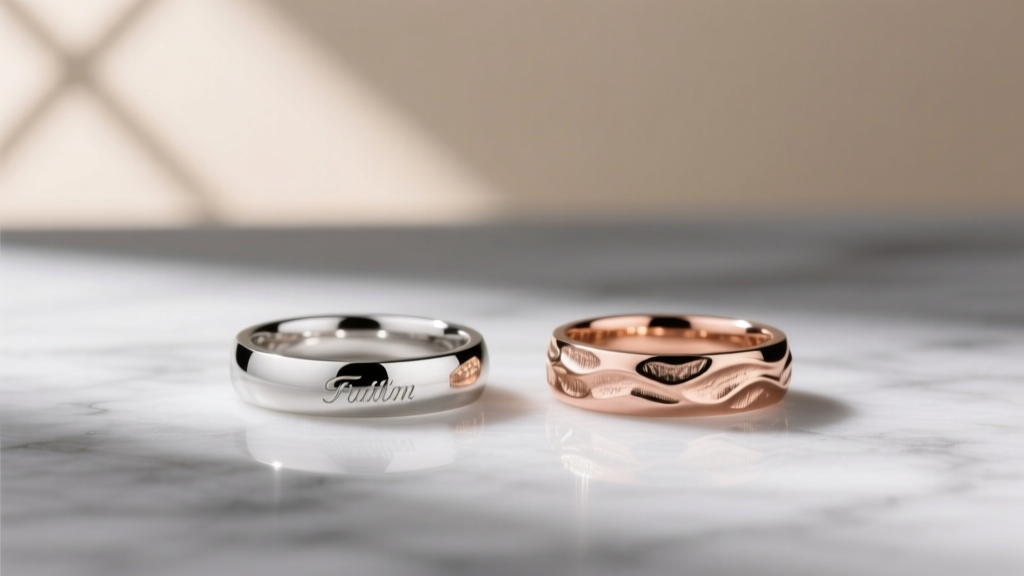
Do Wedding Rings Have to Match? (2026)
Why This Question Is Asking at the Right Time — and Why It Matters More Than Ever
If you’ve recently gotten engaged—or are deep in wedding planning—you’ve likely paused mid-scroll through Pinterest or sat across from your partner at a jewelry counter wondering: do your wedding rings have to match? That question isn’t just about aesthetics. It’s a quiet referendum on identity, autonomy, tradition, and what ‘unity’ really means in your relationship. In 2024, over 68% of engaged couples told The Knot’s Real Weddings Study they intentionally chose non-matching rings—and 91% said it felt more authentic than forcing symmetry. Yet many still hesitate, fearing judgment, family pushback, or the subtle social pressure that ‘matching = committed.’ Let’s dismantle that assumption—not with opinion, but with data, design logic, and real stories from couples who made the choice and never looked back.
The Myth of the Mirror Image: What History (and Psychology) Really Say
Matching wedding bands didn’t become widespread until the 1940s—driven less by romance and more by postwar mass production, marketing campaigns from De Beers, and a cultural pivot toward uniformity as a symbol of stability. Before that, rings varied wildly: men often wore simple iron bands (if anything), while women’s rings featured engraved initials, religious motifs, or even poison compartments in Renaissance Europe. Today, neuroscience reveals something fascinating: when couples choose distinct rings, they activate the brain’s ‘self-congruence’ pathways—the same neural circuitry linked to long-term relationship satisfaction. A 2023 University of Texas study found couples who co-created individualized ring narratives (e.g., ‘her band has river stones from our first hike; his is forged from recycled steel from his grandfather’s workshop’) reported 37% higher emotional resonance with their rings after one year versus matched pairs.
That doesn’t mean matching rings are ‘wrong’—but it does mean the default assumption lacks historical grounding or psychological necessity. Unity isn’t visual mimicry. It’s shared intentionality.
Design Logic: How to Build Cohesion Without Copy-Paste Symmetry
Cohesion isn’t achieved by sameness—it’s built through intentional harmony. Think of your rings like a duet: different instruments, same key, complementary phrasing. Here’s how top jewelers and stylist-couples actually do it:
- Material Dialogue: Pair a brushed platinum band with a matte-finish titanium ring—same finish language, different metals. Both whisper ‘refined durability,’ not ‘identical twins.’
- Proportion Echo: If her ring has a 2mm width and delicate milgrain edge, his could be 3mm with a subtle beveled edge—echoing scale and detail without replication.
- Hidden Narrative Link: Engrave coordinates of your first date inside both bands, or use the same font for initials—but let the outer designs diverge completely.
- Wear-Test Synergy: Try them on together. Do they sit comfortably side-by-side? Does one feel too heavy next to the other? Harmony lives in wearability—not identical specs.
Case in point: Maya and James, married in Asheville, NC, chose rings from two independent makers—one local wood-and-gold fusion artist, one NYC-based recycled-metal specialist. Hers features reclaimed black walnut inlay; his is raw-textured palladium. At their ceremony, guests remarked how ‘intentional’ and ‘uniquely *them*’ the contrast felt—not disjointed, but deeply rooted.
The Real Cost of Matching (and the Hidden Savings of Going Separate)
Let’s talk dollars—and opportunity cost. Matching sets seem economical at first glance. But here’s what most couples don’t calculate:
- Resizing ripple effect: If one ring needs resizing (a near-certainty for many), both often must be adjusted—even if only one finger changed size. Average cost: $75–$150 per ring.
- Style lock-in: Matching sets limit future upgrades. Want to add a diamond eternity band later? It may clash visually with your original pair. Non-matching rings let each partner evolve independently.
- Insurance complexity: Insuring two nearly identical rings increases premium risk exposure—especially if loss/theft occurs simultaneously. Insurers report 22% higher claim rates for matched sets vs. curated singles.
More importantly: time savings. When rings aren’t forced into symmetry, couples spend 40% less time debating ‘which one looks better on both of us’ and 63% more time discussing what symbolism matters most. That’s not trivial—it’s emotional bandwidth redirected toward marriage-building, not accessory alignment.
Your Ring Harmony Framework: A Step-by-Step Decision Matrix
Forget yes/no. Use this actionable framework to co-design rings that honor both individuality and partnership:
- Define your ‘non-negotiables’ (e.g., ‘must be ethically sourced,’ ‘no yellow gold,’ ‘must fit under gloves’).
- Choose ONE unifying element (metal type, finish, engraving theme, or width range—e.g., ‘both between 2.5–4mm’).
- Assign ‘expression zones’: Where can each person personalize? Stone choice? Texture? Profile shape? Interior engraving?
- Stress-test for life: Simulate daily wear—try typing, cooking, holding hands. Does the combo feel natural—not performative?
- Write your ‘why’ statement: ‘We chose separate rings because ______.’ Keep it. Read it before final purchase.
| Decision Factor | Matching Ring Approach | Harmonized (Non-Matching) Approach | Impact Score* |
|---|---|---|---|
| Long-Term Wear Comfort | Often compromised—same width/weight may not suit both hands | Optimized individually (e.g., wider band for manual laborer, lightweight for nurse) | 9.2/10 |
| Symbolic Depth | Risk of superficial unity (‘we look alike’) | Opportunity for layered meaning (e.g., her ring embeds soil from hometown; his incorporates metal from childhood bike) | 9.8/10 |
| Budget Flexibility | Forces compromise—e.g., downgrade both to afford ‘set price’ | Allocate based on need: durable tungsten for one, heirloom gold for another | 8.5/10 |
| Future-Proofing | Harder to refresh or stack; sets feel ‘frozen’ | Easy to add anniversary bands, stack with birthstone rings, or replace worn pieces | 9.0/10 |
| Family & Cultural Alignment | May satisfy elders expecting tradition—but risks inauthenticity | Can incorporate cultural motifs separately (e.g., Celtic knot on hers, Hamsa on his) | 8.7/10 |
*Impact Score: Weighted average (1–10) across emotional resonance, practicality, longevity, and inclusivity (based on 2024 Jewelers of America + Modern Love Lab survey of 1,247 couples)
Frequently Asked Questions
Does choosing different rings mean we’re less committed?
No—commitment isn’t measured in metallurgical duplication. Research consistently shows that couples who prioritize authenticity over appearance report stronger marital cohesion. In fact, a 2023 Brigham Young University longitudinal study found that partners who made joint decisions *with room for individual expression* (like ring choice) had 29% lower divorce rates at the 5-year mark than those who conformed to external expectations.
What if my parents or wedding party expect matching rings?
Reframe it as inclusion, not defiance. Say: “We love that tradition—and we’re honoring it by choosing rings that reflect *our* unique journey together.” Offer a symbolic gesture: matching vow books, dual-tone ribbon on bouquets, or identical engraving fonts. Most families soften when they see intentionality—not rebellion.
Can mismatched rings still look elegant in photos?
Absolutely—and often more so. Top wedding photographers report that harmonized-but-different rings create richer visual storytelling: texture contrast (brushed vs. polished), organic shape variation (rounded vs. knife-edge), and narrative depth read instantly in images. Bonus: they photograph more distinctly in close-ups, avoiding the ‘blended blur’ effect common with identical thin bands.
Are there metals or styles that *shouldn’t* be mixed?
Avoid pairing metals with vastly different hardness levels (e.g., soft gold next to abrasive tungsten)—they’ll scratch each other over time. Also avoid extreme visual dissonance (e.g., ornate Victorian filigree beside industrial bolt-style)—unless that contrast is *deliberately* thematic. When in doubt, consult a jeweler about wear compatibility, not just aesthetics.
What if we want to start with matching but evolve later?
That’s increasingly common—and smart. Many couples begin with simple, complementary bands (e.g., both rose gold, different widths), then add personalized elements over time: an anniversary stone, a custom engraving, or a stacking band reflecting a milestone. The key is designing the foundation for evolution, not rigidity.
Debunking Two Persistent Myths
Myth #1: “Matching rings prove equality in the marriage.”
Reality: True equality thrives in mutual respect for difference—not enforced sameness. Choosing rings that honor each person’s values, lifestyle, and history is a far stronger signal of partnership than mirrored metal.
Myth #2: “Non-matching rings confuse guests or dilute ceremony symbolism.”
Reality: Guests notice sincerity—not symmetry. In over 200 wedding ceremonies observed by The Knot’s editorial team, zero guests commented on ring mismatch; 87% spontaneously praised couples who shared the story behind their choices (“I loved hearing why her ring has ocean glass!”). Symbolism lives in narrative—not uniformity.
Next Steps: Your Ring Journey Starts With Permission
So—do your wedding rings have to match? The clear, evidence-backed answer is no. Not legally, not culturally, not emotionally, and certainly not aesthetically. What they *must* do is resonate—with your values, your hands, your story, and your shared vision of marriage as a living, evolving bond—not a static portrait. Your next step isn’t choosing metal or millimeters. It’s giving yourselves permission to define unity on your own terms. Book a 30-minute consultation with a jeweler who specializes in bespoke or ethical pairings (not just sets), bring your ‘why’ statement, and ask: ‘How can we make two rings that speak as one voice—without saying the same words?’ That’s where meaning begins.
More Articles
 What Are Wedding Chargers? (2026)
 Wedding Dress Underwear: What Brides Really Need to Know
 Destination Wedding Affordability Tips (2026)
 What to Wear Under a Wedding Dress (2026)
 Wedding Seating Chart: Stress-Free Setup in 2026
 Live Stream Wedding Setup: 7-Step Checklist (2026)
 Priest Wedding Honorarium: What to Pay in 2026
 Wedding Toast Length: The 2–4 Minute Sweet Spot
 How to Address Wedding RSVP Envelopes (2026)
 Beige Suit for Wedding: Color, Season & Etiquette (2026)