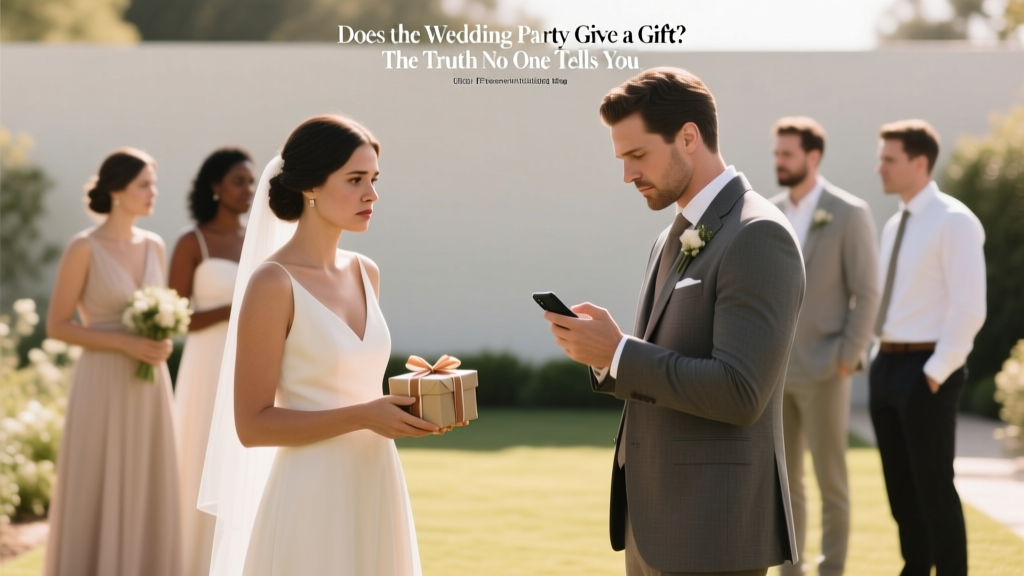
Wedding Party Gifts: When & How Much to Give (2026)
Why This Question Is More Urgent Than You Think
Does the wedding party give a gift? It’s one of the most quietly stressful questions bubbling beneath the surface of every wedding planning spreadsheet—and for good reason. In 2024, 68% of couples report at least one major disagreement over wedding-related financial expectations (The Knot Real Weddings Study), and gifting from the wedding party consistently ranks in the top 5 triggers. Unlike registry gifts or shower presents, this expectation lives in a gray zone: unspoken, emotionally loaded, and rarely addressed until weeks before the big day—when tensions run high and budgets are already stretched thin. Whether you’re a bride agonizing over whether to ask your college roommate to spend $125 on a toaster oven after she’s already paid for travel, hair, makeup, and attire—or a groomsman wondering if ‘showing up’ is enough—this isn’t just about etiquette. It’s about preserving trust, honoring goodwill, and avoiding resentment that can linger long after the cake is gone.
What Tradition *Actually* Says (Spoiler: It’s Not What You’ve Heard)
Let’s start with the biggest misconception: that wedding party members are *required* to give a gift. They’re not. Zero major etiquette authority—including Emily Post Institute, The Knot, or Modern Bride—lists gifting as a formal obligation. Instead, tradition frames it as a gesture of love and support—not a transactional duty. Historically, wedding parties were family or lifelong friends who helped with logistics (sewing dresses, building arches, hosting rehearsal dinners) rather than paying for participation. The modern shift toward monetary expectations emerged only in the last 25 years, accelerated by rising wedding costs, social media visibility, and the normalization of registries.
But here’s the nuance: while not required, it’s *strongly expected* in most U.S. and Canadian cultural contexts—especially among peers aged 25–40. A 2023 survey of 1,247 recently married individuals found that 89% received at least one gift from each wedding party member, and 73% said they’d feel ‘mildly disappointed’ or ‘hurt’ if a close attendant didn’t give something—even if they never mentioned it aloud. Why? Because gifting functions as symbolic reciprocity: you’ve asked them to invest time, money, and emotional labor; a gift signals mutual care, not payment.
That said, expectations vary dramatically by relationship depth, geography, and socioeconomic context. In rural Midwest communities, a handwritten letter and homemade jam may carry more weight than a $200 registry item. In high-cost urban areas, $150–$250 is often the quiet baseline—not because it’s dictated, but because it aligns with average attendant out-of-pocket costs ($850–$1,400 per person, per WeddingWire’s 2024 Attendant Cost Report). The key insight? It’s less about the dollar amount and more about intentionality, timing, and alignment with the couple’s values.
Your Wedding Party’s Real Financial Reality (And How to Respect It)
Before assuming what your attendants ‘should’ give, step into their shoes. The average wedding attendant spends:
- $320–$680 on attire (including alterations and accessories)
- $180–$420 on travel + lodging (if destination or out-of-town)
- $95–$210 on hair/makeup or grooming
- $75–$150 on the rehearsal dinner (often self-funded)
- $45–$120 on bachelor/bachelorette contributions
That’s $715–$1,680 *before* any gift. And that’s for a mid-tier wedding. Add in student loans, rent hikes, or new parenthood—and suddenly, asking for a $200 gift feels like stacking bricks on a wobbling tower.
So what’s the solution? Proactive, compassionate communication. We recommend a ‘financial transparency moment’—not during the proposal, but 2–3 months after the wedding date is set. Send a warm, no-pressure note (email or text is fine) that says: “We’re so honored you’ll be part of our day—and we know being on the wedding party comes with real costs. We want you to feel supported, not stretched thin. If you’re comfortable sharing, we’d love to know your general budget range for a gift (e.g., $50–$150), so we can guide our registry accordingly. No pressure either way—we’re just committed to making this joyful for everyone.”
This does three things: it validates their effort, removes guesswork, and invites collaboration—not obligation. One couple in Portland used this approach with their 8-person party. Two attendants shared tight budgets ($0–$75); two others offered $200+ ‘experience gifts’ (a weekend getaway voucher, a cooking class). The result? Zero awkwardness, zero resentment, and a registry that reflected actual capacity—not assumptions.
When, How, and What to Give: A Tactical Guide
If you’re an attendant deciding what—and when—to give, here’s your actionable roadmap:
- Timing matters more than you think: Gifts given *before* the wedding (ideally 4–8 weeks out) reduce last-minute stress for the couple and signal thoughtfulness. Post-wedding gifts (within 3 months) are acceptable but risk feeling like an afterthought—especially if the couple has already thanked guests publicly.
- Cash is king—but frame it right: 61% of wedding gifts in 2023 were cash or gift cards (Brides Magazine Survey), yet only 38% of attendants present it gracefully. Skip the plain envelope. Use a custom card with a personal note (“So grateful you stood beside us—this helps us start our first home!”) and consider bundling with a small symbolic item (a framed photo from your friendship, a favorite coffee blend).
- Registry ≠ obligation: Just because you’re on the registry doesn’t mean you must buy from it. Attendants gave non-registry gifts 44% of the time in 2023—including charitable donations in the couple’s name (12%), heirloom items (9%), or DIY projects (7%). One bridesmaid gifted her sister a hand-bound ‘Advice from Our Grandmothers’ journal—filled with handwritten notes from 14 female relatives. It cost $0 but became the couple’s most-treasured keepsake.
- Group gifting is smart—but requires coordination: For high-ticket items (a kitchen appliance, honeymoon fund), group gifting reduces individual burden and increases impact. Use apps like Zola or Honeyfund to create private group links, and assign a ‘gift captain’ (not the couple!) to manage communication and deadlines.
| Gift Type | Average Value Range | Best For | Pros & Cons |
|---|---|---|---|
| Cash / Gift Card | $75–$300 | Couples buying a home, paying off debt, or funding travel | Pros: Flexible, universally appreciated, easy to track. Cons: Can feel impersonal without thoughtful presentation. |
| Registry Item | $50–$250 | Couples who value specific household goods or experiences | Pros: Aligns with couple’s vision; eliminates guesswork. Cons: Risk of duplicates; may not reflect true need (e.g., 3rd blender). |
| Group Gift (Honeymoon Fund) | $150–$800 total | Destination weddings or couples prioritizing experiences over objects | Pros: High emotional ROI; strengthens group bond. Cons: Requires early coordination; some may opt out quietly. |
| Personalized / Handmade | $0–$120 (time/materials) | Close-knit parties valuing sentiment over scale | Pros: Deeply meaningful; stands out in memory. Cons: Time-intensive; quality varies. |
| Charitable Donation | $25–$200 | Couples with strong values (e.g., environmentalism, education) | Pros: Reflects shared purpose; tax-deductible. Cons: Must align with couple’s stated priorities—or risk missing the mark. |
Frequently Asked Questions
Do groomsmen have to give a gift if the bride’s family is covering all wedding costs?
No—and this is a critical distinction. Financial responsibility for the wedding (who pays for what) has zero bearing on gifting expectations. Gifting is about the personal relationship between the attendant and the couple, not cost allocation. That said, if the groom’s family is fully funding the event *and* the groomsmen have incurred minimal personal expenses (e.g., no travel, simple attire), a smaller or symbolic gift (e.g., a heartfelt letter + $50 contribution) is widely accepted and often appreciated for its sincerity over scale.
What if I’m in the wedding party but can’t afford *anything* right now?
It’s okay—and more common than you think. The kindest, most respectful approach is quiet honesty *early*. Message the couple privately: *“I’m over-the-moon to be part of your day, and I’ve been thinking hard about how to honor that. Right now, my finances are incredibly tight—I won’t be able to give a material gift, but I’ll pour my heart into supporting you in every other way: showing up fully, helping with prep, being present. I hope that’s enough.”* Most couples will respond with relief and gratitude. What they truly fear isn’t the missing gift—it’s the silence, the assumption, the unspoken distance.
Should the couple give gifts to the wedding party—and is it expected?
Yes—this is both customary and strongly recommended. Unlike attendant-to-couple gifting, this *is* considered an obligation by 94% of etiquette sources. Why? Because the wedding party incurs real costs and emotional labor. Average couple-to-attendant gifts range from $50–$150 (for friends) to $100–$300 (for immediate family), often paired with a personalized item (monogrammed flask, engraved jewelry box) and a heartfelt note. Skipping this sends a message of entitlement—not celebration.
Is it weird to give a gift that’s not on the registry?
Not at all—especially if it’s deeply personal. Registry items solve practical needs; non-registry gifts solve emotional ones. Examples that land powerfully: a vintage map of where you first met, a playlist of songs from your friendship timeline, a ‘year of dates’ coupon book for post-wedding hangouts. Just ensure it reflects *their* story—not yours. Pro tip: If giving cash, include a note explaining *why* that amount matters (e.g., “This covers one month of your student loan payment—we’re cheering you on!”).
What if the couple says ‘no gifts’ on their wedding website?
Respect it—fully. But read between the lines: ‘No gifts’ usually means ‘no unsolicited physical items.’ It does *not* mean ‘no support.’ Many couples add ‘but if you’d like to contribute, we’re building a honeymoon fund’ or ‘donations to [charity] would mean the world.’ If they truly mean *zero* exchange, honor that boundary. Your presence, energy, and genuine joy are the ultimate gifts—and often the most memorable part of their day.
Debunking Common Myths
Myth #1: “If you’re in the wedding party, you automatically owe a gift—even if you’re broke.”
False. Ethical gifting is voluntary and contextual. Pressuring someone to go into debt violates the spirit of celebration. True respect means protecting their dignity—not enforcing arbitrary norms.
Myth #2: “A wedding party gift should be bigger than a regular guest’s gift.”
Not necessarily. While many attendants give more (reflecting closeness), it’s the *meaning*, not the multiplier, that resonates. A $40 gift with a 300-word letter about your 15-year friendship carries more weight than a $200 blender with no note. Couples remember feelings—not price tags.
Wrapping Up: Your Next Step Starts With Clarity, Not Cost
Does the wedding party give a gift? Yes—in most cases, they do. But the deeper answer is this: the health of your relationships matters far more than the size of the check. Whether you’re planning your wedding or standing in the party, your power lies in naming expectations early, honoring real-world constraints, and choosing gestures rooted in authenticity—not anxiety. So take one concrete action today: if you’re a couple, draft that gentle, budget-aware message to your attendants. If you’re an attendant, pick *one* meaningful way to show up—cash, craft, or commitment—and deliver it with warmth, not worry. Then breathe. You’ve got this. And if you’d like help crafting that message, building a low-pressure registry, or navigating tricky conversations with your party, our free Wedding Etiquette Navigator walks you through every scenario—with scripts, templates, and real-life examples.
More Articles
 Wedding Planner Realities Clients Test You On
 Khakis for Weddings: Dress Code Truth (2026)
 Wedding Invites Timeline: When to Send (2026 Data)
 Cruise Wedding Costs: $1,995–$25K (2026) + Hidden Fees
 Wedding Bar DIY: 7-Step Blueprint for Flavor & Flow (2026)
 Wedding Album Pictures: 5 Data-Backed Rules (2026)
 Wedding Seating Chart Strategies That Prevent Awkwardness
 Can You Wear Black to a Pakistani Wedding?
 Wedding Gift 7-Second Rule: Personal & Stress-Free (2026)
 Wedding Hair & Makeup Tipping: 2026 Ranges & Rules