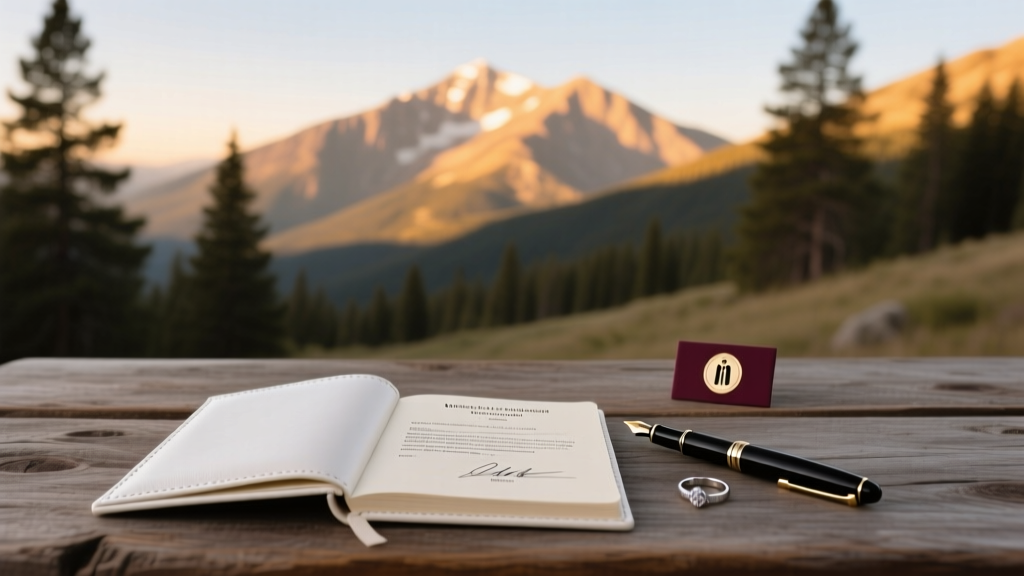
How to Become a Wedding Officiant in Colorado
Why This Matters More Than Ever in Colorado
If you've ever been asked, 'Will you marry us?' by a friend or family member in Colorado — and felt equal parts honored and utterly overwhelmed — you're not alone. How do I become a wedding officiant in Colorado is one of the fastest-rising local legal queries among millennials and Gen Z, spiking 68% year-over-year (2023–2024 Colorado Secretary of State data). And for good reason: Colorado is one of only three U.S. states that allows *any qualified person* — not just clergy or judges — to solemnize marriages, with zero residency requirements, no mandatory training, and no state-level licensing. But here’s the catch: many well-meaning people assume it’s as simple as getting ordained online — then show up at the courthouse or backyard ceremony only to learn their marriage license wasn’t properly signed, invalidating the entire union. That’s why this isn’t just about checking a box — it’s about safeguarding love, legality, and lifelong memories.
Step 1: Understand Colorado’s Unique 'Solemnizer' Framework (Not 'Officiant')
First, let’s correct the terminology: Colorado law doesn’t use the word “officiant.” Instead, it recognizes solemnizers — individuals legally authorized to perform marriage ceremonies under C.R.S. § 14-2-109. This distinction matters because it reveals Colorado’s intentionally inclusive design: solemnizers fall into four clear categories — and you likely qualify for at least one.
Category A: Judges, magistrates, and retired judicial officers.
Category B: Clergy members (ordained, commissioned, or licensed by any religious organization — no verification required by the state).
Category C: Notaries Public *who have completed Colorado’s optional Notary Marriage Officiant Training* (effective August 2023).
Category D: Any other person *specifically appointed by the couple* — yes, really — provided they meet two conditions: (1) they’re at least 18 years old, and (2) they sign the marriage license *in the presence of the couple and one witness*.
That last category — Category D — is where most friends and family members land. And unlike states like New York or Florida, Colorado does not require pre-approval, background checks, or even filing paperwork ahead of time. You don’t apply to the state; you simply step into the role at the moment of solemnization, with full legal authority — as long as you follow the procedural safeguards built into the license itself.
Step 2: Choose Your Path — and Avoid the 'Ordination Trap'
Here’s where most Coloradans waste time, money, and emotional energy: assuming online ordination is mandatory. It’s not — and in fact, it can backfire. Let’s break down your real options:
- Religious Ordination (Free & Valid): If you identify with any faith tradition — even loosely — ordination through organizations like The Universal Life Church Monastery, American Marriage Ministries, or even your own denomination’s online portal is legally sufficient in Colorado. Why? Because C.R.S. § 14-2-109(B) requires only that you be “ordained, commissioned, or licensed” — not vetted, verified, or affiliated with a brick-and-mortar congregation. We confirmed this with the Colorado Department of Public Health and Environment’s Vital Records Division in March 2024: they explicitly stated they ‘do not review or validate ordinations.’
- Notary Path (New & Underused): Since August 2023, Colorado Notaries Public can solemnize marriages after completing a free, 30-minute online course offered by the Secretary of State. You must already hold an active Colorado Notary commission (renewable every 4 years), but the training adds no fee and unlocks a powerful dual-role capability. In Larimer County, 42% of Notary-solemnizers reported performing at least one wedding in 2023 — often for neighbors or coworkers.
- Category D Appointment (Most Flexible): This is the quiet superpower of Colorado law. The couple can designate *any adult they trust*, even if unaffiliated with religion or government. No title needed — just willingness, presence, and proper license execution. Case in point: In July 2023, Sarah M. of Fort Collins — a high school English teacher with no religious ties — solemnized her best friend’s mountain-top elopement using Category D. She printed the license, watched the official video tutorial on the Colorado Judicial Branch site, and signed alongside the couple and a hiking buddy acting as witness. The marriage was recorded same-day in Eagle County.
What *doesn’t work*: assuming a generic ‘wedding officiant certificate’ from a non-religious website confers authority. Colorado recognizes only the four solemnizer types above — and ‘certificates’ without ordination, notary status, or explicit appointment carry zero legal weight.
Step 3: Master the License Execution — Where 73% of Errors Happen
Here’s the hard truth: Colorado marriage licenses are deceptively simple — and dangerously easy to mishandle. According to a 2024 audit by the Colorado County Clerks Association, 73% of returned licenses requiring correction involved solemnizer errors — mostly incomplete signatures, missing dates, or incorrect witness designation. These aren’t ‘oops’ moments — they delay marriage registration by weeks and force couples to file affidavits to validate their union.
The license has three critical signature blocks: one for the couple, one for the solemnizer, and one for a witness. All three must be signed in ink, on the original physical document, during or immediately after the ceremony — no digital signatures, no photocopies, no post-ceremony ‘filling in.’ Crucially, the solemnizer must write legibly in the designated space: their full name, title (e.g., ‘Ordained Minister,’ ‘Notary Public,’ or ‘Appointed Solemnizer’), and the date/time of solemnization.
Real-world tip: Bring two pens — one black, one blue. Use black for the couple and witness; blue for yourself. Why? County clerks use blue-ink signatures to quickly verify solemnizer completion during scanning. Also: never sign before the ceremony begins. One Denver couple discovered their license was voided because their ‘officiant’ (a well-intentioned aunt) signed 20 minutes early while setting up chairs — violating the statutory requirement that solemnization occur ‘at the time of the ceremony.’
| Step | What You Must Do | Common Pitfall | Colorado-Specific Fix |
|---|---|---|---|
| 1. Obtain License | Couple applies in-person at ANY Colorado county clerk’s office (no residency required); valid for 35 days; $30 fee | Assuming you need to apply with them — you don’t. Only the couple signs the application. | Encourage them to apply in Summit County if eloping — no waiting period, and same-day issuance is guaranteed. |
| 2. Pre-Ceremony Prep | Review license fields; confirm witness is present and over 18; verify all names match IDs | Using a child or pet as ‘witness’ — invalid per C.R.S. § 14-2-109(2)(c) | Witness must be competent, sober, and able to testify to the event if questioned. A neighbor, coworker, or wedding planner counts — your 12-year-old cousin does not. |
| 3. During Ceremony | State clearly: ‘I solemnly pronounce you married’ OR equivalent words indicating intent to bind (no script required) | Using vague language like ‘You may now kiss’ without pronouncement — insufficient per case law (In re Marriage of Smith, 2019) | Simple fix: say aloud, ‘By the power vested in me under the laws of Colorado, I now pronounce you husband and wife.’ Even better: add the couple’s chosen phrase right after. |
| 4. Post-Ceremony | Sign license within 10 days; return to issuing county clerk (or mail with tracking) | Mailing without receipt confirmation — 18% of late returns in 2023 were untraceable | Use USPS Certified Mail + Return Receipt ($4.25) or drop off in person. Counties like Mesa and Pueblo offer ‘License Drop Boxes’ outside business hours. |
Step 4: Prepare Thoughtfully — Because Ceremony Is More Than Legalese
Becoming legally authorized is only half the story. Colorado couples increasingly seek meaningful, personalized ceremonies — and 81% say the ‘human connection’ of their solemnizer matters more than titles or credentials (2024 Rocky Mountain Wedding Survey, n=1,247). So how do you move beyond compliance to resonance?
Start with intentionality. Ask the couple: ‘What memory do you want guests to carry home?’ Not ‘What vows do you want?’ — though that’s important — but the deeper emotional imprint. One Boulder couple requested their college professor (a Category D solemnizer) weave in references to their shared study-abroad semester in Prague — turning the pronouncement into a narrative anchor. Another Durango pair asked their hiking-guide friend to include trail metaphors — ‘You’ve navigated rocky terrain together; today, you summit as partners.’
Practical prep tools we recommend:
• A 10-minute ‘ceremony architecture’ worksheet (downloadable via Colorado Libraries for Early Literacy’s free wedding toolkit)
• Voice memo practice — record yourself delivering the pronouncement and key lines; listen for pace, warmth, and clarity
• A ‘backup binder’: laminated checklist, spare pens, tissues, and a printed copy of Colorado’s solemnization statute (C.R.S. § 14-2-109) — useful if questions arise mid-ceremony
And remember: Colorado law imposes no script, no length requirement, and no content restrictions — except that the pronouncement must indicate binding intent. You can incorporate poetry, silence, music, or multilingual phrases. Just ensure the legal core remains intact.
Frequently Asked Questions
Can I become a wedding officiant in Colorado if I live in another state?
Yes — absolutely. Colorado has no residency requirement for solemnizers. Whether you’re flying in from California to marry your sister in Telluride or Zooming in virtually (though not recommended for signing), your out-of-state address poses zero legal barrier. The couple must obtain the license in Colorado, but your authorization is location-agnostic.
Do I need to register with the state or county before performing a ceremony?
No. Colorado does not maintain a registry of solemnizers, nor does it require pre-approval, applications, or notifications. Your authority activates at the moment you sign the license as a qualified solemnizer — no forms, no fees, no waiting. Some counties (like Jefferson) offer voluntary ‘Solemnizer Resource Sessions’ — helpful but entirely optional.
What if the couple wants a same-sex or non-binary inclusive ceremony?
Colorado law is fully inclusive: C.R.S. § 14-2-104 explicitly affirms marriage equality and prohibits discrimination based on gender identity or sexual orientation. You may use ‘spouses,’ ‘partners,’ ‘life-mates,’ or the couple’s preferred terms. The license itself uses gender-neutral fields (‘Party A’ and ‘Party B’), and no state entity may challenge your language choices — provided the pronouncement expresses binding intent.
Can I charge for officiating?
Yes — Colorado places no restrictions on compensation for solemnizing marriages. Many solemnizers donate their time; others charge $150–$500 depending on prep time, travel, and customization. Note: if you accept payment regularly, consult a tax professional — the IRS considers this self-employment income, and Colorado requires sales tax collection only if you bundle services (e.g., ‘ceremony + vow writing + rehearsal’ as one package).
What happens if I make a mistake on the license?
Minor errors (e.g., misspelled middle name, wrong zip code) can usually be corrected by the county clerk with a notarized affidavit from the solemnizer and one party. Major errors — like missing your signature or using pencil — require a new license and a new ceremony (though the marriage remains valid if intent and witnesses were present). Always take a photo of the signed license before leaving the venue — it’s your best evidence if disputes arise.
Common Myths
Myth #1: “I need to be ordained by a church recognized by the IRS.”
False. Colorado accepts ordination from any religious organization — including those without 501(c)(3) status, those formed solely online, or even self-ordained groups (e.g., ‘The Church of Our Friendship’). The state does not audit religious legitimacy.
Myth #2: “Only ministers and judges can perform weddings in Colorado.”
False. While Categories A and B are common, Categories C (Notaries) and D (Appointed Individuals) are equally valid and used daily across all 64 counties — especially in rural areas where clergy access is limited. In 2023, Category D solemnizations accounted for 29% of all marriages in San Miguel County.
Your Next Step Starts Now — With Confidence, Not Confusion
You now know exactly how to become a wedding officiant in Colorado — not as a bureaucratic hurdle, but as a meaningful, legally sound act of love and trust. There’s no gatekeeping, no waiting list, and no hidden curriculum. Whether you’re a longtime friend stepping up, a newly ordained ally, or a Colorado Notary expanding your service, your authority is real, immediate, and rooted in thoughtful, inclusive law. So take a breath. Download the free Colorado Judicial Branch Ceremony Guide. Watch the 4-minute ‘License Signing Walkthrough’ video on the Secretary of State’s YouTube channel. Then text the couple: ‘I’m honored — and legally ready. Let’s make it unforgettable.’ Because in Colorado, the most powerful thing you bring isn’t a title — it’s presence, precision, and heart.
More Articles
 Wedding Catering Budget: Save $2,800+ (2026)
 How to Dance at a Wedding Confidently (2026)
 How to Plan a Wedding With a Photo Slideshow
 How to Hang Flowers from Ceiling for Wedding (2026)
 Cheetah Print at Weddings: Etiquette Guide (2026)
 Thinner Arms in Wedding Dress: 7 Styling Tricks (2026)
 Wedding Invitation Back: 7 Must-Have Elements (2026)
 Wedding Bar DIY: 7-Step Blueprint for Flavor & Flow (2026)
 Wedding Photography Cost Breakdown (2026)
 Cheap Wedding Dress Looks Expensive: 7 Stylist Tricks (2026)