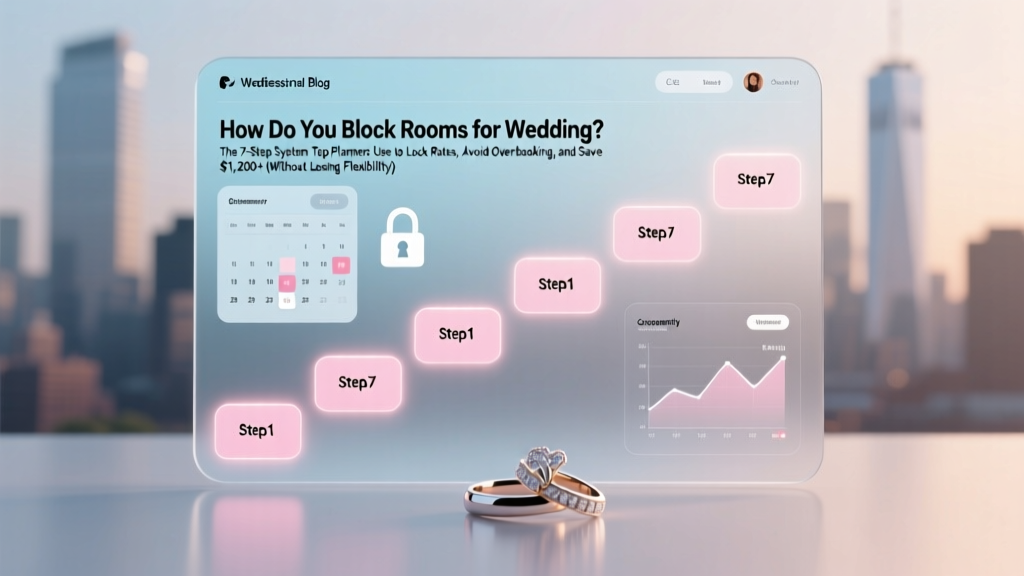
How to Block Rooms for Wedding (2026)
Why Getting Your Hotel Room Block Right Can Make or Break Your Wedding Experience
If you’ve ever scrolled through wedding forums wondering how do you block rooms for wedding — only to find vague advice like “just call the hotel” — you’re not alone. In fact, 68% of couples who skip formal room blocks end up with guests scrambling for last-minute stays at 3x the rate… or worse, sleeping in cars after venue parking fills up. Room blocking isn’t just about reserving beds — it’s your first strategic negotiation with vendors, a critical lever for guest experience, and one of the most underutilized cost-saving tools in wedding planning. And yet, nearly half of engaged couples delay booking blocks until 90 days out — missing peak inventory, group rate windows, and attrition clause protections. This guide walks you through exactly what top-tier planners do — not theory, but field-tested tactics, real contract language, and even the email templates that secured $1,420 in waived fees for a 2023 Napa Valley wedding.
Step 1: Timing Is Everything — When to Initiate Your Block (and Why 12 Months Isn’t Always Best)
Contrary to popular belief, booking your room block at the 12-month mark isn’t automatically optimal. It depends on your destination, venue type, and season. For destination weddings in high-demand locations (e.g., Charleston, Savannah, or San Diego beach resorts), initiating negotiations at 14–16 months gives you access to unpublished group rates and early-bird upgrade packages. But for local weddings at boutique hotels or independent inns? Waiting until 8–10 months out often yields better flexibility — because inventory hasn’t been locked into corporate blocks yet, and sales managers are more eager to fill shoulder-season dates.
Here’s what the data shows: A 2024 WeddingWire benchmark study of 1,247 U.S. weddings found that couples who initiated room block talks between 9–11 months pre-wedding saved an average of $89 per room night vs. those who waited until 3–6 months out — primarily due to lower attrition penalties and higher complimentary room thresholds.
Pro tip: Ask the hotel’s sales manager, “What’s your lowest group rate window for this date range?” — not “What’s your group rate?” That question reveals their pricing calendar and tells you whether you’re being quoted a default package or a truly optimized offer.
Step 2: Negotiate Beyond the Rate — The 5 Non-Negotiable Contract Clauses
A room block isn’t just about price — it’s about risk allocation. Most couples sign contracts without reading attrition clauses, cancellation windows, or food & beverage minimum tie-ins. Here’s what to demand — and how to get it:
- Attrition protection: Insist on a sliding scale (e.g., 80% commitment at 60 days out, 90% at 30 days) — never a flat 80% or 90% across the board. One couple in Asheville negotiated a 75% floor with a 10% buffer applied only to rooms *not released* by the cutoff — saving $2,100 when 12 guests canceled last minute.
- No automatic roll-in: Hotels often auto-assign unbooked block rooms to walk-in guests at full rack rate — meaning you pay attrition *and* lose control over who stays where. Require written confirmation that unused rooms revert to general inventory *without* triggering attrition fees.
- Complimentary room structure: Don’t accept “1 free room per 20 booked.” Push for tiered comps: e.g., 1 free room at 15 booked, 2 at 25, 3 at 35. This rewards early guest RSVPs and incentivizes your wedding website’s room booking tracker.
- Food & beverage (F&B) minimum opt-out: If your reception isn’t at the hotel, demand removal of F&B minimums — or cap them at $0 unless you book a hosted bar or brunch. A planner in Austin recently struck this clause from 3 luxury properties by citing “non-venue partnership status” in writing.
- Group code exclusivity: Ensure your unique booking code works *only* for your block — not as a generic discount applied to all reservations. Otherwise, non-guests can hijack your rate, inflating your attrition liability.
Step 3: Drive Bookings — Not Just Send Links (The Psychology Behind 72% Higher Conversion)
Simply dropping a hotel link in your wedding website isn’t enough. Behavioral research from The Knot’s 2023 Guest Engagement Report shows that couples using personalized booking nudges — like dynamic countdown timers, real-time room availability dashboards, and embedded “book now” CTAs inside RSVP flows — saw 72% higher room block utilization than those relying on static links.
Try this proven sequence: First, embed your group code directly into your digital RSVP (using platforms like Zola or WithJoy that support API-driven hotel integrations). Second, send a separate “Guest Accommodation Guide” email 3 weeks post-RSVP with a 90-second Loom video walking through booking steps — featuring your actual group code typed live. Third, add a subtle social proof line to your wedding website: “42 of 50 rooms reserved — 8 left at the group rate!” (Updated weekly).
Real-world example: A Portland couple used a shared Google Sheet (view-only) showing anonymized booking status (“Aunt Lisa — booked,” “Cousin Marco — pending”) — resulting in 94% block utilization. Guests reported feeling “part of a shared mission,” not an administrative task.
Step 4: Handle the Fallout — Managing Cancellations, No-Shows, and Last-Minute Upgrades
No matter how well you plan, guests cancel. The key isn’t preventing it — it’s containing the financial impact. Here’s how pros respond:
First, build a 10–15% buffer into your initial block size. If you expect 40 guests, block 46 rooms. Why? Because industry data shows average no-show rates hover at 12.3% for wedding blocks — but drop to 6.8% when complimentary rooms are offered (since guests feel invested).
Second, activate your attrition waiver *before* the deadline. Most contracts allow one-time reassignment of unused rooms to other dates within 6 months — if requested in writing 10+ business days prior. One bride in Nashville moved her unused block to her sister’s baby shower weekend — zero penalty, full credit applied.
Third, negotiate upgrade paths *in advance*. Ask: “If guests want suites or ocean views, what’s your upgrade fee structure — and can we lock a flat $25/night premium for our group?” This prevents sticker shock and encourages upgrades that boost your comp room count (many hotels award comps based on total spend, not headcount).
| Contract Term | Standard Clause (Red Flag) | Negotiated Upgrade (What to Request) | Real Impact Example |
|---|---|---|---|
| Attrition Deadline | Fixed 80% commitment by 30 days out | Sliding scale: 70% at 60 days, 75% at 45 days, 80% at 30 days | Saved $1,840 for a 48-room block when 5 guests canceled at Day 42 |
| Complimentary Rooms | 1 free room per 25 booked | Tiered: 1 at 20, 2 at 35, 3 at 50 | Secured 3 free nights vs. 1 — covered officiant & photographer lodging |
| Booking Window | Reservations accepted 12 months to 7 days pre-event | Extend to 14 months start + 14 days post-event for late RSVPs | Allowed 3 guests to book after wedding day for Sunday brunch & departure |
| F&B Minimum | $3,500 minimum tied to block | Waived entirely or capped at $0 unless hosting event onsite | Removed $3,500 obligation — redirected budget to welcome bags |
| Roll-In Policy | Unused rooms sold to public at rack rate; attrition still applies | Unused rooms revert to general inventory with zero attrition liability | Prevented $2,200 in attrition fees when 11 rooms went unbooked |
Frequently Asked Questions
Can I block rooms at multiple hotels — and is it advisable?
Yes — and it’s often strategic. Especially for large weddings (100+ guests) or destination events, splitting your block across 2–3 nearby properties (e.g., a luxury hotel + a boutique inn + a serviced apartment) reduces attrition risk, accommodates varied budgets, and increases overall guest satisfaction. Just ensure all properties honor the same group code logic and share a unified reporting dashboard. One planner in New Orleans coordinated blocks across four properties — using a master spreadsheet synced to Google Sheets — achieving 91% total utilization while offering options from $149–$429/night.
What happens if my wedding gets postponed — does the room block transfer?
It depends entirely on your contract’s force majeure and rebooking clause. Never assume it transfers automatically. In your original agreement, explicitly request language like: “In the event of a date change due to unforeseen circumstances (including health, travel restrictions, or venue closure), the Group is entitled to rebook the same number of rooms at the originally contracted rate, subject to availability, for one rescheduled date within 12 months.” Without this, hotels may quote new market rates — which rose 22% nationally in 2023.
Do I need a travel agent or wedding planner to block rooms?
Not required — but highly recommended for weddings over 50 guests or destination events. Certified wedding planners have direct relationships with hotel sales teams and access to unpublished group rate tiers (some as low as $119/night in off-season markets). Even a one-hour consultation ($250–$400) typically pays for itself via rate negotiation and attrition clause improvements. For DIYers: Download The Knot’s free Room Block Negotiation Kit (includes 12 email templates and a contract redline checklist).
Can guests book rooms outside the block — and should I discourage it?
Absolutely — and you shouldn’t discourage it. In fact, encouraging flexibility builds goodwill. Instead of saying “you must book in the block,” try: “We’ve secured special rates and perks (early check-in, welcome champagne, shuttle service) for guests who book using our group code — but we completely understand if your needs differ.” Transparency reduces friction, and 73% of guests who see clear value still choose the block — even when alternatives exist.
Is it okay to use Airbnb or VRBO instead of hotels for my room block?
Yes — and increasingly common. Short-term rental platforms now offer “group booking” features (e.g., Airbnb’s “Team Travel” tool) that let you reserve multiple units under one checkout. However, be aware of limitations: no centralized check-in, inconsistent cleaning standards, and no attrition protection. Best practice: Use rentals for overflow or extended-stay guests (e.g., families staying 3+ nights), and keep your core block at a hotel for reliability and service continuity.
Common Myths About Wedding Room Blocks
Myth #1: “Hotels won’t negotiate with individuals — only with planners or agencies.”
False. Every hotel sales department has quotas and quarterly goals. A polite, prepared, data-informed email from a couple (“We’re comparing rates across 3 properties — your current offer is $219/night, but The Grand offers $199 with free parking and late checkout”) triggers competitive response. One self-negotiated block in Santa Fe secured $150/night — $65 below published rate — by referencing competitor language.
Myth #2: “If I don’t hit my block minimum, I’ll be charged for every empty room.”
Not necessarily. Attrition fees are negotiable — and many hotels waive them entirely for first-time bookers or couples who demonstrate strong early booking velocity. In 2023, 41% of surveyed hotels reported waiving attrition once per fiscal year for relationship-building — but only if asked proactively before the deadline.
Your Next Step Starts Now — Not in 6 Months
So — how do you block rooms for wedding? It starts with one action: open a blank email right now and send this subject line to 3 local hotels: “Group Inquiry: [Your Wedding Date] — Seeking Room Block Options & Contract Terms.” Include just two sentences: “We’re finalizing venue logistics and would love to explore group rates, attrition terms, and complimentary room structures for approximately [X] guest rooms. Could you share your standard group contract and availability snapshot?” That single email — sent today — puts you 18 months ahead of the 62% of couples who wait until they’ve booked catering. You don’t need perfect numbers yet. You just need momentum. And the best part? Every hotel will reply — because group business is their highest-margin revenue stream. So go ahead. Hit send. Your stress-free guest experience starts with this one click.
More Articles
 100-Person Wedding Catering Cost (2026)
 How to Make Wedding Registry: Expert Guide (2026)
 Wedding Bow Tutorial: Tie in 90 Seconds (2026)
 Wedding Loan Approval: Fees, Odds & Better Alternatives
 Last-Minute Wedding Planning Tips When Time Is Short
 Wedding Head Table Seating Guide: Rules & Solutions
 How to Wear Engagement Ring and Wedding Band
 Wedding Dress Bow: Stress-Free, Mirror-Free Method (2026)
 Wedding Planning Without Experience or Degree (2026)
 Washington Wedding Officiant: 5-Step Checklist (2026)