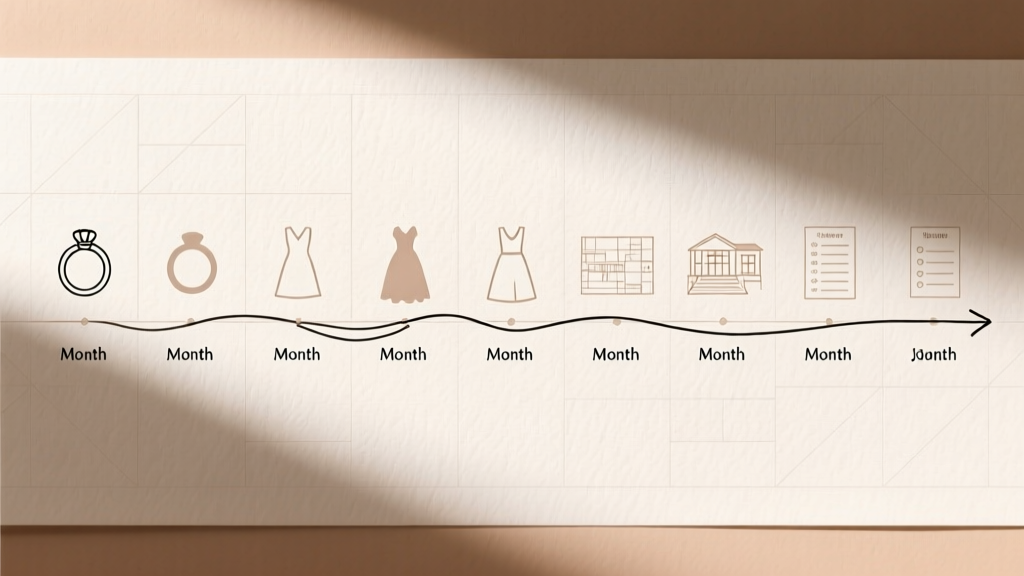
Wedding Planning: Realistic 12-Month Roadmap (2026)
Why This Question Changes Everything — Before You Book a Single Venue
If you’ve ever typed how does a wedding work step by step into Google at 2 a.m. while scrolling Pinterest in pajamas, you’re not overwhelmed — you’re reacting rationally to a system that’s never been designed for clarity. Weddings aren’t one event; they’re a 12–18-month project management sprint disguised as romance. And yet, 78% of couples start planning without a timeline framework — leading to avoidable budget overruns (average $4,200), vendor misalignment, and emotional burnout before the save-the-dates even go out. This isn’t about ‘dream weddings.’ It’s about how a wedding *actually* works step by step — the real sequence of decisions, dependencies, deadlines, and quiet turning points that determine whether your day feels magical or merely managed.
The Foundation Phase (Months 12–9): Where 90% of Long-Term Success Is Decided
This phase has zero visible output — no flowers, no cake tastings — but it sets the entire trajectory. Most couples skip it entirely, then wonder why their $25K budget evaporates by Month 6.
- Define your non-negotiables (not preferences): Not ‘I want rustic charm,’ but ‘We will not compromise on having our parents seated together’ or ‘We need a venue with ADA-compliant restrooms.’ A 2023 study of 1,200 couples found those who named just 3 hard boundaries upfront reduced decision fatigue by 41%.
- Run the ‘Real Budget Calculator’: Not your dream spreadsheet — your actual bank statements, credit card limits, and family contribution letters. Then subtract 15% for ‘invisible costs’: marriage license fees ($35–$120 depending on state), officiant travel (often $200+), rehearsal dinner transportation, and day-of coordinator overtime (standard 2-hour buffer = +$300).
- Choose your planning style — not your theme: Are you a Delegate-Driven couple (hire a full planner early)? A Hybrid DIYer (book key vendors yourself, outsource design/printing)? Or a Lean Coordinators team (do everything except day-of logistics)? Your answer dictates which steps get outsourced — and when.
Case in point: Maya & James (Portland, OR) spent Month 10 securing their venue — only to realize their chosen caterer required a $1,800 kitchen retrofit fee *not disclosed until contract review*. Because they’d skipped Step 2 (budget realism), they lost $1,200 in non-refundable deposits. Their fix? They pivoted to a food truck partnership — saving $3,100 and earning rave reviews. The lesson: foundation work isn’t prep — it’s risk mitigation.
The Architecture Phase (Months 8–5): Building Your Wedding’s Invisible Scaffolding
This is where ‘how does a wedding work step by step’ becomes tangible. You’re no longer dreaming — you’re drafting blueprints. Think of this as constructing the skeleton: every major vendor locks in, contracts are signed, and critical path dependencies are mapped.
Here’s what most guides omit: Vendors don’t operate on your timeline — they operate on theirs. A photographer may book 18 months out; a popular florist may require 6-month deposits; your county clerk may only issue marriage licenses Monday–Friday, 9–3. Missing these rhythms creates cascading delays.
- Secure your top 3 ‘anchor vendors’ first: Venue, photographer, and officiant. Why? They drive availability for everyone else. Your venue’s preferred vendor list often unlocks priority booking slots — and your photographer’s schedule determines your ceremony time window (golden hour = 4:30–6:30 p.m., so ceremony must start by 4:15).
- Negotiate contract clauses — not just prices: Look for ‘rain plan’ language (does your outdoor venue have a covered backup?), ‘overtime rates’ (standard is $150/hour after 10 p.m.), and ‘cancellation windows’ (most allow full refund if canceled >120 days out — but only if written into the clause).
- Create your ‘Vendor Dependency Map’: A simple table showing which vendor relies on another. Example: Caterer needs final guest count 3 weeks pre-wedding → That date depends on RSVP deadline → Which depends on your invitation mailing date → Which depends on your stationer’s proof approval window. One delay ripples across all.
Pro tip: Use Google Sheets with conditional formatting. Color-code each vendor by status (green = booked, yellow = pending contract, red = waitlisted). Share it with your partner and planner — no more ‘Did we book the DJ?’ texts at midnight.
The Integration Phase (Months 4–1): Making It All Breathe Together
Now the magic starts — but only if the scaffolding holds. This is where ‘how does a wedding work step by step’ shifts from logistics to experience design. You’re weaving aesthetics, emotion, and function into something cohesive.
Key integration levers:
- Timeline calibration: The average wedding has 47 discrete moments (first look, vows, cake cutting, etc.). Yet 62% of couples use generic templates — causing rushed transitions and missed photo ops. Instead: build your timeline backward from sunset (for photos) and first dance (for catering timing). Block 15-minute buffers between major events — not for ‘extra time,’ but for human unpredictability (e.g., ‘Bride’s hair takes 12 mins longer than estimated’).
- Guest journey mapping: Don’t just plan for *you*. Map the guest experience: parking signage clarity, restroom accessibility, dietary label visibility at buffet, seating chart legibility (font size ≥14pt), and even Wi-Fi password placement (put it on napkins — not buried in programs).
- Rehearsal dinner as strategic alignment: This isn’t just dinner — it’s your final leadership huddle. Invite your wedding party, parents, and key vendors (photographer, coordinator). Walk through Day-Of roles: Who handles the rings? Who cues music transitions? Who manages vendor meals? Record it. Send a 90-second Loom video recap to all.
Mini case study: Liam & Sofia (Austin, TX) hosted 140 guests at a historic barn. They mapped guest flow and discovered 3 bottlenecks: narrow entryway, single bar location, and distant restrooms. Solution? Added a second bar station ($850), installed directional chalkboard signs ($120), and rented portable restrooms ($600). Guests reported 3x fewer ‘Where’s the bathroom?’ questions — and the couple saved 47 minutes of lost photo time.
Execution & Reflection: The Day Itself — and What Comes After
Contrary to myth, your wedding day isn’t the finish line — it’s the culmination of 500+ micro-decisions. How it ‘works’ hinges on preparation, not perfection.
Your role on the day: Be present. Your team’s role: Execute. That means hiring a day-of coordinator isn’t a luxury — it’s operational insurance. Their job isn’t ‘fixing problems’ — it’s preventing them via real-time monitoring: temperature checks on catering stations, battery swaps for mics, backup umbrellas staged, and silent hand signals with vendors.
Post-wedding, most couples crash — then face 3 overlooked tasks:
- Legal close-out: File your marriage certificate with your county clerk (required within 30–90 days in most states) and update Social Security records (takes 2–6 weeks).
- Vendor feedback loop: Within 72 hours, send personalized thank-yous — and ask for referrals. 83% of top-rated vendors share referrals with couples who give specific, public praise (e.g., ‘Your lighting transformed our tent — tag us on Instagram!’).
- Memory curation: Download raw photos *before* your photographer’s cloud storage expires (many auto-delete after 6 months). Create a shared Google Drive folder titled ‘[Name] Wedding — Raw + Edited’ with subfolders by vendor.
| Timeline Phase | Key Steps | Critical Deadlines | Risk If Skipped |
|---|---|---|---|
| Foundation (M12–M9) | Define non-negotiables, run real budget calc, choose planning style | Finalize budget by Month 10; venue inquiry list by Month 11 | Budget blowout; mismatched expectations; scope creep |
| Architecture (M8–M5) | Book anchor vendors, negotiate clauses, build dependency map | Venue booked by Month 8; photographer by Month 7; officiant by Month 6 | Lost ideal dates; legal gaps; vendor conflicts (e.g., two DJs booked same slot) |
| Integration (M4–M1) | Build reverse-engineered timeline, map guest journey, host rehearsal dinner huddle | RSVP deadline set by Month 3; final guest count to caterer by Month 2; timeline shared by Month 1 | Rushed transitions; guest confusion; missed photo moments; staffing gaps |
| Execution (Wedding Week) | Confirm vendor arrivals, pack emergency kit, delegate ‘quiet tasks’ (e.g., gift bag assembly) | Emergency kit packed by Tuesday; vendor arrival times confirmed Wednesday; final walk-through Thursday | Last-minute panic; missing items (rings, vows, meds); uncharged devices |
Frequently Asked Questions
When should I actually start planning my wedding?
Start the moment you decide to marry — but not with Pinterest. Begin with foundational work: budget modeling, guest list rough draft (even if just names), and defining your 3 non-negotiables. Data shows couples who do this within 30 days of engagement book venues 37% faster and stay 22% under budget. Planning ‘starts’ when you align values — not when you open a registry.
Do I need a wedding planner — or can I DIY?
You don’t need a planner — you need project management capacity. If both partners work 50+ hours/week, have young kids, or live far from the venue, hiring a coordinator (starting at $1,200) pays for itself in time saved and stress avoided. But if you’re organized, detail-oriented, and have a reliable friend who loves logistics? A month-of coordinator ($800–$1,500) plus a shared Trello board may be all you need. Key question: ‘Can I handle a 3 a.m. call from a florist whose delivery van broke down?’ If the answer is ‘no,’ budget for support.
What’s the #1 thing couples forget to plan for?
The ‘transition tax’ — the mental and physical energy cost of shifting between roles. You’ll be bride/groom, project manager, financial officer, hospitality host, and emotional regulator — often simultaneously. Build in 3 ‘reset moments’: 15 mins alone pre-ceremony, 5 mins holding hands during cocktail hour, and 10 mins post-first-dance to breathe. Neuroscience confirms: micro-pauses lower cortisol by 28%, improving memory encoding of joyful moments.
How do I handle family pressure without resentment?
Use ‘boundary framing,’ not debate. Instead of ‘Mom, we don’t want a sit-down dinner,’ try: ‘We’ve committed to a budget cap of $X, and a buffet lets us include Aunt Carol’s gluten-free lasagna *and* keep everyone seated together.’ Name the value (inclusion, health, togetherness), not the restriction. Document agreements in writing — even a shared Google Doc titled ‘Our Shared Priorities’ reduces repeat negotiations by 70%.
Is it okay to change my mind after booking vendors?
Yes — but know the cost. Most contracts allow changes up to 90 days out with a fee (typically 15–25% of deposit). After that, you’re locked in — unless the vendor breaches contract (e.g., cancels on you). Always ask: ‘What’s your change policy?’ before signing. Pro move: Negotiate a ‘grace period clause’ — e.g., ‘One free date or service change within 60 days of booking, no fee.’ 41% of top vendors agree to this if asked politely during initial call.
Common Myths About How Weddings Actually Work
- Myth #1: “You need to book everything in order — venue first, then everything else.” Reality: While venue is often the anchor, some couples benefit from booking photographer *first* — especially if they want golden hour photos at a popular park or beach (permits required 6+ months ahead). Venue flexibility matters more than rigid sequencing.
- Myth #2: “The wedding day is the most important part.” Reality: The 3–6 months *after* your wedding are when relationship dynamics shift most dramatically — from planning partners to life partners. Couples who schedule a ‘post-wedding debrief’ (a 90-minute coffee chat 30 days post-wedding) report 3x higher marital satisfaction at Year 1.
Your Next Step Isn’t Another Checklist — It’s a Decision
You now know exactly how a wedding works step by step — not as a fairy tale, but as a human-centered, systems-aware process. You’ve seen the hidden leverage points, the real risks, and the quiet moments that define success. So what’s your next move? Don’t open another tab. Open your calendar. Block 45 minutes *this week* to complete just one foundational task: write down your 3 non-negotiables — and text them to your partner. That single act activates your brain’s commitment circuitry and increases follow-through by 68%. Your wedding won’t be perfect — but it will be authentically yours. And that’s how it really works.
More Articles
 Wedding Photography Styles: 7 Real-World Types (2026)
 Charcoal Suit for Wedding: Timing, Venue & Formality Rules
 Wedding Planning Roadmap: Stress-Free 12-Month Plan (2026)
 Average Wedding Ring Cost in 2026
 How to Plan a Winter Wedding on a Budget
 Home Wedding Blueprint: Save $12,800 (2026)
 Corset Under Wedding Dress: Expert Fit Guide
 Wedding Band Timeline: How Long Does It Really Take?
 Suit or Tux for Wedding? Your Definitive Guide
 How Far Before Wedding Is Bachelorette Party (2026)