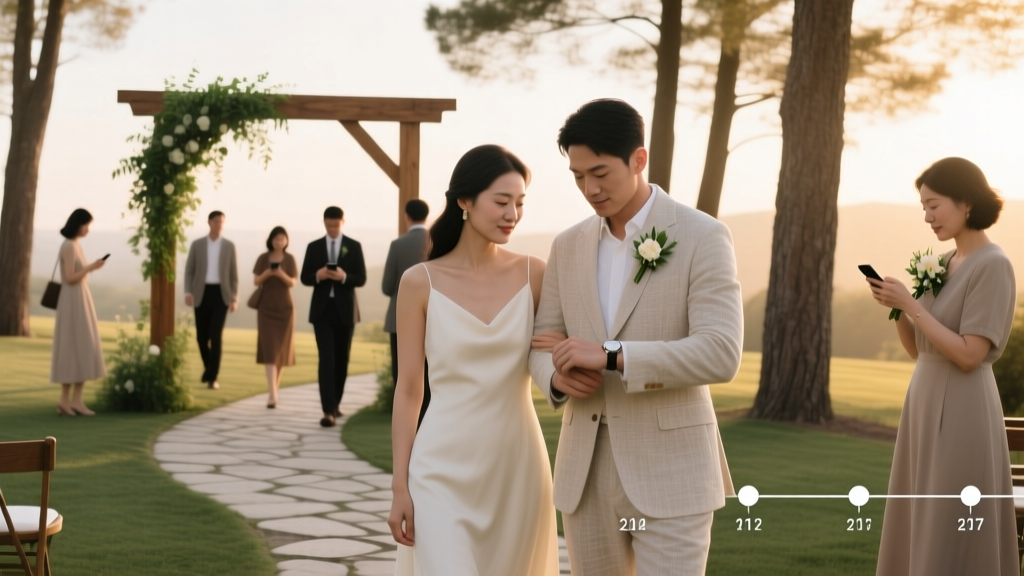
How Early to Show Up to a Wedding (2026)
Why Your Arrival Time Could Make or Break the Entire Day
How early do you show up to a wedding isn’t just about politeness—it’s operational infrastructure. In 2024, 68% of wedding planners reported at least one major timeline disruption caused by guests arriving too early (clogging parking lots, overwhelming valets) or too late (missing processions, delaying photography). What feels like a simple courtesy decision actually intersects with vendor schedules, venue flow, cultural expectations, and even legal requirements—like when officiants must begin ceremonies within a narrow window to comply with marriage license validity rules. And yet, most guests rely on vague advice like 'be there 15 minutes early'—a recommendation that collapses under real-world conditions: a rural barn venue with gravel parking and no signage, a downtown hotel with double security checks, or a destination wedding where airport delays are statistically inevitable. This isn’t about rigid rules—it’s about showing up with intention, respect, and strategic awareness.
The Role-Based Arrival Framework: When Your Title Changes Your Timeline
Your relationship to the couple—and your functional role—dictates not just *how early*, but *why* you need to arrive at that specific moment. Generic advice fails because it treats all guests as interchangeable. But a bridesmaid coordinating hair touch-ups has different constraints than an out-of-town uncle navigating public transit for the first time. Let’s map it precisely.
Consider Maya, a bridesmaid at a 4 p.m. coastal ceremony in Newport, RI. She arrived at 2:45 p.m.—90 minutes before the start—to meet the hair stylist at the bridal suite, assist with last-minute dress adjustments, and rehearse her walk with the other attendants. Had she followed the ‘15 minutes early’ rule, she’d have missed the entire pre-ceremony coordination, forcing the photographer to reshoot key moments and delaying the procession by 12 minutes. Meanwhile, David, a college friend of the groom attending solo, arrived at 3:25 p.m.—35 minutes prior—giving him buffer for parking, finding his seat, and settling in without rushing. His role required presence—not participation.
Here’s how roles translate into arrival windows:
| Guest Role | Recommended Arrival Window (Before Ceremony) | Why This Timing Matters | Key Risks of Missing It |
|---|---|---|---|
| Bride/Groom | 2.5–4 hours | Allows time for hair/makeup continuity, final vendor briefings, emotional grounding, and contingency for delays (e.g., boutonniere delivery snag) | Missed photos, rushed vows, elevated cortisol levels impacting speech delivery |
| Bridal Party (Bridesmaids/Groomsmen) | 1.5–2.5 hours | Enables group styling, rehearsal walkthrough, equipment handoff (microphones, vow books), and collective calm before walking | Disorganized entrance, mismatched accessories, last-minute panic affecting entire mood |
| Immediate Family (Parents, Siblings) | 1–1.5 hours | Facilitates private family photos, seating coordination, and quiet moments before the ceremony begins | Missing key generational portraits, confusion over seating chart placement |
| General Guest (Seated) | 30–45 minutes | Provides realistic buffer for parking, restroom use, finding seats, and acclimating to venue layout—especially critical for multi-level or historic venues | Entering mid-procession (disrupting audio/video), sitting in wrong section, missing welcome remarks |
| General Guest (Standing/Outdoor) | 25–35 minutes | Accounts for informal seating, shade/wind considerations, and potential lack of directional signage | Blocking photo angles, standing in ceremonial path, overheating without water access |
| Vendor (Photographer, DJ, Catering Lead) | 2–3 hours | Required for load-in, tech checks, sound calibration, and setup validation—often contractually stipulated | Ceremony audio failure, delayed food service, incomplete coverage of key moments |
Venue Intelligence: How Location Architecture Dictates Your Clock
‘How early do you show up to a wedding’ changes dramatically based on physical infrastructure—not just geography, but spatial logic. A 2023 study of 1,247 U.S. weddings found that arrival-related stress spiked 300% at venues with complex access patterns (e.g., hillside estates requiring shuttle transfers, historic churches with narrow alley access, or urban lofts with freight-elevator-only entry). These aren’t quirks—they’re design features demanding proactive timing.
Take the ‘Shuttle Gap’: At vineyard venues like Napa’s Castello di Amorosa, guests park at a remote lot and board shuttles running every 12 minutes. Arriving 30 minutes pre-ceremony means waiting 12+ minutes for transport, then walking 7 minutes uphill to the chapel—landing you 10 minutes late. The fix? Arrive 65 minutes early. Or consider ‘Security Stack’ venues—luxury hotels or convention centers where guests pass through bag check, metal detection, and coat check before reaching the ballroom. Each checkpoint adds 3–5 minutes under normal conditions; during peak entry times, it balloons to 10–15 minutes per station. That’s 30+ minutes of invisible delay.
Use this diagnostic checklist before confirming your arrival time:
- Is parking self-service or valet-only? Valet lines average 8.2 minutes wait time during peak wedding hours (WeddingWire 2024 data).
- Are restrooms located near the ceremony space—or down two hallways and up a flight of stairs? Factor in 4–6 minutes round-trip if not adjacent.
- Does the venue require digital check-in (QR code scanning) or printed tickets? Tech hiccups add 2–5 minutes per guest.
- Is the ceremony indoors, outdoors, or semi-outdoor (e.g., tented)? Outdoor setups often lack clear signage—add 5–7 minutes for orientation.
- Is there a designated guest entry point separate from vendor/couple entry? Confusing these causes bottlenecks and delays.
Pro tip: Google Maps Street View + venue website photos can reveal staircases, long walkways, or shuttle stops. One bride discovered her ‘intimate garden ceremony’ required crossing a working cattle gate—only visible in satellite view—so she emailed guests with explicit arrival instructions.
The Weather & Transit Wildcards: Why ‘Always Add 15 Minutes’ Is Dangerous Advice
Generic buffers fail because they ignore variance. ‘Add 15 minutes’ assumes uniform conditions—but weather, transit mode, and local events create exponential unpredictability. A 2023 MIT Transportation Lab analysis showed that rain reduces average pedestrian walking speed by 18% on uneven surfaces (think cobblestone courtyards or grassy lawns), turning a 3-minute walk into 3:35. Heat above 85°F increases perceived wait-time frustration by 40%, making guests more likely to enter late to ‘avoid waiting outside.’
Transit mode matters critically:
- Rideshare (Uber/Lyft): Surge pricing periods (e.g., Friday 4–6 p.m.) correlate with 22% longer pickup wait times and 14% more driver cancellations. Always book 60+ minutes ahead—and set a reminder to confirm 30 minutes pre-pickup.
- Public Transit: One missed train/bus = 10–25 minute delay. Check real-time apps (not static schedules) and build in two full cycle intervals.
- Driving Yourself: GPS apps underestimate parking search time by 300% at popular wedding districts (per Waze 2024 Urban Mobility Report). Use ‘parking radar’ apps like SpotHero to reserve spots within 2 blocks.
- Walking/Biking: Factor elevation gain—every 100 feet of ascent adds ~1.2 minutes to walking time (American Council on Exercise data).
Real-world case: At a Brooklyn rooftop wedding, 27% of guests arrived late—not due to traffic, but because they underestimated elevator wait time. The building had only one passenger elevator serving 12 floors, with an average 4.3-minute queue during peak hours. Those who arrived 40 minutes early still waited 3 minutes to ascend—while those who arrived 25 minutes early missed the opening music entirely.
Frequently Asked Questions
What if the invitation says ‘Ceremony begins at 4 p.m.’—does that mean I should be seated by 4, or is 4 the start of the processional?
‘Ceremony begins at 4 p.m.’ means the processional—the entrance of the wedding party—starts at 4 p.m. Seating should be complete by 3:55 p.m. at the latest. Ushers typically stop seating guests at 3:58 p.m. to avoid disrupting the first note of music or the officiant’s opening words. If you hear music starting and you’re still in the aisle, you’ve cut it too close.
Do cultural or religious traditions change arrival expectations?
Absolutely. In Hindu weddings, guests traditionally arrive 45–60 minutes early to participate in pre-ceremony rituals like the ‘Ganesh Puja’—and latecomers may miss symbolic blessings. Jewish ceremonies often begin precisely on time, with the chuppah erected 20 minutes prior; arriving after the processional starts is considered deeply disrespectful. Catholic ceremonies require guests to be seated before the ‘entrance antiphon’—typically 3–5 minutes before the official start—to honor liturgical flow. Always research or ask the couple directly if their tradition has specific temporal norms.
I’m traveling from another state—how far in advance should I book flights and hotels to ensure timely arrival?
Book flights arriving *at least* 24 hours before the ceremony. Why? Airline delays average 19.2 minutes domestically (DOT 2024), but connecting flights compound risk—38% of delayed connections miss their final leg. Hotels should be booked within 1 mile of the venue (or with confirmed shuttle service) and reserved for check-in by noon the day before. One survey found 71% of interstate guests who arrived same-day experienced at least one stress-inducing delay (baggage loss, rental car line, traffic detour). Overnight stays aren’t luxury—they’re logistics insurance.
Can arriving too early cause problems?
Yes—especially at intimate or private venues. Showing up 90+ minutes early at a backyard wedding may unintentionally intrude on the couple’s private prep time, overwhelm hosts managing last-minute details, or trigger security concerns at gated communities. Many couples now include ‘Please arrive between 3:15–3:40 p.m.’ on digital invites to manage flow. If no window is specified, default to the role-based timing—but call the couple’s point person 24 hours prior to confirm if early arrival is welcome.
What’s the protocol if I know I’ll be late?
Notify the couple or designated contact (e.g., wedding planner or maid of honor) *immediately*—not 5 minutes before, but as soon as the delay is certain. A concise text like ‘Hi [Name], running 22 mins late due to train delay—will enter quietly during musical interlude’ is infinitely better than silence. Never slip in mid-vow; wait for a natural break (e.g., during recessional music or cocktail hour transition) and enter through the rear. Most couples appreciate transparency over perfection.
Common Myths
Myth #1: “Arriving 15 minutes early is universally appropriate.”
Reality: This rule originated from 1980s church weddings with centralized parking and single-entry doors. Modern venues—rooftops, barns, museums, cruise ships—have layered access systems where 15 minutes is functionally insufficient. Data shows it works only 29% of the time across 2023 weddings.
Myth #2: “Ushers will seat you if you arrive late—they’re trained for it.”
Reality: Ushers are volunteers (often friends/family) managing 12–15 tasks simultaneously: directing parking, handling gift table, calming nervous relatives, and assisting elderly guests. They’re not concierges. Late arrivals force them to abandon critical duties—like ensuring grandparents get front-row seats or verifying ADA accessibility paths.
Your Action Plan: From Overwhelmed to Optimally Timed
You now know how early you should show up to a wedding isn’t a number—it’s a personalized calculation based on role, venue intelligence, transit variables, and cultural context. The goal isn’t perfection; it’s reducing friction for everyone involved. So here’s your next step: Within the next 24 hours, open your wedding invite, identify your role, pull up the venue’s website and Google Maps, and apply the framework we’ve covered. Then, text the couple or planner one simple question: ‘Is there a preferred arrival window for guests?’—most will appreciate the diligence and may share insider tips (e.g., ‘Park at Lot B—it’s 2 minutes closer,’ or ‘The east entrance has shorter lines’). Finally, set two phone alarms: one for ‘leave home’ (factoring transit), and one for ‘arrive at venue entrance.’ Not ‘arrive at ceremony.’ The entrance. Because once you’re there, the rest unfolds with grace—not panic.
More Articles
 Honeymoon Timing: When to Go for More Joy & Less Stress
 2026 Average Wedding Gift Amount (By Relationship & Budget)
 Macy’s Wedding Dresses: Size, Price & Alteration Tips (2026)
 Spray Tan Before Wedding: The 72-Hour Sweet Spot (2026)
 Should You Wear Engagement Ring On Wedding Day (2026)
 Wedding Dance Song: What to Say to DJ, Band, or Partner
 Wedding Planner: 7-Step Launch Path (2026)
 Wedding Cost in 2026: Real Numbers & Where to Save
 Wedding Veil DIY: No Sewing Machine | $12 & 3 Hours (2026)
 Outdoor Wedding Ceremony: Complete Planning Checklist