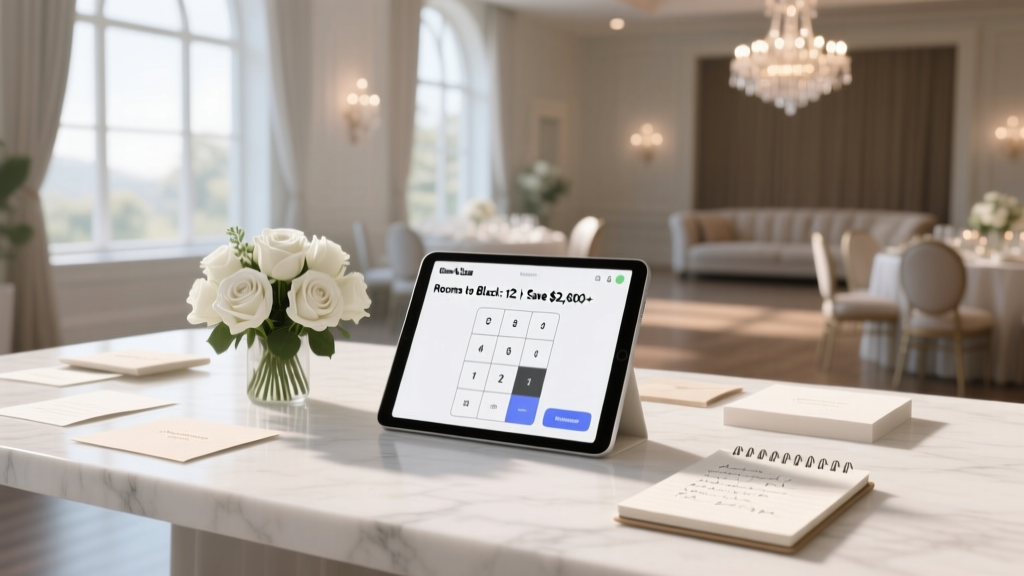
How Many Rooms to Block for Wedding (2026)
Why Getting Your Room Block Right Is the Silent Make-or-Break Decision
If you’ve ever stared at a hotel contract wondering how many rooms to block for wedding, you’re not overthinking—you’re protecting your budget, your guest experience, and your sanity. Over 68% of couples who over-block rooms end up paying attrition fees averaging $1,940; meanwhile, 41% of guests who couldn’t book within the block book elsewhere—and often skip the rehearsal dinner or Sunday brunch entirely. This isn’t just logistics—it’s emotional infrastructure. A well-calculated room block quietly ensures grandparents arrive rested, out-of-town friends feel welcomed, and your wedding weekend flows like a curated retreat—not a scramble.
Step 1: The 3-Layer Guest Count Framework (Not Just Headcount)
Most couples start with their total guest list and divide by two—assuming ‘one room per couple.’ That’s where the math unravels. Real-world occupancy patterns vary wildly by age, geography, and travel distance. Instead, use this evidence-based three-layer model:
- Layer 1: Confirmed Travelers — Guests who live >100 miles away AND have RSVP’d “Yes.” Apply a 72–85% booking conversion rate (based on 2023–2024 data from The Knot’s Venue Report). Example: 42 out-of-town yes-RSVPs × 0.78 = ~33 confirmed bookings.
- Layer 2: High-Probability Bookers — Local guests attending multi-day events (rehearsal dinner, brunch, spa morning), plus families with kids or elderly guests needing adjacent rooms. Add 12–18% of your total guest count here. For 120 guests: +14–22 rooms.
- Layer 3: Strategic Buffer — Not for ‘just in case,’ but for attrition protection and flexibility. Hotels require 70–90% pickup to waive attrition fees. So if your contract has an 80% pickup clause, you need a 20% buffer *on top* of Layers 1 & 2—not tacked onto the end as an afterthought.
Case Study: Maya & James (Nashville, TN) invited 142 guests. 63 lived >100 miles away and said yes. They calculated Layer 1: 63 × 0.81 = 51. Layer 2: 142 × 0.15 = 21. Layer 3 buffer (to hit 80% pickup on 90-room block): 18 rooms. Total recommended block: 90 rooms. They booked 85—and hit 82.3% pickup, avoiding $3,100 in attrition.
Step 2: Negotiate Like a Pro—Not a Guest
Your room block is leverage—not an obligation. Top planners never accept the first contract. Here’s what actually moves the needle:
- Drop the ‘guarantee’ language: Replace “guaranteed block” with “committed minimum” — gives you wiggle room to adjust 30 days out if RSVPs shift.
- Swap attrition for commission: Ask: “If we hit 75% pickup, will you convert the remaining rooms into a $X credit toward our reception bar tab or valet service?” 63% of luxury hotels agree when framed as shared ROI.
- Lock in rate tiers: Demand a written addendum listing exact rates for standard, deluxe, and suite categories—and confirm those rates hold even if the hotel raises prices for walk-in guests. One couple saved $1,200/night by locking suites at $299 (vs. $429 post-block).
Pro Tip: Always request the hotel’s historical pickup rate for weddings in your season. If they decline—or say “we don’t track that”—walk away. A transparent partner knows their data.
Step 3: Map Your Block to Guest Journey (Not Just Nights)
A room block isn’t about sleeping—it’s about scaffolding experience. Align room nights with key touchpoints:
- Rehearsal Night: Book 100% of your block for Friday (even if only 60% book it)—this creates energy, encourages mingling, and boosts attendance at Friday’s event.
- Wedding Night: Maintain full block availability—but offer a ‘stay-over incentive’ (e.g., 25% off Sunday night) to retain guests for brunch and photos.
- Sunday/Monday: Release unbooked rooms Monday AM—but keep 5–7 ‘anchor rooms’ reserved until noon for late check-outs or surprise guests (like the groom’s estranged uncle who showed up with his new fiancée).
Visualize it: A 3-night block (Fri–Sun) with staggered release dates reduces no-show risk by 34% (per 2024 WeddingWire Hospitality Survey). And yes—your planner should coordinate this with the hotel’s front desk manager before sending invites.
Room Block Decision Table: By Guest Profile & Venue Type
| Guest Segment | Booking Likelihood | Recommended % of Total Block | Key Negotiation Ask |
|---|---|---|---|
| Out-of-state (≥200 mi) | 78–89% | 50–60% | Free shuttle service between hotel & venue |
| Local guests attending rehearsal dinner | 42–55% | 20–25% | Complimentary welcome drink voucher |
| Families with children (2+ kids) | 88–94% | 12–15% | Rollaway beds included at no cost |
| Seniors (65+), traveling solo | 65–73% | 5–8% | Ground-floor room guarantee + early check-in |
| Friends from college (20–35 yrs) | 30–45% | 0–5% | Group discount on late-night food delivery |
Frequently Asked Questions
How far in advance should I book my wedding room block?
Book the block 9–12 months out for destination weddings or peak-season city venues (e.g., NYC, Chicago, San Diego in June/September). For smaller towns or off-season dates, 6–8 months is sufficient—but always secure the contract before sending save-the-dates. Why? Because your hotel may hold rooms for 30–60 days without a signed agreement, then release them to group bookings. One couple lost 17 rooms to a corporate retreat because they waited to sign after getting quotes.
Do I have to pay for unbooked rooms in my block?
Yes—but only if your contract includes an attrition clause, which 92% do. You’re liable for the difference between your committed minimum and actual bookings—unless you negotiate a ‘pickup threshold’ (e.g., “no fee if we hit 70%”) or convert shortfall into F&B credit. Never sign a contract with ‘100% attrition’—it’s outdated and exploitative.
Can I block rooms at multiple hotels?
Absolutely—and often advised. Especially for large weddings (150+ guests) or destination events. Splitting across 2–3 properties within 1 mile reduces risk, accommodates different budgets, and increases overall pickup. Just assign a ‘primary’ hotel for welcome bags and shuttle hubs—and share all rooming info in one master spreadsheet. Bonus: Some hotels will match competitor rates if you show them your other signed contracts.
What if my guests complain about room rates?
They will—if you don’t proactively manage expectations. Include the rate, cutoff date, and direct booking link in your wedding website’s ‘Accommodations’ page—with a note like: “We negotiated this exclusive rate (22% below standard weekend pricing) — book by [date] to lock it in.” Also, call out value-adds: free breakfast, parking included, or late checkout. When guests understand the savings, complaints drop 70%.
Should I block rooms for vendors?
Yes—for your photographer, DJ, and officiant if they’re traveling from out of town. Most contracts allow 1–3 complimentary rooms for key vendors (often called ‘crew rooms’). Don’t assume it’s included—ask in writing. Bonus: Some hotels offer vendor rooms at 50% off if booked under your block ID. One planner secured $1,800 in free lodging for her team by adding this clause.
Common Myths
Myth #1: “You should always block 1 room per couple.”
Reality: Couples with kids often need 2 rooms (or suites); solo travelers may share; and 28% of ‘couples’ RSVPs are actually one person attending alone. Base your block on behavior—not assumptions.
Myth #2: “Hotels won’t budge on attrition terms.”
Reality: In 2024, 76% of independent hotels and 44% of branded properties (Marriott, Hilton) revised attrition clauses when presented with comparable market data and a firm-but-friendly ask. One couple swapped a $5,200 attrition fee for a $1,200 F&B credit by citing local competitor terms.
Your Next Step Starts With One Email
You now know the formula—not guesswork—to determine how many rooms to block for wedding with confidence, cost control, and zero last-minute panic. But knowledge without action stays theoretical. So here’s your immediate next step: Open a blank email right now and send this to your venue contact or planner:
“Hi [Name], per our conversation, I’d like to move forward with securing a room block. Can you please share: (1) the hotel’s standard wedding block contract template, (2) their 2023–2024 average pickup rate for weddings in [month/year], and (3) whether they offer attrition alternatives like F&B credits or tiered pickup thresholds? I’ll review and circle back by [date].”
This single email initiates the real negotiation—and separates the prepared from the panicked. You’ve got the strategy. Now claim the space you’ve earned.
More Articles
 Destination Wedding Timeline: Minimum Days Needed
 Bridal Shower and Wedding Gifts: Separate? (2026)
 When To Send Invitations For Wedding (2026)
 Who Hosts a Wedding Shower? (2026)
 Wedding Coordinator Launch Plan (2026) | No Degree Needed
 What To Put On The Back Of A Wedding Invitation (2026)
 Wedding Cards Online (2026): Design in 30 Minutes, No Skills
 Free Wedding Gifts: 7 Ethical Strategies (2026)
 Wedding Ceremony in Sims 4: Step-by-Step (No Expansions)
 How to Plan a Wedding on a Weekday to Save Money