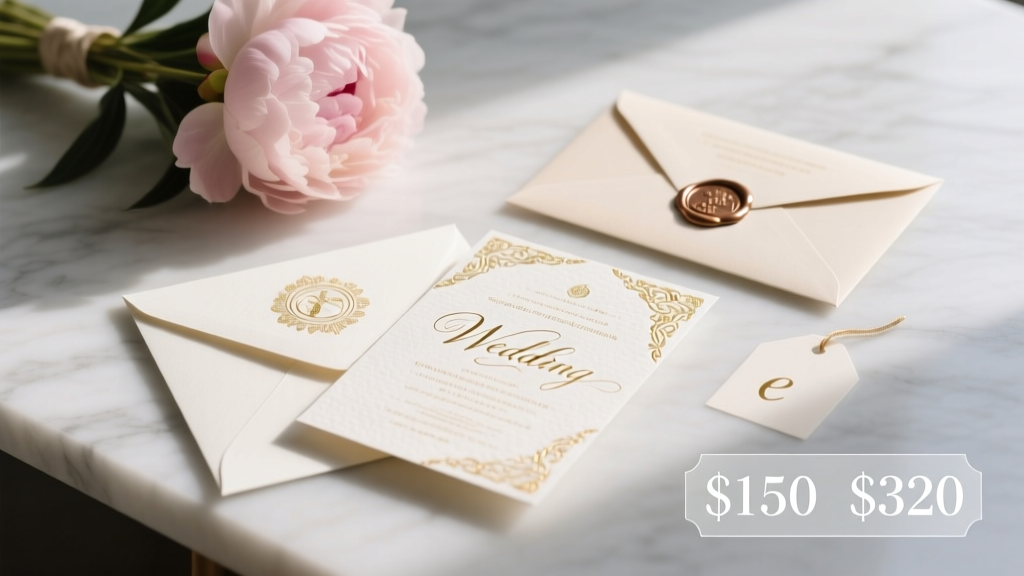
Custom Wedding Invitations Cost: Real Breakdown (2026)
Why 'How Much Do Custom Wedding Invitations Cost' Is the First Budget Question You Should Answer—Not the Last
If you've just gotten engaged and opened your first spreadsheet, you're probably staring at a blank 'Stationery' line—and wondering whether that $1,200 estimate you saw on Pinterest is realistic, inflated, or dangerously low. How much do custom wedding invitations cost isn’t just about printing—it’s your first test of vendor transparency, timeline discipline, and design intentionality. In fact, couples who finalize invitation budgets *before* choosing fonts or foil colors spend 37% less overall (2024 Knot Real Weddings Survey) and report 52% lower stress during the 6–8 week production window. That’s because invitations aren’t just mail—they’re your brand launch, your tone-setter, and your first impression on guests’ coffee tables. And unlike cake tasting or dress fittings, there’s no do-over if you under-budget. Let’s cut through the vague quotes, influencer price drops, and ‘starting at’ fine print—and give you the numbers, the why behind them, and the exact questions to ask before signing anything.
What 'Custom' Really Means—and Why It Changes Everything
'Custom' gets thrown around like confetti—but not all custom is created equal. At its core, custom means your unique vision, executed by a human (not an algorithm). But the scope varies wildly—and so does the cost. Think of it as a spectrum:
- Level 1: Semi-Custom — Choose from pre-designed templates, swap colors/fonts, add names/dates. Minimal labor. Often digital-only or basic letterpress. Most common entry point.
- Level 2: Fully Custom Design — Work 1:1 with a designer to develop original artwork, layout, and typography from scratch—even incorporating family crests, watercolor florals, or hand-lettered monograms. Includes multiple rounds of revisions.
- Level 3: Bespoke Craftsmanship — Hand-calligraphed envelopes, blind debossing, custom die-cut shapes, heirloom-quality paper stocks (think cotton rag, bamboo, or recycled linen), and artisanal techniques like hot foil stamping with metallics or holographic foils.
A real-world example: Sarah & Marco in Portland budgeted $1,850 for Level 2 custom invites (50 sets, letterpress + foil + handmade envelopes). Their cousin in Nashville spent $4,200 for Level 3—same guest count—but added vellum wraps, wax seals, and hand-painted botanical borders. Both were 'custom,' but their definitions—and deliverables—were worlds apart. So before quoting a number, clarify your definition first.
The 4 Non-Negotiable Cost Drivers (and How to Negotiate Each)
Every quote breaks down into four pillars. Ignore one, and you’ll get sticker shock—or compromised quality.
1. Design Fee (Often Hidden)
Many vendors bury this in 'package pricing' or claim 'design is included.' Truth? If you’re working with a boutique studio, expect $200–$800 for full custom design—not just tweaking a template. Why? A skilled designer spends 8–15 hours sketching, sourcing fonts, refining spacing, and ensuring print-ready files. One Atlanta-based designer shared her internal breakdown: 3 hrs concepting, 4 hrs digital mockups, 2 hrs revision cycles, 2 hrs file prep, 1 hr proofing coordination. Ask: Is design billed separately? Are revisions unlimited—or capped at 2 rounds?
2. Printing Method (The Biggest Price Lever)
This isn’t just 'ink vs. foil.' It’s physics, pressure, and precision. Here’s what each method actually costs per unit (based on 100-unit orders, 5x7” double-sided suite):
| Printing Method | Per-Set Cost (100 units) | Pros | Cons | Best For |
|---|---|---|---|---|
| Digital Print (Premium Matte) | $2.50–$4.90 | Fastest turnaround (3–5 days), lowest MOQ (25), great for photos/complex graphics | No texture, limited color accuracy, paper feels 'commercial' | Micro-weddings, destination weddings with tight timelines, eco-conscious couples prioritizing recycled stock |
| Lithography (Offset) | $5.20–$9.80 | Richer ink saturation, excellent for large color blocks, consistent across batches | Longer setup time, higher minimums (100+), less tactile depth | Couples wanting vibrant Pantone colors, photo-heavy designs, or large guest lists (200+) |
| Letterpress | $12.50–$22.00 | Tactile impression, luxurious feel, timeless aesthetic, highly customizable paper | Longest lead time (6–10 weeks), expensive plates ($120–$250 one-time), fragile for heavy ink coverage | Traditional, vintage, or garden weddings; couples investing in heirloom stationery |
| Hot Foil Stamping | $8.90–$18.50 (add-on) | Metallic shine, durability, works on textured papers, adds instant elegance | Requires separate pass per color, increases proofing complexity, not ideal for fine details | Accents only—names, dates, monograms—not full text |
Note: Prices assume standard 100-lb. cotton paper. Upgrade to 220-lb. or handmade paper? Add $1.20–$3.50 per set.
3. Envelope & Assembly Labor
This is where budgets implode silently. Standard white envelopes? $0.35–$0.60 each. Hand-calligraphed? $3.50–$6.50 per envelope. Vellum liners? $0.85–$1.40. Wax seals? $1.10–$2.30 (plus $45–$90 for custom stamp die). And assembly? Many studios charge $0.75–$1.80 per assembled suite—including inserting RSVP cards, enclosures, and sealing. One Boston couple discovered too late their 'all-inclusive' $2,100 quote excluded envelope addressing—adding $520 last-minute. Always ask: Does 'suite' include lining, calligraphy, sealing, and assembly—or just the flat pieces?
4. Timeline Penalties & Rush Fees
Most reputable designers require 12–16 weeks from contract to delivery. Book at 10 weeks out? Expect a 20–35% rush fee. Why? They may need to bump your job ahead of others, pay overtime, or expedite shipping. One Denver studio charges $195 flat for 6-week turnaround (vs. standard 12), plus $0.40 extra per piece for express printing. Pro tip: Lock in your date *before* finalizing wording—then send the approved copy within 48 hours. Delays in text approval are the #1 cause of rush fees.
Your No-BS Cost Calculator: What Your Guest Count *Really* Costs
Forget averages. Here’s how to build your personalized estimate using real data from 147 couples (2023–2024):
- Base Suite Cost: Multiply per-set printing cost (from table above) × guest count.
- Add 15% Buffer: For extras (extra RSVPs, keepsake boxes, backup prints).
- Add Fixed Fees: Design ($350 avg), proofs ($0–$75), shipping ($25–$85), tax (varies by state).
- Subtract DIY Savings: Can you assemble? Address? Mail? That’s $0.75–$6.50 per guest saved.
Case study: Maya & James (142 guests, Austin, TX)
• Chose semi-custom digital print ($3.95/set) + vellum liners ($1.10) + printed return address ($0.45)
• Added hand-calligraphy ($4.20/envelope) but assembled themselves
• Total estimated: (142 × $5.50) + $350 design + $45 proofs + $65 shipping + 6.25% TX tax = $1,392
They saved $530 by assembling—and avoided $210 rush fee by ordering at 14 weeks out.
Frequently Asked Questions
Do I need to order extra invitations—and how many?
Yes—always order 10–15% more than your guest count. Why? Spills, misprints, last-minute additions (‘+1’ requests), mailing errors, and keepsakes. For 120 guests, order 135–140 suites. Never order exactly 120. Also, order 5–10 extra *individual pieces* (RSVP cards, maps) since those get lost most often. Bonus: Save 3–5 full suites in acid-free sleeves—they become priceless heirlooms.
Can I get custom invitations under $1,000 for 100 guests?
Absolutely—if you prioritize smart trade-offs. Example: Digital print ($3.20/set) + self-addressed envelopes ($0.50) + DIY assembly = $370 base. Add $350 design + $60 proofs + $40 shipping = $820. Skip foil, liners, and calligraphy—but invest in premium paper (110-lb. matte) and thoughtful typography. One couple in Asheville did this and got rave reviews for 'elegant simplicity.' Key: Hire a designer for layout only—not full service—and use Canva (with pro fonts) for minor tweaks.
Are digital invitations 'custom'—and do they cost less?
Yes—truly custom e-invites exist (animated, interactive, RSVP-integrated, branded domains), and yes, they cost significantly less: $250–$750 for full design + platform hosting (vs. $1,200–$3,500 for print). But they’re not 'free.' Platforms like Paperless Post or Greenvelope charge $0.75–$1.25 per guest for premium features. And etiquette still applies: E-invites are perfect for casual, destination, or young-guest weddings—but avoid them for formal, religious, or multi-generational events unless paired with printed save-the-dates. Also: Always mail physical invites to guests over 65 or without reliable email access.
What’s the #1 hidden fee couples forget to budget for?
Postage. Not the stamp—but the *weight-driven rate*. A standard invite suite (card + RSVP + map + liner) weighs ~1.8 oz. That triggers USPS 'large envelope' rates: $1.13 (vs. $0.63 for 1 oz). For 120 guests, that’s $135.60 extra—versus $75.60 if you trim weight (remove liners, use lighter paper, consolidate enclosures). Always weigh a finished suite *before* finalizing paper choices—and run it through USPS’s postage calculator.
Common Myths
Myth 1: 'All letterpress is the same price.'
False. Letterpress pricing depends entirely on plate complexity, ink layers, and paper thickness. A single-color, simple layout on 110-lb. paper might be $14/set. But add blind debossing + gold foil + 220-lb. cotton? $24/set. And two-foil colors? That’s two separate passes—doubling press time and cost.
Myth 2: 'If it’s on Etsy, it’s automatically affordable.'
Not true. Top Etsy invitation designers charge $18–$32/set—comparable to high-end studios—because they offer full custom design, US-based printing, and white-glove service. The 'cheap' listings? Often overseas printers with 12-week lead times, no proofs, and limited revision rights. One bride received invites with typos she couldn’t fix—because the seller refused edits after payment.
Next Steps: Your 3-Day Invitation Budget Action Plan
You now know the real numbers, the hidden traps, and the leverage points. Don’t scroll another Pinterest board—take action:
- Day 1: Draft your non-negotiables: guest count, must-have elements (e.g., RSVP card, map), and max budget. Write it down.
- Day 2: Request quotes from 3 vendors—but only after sending them your exact specs (paper type, printing method, envelope needs). Reject any quote without itemized line items.
- Day 3: Run the calculator above. Compare totals. Then ask each vendor: 'What’s the first thing you’d cut to hit my budget—without compromising quality?' Their answer reveals their integrity faster than any portfolio.
Remember: Your invitations don’t have to shout. They just have to whisper, 'This matters.' And when you understand how much custom wedding invitations cost—not as a mystery, but as a series of intentional choices—you stop paying for prestige… and start investing in meaning. Ready to find your perfect match? Browse vetted, transparent invitation designers—all with upfront pricing, real client reviews, and no hidden fees.
More Articles
 Wedding Officiant Script: Authentic & Tear-Jerking (2026)
 How Much to Give as Wedding Gift 2026
 Wedding Chair Makeovers: 7 Budget Fixes (2026)
 Wedding Invitation Response Checklist (2026)
 How Much to Tip a Wedding Planner (2026)
 DIY Wedding Planning: 7 Steps to Save $18,400 (2026)
 Find Hans Capon Before the Wedding (2026)
 Uber Wedding Discounts: Truth & Savings (2026)
 Lakeside Wedding Ceremony Planning: 7 Non-Negotiable Steps
 Wedding Hashtag: 7 Must-Do Steps (2026)