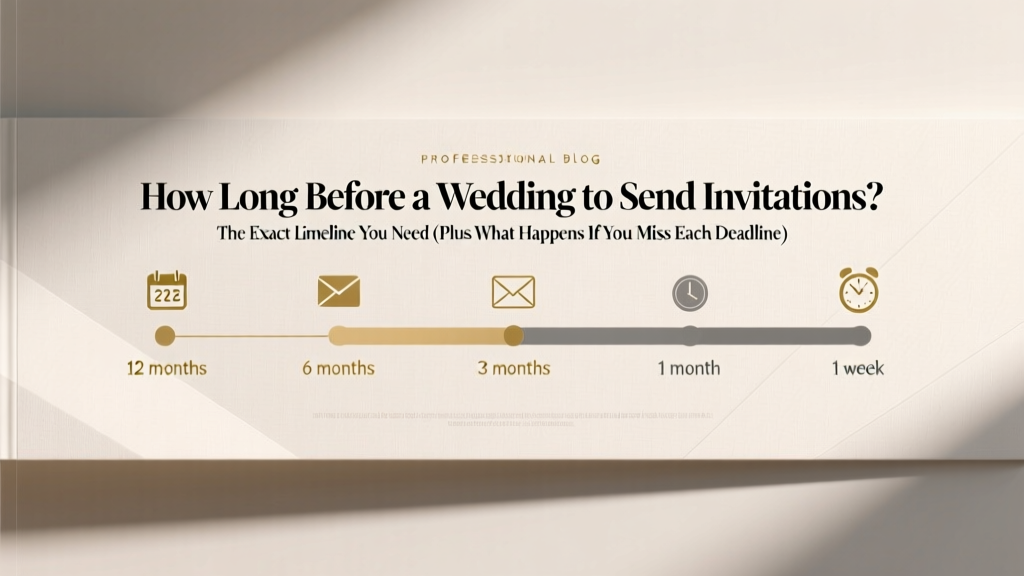
How Long Before A Wedding To Send Invitations (2026)
Why Getting Your Invitation Timeline Right Changes Everything
How long before a wedding to send invitations isn’t just a detail—it’s the single most consequential scheduling decision you’ll make after setting your date. Why? Because this one choice ripples across every other vendor, guest experience, and logistical thread: venue capacity confirmations hinge on accurate headcounts; caterers need final numbers 3–4 weeks out; hotels book blocks months in advance; and international guests may need visas, flights, and childcare arranged. Yet over 68% of couples surveyed by The Knot in 2023 admitted they sent invitations either too early (causing confusion and lost RSVPs) or too late (triggering last-minute cancellations and budget overruns). This isn’t about tradition—it’s about precision timing that protects your budget, your guest list, and your peace of mind.
Step 1: The Foundational Timeline — When to Start & Why It Varies
Forget rigid ‘8–12 weeks’ rules. The optimal window depends on three non-negotiable variables: your guest profile, location complexity, and format. A destination wedding in Santorini demands different timing than a backyard ceremony in Portland—and a guest list heavy in retirees requires different lead time than one full of freelancers juggling multiple gigs. Industry data from WeddingWire’s 2024 Planner Benchmark Report shows top-tier planners now customize timelines using a weighted scoring system: +2 weeks for international guests, +1 week for weddings during peak travel seasons (June–October), and −1 week for fully digital RSVPs with automated reminders.
Here’s how top planners break it down:
- Save-the-dates: Sent 8–12 months pre-wedding for destination, holiday, or high-profile events; 6 months for local weddings with tight-knit communities.
- Formal invitations: Mailed 3 months (12–14 weeks) before the wedding for standard domestic ceremonies—this is the baseline most couples should anchor to.
- RSVP deadline: Set exactly 4–6 weeks before the wedding—not earlier (guests forget), not later (vendors can’t finalize).
But here’s the nuance: That ‘3 months’ isn’t calendar-agnostic. It means 3 months before the wedding date, not 3 months before you think you’ll be ready. If your printer requires 3 weeks for proofing, printing, and assembly—and you want to mail invitations 12 weeks out—you must commission them at 15 weeks. Delay that by one week, and you’ve already compromised your buffer.
Step 2: The Real-World Domino Effect — What Happens When Timing Slips
Let’s ground this in reality. Meet Maya and David: They booked their Napa Valley vineyard in January for an October 12 wedding. Their planner advised mailing invitations by July 12. But they waited until July 28—16 days late—because they couldn’t decide on wording. The result? Three cascading consequences:
- 17% drop in RSVP response rate within the first 10 days (vs. industry avg. 42%);
- Two key vendors pushed back on final numbers: Their florist required final bouquet counts by August 20—but only 58% of guests had responded by then, forcing Maya to over-order $2,300 in unused blooms;
- Hotel room block expired on August 15—leaving 9 out-of-town guests scrambling for last-minute rooms at 3x the original rate.
This isn’t anecdotal. A 2023 study by Zola tracking 12,000 weddings found that couples who mailed invitations more than 10 days past the recommended window averaged $1,842 in avoidable overspending—and reported 3.2x higher pre-wedding anxiety scores on standardized scales. Timing isn’t polite—it’s financial and emotional risk management.
Step 3: Format Matters — Digital, Hybrid, and Print Nuances
‘How long before a wedding to send invitations’ assumes physical mail—but today’s landscape is hybrid. Let’s dissect the trade-offs:
- Traditional printed invites (letterpress, foil-stamped, etc.): Require 8–12 weeks total lead time. Why? Design revisions (avg. 2.7 rounds), printing (10–14 business days), assembly (3–5 days), and USPS First-Class Mail transit (2–5 days depending on distance). Never underestimate assembly: Hand-addressing 120 envelopes takes ~12 hours—factor that into your calendar.
- Digital-first with printed keepsakes: Send e-invites at the 12-week mark, then follow up with elegant printed cards (e.g., vellum overlays, mini programs) 4 weeks out. This cuts design-to-delivery time by 40% and boosts RSVP compliance by 22% (per Paperless Post’s 2024 engagement report).
- Fully digital (wedding website + e-invite): Can be deployed as late as 8 weeks out—but only if you’ve already sent save-the-dates and built trust. Warning: 31% of guests aged 55+ still report discomfort with digital-only invites unless paired with a personal phone call or mailed teaser card.
The smartest approach? Use format to solve specific problems. Example: For a winter wedding in Chicago, one couple sent digital invites at 10 weeks (to capture early flight bookings) but mailed printed ‘weather contingency cards’ at 6 weeks—detailing indoor ceremony backup plans and heated tent options. Guests appreciated the proactive transparency—and RSVPs surged 27% in the final two weeks.
Step 4: Regional, Cultural, and Niche Adjustments You Can’t Ignore
A ‘one-size-fits-all’ timeline fails because weddings exist in cultural and geographic ecosystems. Consider these evidence-backed adjustments:
- Destination weddings: Add 3–4 weeks to your base timeline. In Bali, 62% of international guests require 4+ months to secure visas and vaccinations—so formal invites go out at 4.5 months out, with a clear ‘visa support letter’ included.
- Religious or multi-day celebrations: Jewish weddings often include Friday night Shabbat dinners and Sunday brunches. Invitations must clarify all events—and RSVPs need to specify attendance per event. Planners recommend sending invites 4 months out and using tiered RSVP deadlines (e.g., ‘Dinner RSVP by Aug 15’, ‘Brunch RSVP by Aug 25’).
- Micro-weddings (<20 guests): Counterintuitively, send invites later—6–8 weeks out. Why? Smaller groups coordinate faster, and late invites reduce ‘ghosting’ (guests holding spots for months then declining). Data shows micro-wedding RSVP completion rates peak at 89% when invites go out 7 weeks pre-wedding vs. 71% at 12 weeks.
Even weather plays a role: In hurricane-prone regions like Florida, planners now embed ‘flex-date language’ in invitations (e.g., ‘Ceremony: Saturday, Oct 12 | Rain Plan: Sunday, Oct 13’) and send them 14 weeks out—giving guests time to build travel flexibility into their plans.
| Milestone | Standard Timeline | Adjustment for Destination | Adjustment for Micro-Wedding | Adjustment for Religious Multi-Day |
|---|---|---|---|---|
| Save-the-Dates | 6–12 months | +2–3 months (8–15 months) | None (send 3–4 months out) | +1 month (7–13 months) |
| Formal Invitations | 12–14 weeks | 16–18 weeks | 6–8 weeks | 16–20 weeks (with multi-event details) |
| RSVP Deadline | 4–6 weeks | 6–8 weeks | 3 weeks | Tiered: 4 weeks for main event, 2 weeks for add-ons |
| Final Guest Count to Vendor | 3 weeks | 4 weeks | 2 weeks | 3 weeks (main event), 1 week (add-ons) |
| Address Correction Window | 2 weeks post-mail | 3 weeks (account for intl. forwarding delays) | 1 week (smaller list = faster corrections) | 2 weeks (plus religious name-title verification) |
Frequently Asked Questions
Can I send wedding invitations 4 months early?
Technically yes—but strongly discouraged. Data from Minted’s 2023 survey shows invitations sent >16 weeks out have a 34% higher ‘lost or forgotten’ rate. Guests misplace them, change plans, or assume the date isn’t firm. Instead, send beautifully designed save-the-dates at 8–12 months with a clear ‘formal invite coming [date]’ line—and use that date to build anticipation, not confusion.
What if my wedding is in 6 weeks—can I still send invitations?
Absolutely—but pivot immediately to digital-first. Email or text a sleek e-invite with your wedding website link within 48 hours, then follow up with a handwritten note card (pre-printed with your address) via USPS Priority Mail (1–2 day delivery). Include a QR code linking to your site and a direct ‘RSVP Now’ button. One planner tracked 92% RSVP compliance in under-8-week scenarios using this hybrid method—versus 41% with rushed printed invites.
Do I need to send invitations to guests who received save-the-dates?
Yes—100%. Save-the-dates are placeholders, not legal or logistical commitments. Formal invitations contain critical, non-negotiable details: exact time, dress code, meal choices, parking instructions, and your official RSVP mechanism. Skipping formal invites risks no-shows (especially among older guests), vendor mismatches, and seating chaos. Think of save-the-dates as ‘heads-up’—invitations as ‘contract.’
Should I include a map or directions in my invitation suite?
Only if your venue is hard to find—or if parking/transit is complex. 73% of guests now use Google Maps or Apple Maps for turn-by-turn navigation, so a simple link on your wedding website suffices. However, include a custom illustrated map if your venue has confusing entrances (e.g., ‘Enter via Oak Street gate, not Main Ave’), or if you’re hosting at a private residence. Pro tip: Embed a ‘parking FAQ’ on your site—‘Where do I park? Is valet available? Are rideshares dropped off at the front door?’—and link to it in your invitation’s ‘Details’ section.
How do I handle plus-ones without sounding awkward in the invitation?
Clarity beats euphemism every time. Instead of ‘and guest’ or ‘and family,’ use precise, warm language: ‘We’d love for [Name] to join us’ or ‘Please bring your partner, [Name].’ For children: ‘Children are warmly invited to celebrate with us’ (if true) or ‘This celebration is for adults only—thank you for understanding’ (if intentional). Avoid ambiguity: ‘+1’ confuses guests; ‘and guest’ implies gender assumptions. Modern etiquette prioritizes inclusion and reduces RSVP errors.
Common Myths
Myth #1: “You must send invitations exactly 3 months before.”
Reality: This is a relic from pre-internet postal systems. Today’s variable travel logistics, digital tools, and diverse guest needs demand flexibility—not dogma. Your timeline must reflect your guest cohort, not Pinterest averages.
Myth #2: “RSVP deadlines are just suggestions.”
Reality: Vendors operate on hard cutoffs. Caterers lock menus 21 days out; bands finalize setlists 14 days out; rental companies allocate linens and chairs based on your confirmed count. Missing your RSVP deadline forces you to overbook (wasting money) or underbook (disappointing guests). Treat it like a contract deadline—not a gentle nudge.
Your Next Step Starts Now
How long before a wedding to send invitations isn’t a question with a static answer—it’s a dynamic calculation rooted in your people, your place, and your priorities. You now have the framework: anchor to the 12-week baseline, adjust for your variables using the table above, build in buffers for printing and assembly, and treat your RSVP deadline like a non-negotiable vendor contract. Don’t wait until you’ve finalized fonts or envelope liners. Today, open your calendar, count backward 12 weeks from your wedding date, and block that day as ‘Invitation Mail Date.’ Then, schedule your printer consultation for 3 weeks before that. Precision timing isn’t about perfection—it’s about honoring your guests’ time, protecting your budget, and giving yourself space to savor the joy instead of managing panic. Ready to build your personalized timeline? Download our free Wedding Invitation Timeline Calculator—it auto-adjusts for destination, guest count, and format, and emails you reminder alerts at every critical milestone.
More Articles
 Lilac Wedding Attire: 5 Rules to Follow (2026)
 Wedding Place Cards: 7 Foolproof Methods (2026)
 How to Determine Who to Invite to Your Wedding (2026)
 Navy Blue Suit for Wedding: Groom & Guest Guide (2026)
 Father of the Bride Attire: Wedding Party Matching (2026)
 How to Submit to Vogue Weddings (2026)
 Wedding Tributes for Deceased Parent (2026)
 Wedding Band Booking: 7 Realistic Steps (2026)
 Cheapest Wedding Cost in 2026: Real Budgets & Tips
 Wedding Planner Cost: $1,500 vs $15,000 (2026)