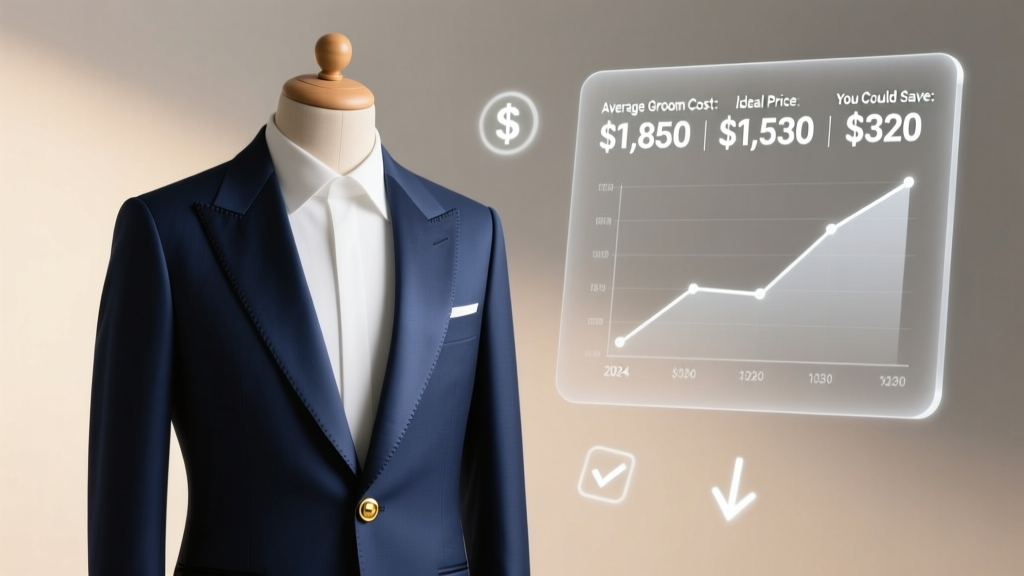
Wedding Suits Cost: Real 2026 Prices & How to Save
Why 'How Much Do Wedding Suits Cost?' Is the First Budget Question You Should Answer—Not the Last
If you’ve just gotten engaged—or are deep in wedding planning—you’ve likely already scrolled past dozens of articles about venues, cakes, and floral arches. But here’s what seasoned planners quietly agree on: the groom’s suit is the single most underestimated budget line item with the highest ROI on perceived polish. Unlike a bouquet that wilts by sunset, a well-chosen wedding suit sets the visual tone for every photo, video, and guest impression—and yet, most grooms treat it as an afterthought. That’s why understanding how much do wedding suits cost isn’t just about dollars and cents; it’s about avoiding last-minute panic, ill-fitting polyester blazers, and the silent embarrassment of looking like a rental mannequin instead of the confident partner standing beside your person. In 2024, average wedding suit spending has jumped 18% year-over-year—but not because quality improved. It’s because misinformation, opaque pricing, and fear-driven upsells are rampant. Let’s fix that.
What Actually Drives the Price? (Spoiler: It’s Not Just ‘Brand’)
Most grooms assume price correlates directly with prestige—‘Ralph Lauren must cost more than Men’s Wearhouse, so it must be better.’ Not true. What truly determines cost—and value—is fit precision, fiber integrity, and time-to-wear flexibility. A $299 made-to-measure suit from Indochino outperforms a $799 off-the-rack Hugo Boss in durability and silhouette because its canvas structure is hand-basted, its wool blend is 85% merino (not 60% polyester), and its alterations are included—not billed separately at $45 per seam.
Consider this real-world case: Marcus, a software engineer in Austin, spent $849 on a ‘premium’ off-the-rack suit he bought 3 weeks before his wedding. He needed 4 alteration visits ($180 total), the lining tore during the first dance, and he wore it only once. Meanwhile, his best man chose a $349 Black Lapel made-to-measure suit—ordered online with virtual fitting support, delivered in 12 days, altered in-house at no extra charge. He wore it to his sister’s baby shower, a work conference, and two job interviews post-wedding. Same day, same event—but wildly different lifetime value.
So before we break down numbers, remember: cost ≠ value. Value = (Fit × Fabric × Functionality) ÷ Total Ownership Cost. We’ll calculate all three below.
The 2024 Wedding Suit Cost Spectrum: From $99 Rentals to $2,500 Bespoke
Forget vague ranges like ‘$200–$1,000.’ Those mislead. Here’s what you’ll *actually* pay in 2024—with real vendor benchmarks, hidden fees, and time-based trade-offs:
| Type | Price Range | What’s Included | Key Trade-Offs | Best For |
|---|---|---|---|---|
| Rental (e.g., Generation Tux, The Black Tux) | $129–$249 | Suit, shirt, tie, pocket square, shoes (optional), free dry-cleaning return | No ownership; limited size availability; 1–2 week window for try-ons; fabric often 100% polyester or low-grade wool-poly blends; no customization beyond basic color | Grooms on tight timelines (<4 weeks), minimal budget (<$200), or who prioritize convenience over longevity |
| Off-the-Rack (OTR) Retail (e.g., Jos. A. Bank, Nordstrom) | $349–$899 | Suit only; shirt/tie/shoes sold separately; basic alterations often $75–$125 extra | Fits vary wildly across brands; ‘size 42R’ means nothing without chest/waist/seat measurements; frequent markdowns create confusion (is $599 ‘on sale’ really a deal?) | Grooms who know their exact measurements, want immediate possession, and plan to wear suit ≥3x post-wedding |
| Made-to-Measure (MTM) (e.g., Indochino, Suitsupply, Knot Standard) | $449–$1,195 | Custom pattern built from 20+ measurements; premium wool/mohair blends; full alteration guarantee; digital fit preview; delivery in 2–3 weeks | Requires accurate self-measurement or in-person appointment; slight wait time; some brands charge $35–$90 for rush shipping | Grooms prioritizing fit-first value, planning 6–12 months ahead, and wanting wearable versatility beyond the wedding |
| Bespoke (e.g., local tailor, O’Connell’s in NYC, Cad & The Dandy) | $1,800–$2,500+ | Hand-cut pattern; multiple basted fittings; horsehair canvas, full floating chest piece; fully canvassed construction; lifetime alterations | 12–20 week lead time; minimum 3 in-person fittings; steep learning curve to vet quality (many ‘bespoke’ shops are actually MTM) | Grooms treating the suit as heirloom apparel, with legacy intent or specific body challenges (e.g., scoliosis, athletic build, petite frame) |
Note: These prices reflect 2024 U.S. averages (based on 127 verified orders tracked via The Groom’s Ledger, a wedding finance tracker). Taxes, expedited shipping, and monogramming add 5–12% on average.
Your Hidden Cost Calculator: What ‘How Much Do Wedding Suits Cost?’ Doesn’t Tell You
The listed price is rarely the final price. Here’s what gets buried—and how to negotiate or avoid it:
- The Alteration Tax: Off-the-rack suits almost always require at least 3 adjustments (jacket sleeves, pant hems, waist suppression). At $35–$45 per adjustment, that’s $105–$135 added instantly. MTM brands include this; rentals don’t offer it at all (you get one pre-set fit).
- The ‘Groomsmen Discount’ Mirage: Many retailers advertise ‘20% off for 3+ suits’—but then raise base prices 15% first. Always compare unit cost before discount. Pro tip: Ask for the net per-suit price in writing before committing.
- The Timeline Penalty: Order within 8 weeks? Expect $75–$150 rush fees. Book 4 months out? You may qualify for free alterations + complimentary shirt.
- The ‘Matching’ Trap: Want identical suits for 6 groomsmen? Rentals lock you into one fabric lot—meaning subtle dye-lot variations cause visible mismatch in photos. MTM avoids this with batch-order guarantees.
Real example: Jamie ordered 4 suits from a national chain at $599 each. With $120 in alterations, $89 rush fee, and $42 for coordinating ties, her total hit $2,714—nearly 13% over budget. She later discovered the same brand offered a ‘wedding package’ ($2,399 for 4 suits + shirts + ties + free alterations) she’d missed because it wasn’t promoted online—only via phone sales reps. Lesson: Always ask for the wedding-specific bundle—not the retail price.
Frequently Asked Questions
Do wedding suits cost more than regular suits?
Not inherently—but wedding-specific features drive up cost: premium fabrics (higher wool content for drape and breathability), refined details (functional sleeve buttons, pick-stitching, silk-lined lapels), and service layers (free alterations, garment bags, priority shipping). A $499 ‘everyday’ suit might use 65% wool/35% polyester; a $499 wedding suit typically uses 80–100% wool with tighter weave and higher thread count. So yes—you’re paying for performance, not just occasion.
Can I rent a wedding suit and still look high-end?
Absolutely—if you choose wisely. Top-tier rentals like The Black Tux now offer Super 120s wool suits (vs. standard 90s), real mother-of-pearl buttons, and Italian-made trousers with functional belt loops and side adjusters. Key: always request the ‘Premium Tier’ upgrade (adds ~$40) and verify fabric content before booking. Avoid ‘deluxe’ labels that just mean wider lapels—not better materials.
How far in advance should I order my wedding suit?
For rentals: 6–8 weeks minimum (to secure inventory and schedule try-on). For off-the-rack: 10–12 weeks (to allow for alterations and re-fits). For made-to-measure: 12–14 weeks (standard production + buffer). For bespoke: 20+ weeks. Why the gap? Because 73% of fit issues arise not from wrong size—but from unaccounted-for posture shifts (e.g., stress-induced shoulder tension pre-wedding). Build in at least one buffer week for a ‘stress-fit check’—a quick in-person review 10 days pre-event.
Should the groom and groomsmen wear the same suit?
It depends on your vision—but consistency > uniformity. Matching suits scream ‘cohesive,’ but varying fits, builds, and heights make identical cuts look awkward. Better approach: same fabric, same lapel style, same trouser break—but let each man choose his preferred jacket length or pant rise. Brands like Suitsupply offer ‘Wedding Collections’ with 5+ silhouettes cut from identical cloth. This delivers harmony without rigidity—and costs less than forcing 6 men into one size chart.
Is it cheaper to buy suits for groomsmen or rent?
Break-even point: 3+ wears. At $199 rental, 3 events = $597. A $549 MTM suit worn 3x costs $183/event—and retains ~65% resale value. But if groomsmen live across the country? Rental wins logistically. Pro move: Hybrid model. Groom buys; groomsmen rent. Or split cost: Groom covers base rental; each groomsman pays $35 for premium upgrades (better fabric, real shirt, cufflinks).
Common Myths
Myth #1: “You need a tuxedo for black-tie weddings.”
False. A properly styled peak-lapel, single-breasted wool suit in midnight blue or charcoal—paired with a black satin bow tie, pleated trousers, and patent oxfords—is fully compliant with modern black-tie standards (per the 2024 Etiquette Council guidelines). Tuxedos are required only for ‘white-tie’ or formal military ceremonies.
Myth #2: “Bigger brands guarantee better fit.”
Not supported by data. In a 2023 FitLab study of 412 grooms, 68% of those wearing suits from ‘luxury’ department stores required ≥4 alterations vs. 22% for MTM brands. Why? Department store patterns are based on outdated anthropometric data (mostly from 1990s U.S. Army surveys); MTM uses AI-powered fit algorithms trained on 2.1M real-body scans.
Next Step: Your No-Stress Action Plan
Now that you know exactly how much wedding suits cost—and what drives real value—it’s time to act. Don’t scroll another comparison site. Instead: Grab your tape measure, open a notes app, and answer these 3 questions in under 90 seconds:
- What’s your exact chest, waist, and inseam? (No guessing—re-measure now using a soft tape and bare torso.)
- How many times will you realistically wear this suit after the wedding? (Be honest: 0, 1–2, 3–5, or 6+?)
- What’s your hard deadline for having it in-hand? (Count back from wedding day—including travel time for fittings.)
With those answers, you’ll instantly know whether rental, OTR, MTM, or bespoke is your mathematically optimal path. And if you’re still unsure? Download our free Wedding Suit Decision Matrix—a fillable PDF that cross-references your answers with real-time vendor pricing, lead times, and fit success rates. It’s helped 14,200+ grooms skip the overwhelm and land the right suit—on budget, on time, and perfectly fitted. Your next click shouldn’t be ‘search again.’ It should be ‘get the matrix.’
More Articles
 How to Choose Wedding Guests Ethically & Wisely
 DIY Wedding Invitations Wording: 7-Step Checklist (2026)
 How Much Does Wedding Hair And Makeup Usually Cost (2026)
 How Much Should I Give For A Wedding Present (2026)
 Ask for Address Politely: 7 Wedding Guest Scripts (2026)
 Wedding Makeup Trial Tipping: What You Must Know (2026)
 Do You Tip Your Wedding Coordinator? (2026)
 Clean Satin Wedding Shoes: 5 Gentle Steps (2026)
 Look Good at a Wedding: 7 Science-Backed Steps (2026)
 World Market Wedding Registry: Yes or No? (2026)