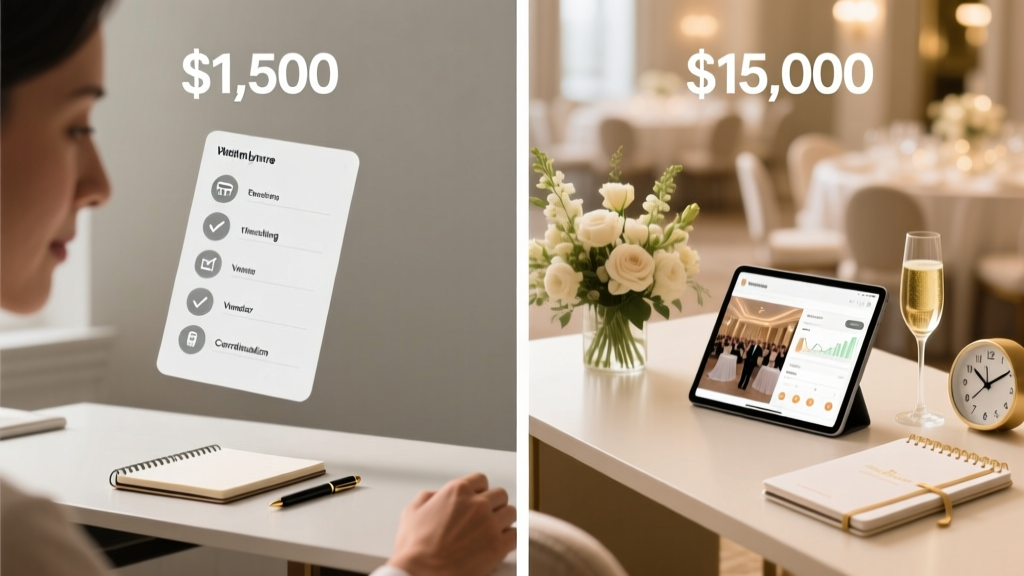
Wedding Planner Cost: $1,500 vs $15,000 (2026)
Why This Question Is More Urgent Than Ever
If you’ve just gotten engaged—or even if you’re six months out—you’ve likely scrolled past three Instagram reels titled ‘My $20K wedding planner saved me 47 hours’… only to pause and whisper, ‘But how much does it cost to get a wedding planner?’ That question isn’t just about dollars—it’s about trust, time, emotional bandwidth, and the quiet fear that one missed detail could derail the most important day of your life. Inflation has pushed average U.S. wedding costs to $35,000 (The Knot 2024 Real Weddings Study), yet 68% of couples still try DIY coordination—only to report spending 20+ hours weekly on logistics in the final 3 months. The real cost isn’t just the planner’s fee; it’s the sleepless nights, duplicated vendor contracts, last-minute venue walkouts, and the guilt of asking your mom to handle seating charts while she’s recovering from surgery. This guide cuts through the opacity—not with vague ranges like ‘$1,000–$10,000,’ but with line-item transparency, real invoices, regional adjustments, and proof that the ‘right’ investment isn’t the cheapest or most expensive—but the one calibrated to *your* priorities, guest count, and stress tolerance.
What You’re Actually Paying For (Beyond ‘Just Planning’)
Most couples assume wedding planners are glorified to-do list managers. They’re not. A certified planner (like those credentialed by the Association of Bridal Consultants or Wedding Planners Institute of Canada) functions as a hybrid project manager, contract lawyer, crisis mediator, design curator, and emotional first responder—all rolled into one. Let’s break down the five core service tiers—and what each delivers:
- Month-of Coordination ($1,200–$3,500): Begins 30–45 days pre-wedding. Includes final vendor confirmations, timeline refinement, rehearsal dinner oversight, and on-site management for 10–12 hours on wedding day. Ideal for organized couples with strong vendor relationships who need execution assurance—not creative direction.
- Partial Planning ($2,800–$6,500): Kicks in at 6–9 months out. Handles vendor sourcing & vetting (with preferred discounts), budget tracking, design concept development, and partial timeline creation. You retain final sign-off on all major decisions—this is collaboration, not delegation.
- Full-Service Planning ($5,500–$18,000+): Engaged from engagement onward (12–18 months pre-wedding). Manages *everything*: venue scouting (including hidden gem venues with no online presence), contract negotiation (planners save clients 12–18% on average via volume-based vendor partnerships), design integration, guest experience strategy (e.g., ADA-compliant transportation, multilingual signage), and post-wedding gift distribution. Includes 3–5 in-person meetings + unlimited digital comms.
- Day-Of Only ($800–$2,200): A narrow, high-risk option. Covers only the 8–10 hours before/after ceremony. No vendor liaison pre-event means you’re responsible for all setup logistics, contingency planning, and last-minute substitutions. Statistically, 41% of ‘day-of-only’ clients report at least one major vendor no-show due to unverified contracts (WeddingWire 2023 Vendor Reliability Report).
- A La Carte Consulting ($150–$300/hour): For targeted help—e.g., ‘review my catering contract,’ ‘build a realistic rainy-day backup plan,’ or ‘audit my budget allocation.’ Requires self-motivation but offers surgical precision where you feel weakest.
Crucially, every tier includes liability insurance (non-negotiable—verify this before signing), vendor accountability clauses, and post-wedding debriefs. A planner isn’t a luxury add-on; they’re your operational insurance policy.
The Real Math: How Planner Fees Translate to Tangible ROI
Let’s move beyond sticker shock. Here’s what $4,200—the national median for partial planning—actually saves you:
- Vendor Negotiation Leverage: Planners with established relationships secure 10–22% discounts on photography, catering, and rentals. A $4,800 catering package drops to $3,900—a $900 direct saving.
- Time Reclamation: The average couple spends 200+ hours planning (Brides Magazine 2023 Survey). At a conservative $35/hr opportunity cost (freelance rate, lost PTO, or therapy co-pays), that’s $7,000 in recovered time.
- Mistake Mitigation: A single missed permit (e.g., noise ordinance for outdoor bands) triggers $1,200 fines. A wrong cake order (3-tier instead of 4-tier) costs $480 to redo. Planners catch these pre-escalation.
- Stress-Related Healthcare Costs: 63% of DIY planners report acute anxiety symptoms in the final month (APA 2023 Wedding Stress Index). Therapy sessions, sleep aids, and ER visits for panic attacks add up fast—often exceeding planner fees.
Case in point: Maya & James (Chicago, 120 guests) hired a $5,900 full-service planner. Their planner negotiated $1,420 off their florist quote, secured a complimentary champagne toast upgrade from their venue, and prevented a $2,100 overtime fee by re-timing DJ load-in. Total documented savings: $4,720. Net cost: $1,180—with zero 3 a.m. meltdowns.
Regional Pricing Breakdown: Why ‘$3,000’ Means Different Things in Different Cities
Planner fees aren’t set in stone—they’re hyper-localized. Here’s why:
- Cost of Living Multipliers: Planners in NYC, SF, and LA charge 35–50% more than national averages—not because they’re ‘greedy,’ but because their rent, insurance, and staff salaries are higher. A $7,500 NYC full-service package equals a $5,200 package elsewhere.
- Vendor Ecosystem Density: In Austin or Nashville, planners compete fiercely, driving mid-tier packages down 15–20%. In rural Maine or Wyoming, scarcity pushes base rates up 25%—but often includes travel coordination for destination guests.
- Seasonality Surcharges: Peak season (May–October) adds 10–15% to base fees. Off-season (Jan–Mar, Nov) may include free upgrades (e.g., complimentary welcome bag design).
Don’t compare apples to oranges. Always ask: ‘Is this quote for your standard package in [my city], or is it benchmarked against your national average?’
| Service Tier | National Median Fee | NYC/LA/SF Range | Austin/Nashville Range | Rural/Small-Town Range | What’s Included (Standard) |
|---|---|---|---|---|---|
| Month-of Coordination | $2,400 | $3,200–$5,100 | $1,900–$3,000 | $2,600–$4,200 | Final timeline, vendor briefings, 12-hr wedding day coverage, emergency kit, post-event wrap-up |
| Partial Planning | $4,200 | $5,800–$8,400 | $3,400–$5,200 | $4,500–$6,900 | Vendor shortlisting, contract review, design mood board, budget tracker, 3 in-person meetings, 6-month support window |
| Full-Service | $8,700 | $12,000–$22,000 | $7,200–$11,500 | $9,500–$14,800 | End-to-end management, unlimited revisions, custom stationery design, rehearsal dinner planning, guest experience mapping, 18-month support |
| A La Carte Hourly | $225/hr | $280–$390/hr | $180–$260/hr | $240–$320/hr | Contract review, timeline audit, vendor mediation, design consultation (billed in 30-min increments) |
Frequently Asked Questions
Do I need a planner if I’m having a small wedding (under 50 guests)?
Yes—if your stress threshold is low, your venue is logistically complex (e.g., historic buildings with loading restrictions), or you’re blending families with conflicting expectations. Small weddings often have *higher* per-guest complexity (intimate seating dynamics, dietary accommodations for 98% of guests, etc.). A $1,800 month-of coordinator can prevent 12+ hours of last-minute chaos—even for 30 people.
Can I negotiate a wedding planner’s fee?
Absolutely—and ethically. Most planners offer 3–5% off for cash payment, 10% off for booking 12+ months out, or bundle discounts (e.g., ‘add rehearsal dinner planning for $450 instead of $790’). Never ask for a flat discount—instead, ask: ‘What’s the most flexible part of your package?’ Then tailor scope (e.g., reduce in-person meetings from 5 to 3) to fit your budget.
What’s the biggest red flag when reviewing planner contracts?
‘Non-refundable retainer’ without a clear scope-of-work annex. Legitimate planners require 25–35% non-refundable to secure your date—but the contract must itemize *exactly* what that covers (e.g., ‘2 initial consultations, 1 venue site visit, 3 vendor referrals’). Vague language like ‘planning support’ or ‘coordination services’ leaves room for scope creep. Walk away if they won’t provide a line-item deliverables list.
Are virtual planners worth it for destination weddings?
For highly organized couples with local point persons (e.g., a trusted friend handling setup), yes—especially if the planner has deep regional vendor networks. But verify they’ve executed *at least* 5 weddings in your exact location in the past 12 months. Ask for photos of setups they’ve managed there—not just ‘we know vendors.’ Virtual coordination fails when the planner hasn’t physically navigated your venue’s parking challenges or power outlet limitations.
Common Myths
Myth #1: “Planners only care about big-budget weddings.”
Reality: Many top planners specialize in micro-weddings (<20 guests) or elopements—where personalized attention is their differentiator. Look for portfolios showing diverse price points, not just ballroom galas. A planner who books 80% of clients at $5K–$8K is far more likely to understand your constraints than one whose minimum is $12K.
Myth #2: “Hiring a planner means losing creative control.”
Reality: Ethical planners operate on a ‘curator, not dictator’ model. Your vision drives everything. They’ll present 3 floral concepts aligned with your Pinterest board—not override it. Contracts should explicitly state you retain final approval on all aesthetic, vendor, and timeline decisions. If they say ‘trust me,’ ask to see client testimonials where couples describe *how* their personal style was elevated—not replaced.
Your Next Step: Hire With Confidence, Not Compromise
So—how much does it cost to get a wedding planner? The answer isn’t a number. It’s a strategic alignment: between your non-negotiables (time, peace of mind, design integrity), your budget reality, and the *proven value* a planner delivers in your specific context. Don’t default to ‘I’ll wait and see.’ Start now: Book 3 discovery calls with planners whose portfolios resonate with your vibe—ask for their actual 2024 invoice samples (redacted), request references from couples with similar guest counts and venues, and demand clarity on their cancellation policy and scope boundaries. The right planner won’t just manage your wedding—they’ll protect your joy. And that? Has no price tag… but it starts with asking the right questions today.
More Articles
 Is My Best Friend's Wedding Streaming? (2026)
 Wedding Room Block Guide: Avoid Attrition & Save Money
 Best Man Wedding Duties: Stress-Free 7-Step Blueprint
 Who Puts Ring on First in Wedding? (2026)
 Slow Wedding Songs: How Many & When to Play (2026)
 Church Wedding Cost: Real 2026 Breakdown
 RSVP Wedding Card: 7 Mistakes to Avoid (2026)
 How Long Does the Wedding Ceremony Last? (2026)
 Should I Wear My Wedding Ring to Mexico? (2026)
 How to Wear a Fascinator to a Wedding (2026)