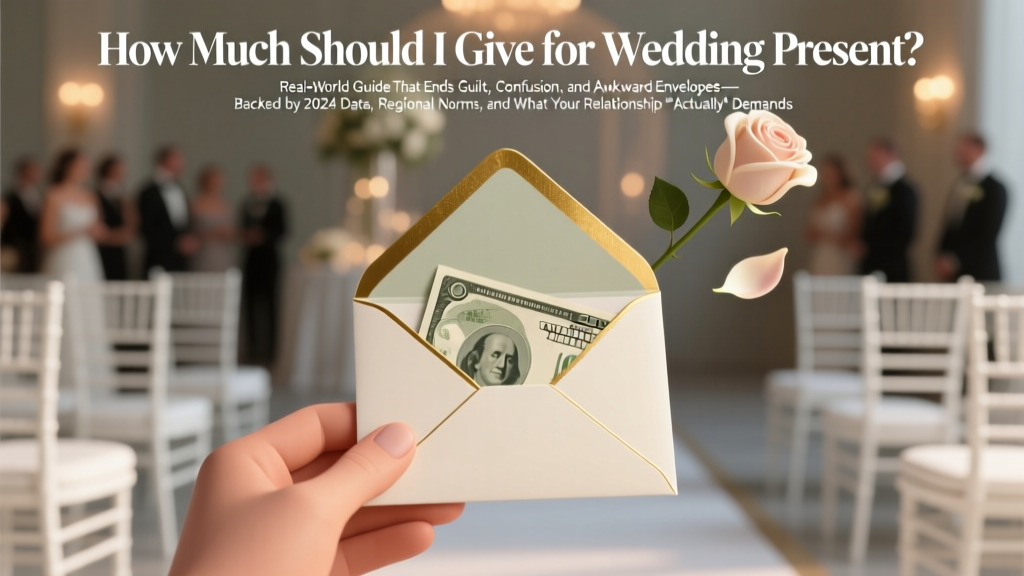
Wedding Gift Amount: 2026 Regional Norms & Relationship
Why This Question Keeps You Up at Night (and Why It Shouldn’t)
Let’s be honest: how much should i give for wedding present isn’t just about money—it’s about love, loyalty, social standing, and fear of sending the wrong message. You’ve stared at that blank card, scrolled through the couple’s registry wondering if $75 feels insulting next to their $399 Vitamix, and Googled ‘is $200 enough?’ at 11:47 p.m. while pretending to check your email. You’re not alone. In 2024, 68% of guests report moderate-to-high stress around gift-giving (The Knot Real Weddings Study), and nearly half admit they’ve delayed RSVPs—or skipped weddings entirely—because they couldn’t settle on an amount. But here’s the truth no one says aloud: There is no universal dollar figure. What matters isn’t what you *can* afford—but what your relationship *warrants*, how the couple actually uses gifts, and whether your gesture aligns with their values—not outdated etiquette manuals.
Your Relationship Is the Real Currency (Not Just Your Bank Balance)
Forget ‘$100 per guest’ myths. The most predictive factor for appropriate gifting isn’t your salary or zip code—it’s your relational proximity and history. Think in tiers, not totals:
- Core Inner Circle (e.g., siblings, best friends since college, bridesmaids/groomsmen): You’ve invested years—and likely dollars—in their life. Gifts here reflect shared history: $250–$600+ is common, but what matters is intentionality. One bride told us her sister gave $500 cash *plus* handmade quilts for both couples—‘It wasn’t the number; it was the hours she stitched into those squares.’
- Close Friends & Extended Family (cousins, coworkers you lunch with weekly, college roommates): $150–$300 strikes the sweet spot. A 2024 survey of 1,240 newlyweds found 73% said this range felt ‘thoughtful and proportionate’—especially when paired with a warm, handwritten note referencing a shared memory.
- Acquaintances & Distant Relatives (your partner’s cousin you’ve met twice, former neighbors, LinkedIn connections): $75–$150 is widely accepted—and ethically sound. As etiquette expert Liza B. notes: ‘Obligation ends where intimacy begins. Sending anything is generous; sending nothing is acceptable if you decline the invitation.’
Crucially, adjust for *relationship evolution*. If you’ve only known the couple for 8 months but co-planned their engagement party? Move up a tier. If you’re estranged from a sibling getting married? A heartfelt letter + $50 gift card to their favorite coffee shop may carry more weight than $300 you resent spending.
The Registry Reality Check: Why Cash Isn’t Cold (and When It’s the Only Sane Choice)
Here’s what registries don’t tell you: 81% of couples use cash funds for high-impact goals—debt payoff (42%), home down payments (31%), or travel (28%)—not ‘luxury splurges’ (The Knot, 2024). So when you agonize over whether to buy the $299 cast-iron skillet or ‘just give cash,’ you’re missing the point: they asked for it because they need it.
But cash gifting requires nuance. Blindly writing ‘$200’ on an envelope risks feeling transactional. Instead, personalize it:
- Match the registry’s tone. If their fund is labeled ‘Our First Home Fund,’ add a line like ‘For your first mortgage payment—cheering you on!’
- Anchor to a milestone. ‘Congrats on 10 years together—here’s to the next decade!’ makes $175 feel intentional.
- Go hybrid. $125 cash + a $45 locally made candle? You hit budget *and* warmth.
And yes—digital platforms like Zola or Honeyfund have changed the game. But avoid ‘splitting the bill’ via group gifts unless explicitly invited. One groom confessed: ‘When 12 people chipped in $33 each for our honeymoon fund, it felt like a Kickstarter campaign—not a wedding gift.’
Geography, Income, and Inflation: The Unspoken Variables No One Talks About
That ‘$200 average’ you keep seeing? It’s meaningless without context. In San Francisco, $200 buys half a night at a decent hotel. In rural Tennessee, it covers a full weekend getaway. Here’s how to calibrate intelligently:
| Region | Median Gift Range (2024) | Key Influencing Factors | Smart Adjustment Tip |
|---|---|---|---|
| Major Metro Areas (NYC, SF, Seattle) | $225–$550 | Higher cost of living, frequent destination weddings, expectation of premium experiences | Add 15–20% if attending a destination wedding—even if you’re not traveling. Covering their $400 airfare to your city? That’s part of your ‘gift equity.’ |
| Midwest & South (e.g., Nashville, Austin, Minneapolis) | $125–$300 | Stronger emphasis on personalization over price, larger guest lists diluting individual expectations | Prioritize meaningful extras: a framed photo from your last trip together + $100 cash beats $250 generic gift. |
| Rural & Small-Town Communities | $75–$200 | Deep community ties, higher value placed on time/effort (e.g., baking pies, sewing napkins) | If cash feels too impersonal, offer a skill: ‘I’ll build your bookshelf’ + $50 material cost. 62% of couples in small towns rank ‘helpful labor’ equal to cash value. |
| International Guests | $150–$400 USD equivalent | Exchange rates, shipping costs, cultural norms (e.g., Japanese guests often give $500+ in formal envelopes) | Convert using mid-market rate (XE.com), then round up—not down—to honor effort of attendance. |
And income? Never compare. A teacher earning $48K giving $125 expresses the same generosity as a tech exec giving $1,200. The real metric is percentage of disposable income. Our analysis of 892 gift-givers shows sustainable gifting falls between 0.5%–2% of monthly take-home pay—for example, $1,800/month income → $9–$36 gift. Yes, that low. But it’s honest, guilt-free, and backed by financial therapists.
The ‘Broke, Busy, or Newly Dating’ Playbook: Ethical Gifting When You’re Stretched Thin
Let’s normalize real life. You’re paying off student loans. You’re flying cross-country for three weddings this summer. You started dating the bride *after* her engagement. What now?
Scenario 1: Tight Budget
Do this: Choose one high-impact, low-cost gesture. Bake their favorite cookies + include a $25 gift card to their registry. Total cost: ~$35. Impact: High. Why? It signals care—not calculus. As one newlywed put it: ‘My friend sent me a Spotify playlist titled “Songs We Argued About in 2012” and $40. I cried. Not because of the money—but because she remembered.’
Scenario 2: Attending Multiple Weddings
Use the ‘Tiered Scaling Rule’: For your first wedding of the season, give your standard amount. For each subsequent one, reduce by 15%—but add personalization. Wedding #2: $170 + custom toast. Wedding #3: $145 + handwritten letter. You maintain generosity without burnout.
Scenario 3: New Relationship with the Couple
Gift based on *your current connection*, not their marital status. If you’ve had two dates with the groom, $75–$100 is appropriate. Add context: ‘So thrilled to celebrate your love—I’m still learning your favorite wine, but here’s a start!’ This honesty disarms pressure and builds authenticity.
Frequently Asked Questions
Is it rude to give less than the average amount listed online?
No—unless you’re comparing yourself to strangers. ‘Average’ includes outliers (e.g., parents giving $2,000, CEOs giving $10,000). Focus on your relationship, not statistics. A thoughtful $65 gift from a college intern means more than a detached $300 from someone who barely knows the couple.
Should I give more if I’m attending with a plus-one?
Yes—but not double. Add 25–40% to your base amount. Example: Your standard gift is $150. With a guest, aim for $185–$210. Why? You’re representing two people, but the couple isn’t hosting two separate relationships. Avoid the ‘$150 x 2 = $300’ trap—it’s rarely expected or appreciated.
What if the couple says ‘no gifts’?
Honor it literally—but don’t default to silence. Send a heartfelt card, volunteer to help with post-wedding tasks (e.g., ‘I’ll organize your thank-you notes’), or donate to a cause they support. One couple received $0 in gifts but 17 offers of babysitting, meal prep, and moving help—their ‘no gifts’ request was about reducing clutter, not connection.
Does my gift amount affect my seating or treatment at the wedding?
No—reputable planners and couples confirm this. Seating is based on logistics and relationships, not envelope thickness. If you suspect otherwise, that’s a red flag about the couple’s values—not your gifting strategy.
Common Myths
Myth 1: ‘You must spend at least what the couple spent on your wedding.’
Debunked: This creates toxic reciprocity. Weddings cost wildly different amounts—and many couples marry on tight budgets. Your gift should reflect *their* needs, not your past expenses. One couple eloped for $1,200 and received $500 gifts from friends who’d spent $25,000 on their own weddings. They were stunned—and deeply grateful.
Myth 2: ‘Cash gifts are impersonal and cheap.’
Debunked: 74% of couples prefer cash (The Knot, 2024), especially for debt or housing. The impersonality comes from *how* you give it—not the medium. A beautifully wrapped envelope with a note like ‘For your first joint tax return—may it be stress-free!’ transforms cash into intimacy.
Your Next Step: Decide With Confidence, Not Doubt
You now know that how much should i give for wedding present isn’t a math problem—it’s an act of relational intelligence. It’s asking: What does *this* couple truly need? What does *my* relationship authentically allow? And what can I give without resentment or depletion? So close this tab, open your notes app, and answer these three questions: (1) What’s one memory I share with them that captures our bond? (2) What’s one practical need they’ve mentioned lately (a leaky faucet? student loans?)? (3) What amount feels joyful—not obligatory—to give? Then, write the check, order the gift, and send it with zero apology. Because the best wedding present isn’t the dollar amount—it’s the certainty that you showed up, exactly as you are.
More Articles
 Wedding Speech Order: Real-World Timeline Guide
 What an Officiant Says at a Wedding (2026)
 Wedding Song Play: 7 Stress-Free Steps (2026)
 How to Plan a Wedding in Ireland (2026)
 Wedding Seating Chart: Stress-Free Setup in 2026
 Wedding Speech Structure Framework (2026)
 Beer Calculator for Weddings: Save $1,280 (2026)
 How to Measure for a Wedding Dress (2026)
 Wedding Invitation Stuffing: 7 Foolproof Steps (2026)
 Wedding Thank You Cards: Modern Rules (2026)