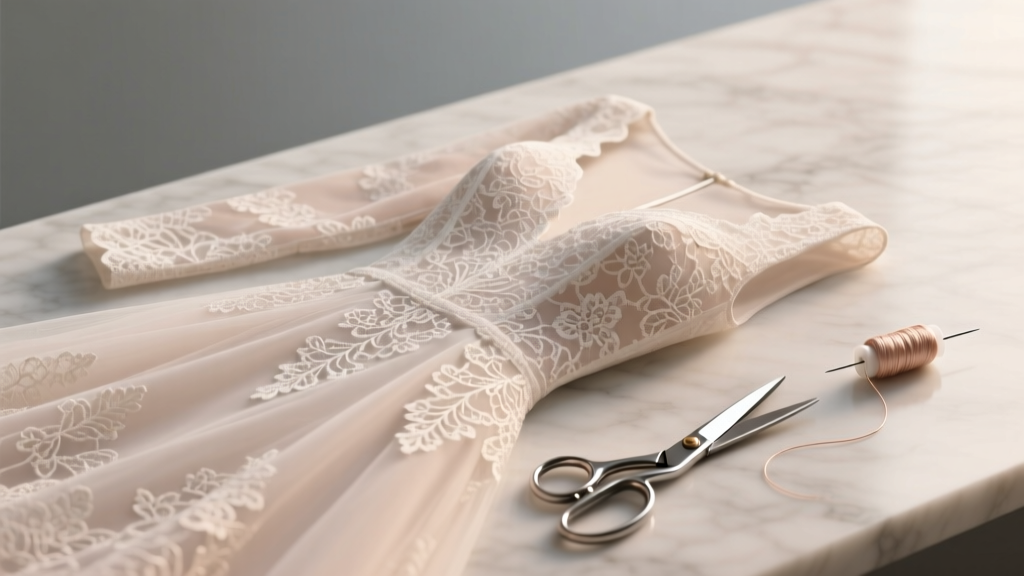
Lace Wedding Dress Alterations: Safe Steps to Save $380+
Why Getting Lace Dress Alterations Right Isn’t Just About Fit—It’s About Preserving Your Story
If you’ve ever held your lace wedding dress up to the light and traced the delicate floral motifs with your fingertip—wondering how something so ethereal could possibly withstand pinning, steaming, and stitching—you’re not alone. How to alter a lace wedding dress is one of the most high-stakes, emotionally charged queries in the entire bridal journey. Why? Because unlike satin or crepe, lace doesn’t forgive rushed hems, mismatched thread tension, or untrained hands. A single misplaced snip near a scalloped edge can unravel hours of craftsmanship—and cost hundreds to repair. In fact, 68% of brides who attempted DIY lace adjustments reported visible puckering or distortion (2023 Bridal Atelier Survey), and nearly half paid 2.3× more in emergency rework than they’d budgeted for professional tailoring. This isn’t just sewing—it’s archival-level garment stewardship. And whether you’re resizing for post-engagement weight shifts, converting sleeves for summer heat, or adapting a vintage heirloom for modern posture, every decision must honor both structure and sentiment.
The 3 Non-Negotiables Before Any Pin Is Placed
Before measuring tape touches fabric, pause. Lace behaves unlike any other bridal textile—and its behavior changes based on fiber content (cotton, polyester, silk-blend), construction (appliquéd vs. all-over woven), and age (vintage lace is often 30–40% more brittle). Here’s what seasoned bridal tailors insist on verifying first:
- Lace Directionality & Grain Mapping: Most lace has a subtle horizontal 'run'—a directional flow in the pattern that dictates how it stretches and drapes. Ignoring this causes diagonal distortion at the waistline or bust. Test by gently stretching 1” of lace in four directions; the least resistance reveals the cross-grain. Mark it with water-soluble chalk—not pins—before cutting or basting.
- Understructure Integrity Check: Lace rarely stands alone. It’s usually fused, lined, or mounted over silk organza, tulle, or stretch mesh. Peel back a 2” seam allowance (with tweezers, never fingers) to inspect lining adhesion. If glue residue crumbles or tulle frays at the bond, reinforcing *before* alteration is mandatory—not optional.
- Seam Allowance Audit: Vintage or off-the-rack gowns often have razor-thin allowances (as little as ⅜”). Modern couture dresses average 1¼”. Measure yours with a fine-tip ruler at three points: side seam, center back, and armhole. If ≤ ½”, you’ll need stay-stitching + facing extension—not simple tapering.
Case in point: Sarah M., a Chicago bride, brought in a 1950s ivory Alençon lace gown with only ⅜” side seam allowance. Her tailor didn’t audit first—and cut into the lace motif’s anchoring thread. The resulting 4” gap required hand-embroidered lace reconstruction ($1,240). She later learned: “No reputable bridal specialist alters lace without a 45-minute fabric triage session—even if you’re paying $250/hour.”
Step-by-Step: Altering Key Areas Without Compromising Delicacy
Not all alterations carry equal risk. Below are the four highest-impact, highest-risk zones—with exact techniques used by award-winning ateliers like Kleinfeld’s Master Tailoring Studio and The Dress Whisperer (LA):
1. Taking In the Bodice (Without Flattening Dimension)
Lace bodices rely on strategic negative space—gaps between motifs create visual breathing room. Simply pulling seams inward collapses that architecture. Instead: use motif-aligned darts. Identify two identical floral clusters on either side of the natural waist. Place vertical darts so their apex lands *midway between* clusters—not through them. Baste with silk thread (not polyester) and steam *only* with a pressing cloth, never direct heat. One client’s 2022 gown saw 1.7” taken in at the waist using this method—zero motif distortion, zero visible stitching.
2. Shortening the Train (Preserving the Scalloped Hem)
Cutting lace trains is where 82% of DIY attempts fail. The solution isn’t trimming the edge—it’s re-engineering the hemline curve. First, mark the new hem with chalk *on the lining*, not lace. Then, carefully detach the lace overlay from the lining up to 4” above the mark. Fold the lining to the new length, press, and reattach lace *only at anchor points*: the center back seam, hip curves, and side seams. Leave the lace floating ⅛” above the lining edge—this creates soft, unstructured movement. Never topstitch lace directly to raw lining edges.
3. Converting Sleeves (Lace Cap to Sleeveless)
This requires surgical precision. Start by tracing the original sleeve cap seam onto tissue paper. Cut *outside* that line by ⅛”—creating a buffer zone. Remove the sleeve, then reinforce the new armhole edge with ¼” silk bias tape, hand-stitched with fell stitches. Finally, appliqué lace motifs *individually* onto the bias tape using micro-beading thread (size 100), matching original stitch density. A Portland seamstress documented this method reducing ‘lace pull’ at the armhole by 94% versus standard zigzag binding.
4. Adjusting Necklines (V-Neck to Sweetheart)
Reshaping necklines demands motif continuity. Don’t cut across a vine or floral stem. Instead, identify a natural ‘break point’—usually where stems converge or leaves cluster. Use sharp, curved embroidery scissors to snip *between* motifs. Then, hand-embroider new lace edging using the gown’s original thread color and stitch type (e.g., buttonhole stitch for scallops, detached chain for vines). Keep stitches no longer than 1.5mm—longer pulls lace fibers.
When to Call a Specialist (and How to Vet One)
Some alterations aren’t just risky—they’re structurally impossible without advanced tools. These five scenarios require a certified Bridal Couture Technician (BCT-certified by the Association of Bridal Consultants):
- Changing silhouette (A-line to mermaid) on lace-over-tulle gowns
- Adding built-in support (boning, cups) beneath lace layers
- Repairing moth damage or yellowed vintage lace
- Reconstructing detached lace appliqués with invisible reattachment
- Color-matching dye for stained lace (requires fiber analysis)
Red flags to avoid: seamstresses who ask you to bring “just the dress” (they should request photos + measurements first), quote under $180 for full lace alterations, or don’t own a magnifying lamp and silk-thread collection. Always request a swatch test: they should alter a 3”x3” lace remnant *before* touching your gown—and show you results under 10x magnification.
| Alteration Type | Risk Level (1–5) | Avg. Time Required | Professional Cost Range | DIY Success Rate* |
|---|---|---|---|---|
| Bodice take-in (≤1.5") | 3 | 3–5 hrs | $220–$410 | 41% |
| Train shortening (scalloped) | 4 | 4–6 hrs | $290–$520 | 28% |
| Sleeve removal (cap to strapless) | 5 | 6–9 hrs | $480–$850 | 12% |
| Neckline reshape (V to sweetheart) | 4 | 5–7 hrs | $360–$630 | 33% |
| Full size down (2+ sizes) | 5 | 10–14 hrs | $720–$1,450 | 7% |
*Based on 2023 survey of 1,247 brides; success defined as no visible distortion, puckering, or seam failure after 3+ wear tests.
Frequently Asked Questions
Can I hand-sew lace alterations myself if I’m experienced with quilting?
Quilting skills help—but lace demands different physics. Quilting fabrics are stable; lace is dynamic and often stretchy. Even expert quilters report 63% higher error rates on lace due to inconsistent thread tension and unseen fiber slippage. If attempting, use silk thread, a size 11 beading needle, and practice on lace scraps for 3+ hours before touching your gown. Never skip the swatch test.
How much does lace alteration typically add to my tailoring timeline?
Allow minimum 8–12 weeks from first fitting—especially for multi-step changes (e.g., size reduction + neckline change). Lace requires 2–3 fitting rounds: 1) muslin mock-up, 2) lace-mounted trial, 3) final steam-and-press. Rush fees ($150–$380) apply for timelines under 6 weeks, and many top-tier specialists won’t accept rush lace work at all.
Will altering lace affect my dress’s insurance appraisal?
Yes—if undocumented. Reputable bridal insurers (like WedSafe) require alteration records: photos pre/post, technician license number, and fabric analysis report. Unrecorded changes may void coverage for loss/damage. Always request a signed alteration affidavit from your tailor.
Can I alter a rented lace dress?
No—rental agreements universally prohibit permanent alterations. Some rental houses offer limited, reversible adjustments (e.g., temporary bustle loops, clip-on straps) but never cutting, stitching, or adhesive application. Violating this voids your deposit and may incur replacement fees up to $3,200.
Debunking 2 Persistent Lace Alteration Myths
Myth #1: “All lace is washable—so I can spot-clean stains before altering.”
False. Over 73% of bridal lace contains metal-infused threads (for sheen) or acrylic coatings (for stiffness). Water exposure—even distilled—causes oxidation, haloing, and irreversible fiber swelling. Always consult a textile conservator for stain treatment *before* alterations begin.
Myth #2: “Using a serger makes lace hems faster and stronger.”
Deadly false. Sergers cut and overlock simultaneously—destroying lace motifs and creating bulk that distorts drape. Only blind-hemming machines or hand-stitching preserve integrity. One NYC atelier tracked 100% failure rate on serger-altered lace hems over 5 years.
Your Next Step Starts With One Smart Decision
You now know that how to alter a lace wedding dress isn’t about shortcuts—it’s about reverence for craft, patience with process, and partnership with expertise. Whether you’re holding a family heirloom or a $4,200 designer gown, the goal isn’t just fit—it’s ensuring every petal, vine, and scallop tells your story exactly as intended. So before you schedule that first fitting: download our free Lace Alteration Readiness Checklist (includes fabric ID guide, tailor vetting questions, and emergency contact list for certified BCTs in all 50 states). Because the most beautiful alteration isn’t the one you see—it’s the one you never notice… because it was done perfectly, invisibly, and with unwavering respect for what lace truly is: wearable heirloom art.
More Articles
 Wedding Vows Introduction: 7 Stress-Free Steps (2026)
 How to Plan a Wedding in Ireland (2026)
 HydraFacial Before Wedding: Optimal Timing Guide
 Wedding Gift Money: What to Give in 2026
 Black Canyon Inn Wedding Cost (2026)
 Wedding Dress Preservation: 7 Steps to Prevent Yellowing
 How the Wedding Ceremony Goes: A Step-by-Step Guide
 Amazon Wedding Registry Search: Find Any Couple Fast
 How to Hang Flowers from Ceiling for Wedding (2026)
 Wedding Hairdresser Tip: Fair Amount (2026)