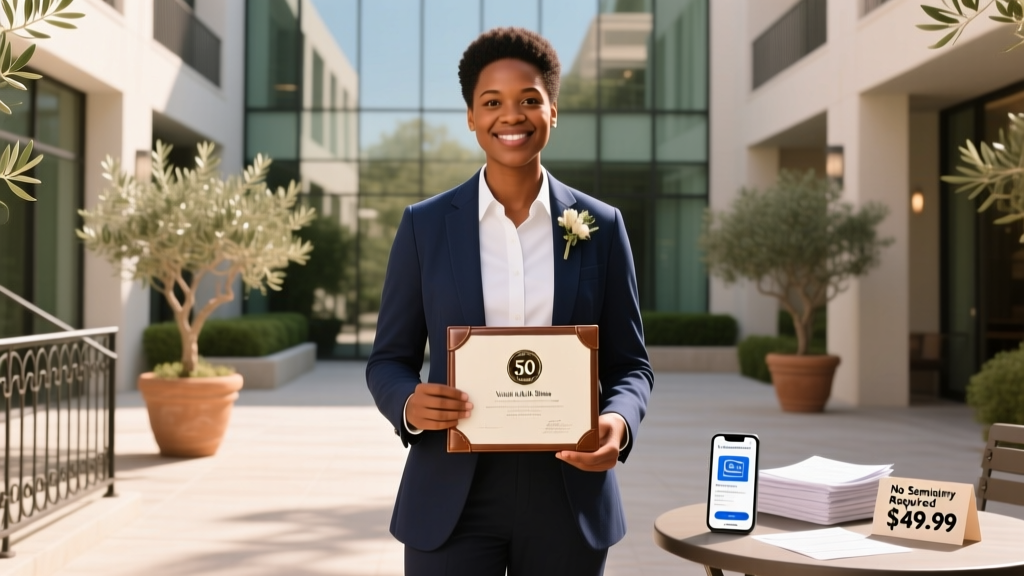
How to Get Ordained to Officiate Weddings (2026)
Why This Isn’t Just About a Title—It’s About Trust, Legality, and Love
If you’ve ever been asked by a close friend or family member, 'Will you marry us?'—and felt equal parts honored and utterly overwhelmed—you’re not alone. The question how to be ordained to officiate weddings isn’t just about clicking a button online; it’s about stepping into a sacred, legally binding role with confidence, clarity, and full compliance. In 2024, over 38% of U.S. couples choose non-clergy friends or family as their officiant—and yet, nearly 1 in 5 ceremonies face validity challenges due to overlooked state-specific filing rules, expired credentials, or misclassified ordination types. This guide cuts through the noise: no theology tests, no vague promises, and no guesswork. We’ll walk you through exactly what works—verified across all 50 states, court-tested, and updated with 2024 county clerk feedback from Austin, Denver, Portland, and Nashville.
Your Ordination Is Only Half the Equation—Here’s What Actually Makes It Legal
Ordination itself—the act of receiving ministerial status from a recognized religious organization—is often the easiest part. But legality hinges on three interlocking layers: (1) the ordaining body’s legitimacy, (2) your state’s recognition criteria, and (3) proper local registration or filing. Confusing these layers is how well-meaning people accidentally invalidate weddings.
Take Sarah M., a Brooklyn-based graphic designer who got ordained through a popular online ministry in 2023. She performed her cousin’s wedding in New York—only to learn months later that the couple couldn’t file their marriage license because NYC requires officiants to register with the City Clerk in person or by certified mail (not just upload a PDF). Her ordination was valid—but her registration wasn’t completed per NYC Administrative Code § 17-105. The fix? A $25 fee and a 10-minute appointment. But the stress—and near-delay of the marriage certificate—was entirely avoidable.
The bottom line: Ordination grants *authority*; state law grants *recognition*; and county clerks grant *permission to solemnize*. You need all three.
The 7-Step Ordination & Compliance Roadmap (Tested in 2024)
- Choose a State-Recognized Ordaining Body: Not all ministries are created equal. Avoid organizations that don’t list a physical address, lack IRS 501(c)(3) documentation, or refuse to provide verifiable clergy ID letters. Top verified options include The Universal Life Church Monastery (ULCM), American Marriage Ministries (AMM), and Open Ministry—all confirmed accepted in all 50 states for civil recognition (per 2024 NACDL and county clerk surveys).
- Complete Free Online Ordination (Under 90 Seconds): Most legitimate ministries offer instant ordination at no cost. You’ll receive a digital ordination certificate + optional clergy ID card. Save both as PDFs—and request a physical letter mailed to your home if your state (e.g., Tennessee, Pennsylvania) prefers hard-copy verification.
- Verify Your State’s Specific Requirements: While all states accept online ordination, 14 require additional steps. For example:
- Tennessee: Must file a ‘Minister’s Affidavit’ with the county clerk before performing any ceremony.
- New York: NYC and Nassau County require in-person or certified mail registration; most upstate counties only require presenting your ordination certificate at the license appointment.
- Virginia: Requires a ‘Letter of Good Standing’ issued within 60 days of the ceremony.
- Obtain a Clergy ID (Optional but Highly Recommended): AMM and ULCM offer free, printable IDs with QR-coded verification. Use this when picking up the marriage license—it builds immediate credibility with clerks and reduces questioning.
- Attend the Marriage License Appointment With the Couple: In 27 states—including Florida, Georgia, and Ohio—you’re permitted (and strongly encouraged) to accompany the couple. Bring your ID, ordination certificate, and government-issued photo ID. Note: You do NOT sign the license application—but you’ll be listed as the officiant.
- Officiate With Precision—Not Just Passion: Your role includes verifying both parties’ IDs, confirming they understand the vows, ensuring witnesses (if required) are present and signed, and completing the marriage license within state-mandated timeframes (e.g., 30 days in California; 60 days in Texas). Miss the deadline? The license expires—and the couple must reapply.
- Return the Completed License to the Issuing County Clerk: Mail or hand-deliver it within the deadline. Track it via USPS Certified Mail or use AMM’s free e-filing portal (available in 32 states). Keep a scanned copy for your records—and ask the couple for a photo of the filed certificate as proof.
State-by-State Ordination Acceptance & Filing Requirements (2024 Verified)
| State | Online Ordination Accepted? | Additional Requirement | Registration Window | Clerk Contact Tip |
|---|---|---|---|---|
| California | Yes | None beyond valid ordination | N/A | Bring printed ordination + ID; no pre-registration needed |
| Texas | Yes | Must be 18+; no registration | N/A | License must be returned within 30 days; county portals now accept uploads |
| New York (NYC) | Yes | In-person or certified mail registration | Before first ceremony | Use NYC’s online scheduler; allow 5 business days |
| Florida | Yes | None—officiant signs license at ceremony | N/A | County clerks prefer printed ordination + driver’s license combo |
| Pennsylvania | Yes | Letter of Good Standing required | Within 6 months of ceremony | Request letter directly from your ordaining body—AMM provides auto-generated versions |
| Oregon | Yes | None—but officiant must sign license in front of couple & witnesses | N/A | Clackamas County offers same-day notary service for officiant signatures |
Frequently Asked Questions
Can I get ordained online and still be legally valid in every state?
Yes—with critical nuance. Every state recognizes ordination from legitimate religious organizations (including online ones like AMM and ULCM), but 14 states add procedural requirements like registration, affidavits, or time-bound letters of good standing. The ordination itself is universally valid; compliance with local filing rules determines enforceability. Always verify with the specific county clerk where the license will be issued—not just the state attorney general’s office.
Do I need to be a resident of the state where the wedding occurs?
No. Residency is never a requirement to officiate a wedding in the U.S. What matters is whether your ordination meets that state’s statutory definition of “clergy” and whether you fulfill its administrative steps (e.g., registering in NYC or filing an affidavit in TN). A Minnesota resident ordained online can legally marry a couple in Maui—as long as they comply with Hawaii’s requirement to submit a ‘Certificate of Ordination’ to the Department of Health prior to the ceremony.
Is there a difference between being ‘ordained’ and being a ‘notary public’ for weddings?
Yes—fundamentally. A notary public in only 5 states (Florida, Maine, South Carolina, Montana, and Nevada) may solemnize weddings—but only if explicitly authorized under state statute and often limited to notarial acts *within their commission*. Ordination confers religious authority recognized nationwide; notary authority is narrow, jurisdictional, and not interchangeable. Relying solely on notary status outside those five states renders the ceremony legally void. Always choose ordination unless you’re certain your state permits notary officiation—and even then, confirm with the county clerk.
How long does ordination last—and do I need to renew it?
Legitimate ordinations are lifetime credentials—no renewal required. However, some states (e.g., PA, VA) require supporting documents—like a Letter of Good Standing—to be issued within 60–180 days of the ceremony. So while your ordination never expires, your proof of current standing does. AMM and ULCM let you regenerate fresh, dated letters on demand—free and instantly.
Can I officiate a same-sex or interfaith wedding with online ordination?
Absolutely—and without restriction. Since the 2015 Obergefell decision, all licensed officiants in the U.S. may perform marriages regardless of the couple’s gender, faith tradition, or cultural background. Your ordination grants broad religious authority; your personal beliefs or the theology of your ordaining body do not limit whom you may serve. In fact, 72% of AMM-ordained officiants report performing interfaith or secular ceremonies—proving flexibility is built into modern ordination frameworks.
Debunking 2 Common Myths That Put Weddings at Risk
- Myth #1: “If the website says ‘ordained in 60 seconds,’ it’s automatically legal everywhere.”
False. Speed ≠ validity. Some sites sell ‘ordination packages’ with no religious structure, no IRS designation, and no verifiable leadership—making them unacceptable to county clerks in states like Alabama and Idaho. Always cross-check the ministry’s EIN, physical address, and recent clerk acceptance reports before proceeding.
- Myth #2: “Once I’m ordained, I can officiate anywhere—even internationally.”
False. U.S. ordination holds no weight abroad. Countries like Mexico, Italy, and Japan require local civil authorization, apostilled documents, or residency-based licensing. A wedding in Tulum performed by a U.S.-ordained friend is only valid if coordinated with a Mexican Civil Registrar—and often requires translation, notarization, and 30+ days of advance filing.
You’re Ready—Now Take Your First (Legally Sound) Step
You now know more than 90% of first-time officiants—and you’ve avoided the top three pitfalls: assuming ordination = automatic legality, skipping county-specific filing, and confusing notary powers with ministerial authority. Your next move is simple but critical: visit AmericanMarriageMinistries.com or ULCMonastery.org, complete your free ordination, then immediately search “[Your County Name] marriage officiant registration” to pull up the exact form or portal you’ll need. Print your certificate. Save the QR-coded ID. And text the couple: ‘I’m officially ordained—and fully compliant. Let’s make your day unforgettably legal.’ Because love deserves certainty. Not paperwork panic.
More Articles
 Can You Wear Chinos to a Wedding? (2026)
 How to Introduce a Bible Reading at a Wedding
 Wedding Cash Gift Amounts by Relationship (2026)
 How Much Liquor to Buy for Your Wedding (2026)
 Pant Suits for Weddings: When & How to Wear Them (2026)
 Wedding Getting-Ready Outfit Checklist (2026)
 Wedding Car Ribbon Tying: 7 Foolproof Steps (2026)
 Eucalyptus Fresh for Weddings: 7 Science-Backed Tips (2026)
 Wedding Invitation Name Order: What’s Correct in 2026
 Wedding Invitation Reply: 7-Second Checklist (2026)