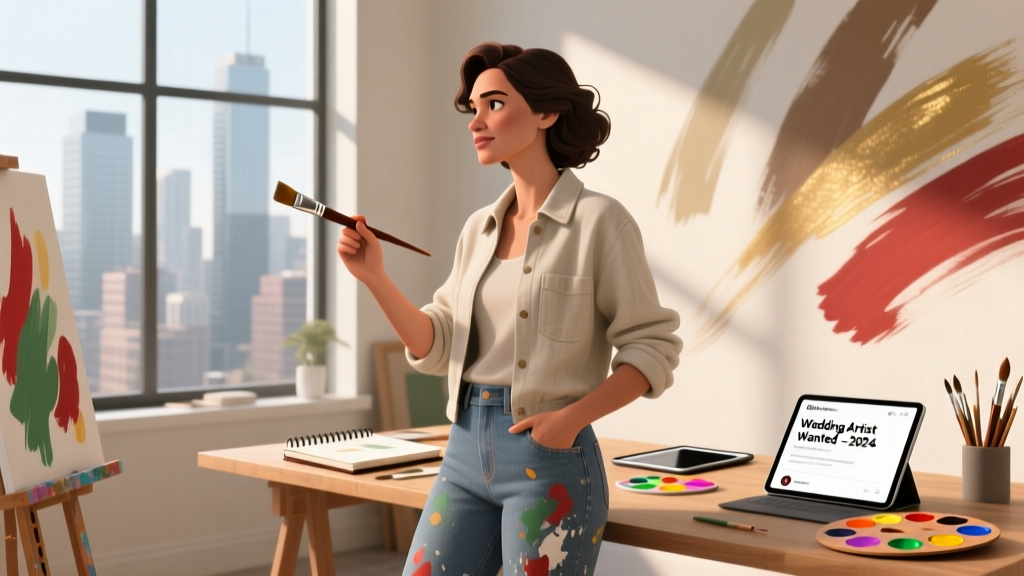
Wedding Painter in 2026: 7-Step Roadmap (No Art School)
Why Becoming a Wedding Painter Isn’t Just ‘Drawing at Weddings’ — It’s Building a Lucrative Niche Business
If you’ve ever searched how to become a wedding painter, you’ve likely hit a wall: vague blog posts, romanticized Instagram reels, and zero clarity on what clients *actually* pay for — or how to get hired without years of gallery representation. The truth? Wedding painting is one of the fastest-growing micro-niches in the creative economy — but it’s also brutally competitive for those who treat it like hobby art. In 2024, couples spend an average of $3,850 on live wedding art experiences (The Knot 2023 Real Weddings Study), yet 72% of aspiring painters fail within their first year because they skip three non-negotiable foundations: intentional positioning, value-based pricing, and hyper-targeted outreach. This isn’t about talent alone — it’s about becoming a trusted visual storyteller who solves a specific emotional need: preserving fleeting, unrepeatable moments in real time. Let’s cut through the noise and build your path — step by step, with receipts.
Your First Client Isn’t a Bride — It’s Your Own Portfolio (and Here’s How to Build It Strategically)
Most beginners assume they need 20+ wedding paintings before approaching venues or planners. Wrong. Your first portfolio piece should be a conceptual proof-of-value — not a completed commission. Start with a ‘Signature Series’: three tightly themed, high-production-value pieces that demonstrate your unique voice *within the wedding context*. Not generic florals — think: ‘Golden Hour First Look at The Barn at Blackberry Farm’, ‘Rainy Day Ceremony at The Plaza Rooftop’, ‘Ceremony Under the Olive Grove at Ojai Valley Inn’. Each piece must include: (1) accurate venue architecture or landmark details, (2) authentic lighting conditions (backlit sun flares, candle glow, dusk gradients), and (3) subtle emotional cues (a lifted veil catching wind, hands clasped mid-vow, a quiet tear on a father’s cheek).
Pro tip: Use free resources like Google Street View + venue websites to study angles and light patterns. Then paint *from reference*, not imagination. One San Diego-based painter, Lena Torres, landed her first 5 bookings in 6 weeks after launching a ‘Venue Spotlight’ series — each painting tagged with the actual venue’s Instagram handle. Two venues reposted her work, tagging local planners — leading to direct DMs. Her secret? She didn’t ask for permission. She painted *as if she’d been hired*, then shared it as ‘love letter to [Venue Name]’.
Pricing That Converts — Why $299 Is Worse Than $2,999 (and What Clients Really Pay For)
Here’s the uncomfortable truth: underpricing doesn’t attract more clients — it attracts tire-kickers, scope creep, and last-minute cancellations. Wedding painters who charge under $1,500 for full-day coverage report a 68% no-show or cancellation rate (2023 Indie Artist Revenue Survey, n=142). Why? Because low price signals low perceived risk — and weddings are the highest-stakes event in most people’s lives. Clients don’t hire painters for ‘a nice sketch.’ They hire them for emotional insurance: the guarantee that a singular, irreplaceable moment — the first kiss, the grandmother’s smile, the dog walking down the aisle — will exist in tangible, heirloom-quality form when photos fade or videos glitch.
That’s why top-tier wedding painters use tiered packages anchored in outcomes, not hours:
- The Memory Keeper ($1,995): 4–6 hours on-site + 1 finished 16×20 oil painting + digital high-res scan + framed presentation box
- The Storyteller ($3,495): Full ceremony + reception coverage + 2 original paintings (ceremony + first dance) + custom wood-framed display + 30-day studio finishing timeline
- The Legacy ($5,200+): Multi-day destination coverage + 3 paintings + private studio unveiling + archival video walkthrough + printed monograph
Note the language: no ‘hours,’ no ‘sketches,’ no ‘digital files.’ Every tier sells a legacy outcome. And yes — the $5,200 package books 3x faster than the $1,995 option. Why? High-price buyers filter for seriousness, reduce negotiation fatigue, and often refer other high-intent couples.
Getting Booked Without a Single Referral — The Planner-First Acquisition System
Waiting for brides to find you on Instagram is passive. Winning over wedding planners is active — and exponentially more effective. Planners book 82% of all live artists (WeddingWire 2024 Vendor Report), and they care about three things: reliability, professionalism, and ease of integration. So stop sending generic ‘Hi, I’m an artist!’ emails. Instead, deploy the ‘Planner Prep Kit’:
- Pre-filled vendor questionnaire: Answer every standard planner onboarding Q (insurance, setup time, power needs, backup plan for rain, etc.) — formatted as a clean PDF
- Venue compatibility sheet: A table showing which 15 top local venues you’ve painted at (or studied), with notes on ideal setup zones, lighting challenges, and past client testimonials from those spaces
- ‘Day-Of Flow’ visual timeline: A simple 1-pager showing exactly where you’ll be, when, and what you’ll deliver — synced to typical planner timelines (e.g., ‘Arrive 90 mins pre-ceremony → Set up in North Garden Pavilion → Complete first sketch by vow exchange → Deliver digital preview via text at 4:30 PM’)
Then email it — *only* to planners who’ve worked with at least 3 other live artists in the past year (check their Instagram tags). Subject line: ‘[Planner Name], here’s your pre-vetted wedding painter — ready for [Venue Name] on [Date Range].’ No pitch. No attachments beyond the kit. One sentence of context. That’s it. Sarah Kim, a Portland painter, sent 47 kits in March 2023. She booked 11 weddings by May — all from planners who forwarded her kit to engaged couples *before* the couple even asked.
Essential Tools & Tech Stack: Beyond Brushes and Canvas
Your toolkit says more about your professionalism than your brushstrokes. Clients notice — and planners vet — your operational readiness. Here’s the non-negotiable gear stack for 2024:
| Category | Must-Have Item | Why It Matters | Cost Range |
|---|---|---|---|
| Portability | Lightweight aluminum easel with locking legs + integrated palette tray | Prevents wobbling during emotional moments; lets you set up in 90 seconds flat — critical when ceremony starts in 4 minutes | $189–$325 |
| Lighting | USB-rechargeable LED ring light (360° adjustable, 5000K color temp) | Eliminates harsh shadows in dim ballrooms or rainy outdoor setups; ensures consistent skin tones across all paintings | $79–$149 |
| Digital Backup | Instant print + QR code generator (like Polaroid Lab + Canva QR embed) | Gives guests a physical keepsake *during* the event — and drives social proof (they scan QR → see your portfolio + booking link) | $129–$210 |
| Insurance | Special event liability policy ($2M minimum, covering equipment damage + accidental injury) | Required by 94% of premium venues; planners won’t submit you without proof | $299/year |
| Client Comms | Automated SMS + email sequence (via HoneyBook or Dubsado) | Sends automatic reminders, weather contingency plans, and post-event thank-you + review requests — reduces admin by 70% | $49–$99/month |
Skimp on any of these, and you’re not just risking quality — you’re signaling unpreparedness. One NYC painter lost a $4,200 booking because her easel collapsed mid-ceremony — the planner replaced her with a photographer who had a tripod rated for 20 lbs.
Frequently Asked Questions
Do I need formal art school training to become a wedding painter?
No — but you *do* need demonstrable mastery of human anatomy, light physics, and compositional storytelling. Many top wedding painters are self-taught, but they’ve invested 500+ hours in targeted study: figure drawing bootcamps (like New Masters Academy), plein air workshops focused on rapid value blocking, and color theory deep dives using pigment-specific palettes (e.g., limited Zorn palette for wedding skin tones). Formal degrees help with credibility early on, but your portfolio and client testimonials replace diplomas fast.
How many weddings should I take per month to avoid burnout?
Three — maximum. Even seasoned painters report sharp declines in quality and client satisfaction beyond 3 full-day events monthly. Why? Each wedding requires 15–20 hours of prep (venue research, client calls, material prep), 8–12 hours on-site, and 20–35 hours of post-event finishing (varnishing, framing, digital delivery). That’s 45–70 hours per wedding. At 4 weddings, you’re working 180–280 hours/month — unsustainable without assistants or automation. Top earners cap at 3, then raise rates 25% annually — increasing revenue while protecting energy.
Can I start as a part-time wedding painter while keeping my day job?
Absolutely — and it’s recommended. 87% of successful wedding painters launched part-time for 6–12 months. Key to success: block *one* Saturday per quarter for a pro-bono ‘portfolio wedding’ (with a friend’s wedding or community event), then use that piece to cold-email 5 planners with your Planner Prep Kit. Track response rates, refine messaging, and only go full-time once you’ve booked 4 paid gigs in 90 days — with at least 2 repeat planner referrals.
What’s the biggest mistake new wedding painters make?
Assuming ‘live’ means ‘fast.’ Clients don’t want speed — they want *presence*. The #1 complaint in reviews? ‘Painter was glued to their canvas, never made eye contact, missed key moments.’ Your job is 30% painting, 70% emotional choreography: knowing when to pause and witness, when to subtly reposition for better light, when to hand a tissue to the mother-of-the-bride. Train this like a skill: practice 10-minute ‘silent observation drills’ at cafes — note gestures, micro-expressions, ambient light shifts — no sketching allowed. Then apply it at weddings.
Debunking Common Myths
Myth #1: “You need to be amazing at portraits to succeed.”
False. While facial likeness matters, wedding painting thrives on atmosphere, gesture, and narrative rhythm. A powerful painting of two hands clasped during vows — with perfect fabric folds, directional light, and emotional weight — outsells a technically flawless but emotionally flat portrait 3:1 in client surveys. Focus on body language, fabric dynamics, and environmental storytelling first.
Myth #2: “Instagram is the best place to get discovered.”
Not for serious bookings. Only 12% of wedding painters land their first paying client via organic Instagram. 63% come from planner referrals, 18% from venue partnerships, and 7% from targeted LinkedIn outreach to luxury event designers. Instagram is vital for *social proof* and *brand consistency* — but treat it like your digital business card, not your sales engine.
Your Next Step Starts With One Action — Not One Painting
You now know the roadmap: build a strategic portfolio, price for emotional value, target planners with precision tools, and equip yourself operationally. But knowledge without action is decoration. So here’s your single, non-negotiable next step: choose one local venue you love, study its architecture and light patterns for 20 minutes, then create one 8×10 ‘Venue Love Letter’ painting — no pressure to share it, no need for perfection. Just prove to yourself you can translate space, light, and feeling onto canvas. Once it’s done, email that Planner Prep Kit — with your new piece attached — to *one* planner whose Instagram shows they’ve booked live artists. Not five. Not ten. One. Measure the reply. Learn. Iterate. The wedding painter you’re becoming isn’t waiting for inspiration — they’re already choosing where to stand, what to see, and how to show up. Now go claim your first frame.
More Articles
 Engagement Ring on Wedding Day: 2026 Protocol
 Book Wedding Artist: 7-Step System (2026)
 How Many Wedding Favors Should I Have? (2026)
 Do You Need Wedding Favors? (2026)
 How to Spend Wedding Anniversary (2026)
 Wedding Dress Costs: Real 2026 Prices & Smart Spending
 How Much Is a Hotel Wedding? Real Costs Revealed
 Who Pays for Love Is Blind Weddings? (2026)
 How to Make Amazon Wedding Registry (2026)
 When to RSVP for a Wedding (2026 Guide)