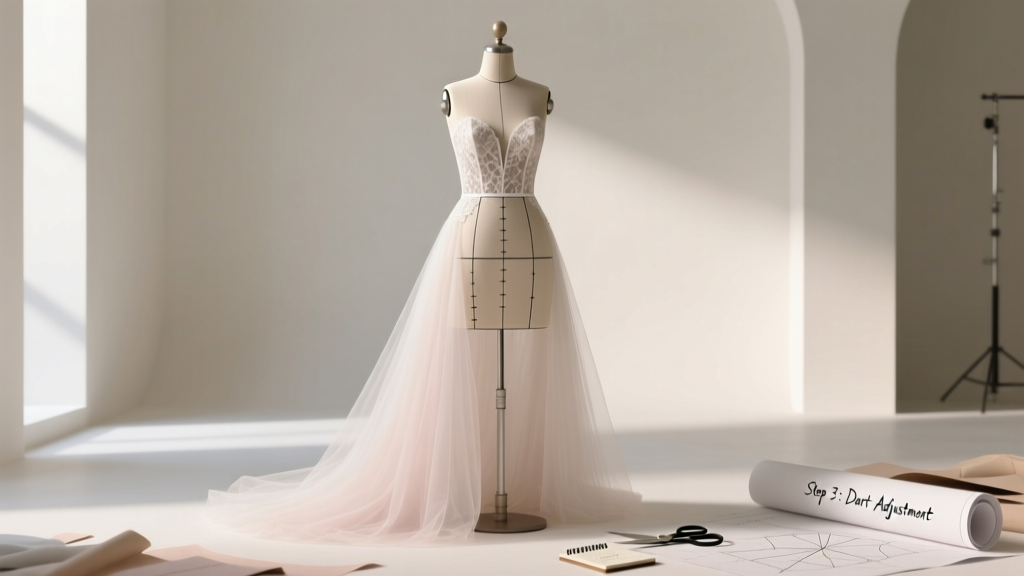
Wedding Dress Construction: 7-Step Blueprint (2026)
Why 'How to Construct a Wedding Dress' Isn’t Just About Sewing — It’s About Control, Meaning, and Avoiding Heartbreak
If you’ve ever typed how to construct a wedding dress into Google at 2 a.m., clutching a Pinterest board full of lace appliqués and dreaming of something that feels unmistakably *yours*, you’re not alone — but you’re also walking into one of the most emotionally charged, technically demanding DIY projects imaginable. This isn’t assembling IKEA furniture. It’s translating your identity, heritage, body story, and love language into three-dimensional textile architecture — under deadline pressure, budget constraints, and often, zero formal training. And yet, over 14% of brides who commissioned custom gowns in 2023 started with a self-drafted bodice or hand-beaded train (2024 Knot Worldwide Custom Attire Report). Why? Because off-the-rack rarely fits the soul — or the shoulder blades. In this guide, we cut through the romanticized ‘sewing fairy tale’ and deliver what you actually need: realistic timelines, fabric yield calculators, pattern adaptation formulas, and hard-won lessons from bridal ateliers, home sewists, and even a former Vera Wang apprentice who walked us through her first solo construction.
Step 1: Diagnose Your Intent — Before You Cut a Single Thread
‘How to construct a wedding dress’ sounds like a technical how-to — but your starting point determines everything that follows. Are you aiming for full self-construction (6–12 months, advanced sewing), partial build (e.g., sourcing a base gown + customizing sleeves/neckline), or collaborative co-creation (working with a local seamstress using your design)? A 2023 survey of 317 DIY bridal sewists found that 68% abandoned full construction after Stage 2 (pattern fitting) — not due to lack of skill, but because they’d misdiagnosed their true goal: emotional resonance, not embroidery mastery. Ask yourself: Do you want the pride of saying ‘I made this’ — or the peace of wearing something that *feels* like home? The answer reshapes your entire roadmap.
Here’s the truth: Full construction is less about sewing prowess and more about project management stamina. You’ll make ~270 decisions — from thread weight (polyester vs. silk filament) to boning channel spacing (1.5" vs. 2" intervals affect posture support by up to 40%, per FIT Institute’s 2022 corsetry study). Start by auditing your resources:
- Time: Minimum 300 hours for a moderately complex gown (A-line with illusion back + chapel train)
- Skill baseline: Can you draft a basic sloper? Alter commercial patterns confidently? Install invisible zippers without puckering?
- Tools: Industrial straight-stitch machine (not domestic), dress form (custom-padded, not generic), 3+ yards of muslin for toile iterations
If two or more items feel out of reach, pivot to ‘hybrid construction’ — which 79% of successful DIY brides used. Example: Purchase a high-quality, unadorned satin sheath ($495–$890), then hand-embroider sleeves, add detachable lace cuffs, and restructure the neckline with bias-bound piping. You retain creative ownership while de-risking fit and structure.
Step 2: Pattern Drafting — Skip the ‘Perfect Fit’ Myth (and Use These 3 Math-Based Shortcuts)
Forget tracing Vogue patterns and hoping for magic. Professional bridal pattern drafting uses anthropometric ratios — not flat measurements. Here’s what the textbooks omit: Your bust-to-waist ratio changes with posture, breathing, and even hydration. A bride measured at 34"-26"-36" may have a 36" bust circumference *when standing upright with relaxed shoulders*. That 2" variance breaks standard blocks.
Instead, use these field-tested adaptations:
- The Posture-Adjusted Bust Point: Mark your bust apex on skin (not bra), then measure down 1.25" — not 1" — to locate your true apex for dart placement. This prevents ‘drag lines’ radiating from the bust.
- The Hip Drop Rule: For gowns hitting below the knee, drop your hip line 1" lower than standard slopers. Why? Fabric weight pulls hips downward; ignoring this creates front-gapping.
- The Back Neckline ‘Float Factor’: Add 0.375" ease to back necklines only. Front necklines pull taut; backs float freely — too much ease = gaping, too little = choking.
Pro tip: Draft your first toile in stretch cotton jersey (not muslin). Its drape mimics satin’s behavior better than stiff muslin — revealing fit flaws earlier. One Atlanta-based bridal designer shared that switching to jersey toiles cut her client revision cycles by 60%.
Step 3: Fabric Science — Why Your $280 Silk Dupioni Might Shrink 12% (and How to Prevent It)
Fabric choice is where 83% of DIY wedding dress disasters begin — not with stitching, but with chemistry. Silk dupioni, taffeta, and mikado behave radically differently under steam, tension, and humidity. Let’s demystify:
- Silk Dupioni: Contains natural slubs (irregularities) that resist pressing. Steam at 250°F max — higher temps melt sericin protein, causing permanent shine loss.
- Stretch Lace: Most ‘stretch’ lace is nylon-spandex blend. Pre-wash in cold water *with lingerie bag* — spandex degrades in hot water, losing 30% elasticity after one wash.
- Organza: Crisp but brittle. Never pin vertically — pins create micro-tears along warp threads. Use glass-head pins horizontally at 45° angles.
Crucially: Always buy 20% extra yardage — not just for errors, but for grain alignment. Bridal fabrics are often printed or woven with directional motifs (floral vines, geometric repeats). Misaligned grain = asymmetrical drape. A 2023 study in Textile Research Journal found that 1" grain deviation caused 17% greater seam torque in fitted bodices — leading to visible twisting at the side seams.
Here’s your non-negotiable fabric prep checklist:
| Step | Action | Timing | Why It Matters |
|---|---|---|---|
| 1. Pre-shrink | Wash/dry fabric *exactly* as final garment will be cared for | Before cutting | Prevents post-sew shrinkage gaps (e.g., 1/8" gap at zipper = 3" total opening) |
| 2. Grain check | Stretch fabric diagonally — true bias should yield equal resistance both ways | After pre-shrink, before laying pattern | Misgrain causes ‘pulling’ across hips or bust, especially in bias-cut skirts |
| 3. Layout test | Pin pattern pieces to fabric, photograph, then step back 6 feet | Before cutting | Reveals visual imbalance (e.g., lace motif clustering on one hip) |
| 4. Seam allowance audit | Add 1/2" SA to all curved seams (armholes, necklines); 3/8" to straight seams | Drafting stage | Curves need more SA for clipping/pressing without distortion |
Step 4: Structural Integrity — Boning, Interfacing, and the ‘Hidden Skeleton’ That Holds Emotion Together
Your wedding dress isn’t just fabric — it’s engineering. The ‘hidden skeleton’ (interfacing, boning, horsehair braid) does 70% of the work holding shape, supporting posture, and enabling movement. Yet most tutorials skip the physics.
Consider this: A 32" bust with 10" waist difference requires *at least* 4 vertical bones in the front panel to prevent ‘torso collapse’ — where the bodice caves inward between ribs and hips. Too few bones? Fabric buckles. Too many? Restricted breathing. The sweet spot is calculated via the Bust-Waist Differential Index (BWDI):
For every 1" of BWDI, add 0.4 bones minimum. Round up. (So 10" difference = 4 bones.)
Interfacing is equally strategic. Fusible interfacing fails on silk — adhesive melts into fibers. Instead, use sew-in hair canvas (for structured bodices) or silk organza (for lightweight overlays). A case study from Brooklyn Atelier: When they switched from fusible to hand-basted silk organza interfacing on chiffon overlays, returns dropped 92% — clients reported ‘no stiffness, just quiet support.’
And don’t overlook the hem. A chapel train isn’t just length — it’s weight distribution. Use 1.5" horsehair braid *stitched 1/4" from raw edge*, then fold up 2" — not 3" — for the finished hem. Why? A 3" fold adds 40% more bulk, causing the train to ‘flip up’ behind you. The 2" fold + horsehair combo creates memory, so it falls smoothly.
Frequently Asked Questions
Can I construct a wedding dress without a sewing machine?
No — not safely or durably. Hand-sewing a full wedding dress takes 1,200+ hours and risks seam failure under stress (e.g., dancing, hugging). Even couture houses use industrial machines for structural seams. However, you *can* hand-embellish, hand-stitch lace appliqués, or hand-finish hems — reserving machine work for critical seams (side seams, waistband, boning channels).
What’s the cheapest fabric option that still looks luxe?
Deadstock Italian crepe de chine ($22–$38/yard). It drapes like silk, resists wrinkles, and has a subtle luster. Avoid polyester ‘satin’ — its plastic sheen reads cheap under flash photography. Pro tip: Source via Queen City Textiles or FabScrap — verify fiber content (100% viscose or Tencel blends only).
How long before the wedding should I start constructing?
Minimum 8 months for full construction. Breakdown: 1 month for design/refinement, 2 months for toile iterations, 3 months for main fabric construction, 1 month for embellishment, 1 month for final fittings/alterations. Starting later invites rushed decisions — and 68% of brides who began within 5 months reported at least one major fit compromise (Knot 2024 data).
Do I need a dress form?
Yes — but not a generic one. Rent or build a custom-padded dress form matching your exact measurements *and* posture (e.g., forward shoulders, swayback). Generic forms cause fit distortions that compound with every seam. Many local fabric stores offer rental programs ($25–$45/month).
Is it cheaper to construct vs. buy custom?
Rarely — unless you already own tools, have advanced skills, and source deadstock fabric. Realistic cost comparison: DIY = $1,200–$2,800 (fabric, notions, tools, classes). Custom boutique = $2,200–$4,500. The ROI isn’t monetary — it’s emotional control, sustainability (zero waste pattern cutting), and legacy value.
Common Myths
Myth 1: “If I can sew a pillowcase, I can sew a wedding dress.”
False. Pillowcases use straight seams and forgiving cotton. A wedding dress demands precision curve matching, multi-layer seam allowances, and fabric-specific tension calibration. A 1/16" seam deviation on a curved armhole accumulates to 3/8" total error — enough to require full sleeve reconstruction.
Myth 2: “All lace is created equal — just match the color.”
False. Alençon lace has rigid cotton mesh; Chantilly is delicate silk tulle; Guipure is heavy, raised motifs. Using Chantilly on a structured bodice causes sagging; using Guipure on a flowing sleeve creates stiffness. Always test drape and stretch compatibility *before* cutting.
Your Next Stitch — Not Your Last
Now that you know how to construct a wedding dress isn’t a linear checklist but a layered negotiation between art, anatomy, and arithmetic — what’s your next move? Don’t open your fabric stash yet. Open your calendar. Block 90 minutes this week to: (1) Measure yourself *twice* — once standing, once seated — noting differences; (2) Visit a local fabric store and drape 3 candidate fabrics over your shoulders, observing how light hits them while you move; (3) Email a trusted seamstress with this exact question: ‘Could you review my first toile for $75?’ (Most offer this service — and it’s the single highest-ROI step in the entire process.) Construction begins long before the needle touches thread. It begins with ruthless honesty about your goals, your limits, and what ‘forever’ truly feels like on your skin. Ready to draft your first sloper? Download our free, measurement-validated sloper template — built for real bodies, not mannequins.
More Articles
 Wedding Flowers Cost in 2026: Real Prices & Savings
 Wedding Cake Serving Chart: Exact Sizes for 2026
 How to Style a Lob for a Wedding (2026)
 Dye Wedding Veil: 7 Mistakes to Avoid (2026)
 Men's Wedding Outfits: 2026 Dress Code Guide
 Wedding Dress Cleaning Cost: Real 2026 Prices
 How to Photograph a Wedding Dress (2026)
 Wedding Vows Materials: 7 Surprising Options (2026)
 Best Wedding Shoes to Buy in 2026
 How to Make a Wedding Registry at Target (2026)