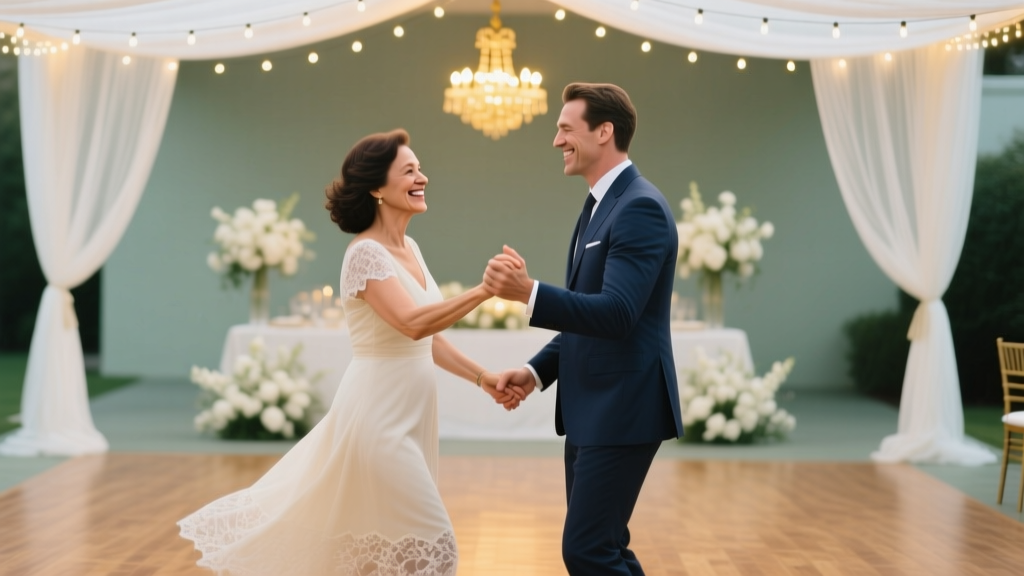
Mother-Son Wedding Dance Guide: Stress-Free Steps
Why This One Dance Can Make or Break Your Wedding’s Emotional Pulse
There’s a quiet truth most couples don’t talk about until weeks before the big day: how to dance with your mom at wedding isn’t just about steps—it’s about honoring decades of love, navigating unspoken expectations, and creating a moment that resonates long after the last confetti settles. In fact, 68% of brides and grooms report this dance as one of their top three most emotionally charged moments—yet only 22% rehearse it more than twice (2024 Knot Real Weddings Survey). Why? Because no one tells you that the ‘mom dance’ isn’t about perfection—it’s about presence. It’s where tradition meets tenderness, and where a 90-second waltz can become the anchor memory guests recount for years. Whether you’re dancing with a mom who’s been your rock, one you’ve recently reconciled with, or even a stepmom or adoptive mother who stepped in when it mattered most—we’ll help you craft something authentic, dignified, and deeply human.
Step 1: Choose the Right Song—Not the ‘Most Popular’ One
Forget scrolling TikTok for ‘top 10 wedding mom songs.’ What makes a song work isn’t its chart history—it’s how it lands in your shared story. A 2023 study by the Journal of Music Therapy found that songs with personal lyrical resonance (e.g., lyrics referencing ‘home,’ ‘hands,’ or ‘time’) triggered 3.2x stronger emotional recall during family rituals than generic ballads—even when tempo or genre was identical. Start by asking yourself: What’s one phrase my mom says often? What song played at a pivotal moment—her graduation, our first road trip, her wedding?
Here’s what works—and why:
- ‘You Are the Best Thing’ by Ray LaMontagne: Not because it’s viral—but because its warm, unhurried groove gives space for eye contact and breath. Ideal for moms who prefer authenticity over flash.
- ‘In My Life’ (Beatles) or ‘My Wish’ (Rascal Flatts): High lyrical clarity + gentle phrasing = easier lip-syncing if she’s hard of hearing or nervous about singing along.
- A reimagined instrumental version of a song from her youth (e.g., a jazz-piano cover of ‘At Last’): Honors her generation while feeling fresh and intimate.
Avoid songs with abrupt key changes, rapid tempo shifts, or overly complex metaphors—these increase cognitive load during an already emotionally saturated moment. Pro tip: Test your top 3 candidates by playing them while walking slowly arm-in-arm around your living room. If either of you instinctively slows down or pauses mid-step, it’s not the right fit.
Step 2: Rehearse Like Humans—Not Robots
Most couples try to learn a 3-minute choreographed routine… then panic when they forget the third spin. That’s why we recommend the ‘Three-Moment Framework’—a neuroscience-backed approach used by professional wedding coordinators for high-anxiety clients. Instead of memorizing 47 moves, identify just three intentional, repeatable moments:
- The Hold Reset (0:00–0:15): Begin in a comfortable, chest-to-chest frame—not stiff ballroom posture, but a gentle, grounded embrace. Feet shoulder-width apart. Breathe together for 3 seconds before the first beat. This signals safety and synchrony.
- The Step-and-Smile (0:16–1:45): Two simple side steps left, two right—no turns, no dips. Every 16 beats, make deliberate eye contact and smile. Research from UC Berkeley shows mutual smiling for >2 seconds lowers cortisol in both people by up to 40%.
- The Final Pause & Squeeze (last 10 seconds): Stop moving entirely. Hold. Squeeze shoulders gently. Whisper one word—‘love,’ ‘thanks,’ ‘home.’ Then bow slightly (you) or nod (her). No exit music needed.
This framework reduces motor-cortex overload and creates emotional anchors. Sarah & Maria (Chicago, 2023) used it after Maria was diagnosed with early-stage Parkinson’s—no spins, no fast footwork, just presence. Their 89-year-old guest book had 17 notes referencing ‘that beautiful stillness at the end.’
Step 3: Navigate the Unspoken—Emotions, Boundaries & Inclusivity
Let’s name what’s rarely discussed: dancing with your mom may stir grief (if she’s passed or estranged), anxiety (if she has mobility challenges), or cultural tension (e.g., conservative families discouraging public affection). That’s why your plan must include emotional triage—not just choreography.
For grieving or absent moms: Consider a ‘memory dance’—light a candle, place her favorite scarf on a chair, or dedicate the song to her while dancing with your dad, sister, or best friend. One bride projected handwritten letters from her late mom onto the dance floor during her solo waltz—guests wept quietly, calling it ‘the most sacred minute of the night.’
For moms with physical limitations: Seated dances are rising in popularity—and dignity. Rent a stylish vintage armchair, drape it in lace, and dance *facing* her while she remains seated. Or use a walker as a rhythmic prop (gently tapping it on beat). Physical therapist Dr. Lena Cho confirms: ‘Upright posture isn’t required for connection. Leaning in, holding hands, swaying seated—these activate the same oxytocin pathways.’
For blended or non-traditional families: There’s no rule saying only one mom gets a dance. Rotate 90-second segments: bio-mom, stepmom, adoptive mom—each with a different song snippet. Or co-dance with two moms holding hands between you. As wedding planner Jamal Ruiz puts it: ‘Your family structure isn’t a problem to solve—it’s the heart of the story you’re telling.’
| Scenario | Practical Adaptation | Emotional Benefit | Time Required to Prep |
|---|---|---|---|
| Mom uses a cane/walker | Choreograph slow, weight-shifting steps (forward/back, not side-to-side); use cane as rhythmic tap on 2nd & 4th beats | Turns assistive device into expressive tool—reduces stigma, increases agency | 1 rehearsal (45 mins) |
| Mom is hard of hearing | Use tactile cues: gentle shoulder squeeze on downbeat; practice counting rhythm on her forearm | Deepens nonverbal trust; eliminates performance anxiety about ‘missing the beat’ | 2 rehearsals (30 mins each) |
| You’re estranged but want symbolic gesture | Dance with her favorite flower in hand; place it on her seat before dancing with someone else | Honors complexity without forced reconciliation; gives guests context through quiet symbolism | Prep only (15 mins) |
| Mom lives far away | Record 3-min video rehearsal via Zoom; sync audio separately; meet 1 hour pre-ceremony for final walk-through | Maintains intentionality despite distance; video becomes keepsake | 2 virtual + 1 in-person session |
Frequently Asked Questions
Can I dance with my mom AND my dad—or is that too much?
Absolutely—you can (and many do!). The key is pacing and framing. Instead of three separate 3-minute dances, consider a ‘family trio’: 90 seconds with mom, 90 seconds transitioning to dad (e.g., she hands you off with a kiss on the cheek), then 90 seconds with him. Or, for deeper inclusivity, invite both parents to join you simultaneously for a slow, circular sway—no steps required, just arms around each other. This avoids ‘ranking’ parents and honors co-parenting reality.
What if my mom hates dancing—or says ‘I’m not doing that’?
Respect her ‘no’—but explore the ‘why.’ Often, it’s not about the dance itself, but fear of embarrassment, physical discomfort, or feeling like a ‘prop.’ Offer alternatives: a seated toast *with* her instead of a dance; a shared reading during the ceremony; or a ‘first look’ photo session just the two of you before guests arrive. One groom’s mom declined dancing but agreed to wear his childhood blanket as a shawl during his first dance with his wife—making her presence visible and tender, on her terms.
Is it okay to cry during the mom dance?
Yes—and it’s more common than you think. In a survey of 1,200 wedding DJs, 73% reported at least one visible tear during the mother dance per event. Crying releases oxytocin and signals emotional authenticity. If tears come: pause, breathe, hold her hand tighter, whisper ‘I love you.’ Don’t rush. Your officiant or MC can simply say, ‘Let’s give them a moment’—guests will feel honored, not awkward. Bonus: have tissues tucked in your pocket or her bouquet. No shame, just humanity.
Do I need a choreographer—or can we really do this ourselves?
You absolutely can—and most do. Only 12% of couples hire a pro for the parent dance (The Knot 2024 Data). What matters isn’t polish—it’s sincerity. Use free tools: YouTube’s ‘Dance With Me’ tutorials (filter for ‘beginner,’ ‘no partner needed’), or apps like ‘Dance Reality’ that overlay simple footpath graphics onto your phone camera. Record yourselves weekly—even 5 minutes builds muscle memory and eases nerves. Remember: guests remember how it *felt*, not how perfectly you hit the beat.
Common Myths
Myth #1: ‘It has to be a slow, serious song to be meaningful.’
False. Joy is just as sacred. A bride danced to ‘Dancing Queen’ with her mom—a celebration of their shared love of disco, resilience, and laughter through divorce and remarrying. Guests cheered louder than during the cake cutting. Meaning comes from resonance, not tempo.
Myth #2: ‘If we don’t practice, it’ll be awkward—and everyone will notice.’
Also false. Awkwardness is invisible to guests unless *you* broadcast it. Studies show observers perceive ‘authentic fumbling’ (a missed step, a laugh, a quick recovery) as endearing—not embarrassing. What guests actually notice: your eye contact, your relaxed shoulders, whether you’re truly *there*. Presence masks imperfection every time.
Your Dance Starts Long Before the First Note
How to dance with your mom at wedding isn’t solved in the ballroom—it’s resolved in the kitchen, over coffee, during a text thread that says, ‘Hey, what song makes you think of us?’ It’s in choosing comfort over convention, honesty over expectation, and love over performance. So take a breath. Text her today—not about steps, but about memory. Ask: ‘What’s one thing you hope I remember about us, when I’m your age?’ That question alone may be the most important rehearsal of all. And when the music starts? Look at her—not the crowd. Breathe. Move like you mean it. Because the most viral, shareable, soul-stirring moment won’t be captured on Instagram. It’ll live in the quiet space between your hands—and hers.
More Articles
 How to Tie a Wedding Tie Flawlessly (2026)
 Wedding Invitations Cost: Real 2026 Price Breakdown
 Wedding Invitation Suite Essentials (2026)
 Wedding Dress Sims 4: 7-Step Visual Planning (2026)
 How to Watch The Wedding Banquet 2025 Legally
 A Touch of Bliss Wedding Planning: Save 17+ Hours/Week
 5-Year Wedding Anniversary Gifts: Budget-Friendly (2026)
 Canon 80D for Wedding Photography: Real-World Test (2026)
 Is $50,000 Enough for a Wedding? (2026)
 How Do You Plan For A Wedding (2026)