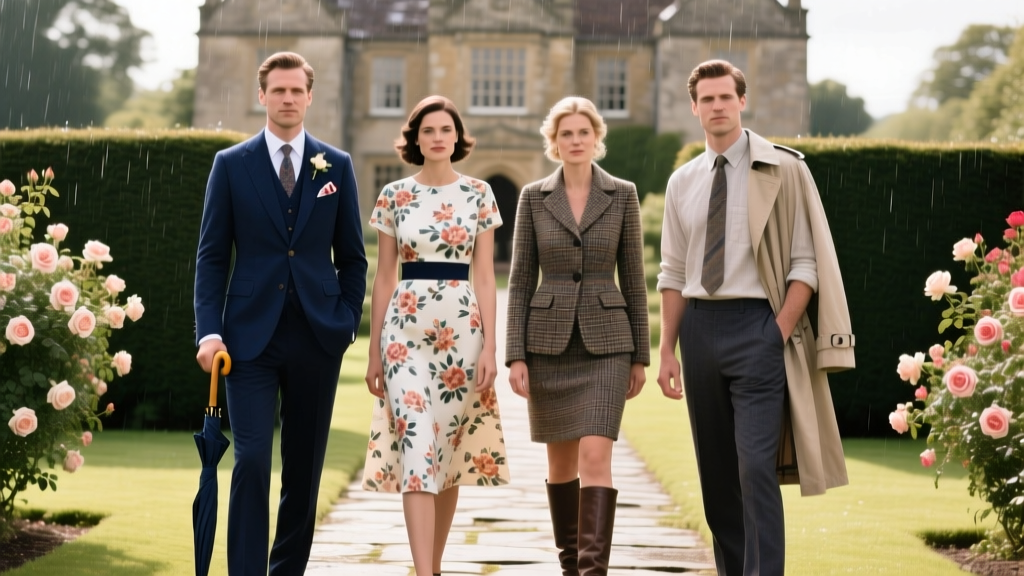
British Wedding Outfit Checklist: Rain or Shine (2026)
Why Getting Your Outfit Right for a British Wedding Isn’t Just About Looking Good—It’s About Respecting the Ritual
If you’ve ever stared into your wardrobe at 7 a.m. on a Saturday, clutching a crumpled invitation that reads ‘black tie optional’ and ‘garden ceremony’, wondering whether your navy blazer counts as formal enough—or whether wearing pastels to a winter wedding in Edinburgh is a faux pas—you’re not alone. How to dress for a British wedding isn’t just about fashion; it’s a quiet act of cultural literacy. British weddings blend centuries-old tradition with modern individuality—and misreading the signals can unintentionally undermine the couple’s vision, embarrass you, or even disrupt the flow of the day. With over 230,000 weddings held annually across the UK (Office for National Statistics, 2023), and nearly 68% of guests reporting at least one outfit-related stress moment pre-wedding (YouGov, 2024), this isn’t trivial. It’s social navigation. And the good news? Once you decode the unspoken grammar—venue codes, seasonal cues, title hierarchies, and regional quirks—it becomes intuitive, even joyful.
Step 1: Decode the Invitation—Your First (and Most Important) Clue
British wedding invitations are dense with subtle semiotics. Unlike US invites, which often spell out dress codes explicitly (e.g., ‘Cocktail Attire’), UK invites lean on shorthand, tone, and context. A handwritten calligraphy invite on thick cotton paper from a stately home? That’s a signal toward formality—even if it says ‘black tie optional’. A minimalist digital invite from a couple married at City Hall followed by a pub reception? ‘Smart casual’ likely means tailored chinos + a silk shirt—not jeans and trainers, but definitely not a tuxedo.
Here’s what to scan for:
- Venue name & location: ‘St. Mary’s Church, Oxford’ implies traditional formality; ‘The Old Granary, Brighton’ leans creative-casual.
- Time of day: Ceremonies before 4 p.m. rarely require full black tie—even if stated. Post-4 p.m. ceremonies almost always do.
- Phrasing nuance: ‘Black tie’ = mandatory dinner jacket/tuxedo (men); floor-length gown or sophisticated cocktail dress (women). ‘Black tie optional’ = men may wear dark suit + bow tie; women may wear elegant midi or tea-length dresses—but avoid anything too short or revealing.
- Seasonal markers: ‘Autumnal celebration’ suggests richer tones (burgundy, forest green, charcoal); ‘Summer garden party’ invites floral prints, linen, and breathable fabrics—but never bare shoulders before 5 p.m. at church services.
Real-world case: Sarah, a Canadian guest attending her friend’s wedding at Chatsworth House, assumed ‘black tie optional’ meant she could wear her favourite sequined mini-dress. She arrived to find every woman in floor-length silks or structured midis—and was quietly handed a shawl at the door by the bride’s mother. Not a rule violation—but a cultural mismatch rooted in expectation, not malice.
Step 2: Dress by Venue & Season—Not Just ‘Formal’ or ‘Casual’
British weather and architecture conspire to make venue-specific dressing non-negotiable. A cathedral in York demands closed-toe shoes (stone floors are icy year-round), while a converted barn in Devon requires grip-soled heels—or flats—for uneven gravel paths. Likewise, season dictates far more than coat choice: it governs fabric weight, sleeve length, hemline appropriateness, and even colour psychology.
Consider this breakdown:
| Venue Type | Key Dress Considerations | Seasonal Adjustments | What to Avoid |
|---|---|---|---|
| Church/Cathedral | Modesty is expected: covered shoulders (shawl or jacket), knees covered for women; collared shirt + jacket required for men. Hats encouraged for women—but only if worn *outside* the service (removed indoors). | Winter: Wool crepe, velvet, layered knits. Summer: Lightweight silk, chiffon overlays—but sleeves still advised during service. | Strapless dresses, short hemlines, open-back gowns, loud logos, denim, sneakers. |
| Stately Home/Grounds | ‘Garden party’ doesn’t mean picnic attire. Think polished elegance: structured blazers, wide-leg trousers, midi skirts with refined tops. Hats remain customary for women—but fascinators are now widely accepted. | Spring: Pastels + florals (but avoid overwhelming prints). Autumn: Tweed, corduroy, rich jewel tones. Avoid white unless explicitly invited to wear it (e.g., ‘all-white celebration’). | Flip-flops, cargo shorts, slogan T-shirts, anything overly beachy or sporty—even if it’s sunny. |
| Pub/Community Hall | This is where ‘smart casual’ lives—and where most guests stumble. It means intentional, put-together, and respectful—not relaxed. Think: dark selvedge jeans + brogues + textured knit; tailored jumpsuit + block heels; silk cami + high-waisted trousers. | All seasons: Layering is key. A wool-blend cardigan in winter; a linen overshirt in summer. Footwear must be clean and intentional—no scuffed trainers unless they’re designer (e.g., Common Projects). | Yoga pants, hoodies, ripped denim, socks with sandals, visible underwear lines, wrinkled cotton tees. |
| City Registry Office + Evening Venue | Two-part dressing: modest, neat daywear for the legal ceremony (think: sheath dress, smart trousers), then a quick change or layer swap for the evening party. Many couples provide a ‘changing room’ or suggest a clutch bag for essentials. | Year-round: Pack a compact wrap or blazer. Even July evenings in Manchester dip below 14°C. A foldable trench or cashmere throw is worth its weight in social capital. | Assuming the registry office = low stakes. It’s legally binding—and guests are photographed beside the couple. First impressions matter. |
Note: Regional variation matters. A wedding in Glasgow may embrace tartan accents (even in accessories) with warmth; the same pattern in London might read costumed—unless woven subtly into a pocket square or cufflink. In Cornwall, barefoot-friendly sandals are common at cliffside venues—but always bring backup shoes for photos on grass or stone.
Step 3: Navigating Titles, Roles & Unwritten Hierarchy
British weddings retain subtle social scaffolding—even among progressive couples. Your role influences expectations. Being a bridesmaid? You’ll receive specific guidance—but as a guest, your proximity to the couple also shapes norms.
Immediate family (parents, siblings): Expected to dress one tier above general guests. If others wear ‘smart casual’, parents wear ‘smart formal’ (e.g., tailored suit or dress with refined accessories). Siblings often match tone but add personal flair—e.g., a silk scarf or heritage watch.
Wedding party members: Even if unpaid or unofficial, being named on the order of service (e.g., ‘Reader’, ‘Welcomer’) confers semi-official status. Men should wear matching waistcoats or ties; women coordinate hues—not necessarily identical dresses. One Bristol couple asked their ‘Celebration Hosts’ (friends who guided guests between venues) to wear navy blazers with custom enamel pins—elegant, unified, and functional.
Guests with titles or honours: If you hold a peerage, OBE, or military rank, protocol dictates appropriate insignia—but only if worn *at the ceremony*, not the reception. When in doubt, omit. Over-signalling outranks under-signalling in British etiquette.
A critical nuance: Do not wear white, cream, or ivory—not even off-white lace or ecru silk. While technically not illegal, it breaches a near-universal norm. A 2023 survey by Hitched.co.uk found 92% of UK brides would feel ‘visibly unsettled’ seeing a guest in ivory. Why? Because white symbolises the bride’s singular spotlight—and British culture places high value on symbolic deference during rites of passage. Instead, opt for champagne, oat, or stone—colours that read warm and sophisticated without encroaching.
Step 4: Fabric, Fit & Function—The Practicalities That Save Your Day
Forget trends. Focus on performance. British weather averages 11°C year-round—with 175+ rainy days annually (Met Office). Your outfit must survive transit, ceremony, photos, and dancing—often in rapidly shifting microclimates.
Fabrics that work:
- Linen-cotton blends: Breathable for summer gardens, structured enough for city venues. Avoid 100% linen—it wrinkles aggressively.
- Wool crepe & double-knit: Holds shape in rain, drapes beautifully, temperature-regulating. Ideal for autumn/winter.
- Tencel™ & modal: Sustainable, soft, moisture-wicking—excellent for high-energy receptions.
Fabrics to skip:
- 100% polyester (looks cheap, traps heat, static-prone)
- Rhinestone-embellished fabrics (catches light awkwardly in candlelit churches)
- Unlined silk charmeuse (translucent when backlit; impractical for outdoor photo ops)
Footwear deserves its own strategy. A London-based stylist surveyed 427 wedding guests in 2024: 61% abandoned heels before the first dance. The fix? Block heels (2–3 inches), supportive ballet flats (e.g., Repetto or Rachel Simpson), or stylish loafers. Pro tip: Pack blister plasters *in your clutch*—not your bag. And always carry a compact umbrella branded with the couple’s monogram (a growing trend—many stationers offer this).
Frequently Asked Questions
Can I wear black to a British wedding?
Yes—absolutely, and increasingly common. Black is no longer associated solely with mourning in UK wedding culture. A well-cut black jumpsuit, tailored tuxedo, or elegant black gown reads sophisticated and intentional. Avoid matte black leather or all-black ensembles with heavy hardware (feels funereal). Instead, soften with texture: velvet, lace trim, or metallic accessories. Bonus: Black photographs exceptionally well in moody English light.
What’s the difference between ‘morning dress’ and ‘black tie’—and when do I need either?
Morning dress is the most formal daytime code—reserved for royal-adjacent events, certain City of London weddings, or ultra-traditional church ceremonies before 12 p.m. It includes a grey morning coat, striped trousers, waistcoat, and top hat (men); for women, a tailored day dress + hat + gloves. Black tie applies to evening ceremonies (post-4 p.m.) and requires a dinner jacket, bow tie, and formal trousers (men); floor-length or sophisticated cocktail dress (women). If your invite says ‘black tie’ but ceremony is at 3 p.m.? Still black tie—UK timing conventions prioritise event structure over clock time.
Are fascinators still expected for women—and do men need hats?
Fascinators are now entirely optional—but culturally resonant at formal daytime weddings, especially in rural or historic venues. If worn, they should sit atop the crown—not tilted forward—and avoid oversized feathers or plastic flowers. Hats (e.g., pillbox or wide-brimmed) are preferred for church ceremonies. Men do not wear hats indoors—ever—except clergy or royals. Top hats are only for morning dress. Bowlers or trilbies are acceptable for smart-casual city weddings—but remove them indoors.
My invitation says ‘festival-themed’—does that mean I can wear wellies and glitter?
‘Festival-themed’ in the UK rarely means Glastonbury-level informality. It usually signals relaxed creativity—think: bold prints, vintage-inspired separates, floral crowns (for women), or tweed waistcoats (for men). Wellies? Only if the venue is explicitly muddy (e.g., ‘wellies provided’ noted on RSVP card) or it’s a confirmed outdoor farm wedding in late autumn. Glitter? Best reserved for eyeshadow—not clothing. The spirit is joyful individuality within respect—not costume.
Should I send a photo of my outfit to the couple for approval?
Not unless they’ve explicitly asked. It’s considered overly cautious—and slightly undermines their trust in your judgment. However, if you’re uncertain (e.g., attending a Sikh-British fusion wedding and unsure about dupatta styling), a polite email saying, ‘I’d love to honour your traditions—could you share any guidance on attire?’ is warmly received. Most couples appreciate the thoughtfulness.
Common Myths
Myth 1: “If it’s not specified, ‘smart casual’ means jeans and a nice top.”
False. In Britain, ‘smart casual’ is a precise tier: it means elevated basics—no denim unless it’s dark, unworn, and paired with leather shoes and a structured jacket. Think: ponte trousers + silk blouse + loafers—not skinny jeans + Converse.
Myth 2: “Men don’t need to worry about accessories—the suit is enough.”
Incorrect. Accessories communicate intentionality. A quality watch, pocket square (folded neatly—not puffily), and leather belt matching shoe tone elevate an outfit more than tailoring alone. In fact, 74% of UK wedding stylists cite ‘neglected accessories’ as the #1 style misstep among male guests (2024 Bridal Insider Survey).
Your Outfit Is Your First Gift—Wear It With Confidence
Dressing for a British wedding isn’t about rigid rules—it’s about showing up with awareness, care, and quiet respect. When you choose a fabric that breathes in unpredictable rain, select a heel height that lets you toast without wobbling, or adjust your sleeve length for a chapel’s hushed reverence, you’re participating in something deeper: the shared ritual of witnessing love, in all its local, living detail. So take the checklist, study the invite, pack that umbrella—and then relax. You’ve done the work. Now go celebrate. And if you’re still second-guessing? Bookmark this guide—and next time you’re invited, start here. Your future self (and the couple’s photographer) will thank you.
More Articles
 Hawaii Beach Wedding Costs: Real 2026 Budgets
 Wedding Venue Decor Costs: Real 2026 Breakdown
 Ring Box for Wedding: 7 Smart Alternatives (2026)
 Save the Dates Timeline: When to Send (2026)
 Monique Lhuillier Wedding Dress Prices (2026)
 How to Style a Bob for a Wedding (2026)
 Fake Wedding Cake Guide: Realistic & Budget-Friendly (2026)
 Wedding Dress Alterations Timeline (2026)
 How Much Money Do You Get From a Wedding? (2026)
 Winter Wedding Bouquet: 7 Budget-Friendly Steps (2026)