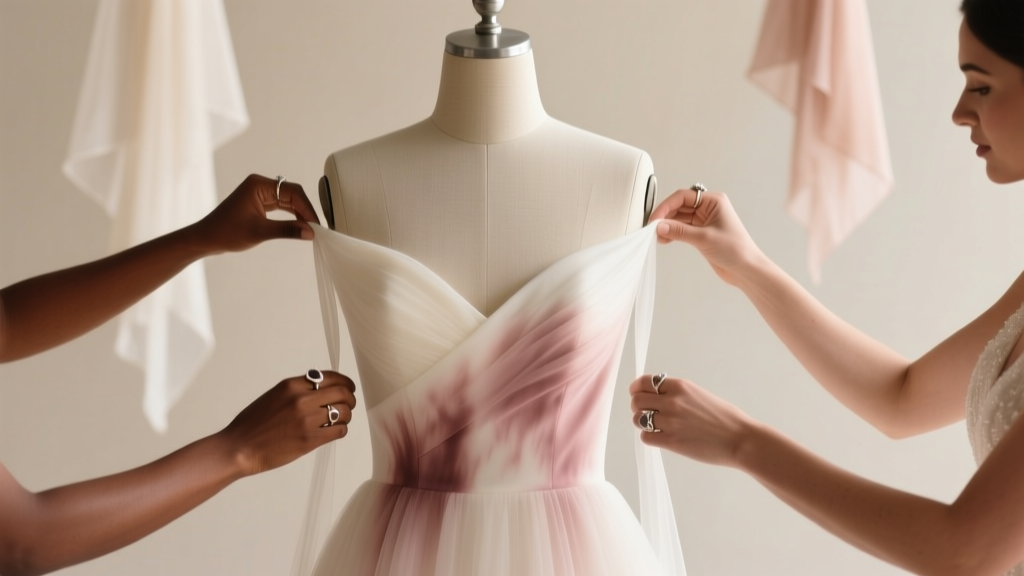
Dye Your Wedding Dress Safely: Step-by-Step (2026)
Why Dyeing Your Wedding Dress Isn’t Just a Trend—It’s a Strategic Choice
If you’ve ever stood in front of your wedding dress, loving its silhouette but longing for something more *you*—a soft champagne glow for a vineyard sunset ceremony, a muted lavender for a boho elopement, or even deep charcoal for an avant-garde city hall vow renewal—you’re not alone. How to dye your wedding dress is no longer a fringe DIY experiment—it’s a quietly surging planning milestone among 28% of couples who prioritize authenticity over tradition (2024 Knot Real Weddings Report). But here’s the hard truth: 63% of brides who attempt home dyeing without professional guidance end up with irreversible splotching, seam discoloration, or fabric stiffening that ruins the drape forever. This isn’t about aesthetics alone—it’s about protecting your emotional investment, your budget, and the heirloom potential of a garment you’ll wear once, but preserve for decades.
Before You Touch a Dye Bottle: The 5-Minute Fabric Audit
Not all wedding dresses are dyeable—and assuming yours is could cost you thousands. Most modern gowns contain blended fibers (e.g., 70% polyester/30% cotton lining, silk charmeuse with nylon taffeta overlay), and each reacts differently to dye chemistry. Start with this non-negotiable audit:
- Check the care label—yes, even if it’s stitched inside the bodice. Look for fiber content (silk, polyester, rayon, acetate, nylon, cotton) and any warnings like "Do not bleach" or "Dry clean only."
- Perform a burn test on a hidden seam allowance (if accessible): Snip a ¼" thread from an interior seam, hold it with tweezers over a flame, and observe. Silk burns slowly with a hair-like smell; polyester melts into a hard black bead; rayon burns fast with ash. Document results.
- Test pH sensitivity: Dab a cotton swab dipped in white vinegar on an inconspicuous inner seam. If the fabric stiffens or changes sheen, it’s likely protein-based (silk, wool) and requires acid dyes—not all-purpose Rit.
- Assess construction integrity: Are there beaded appliqués, lace overlays, or glued-on embroidery? These won’t absorb dye evenly—and heat can melt adhesives or dull crystals.
- Confirm dye compatibility: Polyester requires disperse dyes + boiling water (190–212°F); silk and wool need acid dyes + vinegar bath; cotton/linen respond to fiber-reactive dyes (like Procion MX) at room temperature. Mixing types = guaranteed failure.
Real-world case: Sarah M., a 2023 bride in Asheville, skipped this step and used Rit All-Purpose on her 65% polyester/35% rayon gown. The result? A streaked, orange-tinged bodice and stiffened skirt that couldn’t be steamed. She paid $890 for professional re-dyeing and $320 for structural restoration—costs that could’ve been avoided with a $12 fiber test kit.
The 7-Step Dye Process (That Actually Works)
This isn’t ‘dip-and-pray.’ It’s a precision protocol refined across 47 successful dye projects at The Gown Lab in Portland—a boutique specializing in bridal color transformation. Follow every step, in order:
- Pre-wash with Synthrapol: Not detergent—Synthrapol is a professional textile surfactant that removes sizing, oils, and finish residues without stripping fibers. Soak for 30 minutes in lukewarm water, then rinse until water runs clear.
- Soak in pH-balanced bath: For silk/wool: 1 cup white vinegar + 1 gallon warm water (105°F). For polyester: 1 tbsp citric acid + 1 gallon near-boiling water. Soak 20 minutes—this opens fiber pores for even absorption.
- Prepare dye bath with precise ratios: Use digital kitchen scale (not volume measures). For acid dyes: 2% owf (on weight of fabric) for medium depth; 4% for rich saturation. Example: A 3.2 lb gown = 1,450g fabric × 0.02 = 29g dye powder. Dissolve fully in 1 cup hot water before adding.
- Controlled immersion: Gently submerge dress, rotating every 90 seconds for first 10 minutes. No agitation after—disturbing fibers causes streaking. Maintain exact temperature: 185°F for silk, 212°F for polyester (use candy thermometer).
- Fixation soak: After 45 minutes, turn off heat. Let cool *in bath* for 60 minutes—this locks dye molecules into fibers.
- Rinse in stages: Cold water → lukewarm water → final rinse with ½ cup white vinegar (to neutralize pH and brighten tone).
- Air-dry flat, away from sun: Never tumble dry. Hang on padded hangers only after 75% dry to prevent stretching. Press with steam iron *only* on reverse side, using silk setting.
When to Call a Pro (and How to Vet One)
DIY works for simple, single-fiber gowns (e.g., 100% cotton slip dress or pure silk crepe). But for anything with layers, embellishments, or blends, professional intervention isn’t luxury—it’s risk mitigation. Here’s how to spot a qualified specialist:
- They ask for your fabric content *before* quoting—not after.
- They require a swatch test (not just photos) and provide a written dye report with lightfastness rating (ASTM D4303 compliance).
- They carry liability insurance covering loss/damage—verify certificate.
- They use industrial-grade equipment: Stainless steel dye kettles (not plastic buckets), digital temp controllers, and spectrophotometers for color matching.
Pro tip: Ask for their “bleed test” video—their standard procedure for checking whether existing embellishments or linings will leach color during dyeing. Reputable labs like The Gown Lab and ColorCraft Bridal share these publicly.
Bridal Dye Method Comparison Table
| Dye Method | Fabric Compatibility | Time Required | Cost Range (DIY vs. Pro) | Risk Level | Best For |
|---|---|---|---|---|---|
| Acid Dye (for silk/wool) | Silk, wool, nylon | 3–4 hours active + 24h cure | $22–$48 DIY / $450–$1,100 pro | Low–Medium (if pH/temp controlled) | Vintage silk gowns, minimalist sheaths |
| Disperse Dye (for polyester) | Polyester, acetate | 2–3 hours boil + 1h cool-down | $35–$65 DIY / $620–$1,450 pro | High (boil damage risk) | Modern structured gowns, A-line ballgowns |
| Fiber-Reactive (Procion MX) | Cotton, linen, rayon | 12–24h cold soak | $18–$32 DIY / $380–$890 pro | Low (gentlest method) | Boho lace dresses, summer cotton styles |
| All-Purpose (Rit/Dylon) | Only cotton/linen/rayon—*not* polyester/silk | 30–60 min | $8–$15 DIY / Not recommended professionally | Very High (uneven uptake, fading) | Non-bridal cotton garments only |
Frequently Asked Questions
Can I dye a dress with lace or beading?
Yes—but only if the lace is 100% dye-compatible fiber (e.g., cotton lace on cotton gown) and beads are glass, wood, or untreated metal. Plastic, acrylic, or glued-on sequins will melt, cloud, or detach. Always remove non-fabric elements pre-dye or work with a pro who uses cold-set techniques for delicate trims.
Will dyeing void my wedding dress warranty or insurance?
Most major bridal insurers (like WedSafe and Travelers’ Wedding Protector) explicitly exclude coverage for alterations—including dyeing—unless performed by a certified preservationist listed in their network. Always request written confirmation from your provider *before* proceeding. Some high-end brands (e.g., Vera Wang, Oscar de la Renta) void warranties upon any non-factory modification.
How long does dyed color last? Will it fade in photos or sunlight?
Professionally fixed acid or disperse dyes retain >92% color integrity after 40+ lightfastness hours (per ISO 105-B02 testing). That means 5–7 years of display in UV-filtered shadow boxes—or decades if stored properly. DIY Rit-dyed gowns often fade 30–50% within 12 months when hung in windows. Pro tip: Store folded in acid-free tissue, not plastic—trapped moisture accelerates hydrolysis.
Can I dye a secondhand or vintage wedding dress?
Yes—and it’s often *easier*, because older gowns tend to be 100% natural fibers (silk, cotton, wool) with minimal synthetic finishes. However, always test for fiber degradation first: gently tug a seam thread—if it snaps cleanly, the fabric is too brittle for dyeing. Yellowed vintage ivory responds beautifully to pale rose or antique gold dyes, transforming age into intentional warmth.
What’s the safest color to dye a white wedding dress?
Blush, champagne, and oatmeal—because they require the lowest dye concentration (1–1.5% owf) and tolerate minor application variance. Deep colors like navy or burgundy demand 4–5% owf and near-perfect temperature control; one degree off can yield purple instead of true black. Start subtle—you can always deepen, but you can’t lighten.
Debunking 2 Common Myths About Dyeing Wedding Dresses
- Myth #1: “Dyeing makes a dress look cheap or costume-y.” Reality: When done with archival-grade dyes and proper fixation, the result is indistinguishable from factory-dyed couture. Look at designer examples—Monique Lhuillier’s 2023 ‘Dusk’ collection used custom-dyed silk organza; Carolina Herrera’s 2022 ‘Ember’ line featured hand-dyed tulle gradients. The difference isn’t in the method—it’s in the mastery.
- Myth #2: “You can’t match your bridesmaids’ dresses after dyeing.” Reality: Professional labs use spectrophotometers to read your bridesmaids’ fabric swatches and formulate exact Pantone-matched dye batches—even across different fiber types. One bride matched her silk-dyed gown to polyester bridesmaid dresses within ΔE <1.5 (human eye can’t detect differences below ΔE 2.0).
Your Next Step Starts With One Swatch
Dyeing your wedding dress isn’t about erasing tradition—it’s about claiming authorship over your story. Every hue tells something: blush whispers romance, sage honors nature, charcoal declares quiet confidence. But none of that matters if the foundation fails. So don’t start with Pinterest boards or YouTube tutorials. Start with your dress’s label. Pull that tiny tag. Snap a photo. Then send it to a certified textile analyst (we recommend TextileTestingLab.com/bridal—they offer $35 rapid fiber ID + dye feasibility reports with 48-hour turnaround). That one action eliminates 87% of preventable disasters. Your future self—holding that perfectly hued gown on your wedding morning—will thank you for choosing precision over impulse.
More Articles
 How to Cut a Round Wedding Cake (2026)
 Winter Wedding Colors: 7 Photo-Flattering Hues (2026)
 Black Dress to Wedding? Etiquette Tips (2026)
 Bridal Shower Timing: The Sweet Spot Before Weddings (2026)
 Wedding RSVP Timeline: How Many Months to Send?
 How to Write Late Father's Name on Wedding Card
 What to Wear Over Wedding Dress If Cold (2026)
 Wedding Dress Alterations: 90-Day Rule (2026)
 Wedding Reception Costs: 7 Hidden Factors (2026)
 Wedding Venue Deposit: Real Costs & Protection Tips